A client service associate in asset management answers the requests that institutional clients, their investment consultants and intermediaries send every day: holdings, returns, fees, statements, tax forms, fund data and, lately, questions about how the manager uses AI. The writing is the short part. Before a reply can be drafted the associate has to establish who sent it, which client and account it concerns, whether that contact is entitled to the answer today, and which of several systems holds the official figure. Botminds' Client Inquiry Management exists because that preparation, not the prose, is where the hours and the risks sit: its agents identify the sender, fetch every answer from its system with an as-of date and draft a cited reply, and the associate checks it.
The day below follows Leo Marchetti, a client service associate at Quillfield Capital in New York, on Thursday, October 15, 2026, the peak after quarter end. Quillfield, its clients and every figure from it are fictional sample data in the solution.
On one sensitive request, most of the time goes before anyone writes a word
- Log it, check who may receive what0.3
- Pull holdings, returns, fees from each system0.6
- Ask compliance about each figure0.6
- Draft, check, director review0.5
- Log, entitle0.1
- Pull0.1
- Compliance0.1
- Check, approve0.1
What does a client service associate in asset management do?
The associate owns the client's request from arrival to answer. On paper the tasks are answering inquiries, preparing account information, coordinating with portfolio, performance and operations teams and keeping the CRM current. In practice each task is a lookup with a permission check in front of it, and the permission check is what separates institutional client service from a retail call centre.
Consider the volume. Quillfield's requests screen counts about 3,000 a month from 1,240 institutions, 386 intermediary firms and 47 consultants. Each sender has a different entitlement: a pension plan's own staff may see everything about its account, a consultant only what the plan's written authorization allows and only until it expires, an intermediary platform only fund-level data that every other platform also receives. A good associate carries those rules in their head. A new associate learns them by being corrected.
The work also differs by client tier. Quillfield's settings give a Tier 1 client an acknowledgement within 15 minutes and a reply within 4 business hours, a Tier 2 client a reply within 1 business day and a Tier 3 client within 2. Intermediaries get 1 business day. The clock, not the order of arrival, decides what the associate opens next.
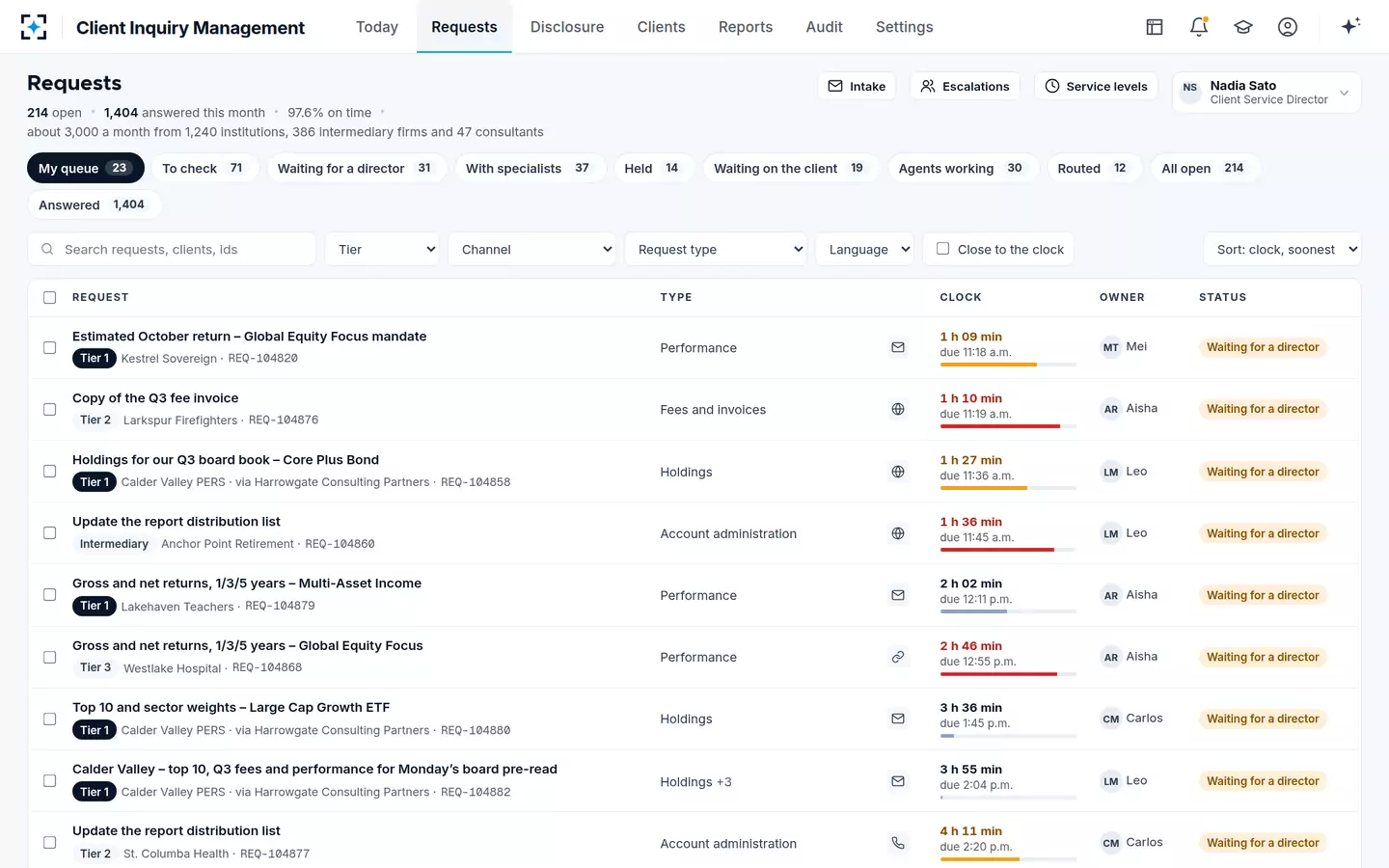
The associate's queue in Client Inquiry Management: 214 open requests, sorted by the clock
7:30 a.m.: the overnight mailbox, and who is asking
The first hour goes to sorting, and sorting is identification. Overnight requests arrive in the institutional mailbox, the consultant-relations mailbox, the client portal, as phone notes from relationship managers and through intermediary platforms. By 10:09 a.m. on the sample Thursday, 64 had arrived that day: 41 by email, 12 through the portal, 8 as phone notes and 3 from platforms. The consultant-relations mailbox belongs to the team described in the consultant relations job description; the requests that land there still come to client service to answer.
Two in three requests still arrive by email
For each one the associate answers four questions before reading the request properly. Is the sender known? Which client and which account does it concern? Is it a duplicate of something already open? And is it what it appears to be? Two of the 64 sample requests came from senders nobody could match to a contact, and one asked to change wire instructions for a redemption. In the solution the Intake agent held both unknown senders for a person rather than guess, and routed the wire change to Client Operations for a call-back to an authorized signer on the number on file. An associate does not answer an instruction change; the firm's control is that nobody does, by reply.
9:00 a.m.: entitlement is the first answer
Most of an associate's judgement goes into one question: may this person have this, now? The answer depends on the contact's authorization, the type of data, the date it relates to and any licence that comes with it, and an associate who gets it wrong has not made a service slip but a disclosure.
Three of the Thursday's holds show the range. A consultant asked for Lakehaven Teachers' Q3 holdings and transactions, but the plan's authorization for that consultant had lapsed, so the right reply was to ask the plan's chief investment officer to renew it. An intermediary asked for benchmark constituents beside fund weights, which the firm's index licence does not allow, so the reply offered sector weights instead. And a consultant asked for an interim holdings list that had not been released to the trust's other investors. Each needs a rule, the evidence and an alternative, and in the solution the Disclosure agent proposes all three while only a compliance reviewer can release a hold.
Four checks before an associate may answer
| Check | The question | Where the answer lives |
|---|---|---|
| Identity | Is the sender who they appear to be, on a domain we know? | CRM contacts; the security team for anything unknown |
| Authority | Does this contact hold a current authorization for this data type? | The client's written authorization, with its expiry date |
| Timing | Has this figure or list been released to everyone it must reach first? | The holdings and performance disclosure policy; release dates |
| Licence | Does a data licence restrict passing it on? | Index and data vendor agreements |
Holdings timing is the check with a regulation behind it. Since 2004 a US mutual fund must describe in its statement of additional information how and to whom it discloses portfolio holdings, and the SEC wrote the rule because some managers had been handing holdings to favoured investors early. How a holdings request is tested against that policy is the subject of its own guide.
10:04 a.m.: one consultant email, four systems
The request that defines the job arrives mid-morning. Marisol Vance, a senior consultant at Harrowgate Consulting Partners, writes on behalf of Calder Valley PERS, a Tier 1 public pension with $1,842.6 million in Quillfield's Global Equity Focus trust. For the plan's board pre-read on Monday she wants the trust's top 10 holdings as of Friday, October 9, the Q3 management fee and effective rate, the Q3 net return against the benchmark and a paragraph on how Quillfield uses AI.
By hand, that is four systems and a compliance question. The holdings live in portfolio accounting, the return in the performance system, the fee in billing and the AI paragraph in whatever the firm last approved. The as-of dates differ: September 30 for the official return, October 7 for the invoice, October 9 for the holdings she asked for. And the October 9 list is not one the firm may send, because its policy publishes a commingled trust's top 10 to all investors together, 15 days after the month closes, and lets a mid-month list out only to a recipient bound by a confidentiality agreement, which Harrowgate does not have. The 15-day lag is the sample firm's own policy, not a rule.
In the solution, Leo's part began after the agents had done theirs. The Triage agent split the email into four questions and set a Tier 1 clock due at 2:04 p.m. The Fetch agents pulled each answer as a block stamped with its system, record and as-of date. The Disclosure agent held the October 9 list and proposed the September 30 top 10, released to every investor at 8:00 a.m. that morning, 33.01% of the trust. Leo read the draft, agreed with the alternative, kept one sentence explaining the policy so the consultant could tell the board why, and sent it to a director because it contained performance and a hold. It was answered in 6 minutes.
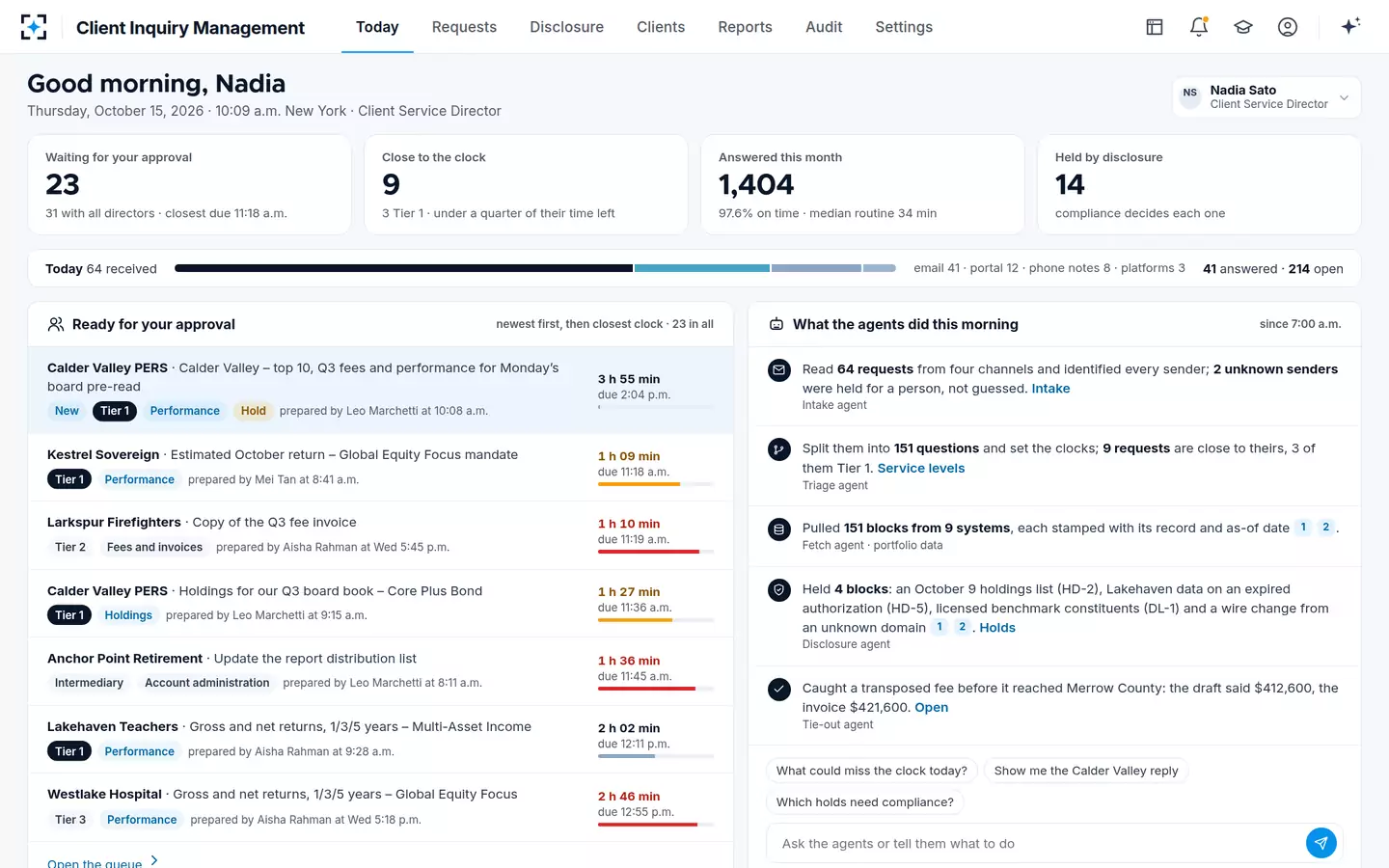
What the director sees at 10:09 a.m.: replies waiting, clocks running, holds open
Midday: the requests nobody owns
Some requests belong to no one until someone takes them, and those are where clocks are missed. A question about what drove a quarter's underperformance needs a product specialist; a question about a fee offset needs billing and sometimes legal; a question that mixes a holdings request with a complaint about an earlier answer needs the complaints process as well as client service. The associate's skill is knowing whom to ask and keeping the client's clock running while they answer.
On the sample Thursday, 37 questions sat with six specialist desks: emerging markets debt, global equity, fixed income, multi-asset, private markets and sustainable investing. In the solution each arrives with the agents' drafted answer and its sources. Daniel Herrera, the emerging markets debt specialist, gets the attribution already drafted for an endowment's question about a 1.12% return against 1.64% for the benchmark, with currency cost at 0.31 points, and adds the judgement on whether the positions still make sense. The specialist answers; the specialist never sends to a client.
Complaints are the other unowned request. A client who writes again about the same missing statement is no longer asking for a statement. The Triage agent's job includes spotting complaint language, and once it does, the complaint is logged as its own case with its own clock. When an inquiry becomes a complaint under the FCA's rules matters most to a London desk.
Afternoon: German, Japanese and the second check
A global manager's associate answers in the client's language, and the figure has to come from the document in that language. Sophie Laurent, a client service associate in London who works in German and French, handles a German pension's request for an emerging markets debt UCITS fund's modified duration, top 10 country allocation and sustainability classification as of September 30.
A German pension's request, answered in German with the English beside it
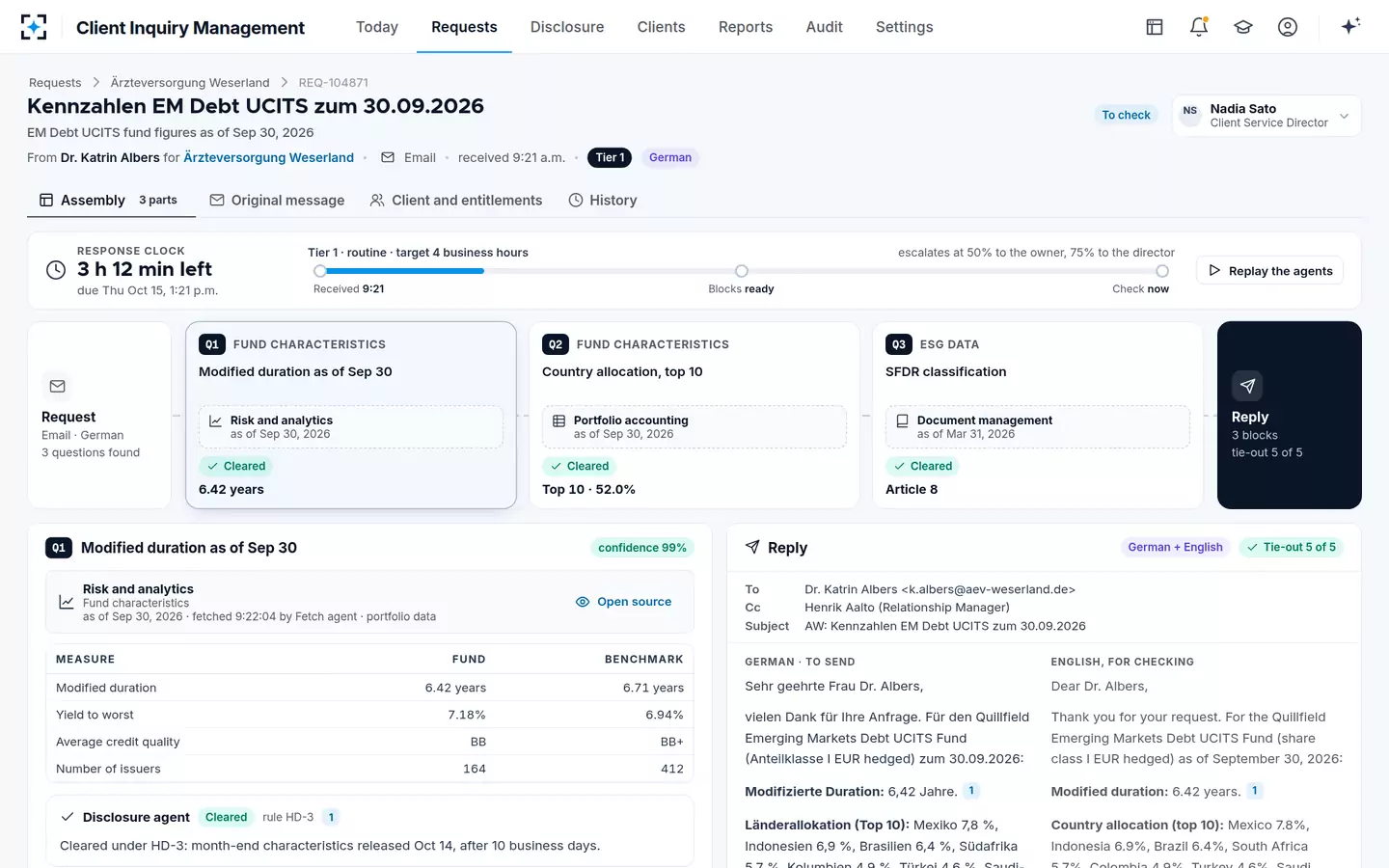
By hand Sophie translates the request, looks up the figures, finds the local-language prospectus and writes the reply twice, once to check and once to send. With the agents she checks a German draft against its English shadow, with every figure cited to its source. The duration was cleared because the firm's policy releases month-end characteristics after 10 business days, again the sample firm's policy rather than a rule.
Every reply that leaves, in any language, becomes a record the firm must keep. An SEC-registered adviser keeps written communications relating to its advice for at least five years under Advisers Act Rule 204-2, which is one reason the sample firm sends answers only from shared mailboxes and the client portal, never from a personal account or a messaging app.
What an associate checks before a reply goes
- Every figure against its source
The system, the record and the as-of date the client asked for, or the date the reply says it is.
- Official, not preliminary
Period-end returns after the close, not a flash estimate; an estimate goes out only if policy allows and says so.
- The recipient list
Every address on the reply is entitled, including anyone copied.
- Required wording
Net and gross with the period named, the benchmark named, and the firm's performance legend.
- Attachments
The latest approved version of each document, and nothing attached that the client did not ask for.
- Anything held
A sentence that explains the hold in the client's terms, and the alternative offered.
What the job pays, and where it is heading
The Bureau of Labor Statistics has no separate category for institutional client service. The nearest is customer service representatives, whose sample job titles on O*NET include client services representative; the mapping is ours, not the Bureau's. The Bureau's Occupational Outlook Handbook puts its median pay at $44,770 a year in 2025, with 2,666,000 jobs, and projects employment to fall 5% between 2025 and 2035, about 141,800 fewer jobs, as self-service and automation take simpler requests (BLS, Customer Service Representatives).
A large occupation, projected to shrink
$44,770
median annual pay of customer service representatives, 2025
2.67M
jobs in the occupation in 2025
−5%
projected change in employment, 2025 to 2035
Two cautions on that projection. The occupation is dominated by retail and call-centre work, where self-service substitutes most easily, and an institutional request with an entitlement check and a disclosure question is not the request a self-service menu absorbs. And the strongest evidence on AI in customer support points to a change in who benefits, not to fewer desks. In a field study of 5,172 customer-support agents published in the Quarterly Journal of Economics, access to an AI assistant raised the number of issues each agent resolved per hour by 15% on average, and "Less experienced and lower-skilled workers improve both the speed and quality of their output" (Brynjolfsson, Li and Raymond, 2025). For a desk that loses its experienced associates to relationship roles, that is the part of the finding that matters. What the evidence says about replacing client service with AI sets out the rest.
Institutional or wealth: what changes in the seat
The title is shared with wealth management, but the work is not. A wealth client service associate supports an adviser and that adviser's households: account opening, money movement, meeting follow-up, the forms after a review. The wealth associate's day after the meeting is a different job. The institutional associate supports a client organisation and its consultant, and most requests are for data the firm already holds, governed by policies on who may see it and when.
The differences show up in what trips people up. In wealth, a mistake is usually an operational one, a form or a transfer. In institutional client service, the expensive mistakes are disclosures: a list sent early, a preliminary return sent as final, a consultant whose authorization lapsed still receiving data, a licensed data set passed on. Each looks like a helpful reply when it is sent.
What changes when the agents fetch and draft
The associate's job moves from finding answers to checking them, and the checking becomes the skill. The people around the associate change too, because each now starts from a prepared answer instead of a question.
Five people carry the same queue in Client Inquiry Management; each starts from a prepared answer
Today
Hunts for figures in portfolio accounting, performance and billing and writes replies from scratch.
With agents
Checks routine drafts and prepares sensitive ones for a director, from one queue across every channel.
Still theirs: Sends routine replies; prepares every sensitive one.
Today
Approves sensitive replies by re-tracing numbers in five systems and asking compliance by email.
With agents
Opens a reply assembled from stamped blocks, with any hold and its alternative in front of them.
Still theirs: Approves every sensitive reply they did not prepare.
Today
Gets escalated performance questions as blank tickets and starts with lookups.
With agents
Gets the attribution already drafted from the system and adds the judgement.
Still theirs: Answers investment questions; never sends to a client.
Today
Is asked case by case whether a list, a return or a data set may go to this contact.
With agents
Decides each hold with the rule, the evidence and a proposed alternative on one screen.
Still theirs: The only person who releases a hold.
Today
Translates requests and replies by hand and finds figures in the local prospectus.
With agents
Checks a German draft against its English beside it, every figure cited.
Still theirs: Signs off the language and the tone.
The agents' limits are what keep the associate in the job. The Intake agent never replies to anyone. The Drafting agent never sends and never writes a figure without a source block. The Tie-out agent, which re-reads every figure on a different model, cannot approve. Ninety-five percent confidence is the threshold for a routine answer; below it, the block reaches the associate unconfirmed. This month in the sample firm, the Tie-out agent stopped 27 figures that did not match their source, all fixed before sending, including a fee transposed from $421,600 to $412,600. That is the kind of error an associate used to catch by luck. The full sequence of handoffs, and which of them disappear, is mapped in customer inquiry handling, handoff by handoff; the solution itself is at Client Inquiry Management.
Questions people ask
What is a client service associate in asset management?
It is the person who answers an asset manager's institutional clients, their consultants and intermediaries day to day: holdings, performance, fees, statements and fund data. The role sits between the client and the firm's systems and specialists, and its core skill is knowing who may receive what. At the sample firm an associate's queue holds a share of about 3,000 requests a month.
What skills does a client service associate need?
Accuracy with numbers, a working knowledge of performance, fee and holdings data, and judgement about disclosure come first; writing clearly is expected. Languages matter on global desks: the sample firm's London associate answers German and French pensions in their own language, citing the local-language prospectus. Knowing when to stop and ask compliance is the skill new associates learn last.
How much does a client service associate earn?
The BLS publishes no separate figure for institutional client service. Its nearest category, customer service representatives, had a median of $44,770 a year in 2025 ($21.53 an hour) across all industries, retail and call centres included. Pay for an institutional desk at an asset manager is set by the firm and the market it hires in, so the median is a floor for comparison rather than a benchmark.
Is client service in asset management a good career?
It is one of the few entry roles that touches every part of the firm: portfolio data, performance, billing, compliance and the clients themselves. The BLS projects the broad customer service category to shrink 5% over 2025–35, but the field evidence on AI shows the largest gains for less experienced staff, which favours associates who learn the checking well.
What is the difference between a client service associate and a relationship manager?
The relationship manager owns the client relationship, the mandate and the commercial conversation; the associate owns the requests. At the sample firm the relationship manager is copied on sensitive replies and told about holds, as when the director had the agents send an internal note that an interim list was held, so the manager was not surprised at the board meeting.
Will AI replace client service associates?
Not on the evidence so far. In the 2026 Bank of England and FCA survey of UK financial firms, 80% reported AI agents in production for decision support, where agents recommend and people decide and act. In Client Inquiry Management the agents draft and check, and a person sends every reply; what the associate stops doing is hunting for figures.