Some companies say they have replaced customer service with AI, but the strongest evidence shows something narrower: AI assistance raised the number of issues each support agent resolved per hour by 15% on average, with the largest gains for less experienced staff, and regulators' surveys find most financial firms using AI agents to recommend while people decide. For an asset manager's institutional client service desk, the work that moves to software is finding and assembling answers; the work that stays is deciding what may be sent, to whom, and when. Botminds' Client Inquiry Management is built on that split: its agents identify the sender, fetch every figure from its source and draft a cited reply, and a person checks or approves every reply before it goes.
The studies below are peer-reviewed unless marked as a working paper; the survey is the Bank of England's and the FCA's own. The sample examples come from Quillfield Capital, a fictional firm in the solution.
What the headline claims, and what the evidence measured
The headline: Jobs or seats removed
The evidence: Issues resolved per hour, time per task, quality ratings
The headline: The company, by cutting staff
The evidence: Newer and less skilled agents most; the most experienced little, with small quality losses
The headline: Answers the customer
The evidence: Suggests answers a person uses, in the largest field study
The headline: Agents run the service
The evidence: 80% of UK firms with agents use them for decision support; 2% report broad autonomy
The headline: Moves to the software
The evidence: Stays with the firm, whoever or whatever wrote the reply
Do companies replace customer service with AI? What the studies found
The studies with real workers and measured output found AI changing how much each person does, not removing the person. That is partly design: researchers study assistants that people use, because that is what firms deployed first. But it is also what the results support. In every study below the output that improved was a person's output with AI help.
Three studies carry most of the weight. A field study of 5,172 customer-support agents measured productivity before and after an AI assistant was introduced (Brynjolfsson, Li and Raymond, QJE 2025). An experiment with 453 college-educated professionals found ChatGPT cut the time spent on writing tasks by 40% and raised output quality by 18% (Noy and Zhang, Science, 2023). And an experiment with 758 consultants, published as a working paper, found large gains on tasks inside what the authors called the AI's frontier and lower accuracy on a task outside it, where consultants using AI were 19% less likely to produce a correct solution than those without it (Dell'Acqua et al., Harvard Business School working paper, 2023).
The largest field study: 15% more issues resolved, most for newer agents
The customer-support study is the closest to a client service desk, and its finding is about distribution. AI assistance raised issues resolved per hour by 15% on average, but less experienced and lower-skilled agents improved both their speed and their quality, while the most experienced and highest-skilled saw small gains in speed and small declines in quality (QJE 2025). The authors also report that the assistant helped agents learn, and that the gains were largest on problems that were rare enough for agents to lack experience but common enough for the system to have learned them.
AI assistance improves the experience of work along several dimensions: customers are more polite and less likely to ask to speak to a manager.
Brynjolfsson, Li and Raymond, Quarterly Journal of Economics (2025)
For an asset manager, two parts matter. The first is that the gains went to the people with least experience, which is the opposite of a replacement story: the desk's newer associates become useful sooner. The second is the caution in the same abstract. Experienced agents lost a little quality, which in a desk where a wrong figure is a disclosure problem means the AI's suggestion must be checked, not just accepted. Five measures of an AI agent's accuracy turn that check into numbers.
What regulators count: decision support, not autonomy
The Bank of England and the FCA asked UK financial firms in 2026 how much autonomy their AI agents have, and the answer was little. Of 196 responding firms, 80% reported agents deployed for decision support, where agents recommend and humans decide and execute; 46% reported agents with constrained execution, 22% with conditional autonomy, and only 2% with broad autonomy (Bank of England and FCA, AI in UK financial services 2026).
Share of UK firms reporting AI agents at each level of autonomy
The asset management row of the same table is starker. Among respondents, 23% reported agents in asset management used for decision support only, 5% with constrained execution, 3% with conditional autonomy and none with broad autonomy. The survey also found that even including plans for the next 12 months, no more than 9% expected agents to approve or decline customer outcomes. Firms are adding agents to service work and keeping the decisions.
Why institutional client service resists the headline
Three features of the work keep a person in the chair. The answer depends on who is asking: a consultant's written authorization from the client can lapse, and the reply must reflect it. The answer depends on when: a fund's holdings policy can make an accurate list unsendable for another week. And the firm answers for the reply whoever wrote it: FINRA's position on AI-created communications is that firms are responsible for their communications regardless of whether a human or AI generated them (FINRA FAQ D.8).
The SEC's examination staff have made the same point in their own vocabulary. Their FY2027 priorities say registrants are using what the SEC calls "super intelligence" (SI) tools for drafting and client communications, among other work, and that examiners will look at whether firms still meet obligations that do not depend on the technology (SEC Division of Examinations, FY2027 priorities). A desk that removed its people would have to show how the same obligations are met without them.
The work that stays with people in Client Inquiry Management, in one month
46
disclosure holds raised; only a compliance reviewer may release one
37
questions with six specialist desks on one morning
1,404
replies answered this month, each sent by a person
What BLS projects for customer service work
The Bureau of Labor Statistics projects employment of customer service representatives to fall 5% from 2025 to 2035, about 141,800 fewer jobs from 2,666,000, as self-service and automation absorb simple tasks, especially in retail (BLS, Occupational Outlook Handbook). That is the occupation-wide trend, and it is driven by the requests a menu or a website can complete: a balance, an order status, a password.
An institutional request rarely looks like that. The sample firm's 10:04 a.m. email from a consultant asked for four things, from four systems, one of which the disclosure policy held. The projection tells a client service leader that simple requests will keep moving to self-service; it does not say the desk that handles entitlement and disclosure decisions disappears. For the associate's job itself, a client service associate's day, request by request follows one Thursday.
Reassign, not remove: the work that moves
The useful question is which tasks move, and the evidence and the rules point to the same answer: lookup and assembly move; judgement, approval and release stay. In the sample firm, the agents do the reading, the splitting, the fetching, the checking against policy, the drafting and a second, independent re-check of every figure. People do the parts a firm must be able to attribute to a person.
Who does what once Client Inquiry Management's agents fetch and draft
Today
Spends the day hunting for figures across portfolio accounting, performance and billing, then writes replies from scratch.
With agents
Checks routine drafts and prepares sensitive ones, from one queue across every channel.
Still theirs: Sends routine replies; owns the client's request.
Today
Re-traces numbers in five systems to approve a sensitive reply.
With agents
Reads a reply built from stamped blocks, with any hold and its alternative beside it.
Still theirs: Approves every sensitive reply they did not prepare.
Today
Gets escalated questions as blank tickets.
With agents
Gets the attribution already drafted and adds the judgement.
Still theirs: Every investment judgement; never sends to a client.
Today
Is asked case by case, by email, whether a figure may go.
With agents
Decides each hold with the rule, the evidence and an alternative on one screen.
Still theirs: The only person who releases a hold.
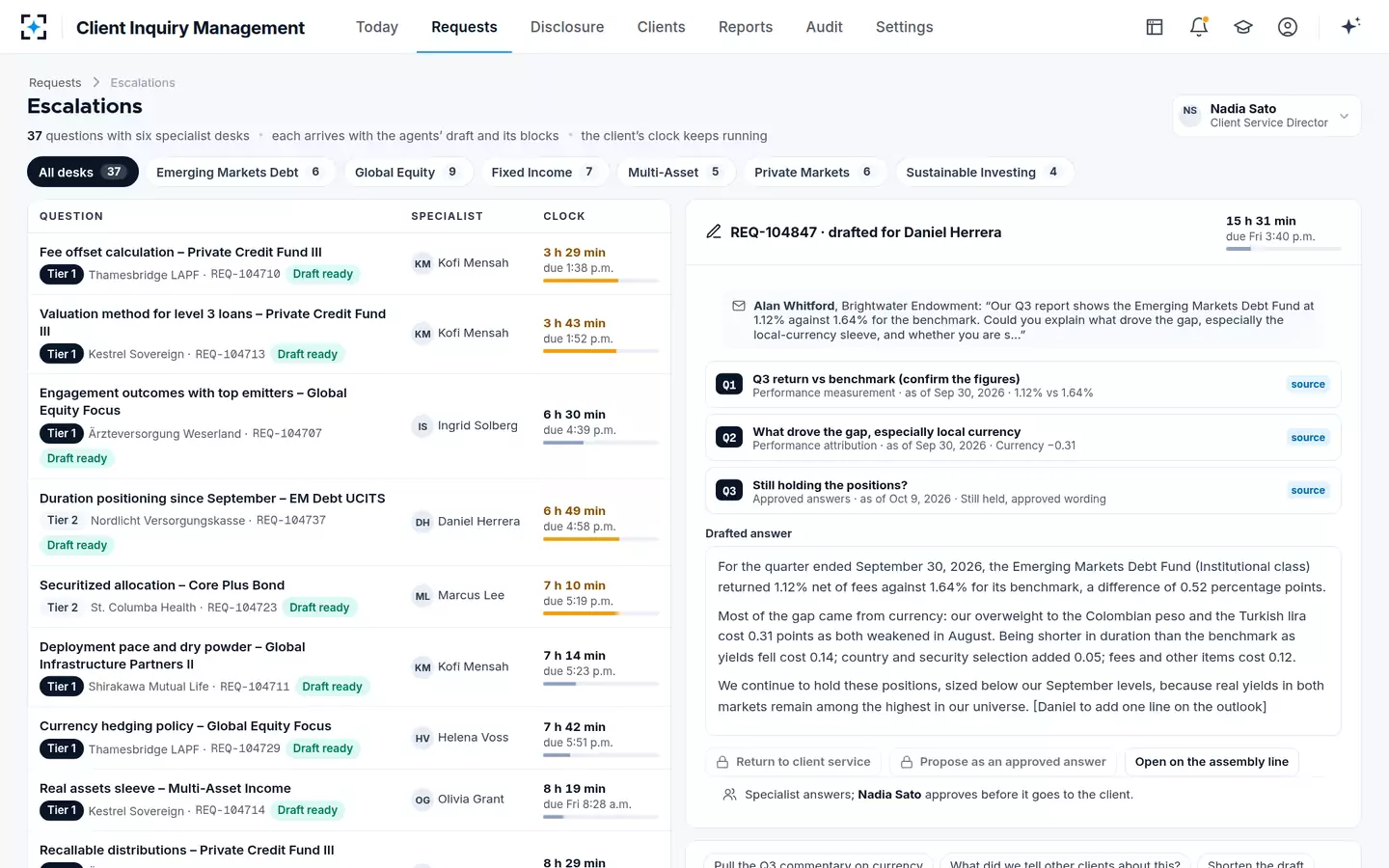
Specialists still answer; they start from a drafted answer
What to measure before deciding the desk's size
A decision about headcount made on a vendor's productivity claim is a decision made on someone else's data. The studies above measured output per person, and the right first step for a client service leader is to measure the same thing on the firm's own requests before and after agents start drafting. Four measures are enough for a first quarter.
First, people minutes per request, by request type and role, timed on a sample for two weeks before and two weeks after; that is the productivity figure the field study reported, measured on your work. Second, the share of drafts sent without a material edit; in the sample firm's shadow run on the previous month's 3,212 requests, 88.7% of drafts matched what the team had sent, which says the drafts were usable, not that the team was redundant. Third, what the people did with the time released: specialist questions answered sooner, holds decided the same day, complaints logged at intake. Fourth, errors that reached a client, which must not rise; in the sample month 27 figures were stopped before sending.
If minutes per request fall and errors do not rise, the desk can absorb growth without hiring, or move people to the checking and specialist work that grows. That is a staffing decision a firm can defend. A desk cut before those numbers exist is a bet that the headline applies to institutional work, and the evidence so far does not support it. The client service KPIs define each measure with its formula.
The jobs that grow: checking, deciding, explaining
If lookup moves to agents, the share of the desk's time spent checking, deciding and explaining rises, and those are the skills a firm should hire and train for. The sample firm's numbers show where that time goes. In one month the Disclosure agent raised 46 holds, each decided by a compliance reviewer, and the Tie-out agent stopped 27 figures that did not match their source, each fixed by a person before sending. Questions about AI itself are growing: 58 requests this month asked how the firm uses AI, up from 31 in September.
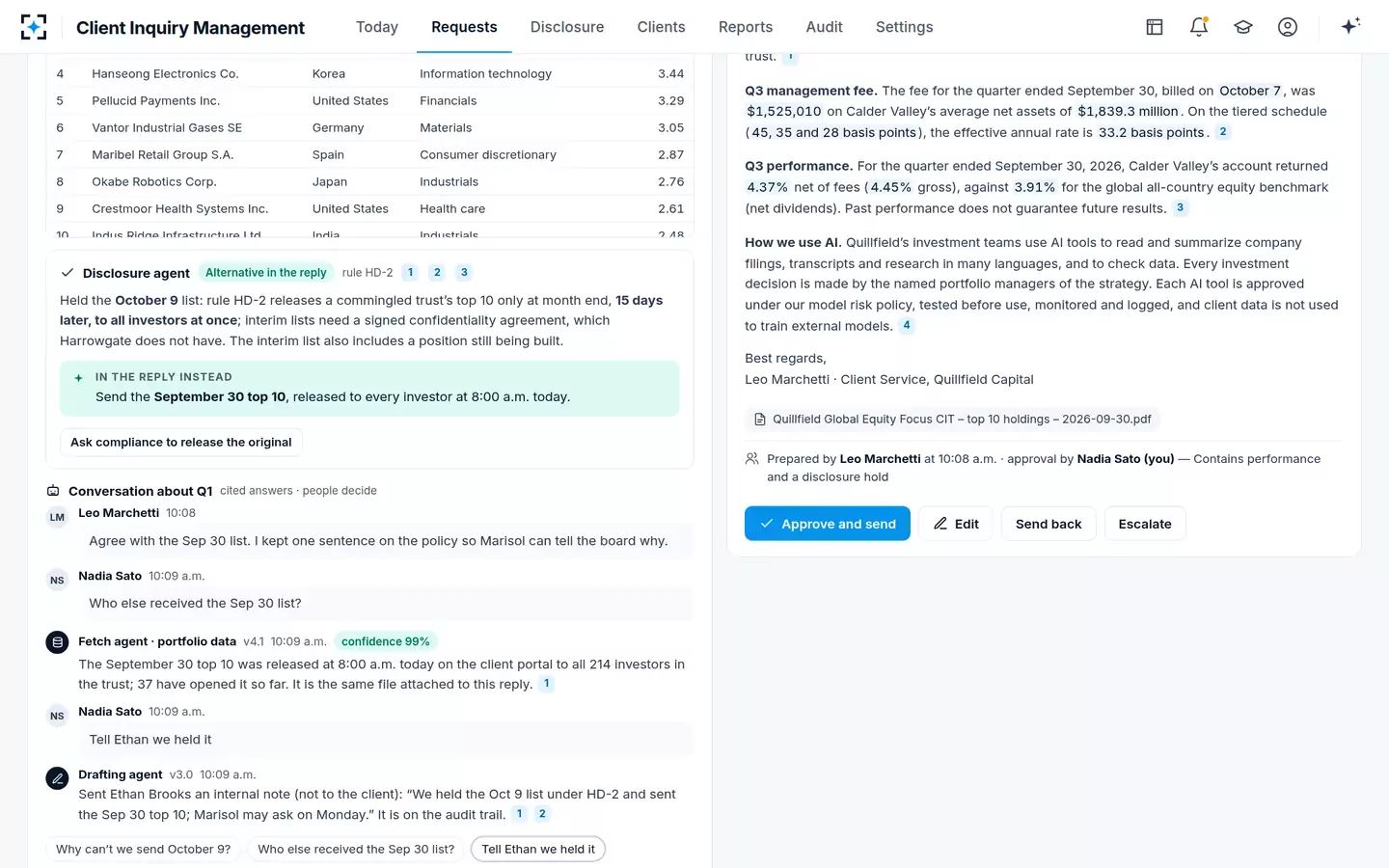
Explaining is the part that gets harder. A director who approves a reply is now asked why a figure was held, who else has the list, what the client was told. In the sample firm she asks the agents in the request itself and gets cited answers, then tells them what to do.
The director asks, the agents answer with sources, a person decides
That is the honest version of the headline for this kind of work. The desk keeps its people and changes their day. What no agent may send sets out the limits that keep the decisions with people, and the solution is at Client Inquiry Management.
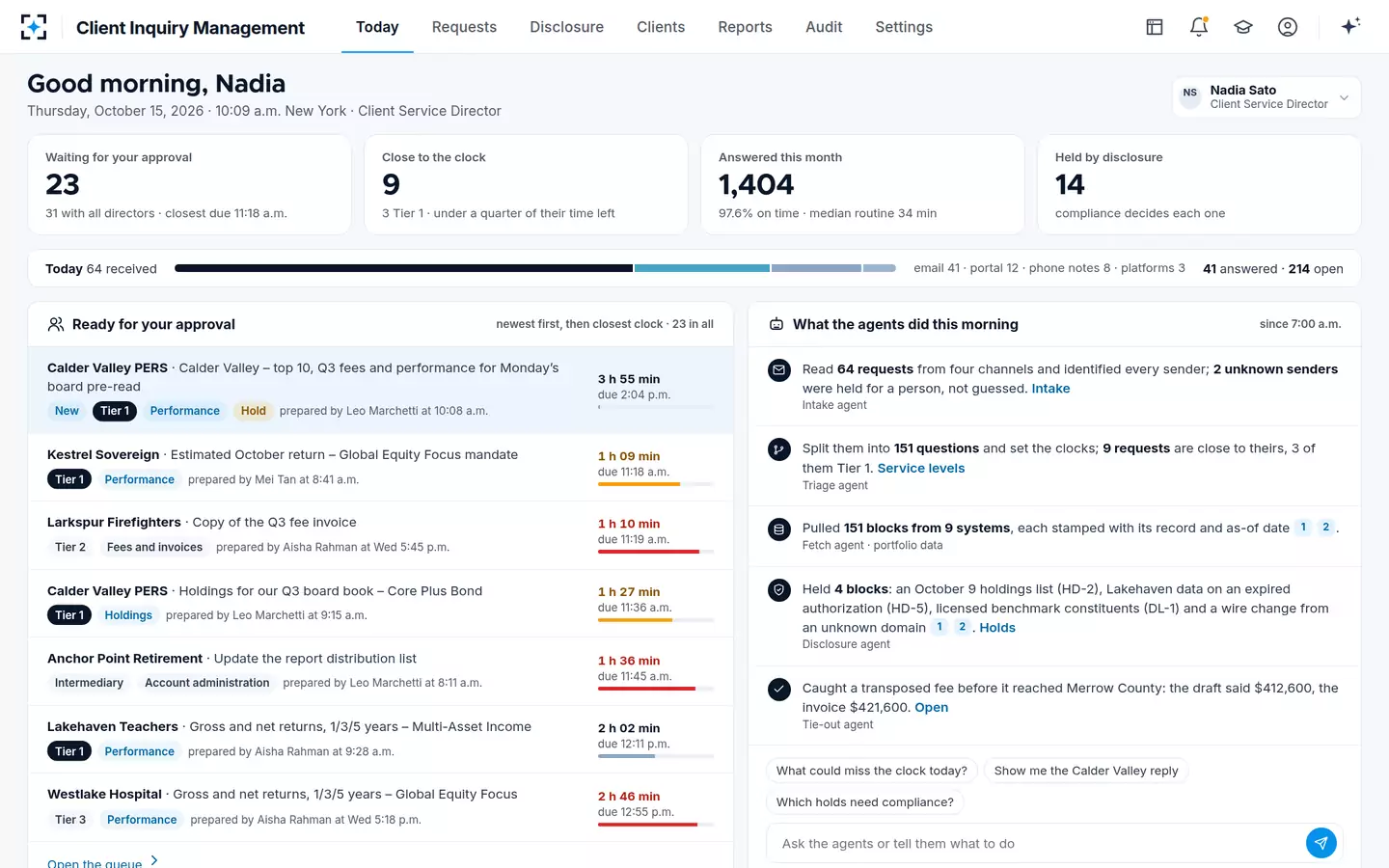
The director's morning, already sorted by the clock
Questions people ask
What does AI in client services look like at an asset manager?
Mostly behind the reply: reading requests, identifying the sender and what they may receive, fetching figures from the systems of record and drafting a cited answer that a person checks. At the sample firm a consultant's four-question email became an approved reply in 6 minutes, with every figure re-checked by a second agent before the director approved it.
What are examples of generative AI in customer service?
Suggested replies for agents in a chat, as in the 5,172-agent field study; summaries of a customer's history; drafted emails; answers from an approved knowledge base; and translation. In institutional client service the same tools draft replies in the client's language, such as a German pension's request answered in German with the English beside it for the associate to check.
Does AI make client service staff more productive?
In the largest field study, AI assistance raised issues resolved per hour by 15% on average, with the largest gains for less experienced agents. In a writing experiment published in Science, it cut task time by 40% and raised quality by 18%. Neither measured an institutional desk, where much of the time goes on entitlement and disclosure checks.
Will AI replace client service associates?
The evidence so far points to changing the job rather than removing it. The BLS projects customer service employment overall to fall 5% from 2025 to 2035, driven by self-service for simple requests, while UK firms report using agents for decision support far more than with autonomy. Associates who are good at checking figures and explaining holds become more valuable, not less.
How many financial firms use AI agents for customer communications?
In the Bank of England and FCA's 2026 survey, 16% of responding firms reported current use of agents for automated customer communications, rising to 34% including planned deployment. No more than 9% expected agents to approve or decline customer outcomes over the next year, even including plans.
Is a company responsible for what its AI tells customers?
Yes. FINRA's FAQ says firms are responsible for their communications whether a human or AI generated them, and must supervise chatbot communications under its rules. ESMA expects firms using AI in client interactions to disclose it. The sample firm keeps a person on every send and every step on its audit trail for 7 years.