Under the mutual fund portfolio disclosure rules, US funds report their full portfolio holdings to the SEC every month on Form N-PORT, but only the report for the third month of each fiscal quarter becomes public, on filing, and funds may file up to 60 days after the quarter ends. So, in practice, a mutual fund's complete holdings become public four times a year, roughly two months late; open-end funds must also post their first and third fiscal-quarter holdings, and their semiannual and annual financial statements, on a website within 60 days. Money market funds publish monthly within five business days, ETFs publish every business day, and investment managers with at least $100 million in exchange-listed equities file Form 13F within 45 days of each quarter. For a client service desk the calendar decides what may be sent to one requester and when, and Botminds' Client Inquiry Management checks each holdings answer against the fund's release dates before anything goes out.
Every date below is read from the rule or the SEC release that sets it, linked in the text; the sample example comes from Quillfield Capital, a fictional firm in the solution.
How often each kind of fund reports and publishes holdings
| Vehicle | What is filed or posted | When it becomes public | Rule |
|---|---|---|---|
| Mutual fund, closed-end fund | Form N-PORT for every month, filed within 60 days after each fiscal quarter | Third month of each fiscal quarter, on filing; months one and two not made public | Rule 30b1-9; Form N-PORT |
| Open-end fund (Form N-1A) | Shareholder report financials (Form N-CSR items) and first- and third-quarter complete holdings on its website | Within 60 days of each half-year or year end, and of each first and third fiscal quarter | Rule 30e-1(b)(2) |
| Money market fund | Form N-MFP, and a schedule of investments on its website | By the fifth business day of each month, for the prior month | Rules 30b1-7, 2a-7(h)(10) |
| ETF relying on Rule 6c-11 | Every portfolio holding behind the next NAV, on its website | Each business day, before the market opens | Rule 6c-11(c) |
| Institutional investment manager over $100 million | Form 13F of exchange-listed equity positions | Within 45 days after each calendar quarter | Rule 13f-1 |
How often do mutual funds report holdings?
To the SEC, every month; to the public, every quarter. Under Rule 30b1-9, a fund files a Form N-PORT report for each month, current as of the last business day or last calendar day of the month, and all three months of a fiscal quarter must be filed within 60 days after that quarter ends. The form's public-availability instruction then decides what anyone else sees: only the report for the last month of each fiscal quarter goes public, as soon as it is filed, while the SEC does not intend to make public the first and second months' fund-identifiable information (Form N-PORT, General Instruction F).
So a June 30 fiscal quarter end can become public as late as the end of August, and the April and May portfolios not at all. Some fields stay private even in the third month, including each holding's country of risk and liquidity classification. For a fund whose fiscal year ends in December, the latest public dates fall around May 30, August 29, November 29 and March 1.
The scale of the calendar
13,648
registered funds filing with the SEC, March 2026
8,117
mutual funds other than money market funds
4,829
exchange-traded funds
When will monthly N-PORT data be public?
Not before late 2027, and possibly not at all. In 2024 the SEC adopted amendments that would have funds file each month's report within 30 days of month end and make every month public 60 days after month end. In April 2025 it delayed the effective date of those amendments to November 17, 2027, and their compliance date to November 17, 2027 for fund groups with net assets of $1 billion or more and to May 18, 2028 for smaller groups (90 FR 16812, April 22, 2025).
Then, in February 2026, it proposed to change course again: funds would file monthly within 45 days after month end, and only the third month of each fiscal quarter would be published, 60 days after that month ends (SEC, Form N-PORT Reporting, 91 FR 8582, February 23, 2026). That is a proposal, not a rule, and no final rule had been published in the Federal Register by late October 2026. A desk that tells a consultant "holdings go public monthly from 2025" is repeating a rule that never took effect.
Three versions of the N-PORT calendar: in force, delayed and proposed
| In force today | 2024 amendments (delayed) | February 2026 proposal | |
|---|---|---|---|
| Filing deadline | All three months within 60 days after the fiscal quarter ends | Each month within 30 days after month end | Each month within 45 days after month end |
| What becomes public | Third month of the fiscal quarter, on filing | Every month, 60 days after month end | Third month of the fiscal quarter, 60 days after its end |
| Status | Rule 30b1-9 and Form N-PORT as in force | Effective November 17, 2027; smaller groups comply from May 18, 2028 | Proposal; not adopted as of October 2026 |
Shareholder reports and website holdings: the other 60-day clock
Every open-end fund registered on Form N-1A also has a website calendar. Under Rule 30e-1, it must post the financial statement items of its Form N-CSR, which include the schedule of investments, no later than 60 days after each fiscal half-year and year end, and, unless it is a money market fund, its complete portfolio holdings as of its first and third fiscal quarters within 60 days of each. Shareholder reports themselves go out within 60 days of the period they cover.
The practical result is that each fiscal quarter's holdings reach the public by two routes, the fund's website and the SEC's N-PORT data, within the same 60 days. That is the outer limit. A fund may post a month-end list sooner under its own policy, and the policy, not the rule, is what a desk applies first.
Money market funds: monthly, by the fifth business day
Money market funds publish more often and sooner. A money market fund files Form N-MFP with its portfolio holdings for the prior month "no later than the fifth business day of each month" (Rule 30b1-7), and it must post on its website, beginning no later than the fifth business day of the month and for at least six months, a schedule of its investments as of the last business day of the previous month, with each security's issuer, category, CUSIP, principal amount, maturity dates, coupon or yield and value (Rule 2a-7(h)(10)).
For a client service desk that means a money market fund's month-end holdings are public within a week of month end. A request for the prior month's money market holdings is usually a request for a link.
ETFs: every business day, before the open
An ETF relying on the SEC's ETF rule publishes its whole portfolio daily. Each business day, before regular trading opens on its listing exchange, it must disclose on a public website, free of charge, each portfolio holding that will form the basis of the next net asset value calculation, with ticker, identifier, description, quantity and weight (Rule 6c-11(c)). An ETF's holdings request is almost never a disclosure question; its benchmark constituents may be, because index data is licensed.
How many days until a quarter-end portfolio is public, at the latest
When do hedge funds report holdings?
Hedge funds do not file N-PORT. Their managers report through Form 13F if they exercise investment discretion over at least $100 million of exchange-listed equities, and they file "within 45 days after the last day" of each calendar quarter (Rule 13f-1). A 13F lists only those equity positions held at quarter end, so it shows less than a fund's full portfolio and arrives on a single calendar for every manager, which is why mid-February, mid-May, mid-August and mid-November are 13F season.
The same applies to the managers of separate accounts and collective trusts: a 13F covers the manager's discretionary equity positions across accounts, not any one client's portfolio. A consultant who asks a manager for its 13F is asking for a public document; a consultant who asks for one client's positions is asking for that client's information, under that client's authorization.
Your fund's own calendar: the policy lag
The rule sets the latest date; the fund's policy sets the actual one. Since 2004 every mutual fund has had to describe in its SAI "The frequency with which information about portfolio securities is disclosed, and the length of the lag, if any, between the date of the information and the date on which the information is disclosed" (SEC Release IC-26418, 2004). Most client service questions about holdings are really questions about that lag.
One commingled trust's month end at the sample firm: when each list may go
- Held: policy lag, no one receives it15 days
- Released to all investors at once, then to entitled requestersfrom Oct 15
- Interim: only under a signed confidentiality agreementnot released
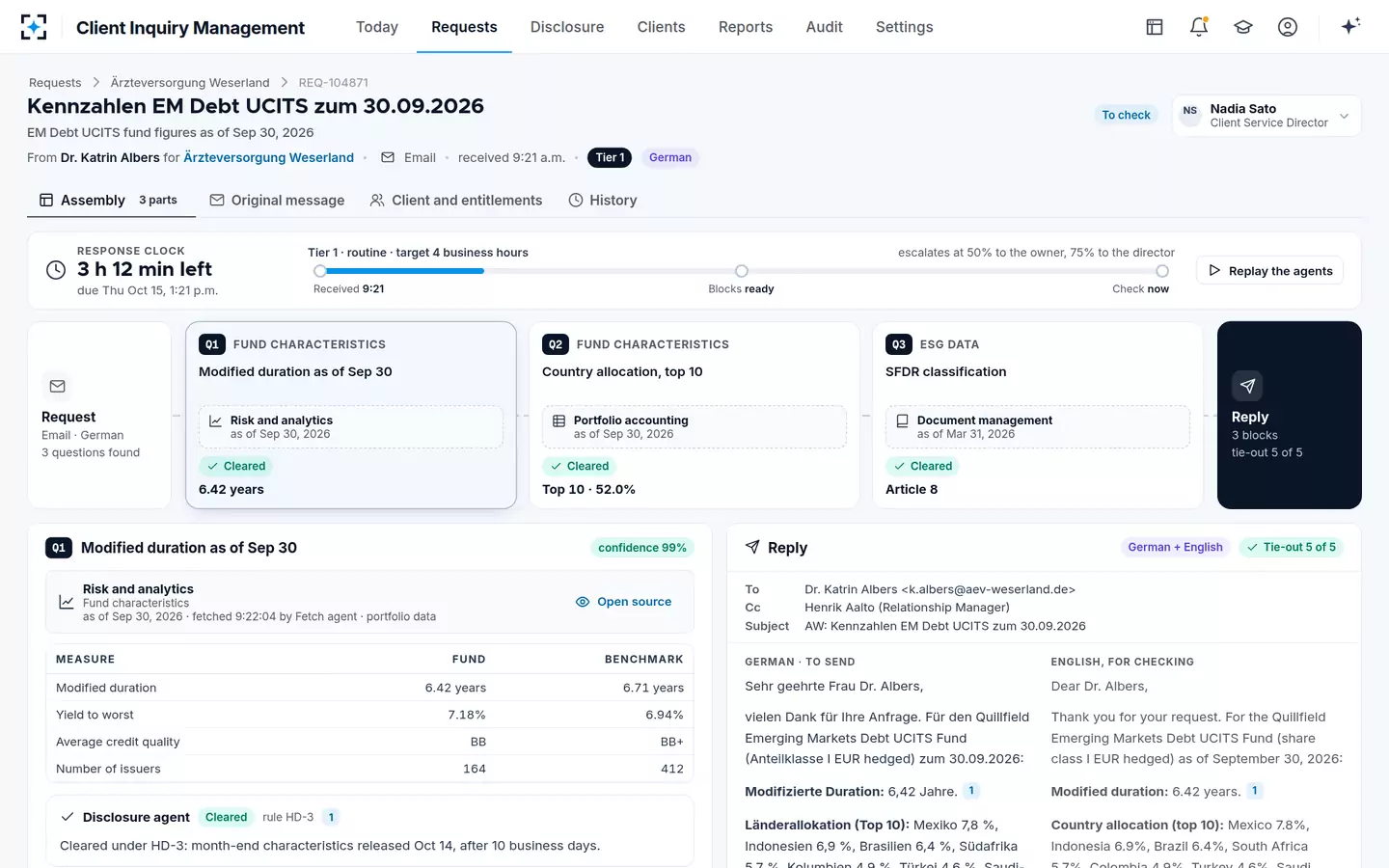
That is what happened to the sample firm's request on October 15, 2026. A consultant asked for the trust's top 10 as of October 9 for a pension board. The October 9 list was held; the September 30 top 10, released to all 214 investors in the trust at 8:00 a.m. that morning, went in its place. The firm's other policies follow the same pattern: a German pension's request for an emerging markets debt fund's month-end characteristics was cleared under rule HD-3, which releases them 10 business days after month end. The four tests for a holdings request explain what turns an early list into selective disclosure.
A month-end characteristics release, checked by Client Inquiry Management before it goes
What you may send before the public date
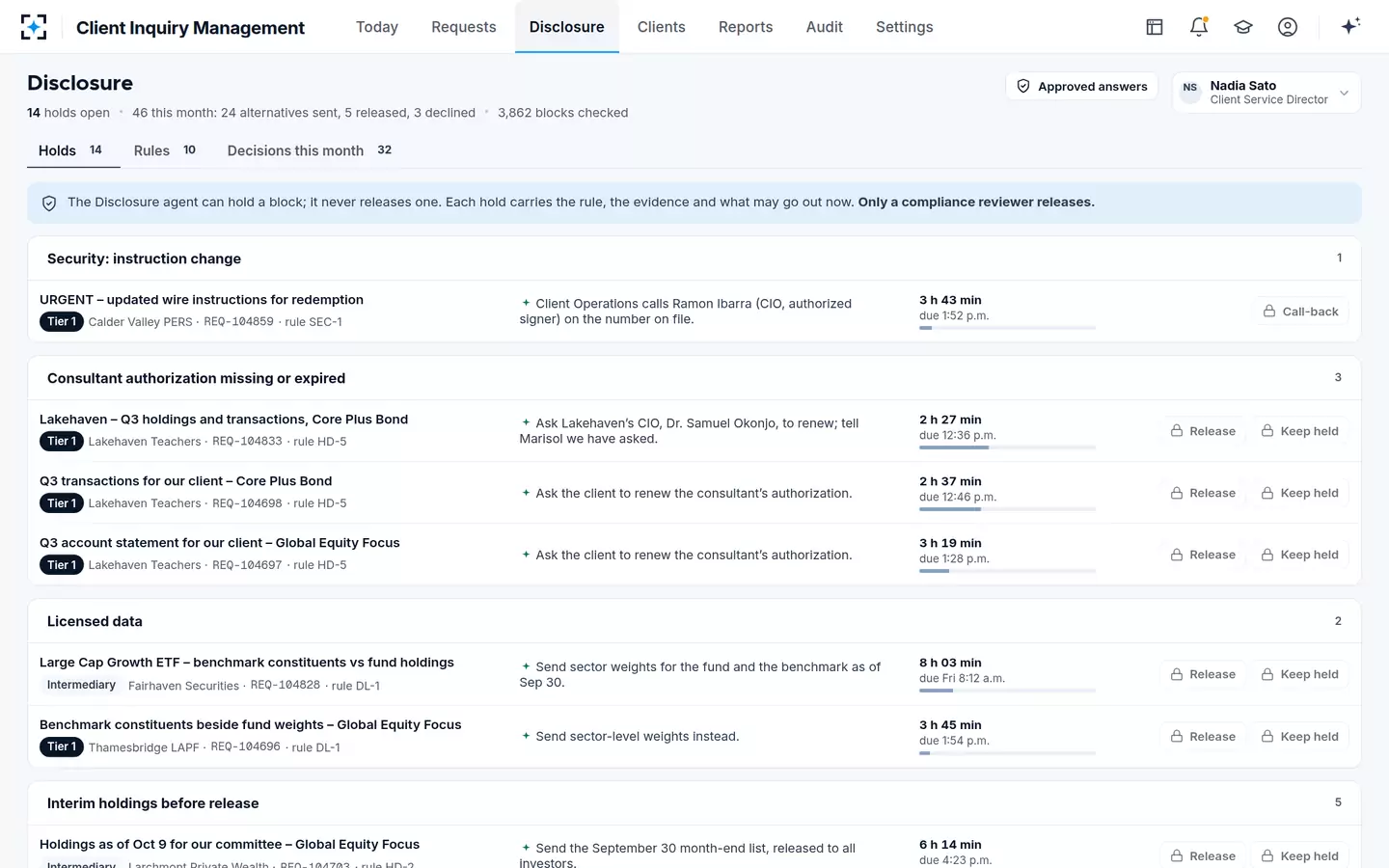
Before a list is public, the fund's policy decides; the sample firm's offers the most recent released list, or characteristics its policy releases sooner. A client's own separate account holdings are a different case, governed by the client's written authorization. The sample firm's Disclosure screen shows the alternatives in use: the month-end list instead of the interim one, sector weights instead of licensed benchmark constituents.
Each hold in Client Inquiry Management, with its rule and what may go out now
Before a holdings list goes to one requester
- Find the list's date and its release date under the policy
Not the date of the request.
- Check whether it is already public
Website, N-PORT third month, N-MFP or ETF daily file. If so, it may go the day after posting.
- If it is interim, check for a confidentiality agreement
Signed, current, covering this fund and this recipient.
- Check the requester's authorization
A consultant's authority from the client, with its expiry date.
- Check licences on anything index-related
Benchmark constituents and weights are often licensed index data.
- Offer the alternative
The latest released list, or characteristics, with one sentence on the policy.
Where a requester wants the public data itself, the SEC publishes N-PORT data sets each quarter; downloading mutual fund holdings data explains what those files hold. How a held list travels through the rest of a reply, from intake to the kept record, is mapped in customer inquiry handling, handoff by handoff. The solution that applies the calendar to client requests is Client Inquiry Management.
Questions people ask
When do mutual funds disclose their holdings?
Publicly, once a quarter: the N-PORT report for the third month of each fiscal quarter is public on filing, which must be within 60 days of the quarter end, and open-end funds post their quarterly holdings on a website within 60 days too. A fund may post a month-end list sooner under its own policy, which its SAI describes with its lag.
What is an N-PORT filing?
Form N-PORT is the monthly portfolio report registered funds other than money market funds file with the SEC, listing each holding with identifiers, value, percentage of net assets and risk data. Under the current rule all three months of a quarter are due within 60 days after the quarter ends, and only the third month is made public.
What are the Form N-PORT filing requirements?
Today, a report for each month, current as of the month's last business or calendar day, with all of a fiscal quarter's reports filed within 60 days after its end. Amendments adopted in 2024 would require filing within 30 days of each month end; their effective date is delayed to November 17, 2027, and a February 2026 proposal would set 45 days instead.
Can mutual funds disclose holdings daily?
Yes, a fund may publish as often as its policy allows, and ETFs relying on Rule 6c-11 must publish every business day before the open. A fund may prefer a lag to protect positions it is still building, as the sample firm's interim-list rule does; whatever it chooses, its SAI must describe the frequency and the lag.
How often do mutual funds publish holdings compared with ETFs?
A mutual fund's full portfolio is public at least quarterly, up to 60 days late; an ETF under Rule 6c-11 publishes its full portfolio every business day. A money market fund sits between them, posting monthly by the fifth business day. That difference is why ETF holdings requests rarely raise a disclosure question.