Selective disclosure for mutual funds means giving non-public information about a fund's portfolio holdings to selected people, such as one large investor or one consultant, before it is available to everyone. It is not banned outright, but since 2004 the SEC has required each fund to describe in its statement of additional information (SAI) its policies on disclosing holdings to anyone, and any ongoing arrangements to do so, and the SEC said such disclosure is acceptable only for a legitimate business purpose and where the recipient owes a duty of confidentiality, including not trading on it. For a client service desk that turns every holdings request into four tests: who is asking, why, under what agreement, and as of what date. Botminds' Client Inquiry Management runs those tests on every holdings answer and holds the ones that fail, proposing what may go out now.
The worked example comes from Quillfield Capital, a fictional firm in the solution.
Why the SEC wrote the rule
88
of the largest fund complexes received the SEC examination request behind the rule
30%+
of those responding appear to have disclosed holdings in ways that could let some shareholders trade advantageously
2004
the year funds had to describe their holdings disclosure policies in the SAI
What is selective disclosure for mutual funds?
It is giving some people a fund's holdings information that others do not yet have. The risk is not the information itself, which becomes public in time, but the head start: an investor who knows what a fund holds before other shareholders can trade ahead of the fund, or redeem ahead of other investors when a position looks troubled. The cost falls on the shareholders who did not get the list.
The SEC's 2004 release described the abuse plainly. Among the problems that prompted its reforms, it wrote:
Other abuses involve the selective disclosure by some fund managers of their funds' portfolio holdings in order to curry favor with large investors.
SEC, Release IC-26418, 69 FR 22300 (April 23, 2004)
The release added that more than 30% of the fund complexes that responded to an examination request sent to 88 of the largest "appear to have disclosed portfolio information in circumstances that may have provided certain fund shareholders with the ability to make advantageous decisions to place orders for fund shares" (69 FR 22300). The rule that followed did not set a release date for holdings. It required each fund to write down its own policy and publish a description of it.
What must a fund's SAI say about disclosing holdings?
The 2004 amendments to Form N-1A require a fund to describe its policies and procedures for disclosing its portfolio securities to any person, under seven headings, and to say in its prospectus that the description is available in the SAI and on its website if it has one. A client service team should be able to answer each of the seven for its own funds without looking it up.
The seven things a fund's SAI must describe about holdings disclosure
| Item | What the fund must describe | The client service question it answers |
|---|---|---|
| (i) Categories | How the policy applies to individual investors, institutional investors, intermediaries, service providers, rating and ranking organizations and affiliates | Which kind of requester is this? |
| (ii) Conditions | Conditions on use, including confidentiality and no-trading requirements, and how use is monitored | Has this recipient signed what the policy requires? |
| (iii) Frequency and lag | How often holdings are disclosed and the lag between their date and disclosure | Has the lag passed for this date? |
| (iv) Compensation | Policies on compensation or other consideration received for disclosure | Is anything being given in return? |
| (v) Authority | Who may authorize disclosure | Who can approve an exception? |
| (vi) Conflicts | How the fund ensures disclosure is in shareholders' best interests, including adviser conflicts | Does this help the adviser more than the fund? |
| (vii) Board oversight | How the board oversees holdings disclosure | Will this exception reach the board's report? |
Two further requirements catch requests that look routine. A fund must also describe any ongoing arrangement to make holdings available to any person, including who receives it, and the instruction to that item says the consideration to be disclosed "includes any agreement to maintain assets in the Fund" or in other accounts managed by the adviser (69 FR 22300). An investor who receives a monthly list and keeps its money in the fund has an arrangement, whether or not anyone called it one.
Can a consultant receive holdings before they are public?
Only where the fund's own policy allows it, for a legitimate business purpose, under a confidentiality agreement that includes a duty not to trade. The SEC's release says non-public holdings may go to selected third parties only when the fund has a legitimate business reason and the recipients are bound to keep the information confidential and not trade on it (69 FR 22300). Its examples are telling: due diligence by an adviser in "merger or acquisition talks with the fund's current adviser", a "newly hired investment adviser or sub-adviser prior to commencing its duties", and a rating agency "for use in developing a rating".
A consultant preparing a client's board pre-read is not on that list, but a fund's policy can include consultants on terms, typically a signed confidentiality agreement and a lag. What the policy cannot do is make an exception for a familiar name. The SEC noted that circumstances in which a fund has a legitimate business purpose for selective disclosure "typically would be limited", which is how most compliance teams read their own policies.
The website exception: send it the day after it is posted
The simplest way to give holdings to one requester without selective disclosure is to publish them first. The 2004 form instructions say a fund need not describe an ongoing arrangement if it makes the information available to the recipient "no earlier than the day next following the day on which the Fund makes the information available on its website", provided its prospectus says the holdings are posted there (69 FR 22300). There is a parallel exception where the information is already in a required public filing with the SEC.
The exception explains a common practice: funds post month-end holdings after a set lag and then send the same list to consultants and databases. It also sets the trap. A list dated later than the most recent posted one, an interim list, is by definition not yet public, so it cannot ride on the exception. The holdings calendar, fund by fund sets out when each kind of fund makes its holdings public.
Four tests for every holdings request
Every holdings request passes through the same four tests, in order, and a request that fails any of them is held, not refused. The useful reply explains the hold in the client's terms and offers what may go out now.
Recipient, purpose, agreement, date: the four tests
- Recipient: who is asking, and in which category?
A shareholder, a consultant on a client's behalf, an intermediary, a database, a rating agency. Check the contact's current authorization and its expiry date.
- Purpose: is there a legitimate business reason in the policy?
A board pre-read, due diligence before hiring, a rating. "The client asked" is not a purpose.
- Agreement: is a confidentiality and no-trading agreement in force?
Signed by this firm, covering this fund, current on the date of sending.
- Date: has the holdings date passed the policy's lag, and is it public?
If the list is on the website or in a public filing, send it the day after. If not, it is an interim list.
Two details change the answer more often than any rule. Partial lists are still holdings: a top 10, a sector breakdown with names, or a list of new positions is portfolio information. And a request can be for a client's own account. A separate account's holdings belong to the client, and the client's consultant may receive them under the client's authorization; a pooled vehicle's holdings belong to all its investors at once.
Commingled trusts and separate accounts: where the fund rules stop
The SAI requirement applies to registered funds, and not every pooled vehicle is one. A collective trust fund maintained by a bank, holding only the assets of qualified plans, governmental plans and similar accounts, is excluded from the definition of an investment company (15 U.S.C. 80a-3(c)(11)), so Form N-1A does not apply to it. The economics of selective disclosure do not change with the wrapper, though: an investor who gets the trust's list early can still trade ahead of the others. A manager can apply the same policy to its commingled trusts, and the sample firm does.
That is the sample request. On Thursday, October 15, 2026, a consultant for Calder Valley PERS, a public pension with $1,842.6 million in the sample firm's Global Equity Focus trust, asked for the trust's top 10 holdings as of October 9 for Monday's board. The firm's rule HD-2 releases a commingled trust's month-end top 10 to all investors at once, 15 days after month end, and sends interim lists only under a signed confidentiality agreement. The consultant's firm had none for this trust, and the interim list included a position still being built. The 15-day lag is the sample firm's own policy, not a rule.
In Client Inquiry Management, the October 9 list is held and the September 30 list offered
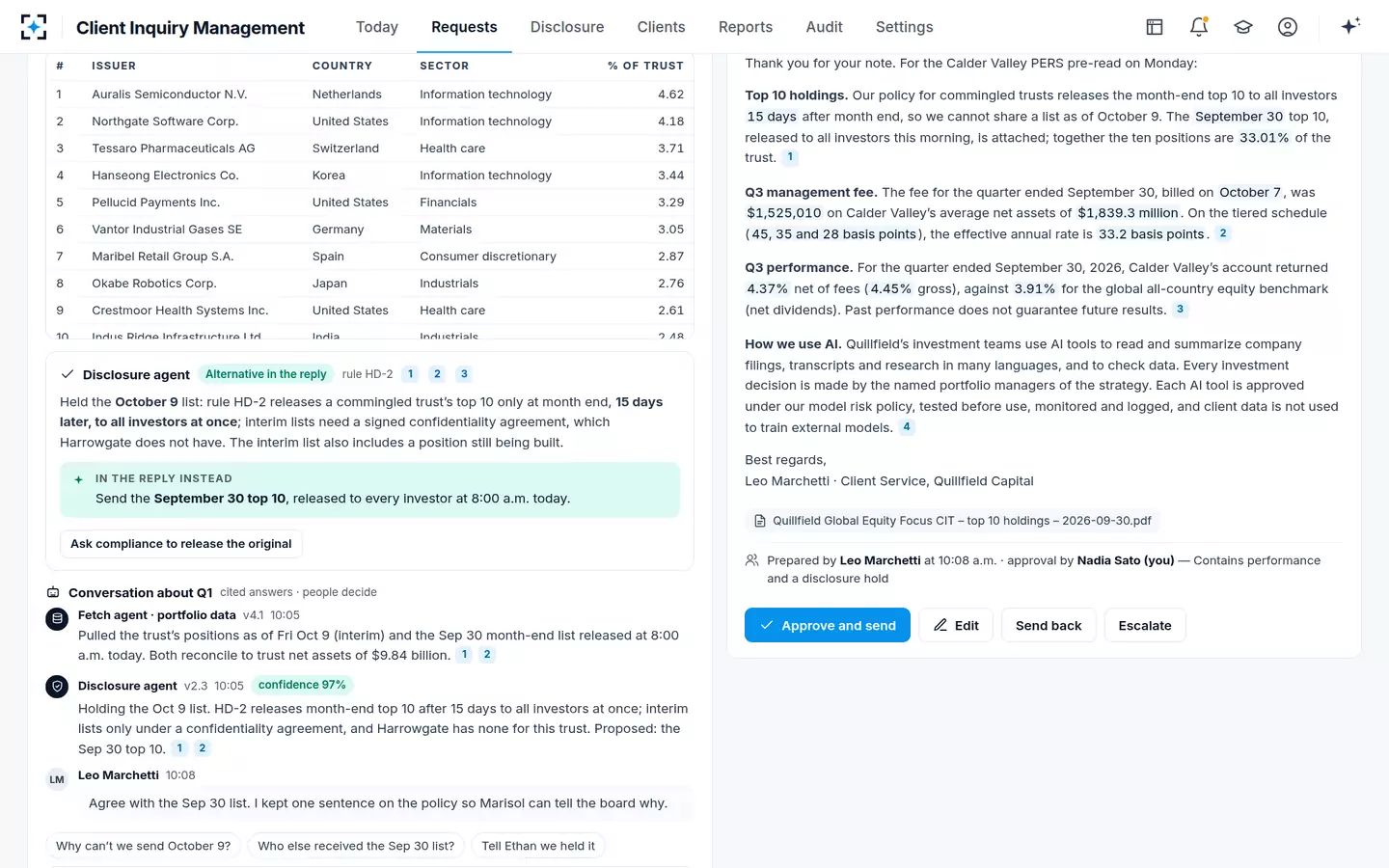
How the sample request was answered
The reply did three things. It explained the policy in one sentence, so the consultant could tell the board why the list was dated September 30. It attached the September 30 top 10, released to every investor in the trust at 8:00 a.m. that morning and representing 33.01% of the trust. And it answered the other three questions, the fee, the return and the AI paragraph, without waiting on the holdings decision.
From a holdings request to a reply that discloses nothing early, in Client Inquiry Management
Agent
IntakeMatches the sender to a consultant authorized for reporting, performance and fees, to January 31, 2027.
Never: guesses an unknown sender.
Agent
FetchPulls the October 9 interim list and the September 30 month-end list from portfolio accounting, each stamped with its date.
Never: writes to portfolio accounting; it is read-only.
Agent
DisclosureApplies HD-2: no confidentiality agreement, interim date, a position being built. Holds October 9; proposes September 30.
Never: releases a hold.
A person decides
AssociateAgrees with the alternative and keeps one sentence on the policy for the board.
A person decides
DirectorAsks who else received the September 30 list, confirms it went to all 214 investors, approves and sends.
A person decides
ComplianceCould release the October 9 list with a reason code; did not need to.
The director asks who else has the September 30 list, before she approves
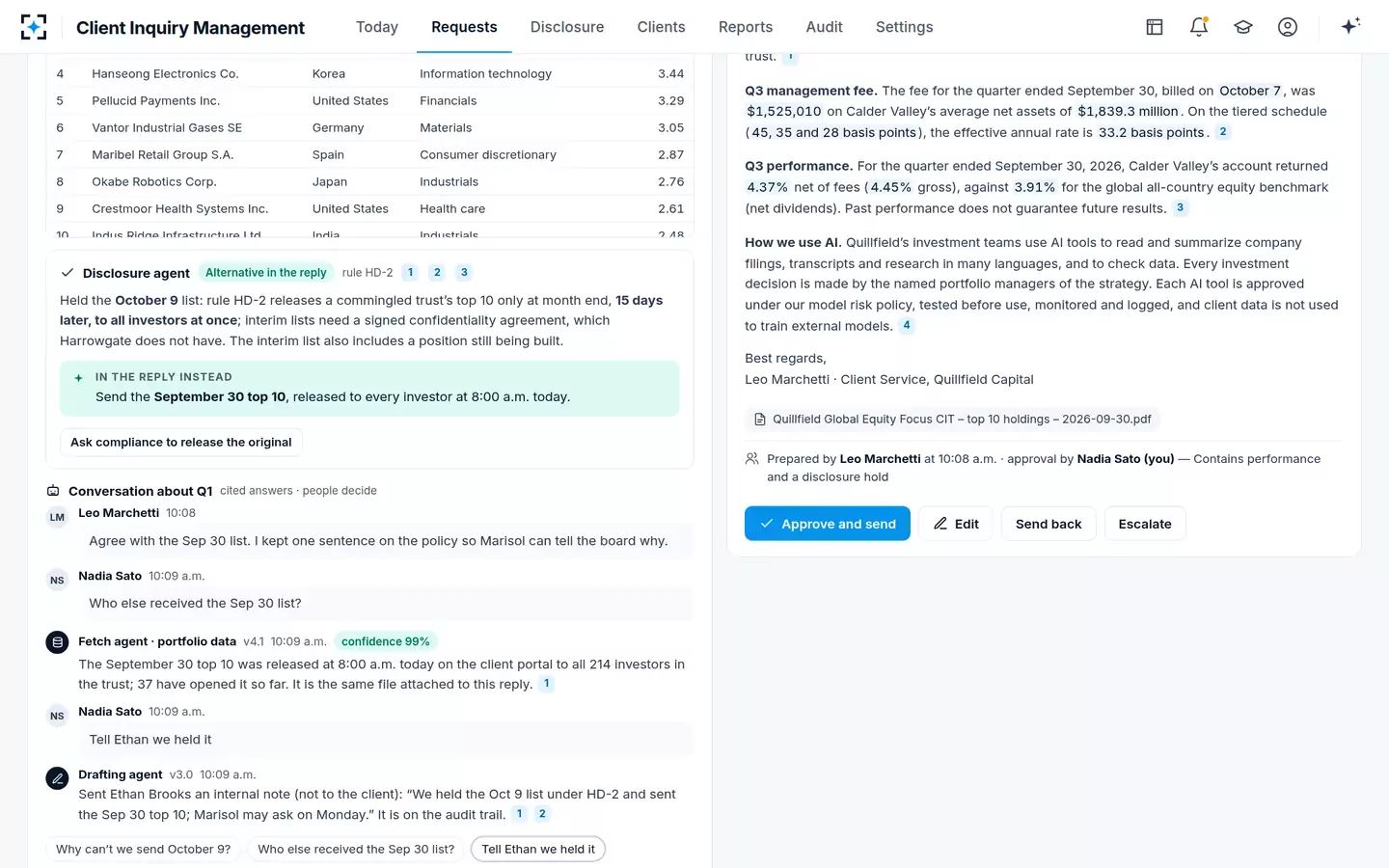
Who decides a hold, and who answers for the policy
The policy belongs to the fund and its board; the decision on an exception belongs to the people the policy names. Under the SEC's fund compliance rule, a fund must adopt written policies and procedures reasonably designed to prevent violations of the federal securities laws, its board must approve them, and its chief compliance officer must report to the board at least annually on their operation (17 CFR 270.38a-1). Holdings disclosure policies sit inside that program, and the seventh SAI item asks how the board oversees them.
That is why the sample firm's Disclosure agent can hold a block but never release one, and why a compliance reviewer releases or keeps each hold with a reason code. In the sample month the agent raised 46 holds; compliance had decided 32 by October 15 and released 5. Every decision is kept, because a reply is a business communication the adviser must keep for at least five years (Advisers Act Rule 204-2), and an exception to a disclosure policy is the reply an examiner is most likely to ask about. What no agent may send sets out the other limits, and the solution is at Client Inquiry Management.
Questions people ask
What is selective disclosure?
Selective disclosure is giving material non-public information to some people before it is public. For mutual funds it usually means portfolio holdings given to one investor, consultant or intermediary ahead of others; the SEC's 2004 release said some managers had done it to win favour with large investors, and it required every fund to describe its holdings disclosure policy in its SAI.
What should a portfolio holdings disclosure policy include?
At least the seven items Form N-1A requires: how the policy treats each category of recipient, the conditions such as confidentiality and no-trading terms, the frequency and lag, any compensation, who may authorize disclosure, how conflicts with the adviser are handled, and how the board oversees it. A desk-level version adds the alternative to offer when a request fails.
What are the SEC's mutual fund portfolio disclosure rules?
Funds report holdings to the SEC on Form N-PORT and in shareholder reports, and some must post them on a website, each on its own schedule. Separately, since the 2004 release, each fund must describe in its SAI how and to whom it discloses holdings before or outside those public dates, and its compliance program under Rule 38a-1 must cover that policy.
Can a fund give its holdings to a rating agency?
Yes, if its policy allows it: the SEC's release names disclosure to a rating agency for use in developing a rating as an example where selective disclosure may be appropriate, subject to confidentiality agreements and trading restrictions. An ongoing arrangement of that kind must be described in the SAI, including who receives the information.
Is sending a client its own separate account holdings selective disclosure?
No. A separate account's holdings are the client's, and the client, or a consultant it has authorized in writing, may receive them. The care needed is with the authorization, which should be current on the day of sending; at the sample firm, requests from consultants whose authorization had lapsed were held until the client renewed it.
Do the SEC's holdings rules apply to collective investment trusts?
Not directly. A bank-maintained collective trust fund for qualified and governmental plans is excluded from the Investment Company Act's definition of an investment company, so Form N-1A's SAI requirement does not reach it. The risk of an early list is the same, so a manager can sensibly apply its fund policy to its commingled trusts too, as the sample firm does.