An email triage agent is software that reads incoming messages, works out what each one is, who sent it and how urgent it is, and routes it to the right queue or person. In an asset manager's institutional client mailbox that is the easy half. The harder half is everything triage must not do: answer a sender it cannot identify, send a figure before the disclosure policy allows it, or act on a request to change bank details. Botminds' Client Inquiry Management splits the work across seven agents with written limits, so triage, lookup and drafting run on their own while every reply waits for a person, and this guide shows where each line falls and why.
The examples come from Quillfield Capital, a fictional sample firm in the solution, on Thursday, October 15, 2026.
Client Inquiry Management's seven agents prepare the reply; people check, approve and release
Agent
Intake agentReads the shared mailboxes, portal, phone notes and platform messages; identifies sender, client, account and the contact's entitlements; detects language and duplicates; logs it in the CRM.
Never: replies to anyone, guesses an unknown sender or acts on an instruction change.
Agent
Triage agentClassifies the request, splits it into its questions, sets the clock by tier, spots complaints, security risks and ambiguity, routes judgement questions to a specialist.
Never: closes a request; below 85% confidence a person classifies.
Agent
Two Fetch agentsPull holdings, returns, fees, statements and documents, each block stamped with its system, record and as-of date.
Never: write to a system; they are read-only.
Agent
Disclosure agentChecks every block against the disclosure policy, the contact's entitlements, data licences and preliminary-number rules; holds what may not go and proposes what may.
Never: releases a hold.
Agent
Drafting and Tie-out agentsOne assembles the reply in the client's language, each sentence tied to a block; the other re-reads every figure against its block on a different model family.
Never: send a reply, or approve one.
A person decides
Associate, director, complianceThe associate checks routine replies; a director who did not prepare it approves every sensitive one; only compliance releases a hold.
What is an email triage agent?
An email triage agent is the first reader of a shared mailbox: it classifies, prioritises and routes each message so that people start with the right ones. In a support inbox that is most of the job. In institutional client service it is the first of several decisions, because the same email can hold a routine request, a disclosure question, a complaint and a fraud attempt.
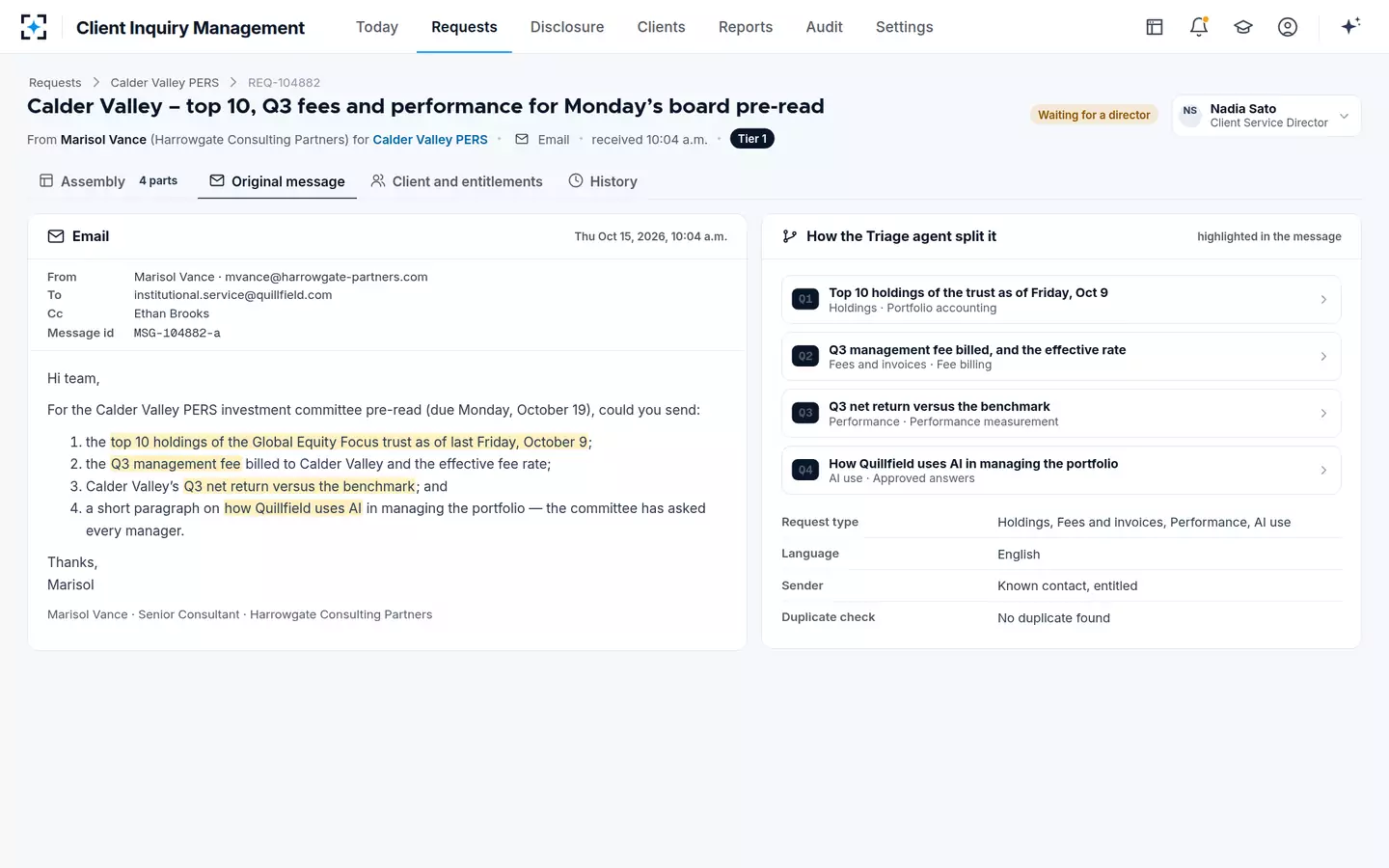
Take the sample firm's 10:04 a.m. message. Marisol Vance, a consultant at Harrowgate Consulting Partners, writes for Calder Valley PERS, a Tier 1 public pension, asking for four things for Monday's board pre-read: the trust's top 10 holdings as of October 9, the Q3 management fee and effective rate, the Q3 net return against the benchmark, and a paragraph on how the firm uses AI. A classic triage tool would label it "holdings" and put it in a queue. The useful output is four questions, each routed to a different system, with a clock set by the hardest one.
The original message, split into four questions by the Triage agent
Why a client mailbox is harder than a support inbox
Three things make an institutional client mailbox different, and each changes what triage must do. First, entitlement: the same question from a plan's staff, its consultant and an intermediary platform may have three different right answers, and one of them may be "not yet". Second, disclosure: a holdings list, a preliminary return or a licensed index constituent list can be accurate and still not be sendable. Third, the record: every reply is a business communication the firm must keep and may have to produce.
That is why the sample firm's Intake agent does more than read. It matches the sender to a CRM contact, checks the contact's written authorization and its expiry date, and records which data types that contact may receive. On the sample Thursday it read 64 requests from four channels and held 2 unknown senders for a person, not guessed. A triage step that guesses the sender has made a disclosure decision without knowing it.
What each agent does, and what it may never do
The clearest way to evaluate an email triage agent is to ask for its limits in writing. A vendor who can describe what the agent does but not what it is barred from doing has not designed the second half. The matrix below is the sample firm's, and it is the form a buyer should ask every vendor to fill in.
The limits matrix in Client Inquiry Management: one row per agent, the never column first
| Agent | May never | Who does it instead |
|---|---|---|
| Intake | Reply to anyone; guess an unknown sender; act on an instruction change | A person identifies the sender; Client Operations handles instruction changes |
| Triage | Close a request; classify below 85% confidence; handle a complaint inside a reply | An associate classifies; the complaints process takes the complaint |
| Fetch · portfolio data | Write to a system; use a non-official period-end figure by default; compute anything but stated arithmetic | The performance and accounting teams own the figures |
| Fetch · documents and billing | Use anything but the latest approved version; use an expired statement | A person decides on an expired document |
| Disclosure | Release a hold | A compliance reviewer releases or keeps each hold, with a reason code |
| Drafting | Send a reply; write a figure without a source block | The associate or director sends |
| Tie-out | Approve a reply; let a figure that does not tie through | A person approves; a failed tie stops the reply |
Can an AI agent send a reply to a client on its own?
It can technically, and a firm that lets it remains responsible for every word. FINRA's answer to whether a firm is responsible for AI-created communications is one word long, followed by a sentence that leaves no room:
Yes. Firms are responsible for their communications, regardless of whether they are generated by a human or AI technology.
FINRA, Advertising Regulation FAQ D.8, posted May 10, 2024
For chatbots that talk to investors, FINRA's FAQ B.4 says the communications may be correspondence, retail communications or institutional communications depending on who receives them, and "Therefore, the firm must supervise the chatbot communications in accordance with applicable FINRA rules" (FINRA FAQ B.4). Under FINRA Rule 2210, a written communication sent only to institutional investors, which includes governmental entities, certain employee benefit plans and a person acting solely on behalf of an institutional investor, is an institutional communication, reviewed under written procedures the member sets; a message to 25 or fewer retail investors in 30 days is correspondence. Those rules bind a fund's broker-dealer distributor. The adviser has its own obligation: an SEC-registered adviser keeps originals of written communications received and copies of those sent that relate to its advice, for at least five years (Advisers Act Rule 204-2).
In Europe the expectation adds disclosure to supervision. ESMA's 2024 statement on AI in retail investment services says firms "using AI for client interactions, such as through chatbots or other types of AI-related automated systems, should transparently disclose to clients the use of such technology during these interactions" (ESMA, May 30, 2024). None of these rules bans an automated reply. Together they mean that an automated reply is supervised, kept and, for European retail clients, disclosed, and that the supervision is the firm's, not the vendor's.
The sample firm's answer is the simplest one to supervise: agents draft and check, and a person sends. An associate checks routine replies. A director who did not prepare it approves any reply with performance, holdings, a complaint, a hold, an edited figure or non-standard text. Five percent of bulk sends are drawn for a director to check.
Why triage never acts on an instruction change
A request to change wire instructions, a bank account or an address is the message an attacker most wants answered, and the safest triage is the one that never answers it. Business email compromise accounted for $3,046,598,558 in losses reported to the FBI's Internet Crime Complaint Center in 2025 (FBI IC3, 2025 Internet Crime Report), and a redemption is a large, one-off payment of exactly the kind that attracts it.
On the sample Thursday the Triage agent held an urgent message asking for updated wire instructions for a redemption, from a domain nobody could match, and routed it to Client Operations. Client Operations calls an authorized signer on the number already on file, and a second person confirms. The agents draft nothing to the sender, because even an acknowledgement tells an attacker the message landed.
What triage must catch: complaints, security risks and ambiguity
Classification is the visible part of triage; detection is the valuable part. Three signals change what happens next. A complaint inside a request is split out and logged as its own case with its own clock, under the firm's complaints process, and the reply acknowledges it. A security risk, such as an unknown domain, an instruction change or an urgent tone around money, is held. And ambiguity, such as "the usual report" from a contact with three mandates, goes to a person instead of being resolved by a confident guess.
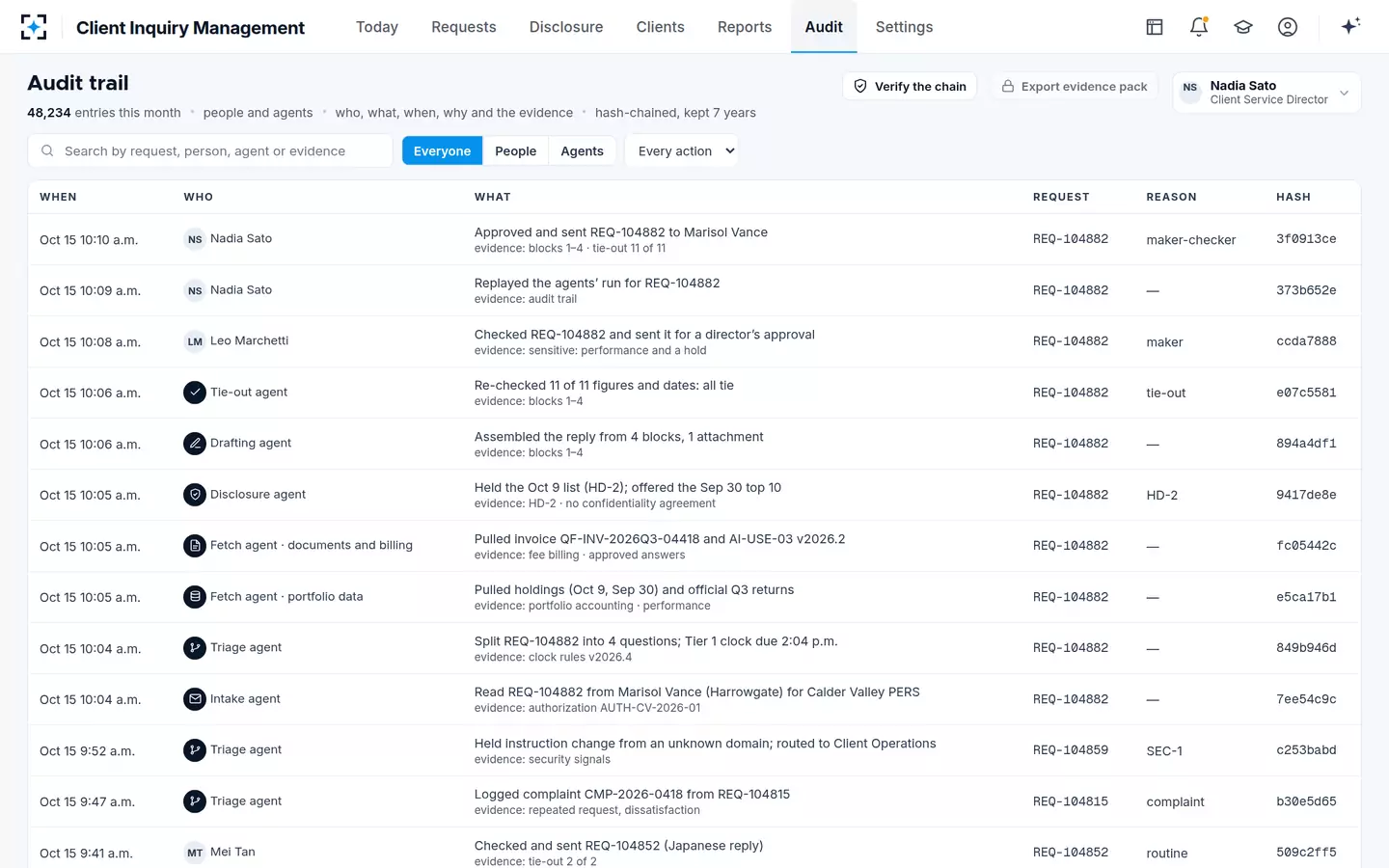
The audit trail shows what that looks like in practice. At 9:47 a.m. the Triage agent logged complaint CMP-2026-0418 from request REQ-104815, citing a repeated request and expressed dissatisfaction as its evidence. At 9:52 a.m. it held an instruction change from an unknown domain under rule SEC-1 and routed it to Client Operations. Neither is a classification a support-inbox triage would make.
Every step by every agent and person, with its reason and a hash
Keeping every step: what regulators expect of the trail
A triage agent that cannot show what it decided and why is a supervision gap, whatever its accuracy. Beyond the adviser's five-year rule, a broker-dealer keeps originals of all communications received and copies of those sent relating to its business, and any approvals of them, for at least three years under Exchange Act Rule 17a-4(b)(4). FINRA's 2026 oversight report lists, among practices it observed for generative AI, keeping prompt and output logs, tracking which model version was used and when, and human review of outputs (FINRA, 2026 Annual Regulatory Oversight Report).
The sample firm keeps replies, answer blocks and evidence for 7 years, longer than either rule's minimum, and logs every agent step with the agent's version. That matters for a reason beyond retention. When a rule in the disclosure policy changes, the change is tested on the last 90 days of replies before it applies, which is only possible if those replies and their reasons were kept.
UK firms let agents write to customers more readily than decide for them
16%
of firms already use agents for automated customer communications
34%
including planned deployment over the next 12 months
9%
at most expect agents to approve or decline customer outcomes, plans included
39%
routinely monitor customer-impact metrics for their AI systems
The same survey gives the risk its scale. About one firm in six already lets agents handle automated customer communications, and one in three will once planned deployments land, while only 39% of respondents routinely monitored customer-impact metrics for their AI systems, against 72% that monitored accuracy, precision or recall (Bank of England and FCA, 2026). Firms are measuring whether the output is right more often than what it does to the customer who receives it.
How to evaluate an email triage agent before you buy
Judge an email triage agent on your own closed requests, not on a demonstration mailbox, and judge it on its refusals as much as its answers. The checklist below is the one we would hand a vendor; a 30-day pilot on last quarter's mailbox turns it into a test with pass marks set in advance.
Ten questions for any email triage agent vendor
- Show me the limits matrix
Every agent's "may never" list, in writing, and how each limit is enforced.
- What happens to an unknown sender?
The right answer is a person, never a guess or a reply.
- What happens to an instruction change?
Held and routed for a call-back; nothing drafted to the sender.
- How are complaints detected and split out?
Ask for the detection rate on your own past complaints, in every language you serve.
- Where does entitlement data come from?
The CRM authorization with its expiry, read at intake, not a mailbox rule.
- Can any agent send?
If yes, under what threshold, and who supervises those sends.
- What is checked independently?
A second agent on a different model, or only the drafting agent checking itself.
- What is the confidence threshold for routing, and who changes it?
Versioned, approved and logged.
- What does the trail hold?
Each step, agent version, evidence and reason, kept as long as your longest retention rule.
- Which data leaves your region?
EU clients' data in particular.
Where an email triage agent fits, and where it does not
An email triage agent fits where requests are many, the answers live in systems the firm already trusts, and the rules about who may receive what can be written down. Institutional client service is that kind of work: most requests are for data the firm holds, and the disclosure policy and the CRM authorizations can be read by an agent as easily as by an associate.
It fits less well where the answer is a judgement. A question about why a strategy underperformed needs a portfolio manager or a product specialist, and the agent's job there is to route it with the attribution already drafted, not to answer it. It does not fit at all as a replacement for the complaints process, the call-back on an instruction change or a compliance reviewer's decision to release a hold. Those stay with people because the firm needs a named person to have made them. The handoffs before and after triage are mapped in customer inquiry handling, handoff by handoff, and five measures of accuracy show how to score the drafts. The solution itself is at Client Inquiry Management.
Questions people ask
What does email triage mean?
Email triage means sorting incoming messages by type, urgency and owner before anyone answers them, the way a hospital sorts patients by need. In institutional client service it also means identifying the sender and what they may receive. In the sample firm the Triage agent sets a clock by the client's tier and the hardest question, for example 4 business hours for a Tier 1 client.
What is the email triage process at an asset manager?
Identify the sender and client, check entitlements and duplicates, classify and split the request into its questions, set the response clock, and flag complaints, security risks and ambiguity before routing. In the sample firm the first two steps belong to the Intake agent and the rest to the Triage agent; unknown senders and anything below 85% confidence go to a person.
What is the difference between an email triage system and an email triage agent?
A triage system usually applies rules and labels: keywords, sender lists and routing to queues. An agent reads the message as a person would, splits it into questions, and can explain why it routed each one, but it needs written limits and a second check because it can be confidently wrong. Most buyers will want both: rules for the hard limits, agents for the reading.
Can AI answer client emails?
It can draft them, and with sources it can draft them accurately, but under FINRA's FAQ the firm is responsible for the communication either way and must supervise it. In Client Inquiry Management the agents draft and re-check every figure, and a person sends every reply; on the sample request, four questions were answered and approved in 6 minutes.
Does a human have to approve every AI-drafted reply?
No rule says every reply needs a named approver, but every reply must be supervised and kept, and an approval step is the easiest supervision to evidence. The sample firm requires an associate's check on routine replies, a director's approval on sensitive ones and a director's review of 5% of bulk sends.