To download mutual fund holdings data for US funds, use the SEC's Form N-PORT data sets: free ZIP files on sec.gov, updated quarterly, that hold the portfolio of every registered mutual fund, ETF and closed-end fund filing Form N-PORT, line by line, with issuer, identifiers, value, percentage of net assets, asset and issuer type and country. With them an insurer, pension or fund-of-funds analyst can look through a US fund from public data, and save manager requests for private funds and non-US vehicles. Two gaps matter: only the third month of each fiscal quarter is public, and the country field is where the issuer is organized, not where its risk sits. Botminds' Look-Through Risk Analysis reads the manager reports the public files do not cover, maps every line to country of risk, and ties each fund to the manager's own NAV.
Screens are from the solution on a fictional sample portfolio.
Where fund holdings data is public, and what each source can and cannot do
| Source | Covers | How current | Fields you get | What it cannot give you |
|---|---|---|---|---|
| SEC Form N-PORT data sets | US registered funds other than money market funds: mutual funds, ETFs, closed-end funds | Third month of each fiscal quarter, public on filing; filed within 60 days; data sets posted quarterly | Issuer name, LEI, CUSIP, ISIN, ticker, balance, currency, value, % of net assets, asset type, issuer type, country of organization, fair value level, debt terms, derivatives | The first two months of each quarter; country of risk (Item C.5.b); liquidity classifications |
| A fund’s own N-PORT filing | One fund | Same as above, on the day it is filed | The full public form for that fund | The same non-public items |
| SEC staff Registered Fund Statistics | All N-PORT filers, aggregated | About four months after a calendar quarter ends | Totals by asset type, country (both definitions), liquidity, derivatives | Anything about a single fund |
| Manager reports and capital account statements | Private funds, UCITS and other non-US funds, separate accounts | Whenever the manager reports: weeks to 75 days or more | Whatever the manager prints, in its layout and language | A standard format; often country of risk and identifiers |
Where can I get N-PORT data? The SEC's Form N-PORT data sets
The SEC publishes N-PORT holdings on its data and research pages as one ZIP file per calendar quarter, from the fourth quarter of 2019 onward; the third-quarter 2026 file, covering filings to September 2026, is about 440 MB (SEC, Form N-PORT data sets). The page states that "The data sets will be updated quarterly" and that they include only publicly available information.
The data set documentation describes the content plainly: "Form N-PORT filings are disseminated quarterly", the data sets are flat files extracted from the XML submissions, and "The N-PORT data sets consists of XML data submitted from October 2019 through current period", amendments included (SEC, N-PORT data sets readme). Each quarter is assigned by filing date: "Data contained in documents filed after 5:30pm EST on the last business day of the quarter will be included in the next quarterly posting." A June 30 portfolio filed in August therefore appears in the file for the third calendar quarter.
What holdings data does N-PORT include?
The holdings sit in one table, FUND_REPORTED_HOLDING, with one row per position; it is one of up to 30 data files in each quarter's set, the others holding identifiers, debt terms, repurchase agreements, derivatives and securities lending. For a look-through the useful columns are ISSUER_NAME, ISSUER_LEI, ISSUER_CUSIP, BALANCE, CURRENCY_CODE, CURRENCY_VALUE, PERCENTAGE (of net assets), ASSET_CAT, ISSUER_TYPE, INVESTMENT_COUNTRY and FAIR_VALUE_LEVEL, plus IDENTIFIER_ISIN and IDENTIFIER_TICKER in the IDENTIFIERS table. Fund-level totals, including NET_ASSETS and the EDGAR series identifier, are in FUND_REPORTED_INFO.
Two columns deserve a closer look. ISSUER_TYPE uses Form N-PORT's categories, which include "private fund" and "registered fund", so the lines that are themselves funds can be found and followed. INVESTMENT_COUNTRY is Item C.5.a, "the country where the issuer is organized"; the form's other country, C.5.b, is not in the public files, as the next sections explain.
Why public N-PORT data matters for a look-through
13,648
US registered funds in the SEC staff’s N-PORT statistics, March 2026
$3.1tn
gross value of registered funds held by registered funds, March 2026
40%
of registered funds hold at least one other fund (SEC staff estimate, 2020)
60days
after fiscal quarter end: the latest a fund may file its N-PORT reports
How current is public N-PORT data?
Public N-PORT data is up to two months old on the day a fund files it, and older by the time it reaches the quarterly data set. Rule 30b1-9 requires that "Reports on Form N-PORT for each month in each fiscal quarter of a registered investment company must be filed with the Commission no later than 60 days after the end of such fiscal quarter" (17 CFR 270.30b1-9). The form then says that "Information reported on Form N-PORT for the third month of each Fund’s fiscal quarter will be made publicly available upon filing."
From a June 30 portfolio to a public look-through: where the weeks go
- Fund prepares and filesup to 60 days
- Fund prepares and filesup to 60 days
- Quarter closesto Sept 30
- All funds’ filings arriveabout four months
This timing is under review. The SEC adopted amendments in 2024 "to require more frequent reporting of monthly portfolio holdings and related information to the Commission and the public", then delayed them: the form amendments "are delayed to November 17, 2027" and part of the rule change "is delayed to May 18, 2028" (90 FR 16812). In February 2026 it proposed instead to give funds fifteen more days to file monthly reports and to go back to publishing holdings once a quarter, as the SEC had for more than twenty years (91 FR 8582; what else changed in 2026). That is a proposal; until a final rule says otherwise, plan on the quarterly cycle above.
What the public files leave out: two months a quarter, and country of risk
The SEC collects more than it publishes. Form N-PORT's instructions say the SEC does not intend to make public, in a form identifiable to a fund, "the information reported on Form N-PORT for the first and second months of each Fund’s fiscal quarter", nor several items including the highly liquid investment minimum, liquidity classifications and "country of risk and economic exposure (Item C.5.b)" (Form N-PORT, General Instruction F). The SEC's staff can use those items, and its statistics do, but they are "anonymized, and are aggregated, rounded, and/or masked". What those aggregates show about illiquid holdings is read in liquidity risk in mutual funds.
For a look-through, the missing country of risk is the bigger loss. In the SEC staff's own tables for March 2026, US mutual funds held $215 billion of securities issued by entities organized in the Cayman Islands, while by country of risk the Cayman Islands did not make the top ten and China ($251 billion) and Taiwan ($309 billion) did. An investor that uses the public INVESTMENT_COUNTRY column as its country exposure inherits the domicile view; country of risk versus country of domicile shows how to reset it issuer by issuer.
Can you look through a fund using public data? Six steps
Yes, for US registered funds, and the method is the same as for any manager report: find the holdings, scale them to your share, classify them, follow the funds inside the fund, and check the total. The steps below use the N-PORT data set tables named in the SEC's documentation.
Looking through a US fund with the N-PORT data sets
- 1. Find the fund’s latest public report
Match the fund on SERIES_ID or SERIES_LEI in FUND_REPORTED_INFO; take the latest REPORT_DATE and, where a report was amended, the latest filing for that date.
- 2. Scale to your holding
Your units times NAV per unit, divided by NET_ASSETS, gives your share; apply it to each holding’s CURRENCY_VALUE or to PERCENTAGE.
- 3. Identify each line
Join IDENTIFIERS for ISIN and ticker; match CUSIP, ISIN or LEI to your security master. Lines with no identifier need the issuer name and title.
- 4. Set the country of risk
INVESTMENT_COUNTRY is the country of organization. Re-map offshore issuers to the parent’s country of risk.
- 5. Follow the funds inside the fund
Lines with ISSUER_TYPE “registered fund” can be looked through with their own N-PORT data; “private fund” lines cannot.
- 6. Tie out
Holdings should sum close to 100% of net assets once cash, receivables and liabilities are counted; explain the gap before you use the result.
Expect friction at steps 3 and 6. The data is "as filed": the readme warns that it "may contain redundancies, inconsistencies, and discrepancies relative to prior submissions", and the SEC's data page adds "we cannot guarantee the accuracy of the data". Treat a public look-through like any other: a reconciliation to net assets, and a note of what you corrected.
Funds inside funds: following the registered-fund lines down
Funds of funds are common enough that the look-through usually needs more than one pass. The SEC estimated in 2020 that roughly two in five registered funds held at least one other fund, and that "total net assets in mutual funds that invest primarily in other mutual funds have grown from $469 billion in 2008 to $2.54 trillion in 2019" (85 FR 73924). Its March 2026 statistics count $3.1 trillion of registered funds held by registered funds.
Registered funds held inside US registered funds, gross value
The structure has a floor. Under rule 12d1-4, an acquired fund generally may not itself hold more than 10% of its total assets in other investment companies and private funds, subject to listed exceptions, which limits how deep a chain built on the rule can go (17 CFR 270.12d1-4). A look-through that follows registered-fund lines one level down will usually reach securities; one that stops at the first level will report a fund of funds as a list of funds.
Where public holdings data stops: private funds and non-US vehicles
Public N-PORT data covers US registered funds only. It does not cover private funds, which file no N-PORT; money market funds, which are excluded from the form; or UCITS and other non-US funds, which report to their own regulators and investors. For a typical multi-manager pension or insurer, that is often the hardest part of the portfolio: private credit, private equity, infrastructure and European funds whose holdings arrive as quarterly reports and capital account statements, weeks or months after quarter end.
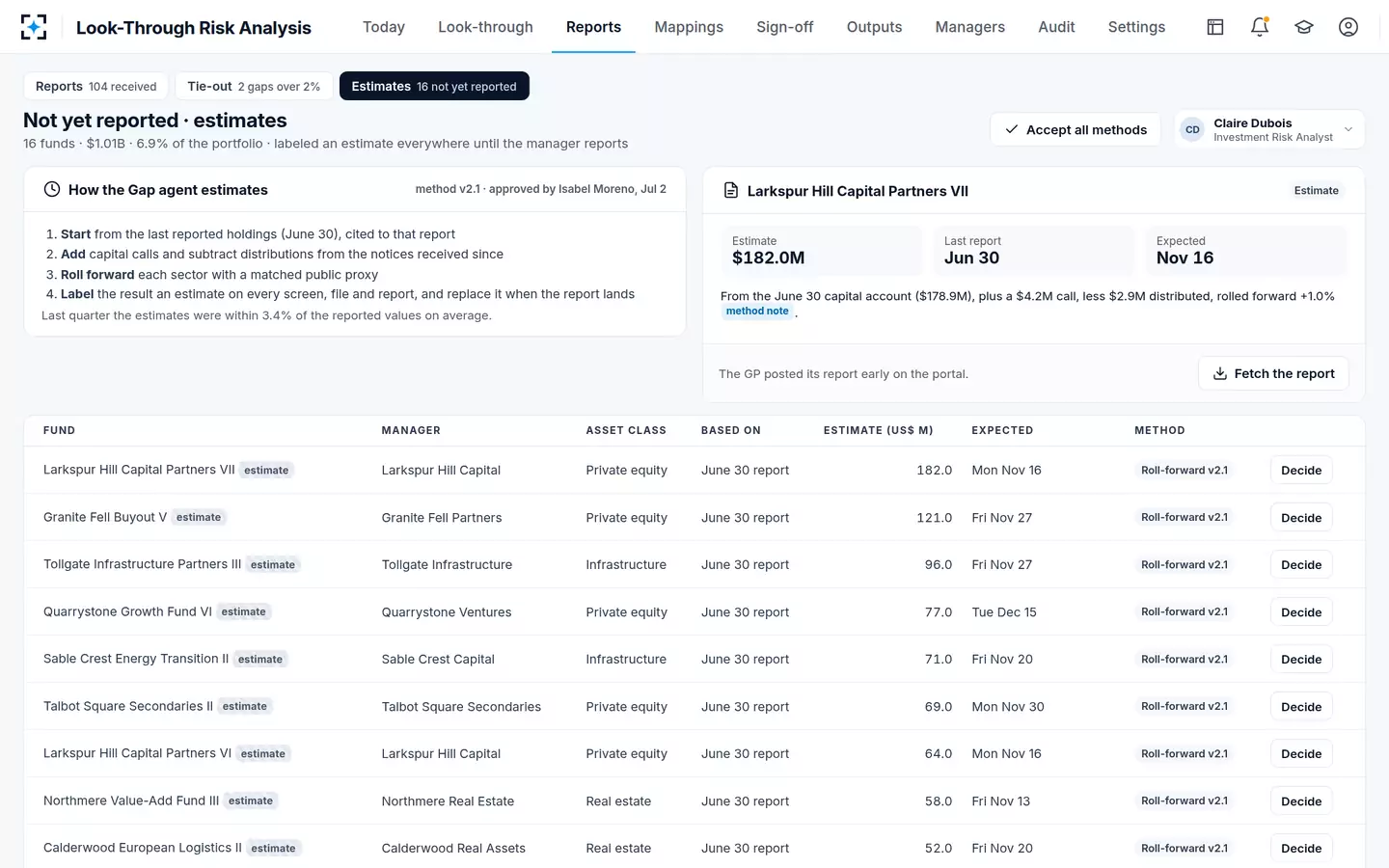
In the solution's fictional sample portfolio, 16 of 120 funds had not reported by business day 6 of the close, $1.01 billion or 6.9% of NAV, mostly private funds that report 45 to 75 days after quarter end. No public file would have helped with any of them. They are held at a labelled estimate, rolled forward from the last capital account with calls and distributions since, and replaced when the report arrives.
The share no public file covers: funds not yet reported, held at labelled estimates
Using the public files alongside Look-Through Risk Analysis
The public N-PORT files and a report-reading look-through are complements. The public files give a free, structured, regulator-collected holdings list for US registered funds; the manager's own report gives everything else, plus the NAV the investor actually owns. A sensible design uses the public data where it exists, as a cross-check on the manager's report or as the primary source for US funds, and reserves manager requests for the funds no public source reaches.
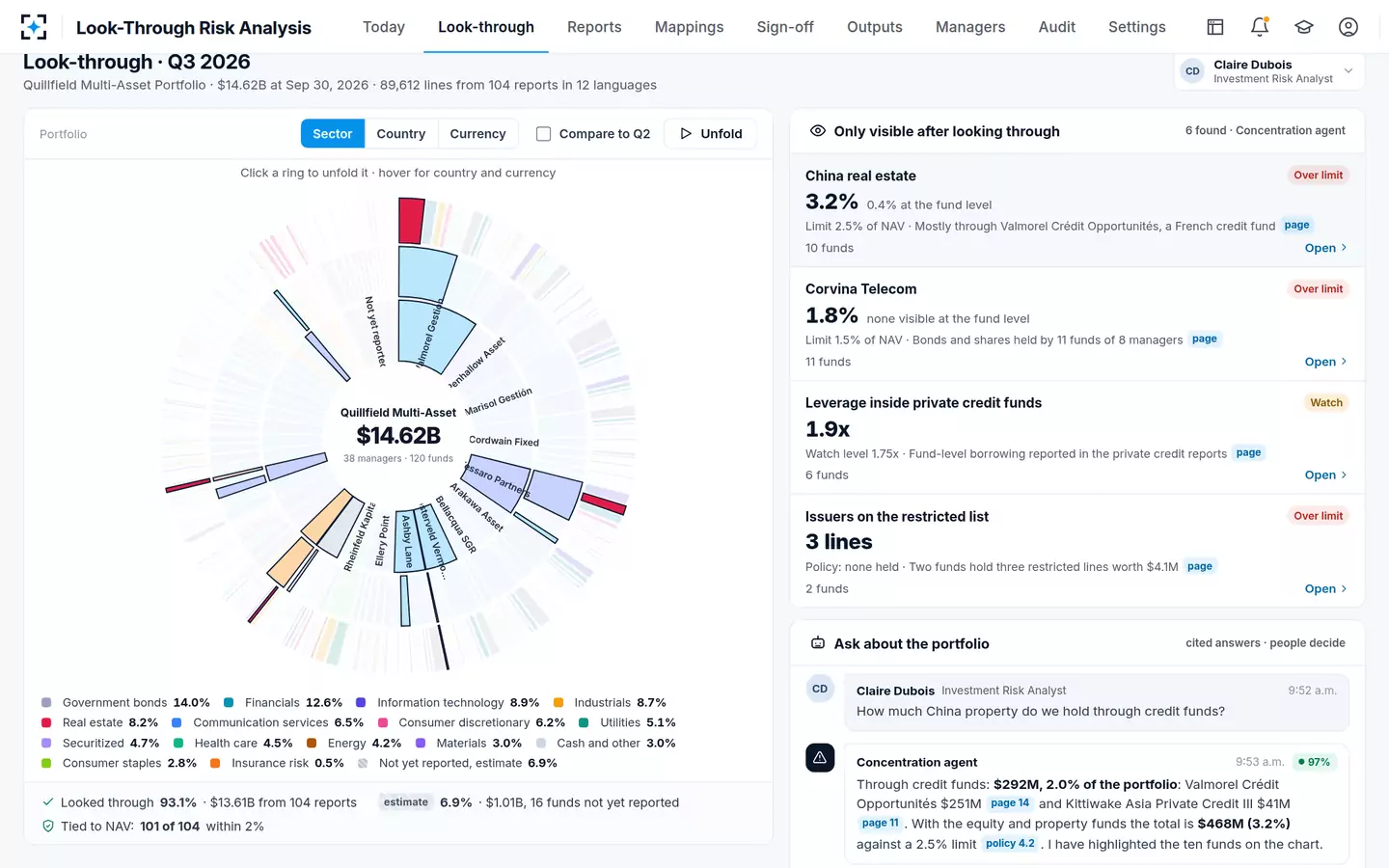
Look-Through Risk Analysis is built for the second half: it reads quarterly reports, capital account statements, holdings files and Tripartite Template files in any language, cites every line to its page, maps each line to country of risk rather than the country printed beside it, and ties each fund to the manager's NAV. Where a holdings file is already structured, it is read as one more source; where it is a scanned PDF in Portuguese, the Reader agent reads it and marks what it cannot read. The comparison of look-through approaches sets the options side by side, and which look-through regime applies explains why insurers in particular cannot stop at the fund label.
Look-Through Risk Analysis: one question across 120 funds, answered with the path and the pages
Questions people ask
Is mutual fund holdings data free to download?
Yes. The SEC's Form N-PORT data sets are free ZIP files on sec.gov, one per calendar quarter since the fourth quarter of 2019, covering US registered funds other than money market funds. The 2026 Q3 file was 440.95 MB. They contain only the information the SEC makes public.
How often is N-PORT data published?
A fund's public N-PORT report, for the third month of its fiscal quarter, becomes public when filed, within 60 days of quarter end. The SEC's flat-file data sets are updated quarterly. A 2024 rule to publish monthly has been delayed to November 2027, and a February 2026 proposal would restore quarterly publication.
Does N-PORT data show country of risk?
Not publicly. Funds report the country where each issuer is organized (Item C.5.a) and, if different, the country of risk and economic exposure (Item C.5.b), but the form lists C.5.b among the items the SEC does not intend to make public in a form identifiable to a fund.
Can I see a fund's holdings for every month?
Not from public sources. Funds report holdings for each month, but the SEC does not intend to make public the first and second months of each fiscal quarter for any identifiable fund. What is public is quarterly, as of the third month.
Does N-PORT cover money market funds and ETFs?
ETFs and closed-end funds, yes; money market funds, no. Form N-PORT is filed by registered management investment companies and ETFs organized as unit investment trusts, other than money market funds and small business investment companies.
Can I look through a private fund with public data?
No. Private funds do not file Form N-PORT, so their holdings reach an investor only through the manager's reports and capital account statements. In a US fund's N-PORT data, a private fund appears as a single line with issuer type "private fund".