Country of domicile is the country where an issuer is incorporated or registered; country of risk is the country whose economy, law and politics actually determine whether it pays, usually where it earns its revenue and holds its operating assets. The two differ most for groups that issue through offshore vehicles: a property developer registered in the Cayman Islands whose revenue all comes from mainland China is a China risk, whatever its prospectus cover says. In a fund look-through the difference decides whether a country limit breach is seen at all. Botminds' Look-Through Risk Analysis reads each manager's holdings report, maps every line to its country of risk rather than the domicile printed beside it, and sends the uncertain ones to an analyst with the evidence.
The examples on this page use a fictional sample portfolio as it runs through the solution: a $14.62 billion multi-asset portfolio invested through 38 managers and 120 funds.
Nine bonds in one French credit fund, by domicile and by country of risk
Mapped by domicile: Page 14 of the quarterly report lists nine developers’ bonds under “Îles Caïmans” and “Îles Vierges”.
Mapped by country of risk: The same nine lines, each with its issuer’s parent: listed in Hong Kong, all revenue from mainland China property sales.
Mapped by domicile: Cayman Islands and British Virgin Islands, $251.0M.
Mapped by country of risk: China, real estate, $251.0M, with the report page and the security master entry as evidence.
Mapped by domicile: 0.4% ($58.0M): only the one fund labelled as a China property fund.
Mapped by country of risk: 3.2% ($468M) across ten funds of eight managers.
Mapped by domicile: Comfortably inside. No alert.
Mapped by country of risk: Over by 0.7 points, about $102M. Escalated to the investment committee.
Mapped by domicile: Nobody: the domicile field was copied.
Mapped by country of risk: The analyst approved the mapping with a reason code; the Head of Investment Risk decided the breach.
What is country of risk, and how is it different from country of domicile?
Country of risk is the country an exposure really depends on; country of domicile is the country on the issuer's registration. No single regulation defines country of risk for every purpose, but the SEC's Form N-PORT gives the clearest working definition: funds must report "the country where the issuer is organized" and, if different, "the country of investment or issuer based on the concentrations of the risk and economic exposure of the investments" (Form N-PORT, Item C.5).
Domicile is a legal status, easy to look up and stable for years. Country of risk is a judgment, built from where the issuer sells, where its assets and staff are, where its parent is listed and which state could block its cash; currency controls of that kind can also make a US fund's holding illiquid under the SEC's 2024 guidance (the liquidity rule in 2026). Searchers also ask about country of incorporation: in practice incorporation, registration and domicile point to the same legal home, and all three can differ from the country of risk.
The distinction is not new to finance. What is new for many pension and insurance risk teams is that they now apply limits to the inside of funds, where the domicile field is usually the only country the manager's report prints.
Why does country of domicile mislead risk reports?
Domicile misleads because a large share of the world's securities is issued through vehicles registered in places where almost nothing happens economically. Research published in the Quarterly Journal of Economics puts it plainly: "Global firms finance themselves through foreign subsidiaries, often shell companies in tax havens, which obscures their true economic location in official statistics" (Coppola, Maggiori, Neiman and Schreger, NBER working paper 26855; QJE 136(3), 2021).
How much of the market a domicile view misplaces
10%
of outstanding corporate bonds worldwide issued by firms based in tax havens, 2017
8%
of global equity, the same year
$750bn
US holdings of Chinese firms once securities are traced to their ultimate parent, against $160bn in the official data
~600bnUSD
by which US national accounts understate the US position in Chinese firms
The NBER summary of the same study gives the portfolio version of the problem: "nearly 10 percent of US and eurozone foreign equity positions actually represent claims on Chinese firms, rather than the 2 percent in the official data" (NBER Digest). An investor who builds its country exposures from domicile is using the official-statistics picture, not the economic one. Inside funds the error compounds, because each fund report adds its own country convention and the investor sees only the sum.
The SEC collects both countries, and publishes only one
US registered funds already report both countries for every holding, but only the domicile-like one is public. Item C.5.a of Form N-PORT asks for the country "where the issuer is organized"; Item C.5.b asks for the country of risk where it differs. The form's public-availability instruction lists "country of risk and economic exposure (Item C.5.b)" among the items the SEC does not intend to make public in a form identifiable to a fund (Form N-PORT, General Instruction F).
The SEC's own staff statistics show what that difference amounts to. Table 6.1 of the Registered Fund Statistics aggregates US funds' holdings by country of organization; Table 6.2 aggregates the same holdings by country of risk. In March 2026 the Cayman Islands was one of the ten largest countries in the first table and absent from the top ten in the second; China and Taiwan were in the top ten by risk and absent from the top ten by organization (SEC Division of Investment Management, Registered Fund Statistics, March 2026).
US mutual funds, March 2026: the same holdings by country of organization and by country of risk
For an investor who looks through US funds using the public N-PORT data sets, this is the trap: the country column in the public file is the country of organization. It is a good start for identifiers and weights, as downloading mutual fund holdings data explains, but every Cayman, Bermuda, BVI or Luxembourg issuer in it needs its country of risk set again.
Solvency II reports a third country, and the CIC code a fourth
European insurers meet yet another definition in their supervisory reporting. For the list of assets and for the look-through template S.06.03, "The localisation of the issuer is assessed by the address of the entity issuing the asset", which for an offshore issuer is the offshore address (Implementing Regulation (EU) 2023/894, Annex II). The first two characters of the Complementary Identification Code are different again: they give the country "where the asset is listed in", or XL for an asset not listed and XT for one not exchange-tradable.
None of these is wrong; each answers a different question. The mistake is to let one field answer all of them. EIOPA's own analysis of insurers' fund holdings shows how much depends on the choice: looked through, the analysis "captures the country of issuance of the underlying asset (and not the country of the fund management", and even then "for some asset classes within CIUs the issuer country is not reported" (EIOPA, Financial Stability Report, December 2025).
Four countries for one bond, and the question each one answers
| Field | Where it is defined | What it captures | For a Cayman-registered developer of China property |
|---|---|---|---|
| Country of organization | Form N-PORT, Item C.5.a (public) | Where the issuer is organized | Cayman Islands |
| Country of risk | Form N-PORT, Item C.5.b (not public); your investment policy | Where the risk and economic exposure are concentrated | China |
| Issuer country | Solvency II templates S.06.02 and S.06.03 | The address of the entity issuing the asset | Cayman Islands |
| CIC, first two characters | Solvency II CIC table (Annex VI) | Where the asset is listed, or XL / XT | The listing venue used for valuation, or XL if unlisted |
The practical rule follows: keep all four, and use each for its job. Country of risk drives limits, stress tests and committee papers; the issuer address and CIC drive the Solvency II templates; the organization field drives legal and sanctions questions. A look-through system that stores only one country forces someone to choose which report will be wrong.
How is country of risk determined? A five-step hierarchy
Country of risk is set by following the issuer's economics until they point to one country, and noting which test settled it. The order below is the one we suggest for a fund look-through; it puts the evidence a manager's report and a security master usually hold first, and the judgment calls last.
Setting country of risk for one issuer, in order
- 1. Find the ultimate parent
Follow the issuing vehicle to its group. Solvency II already asks for the "Issuer Group", the "ultimate parent entity", on every line of the list of assets.
- 2. Where does the group earn its revenue?
If one country carries most of it, that is usually the answer. The sample developers earn all of theirs from mainland China property sales.
- 3. Where are the operating assets and the cash?
For property, infrastructure and loans, the location of the collateral can outweigh the revenue split.
- 4. Where is the parent listed and supervised?
A Hong Kong listing with mainland revenue points to China; a New York listing with global revenue may not point anywhere but the head office.
- 5. Who guarantees the bond?
An explicit guarantee from a parent in another country can move the risk to the guarantor’s country.
Two cases need a rule written down in advance. Supranational and multi-country issuers rarely have one country of risk; most policies map them to a separate bucket. And holdings with no issuer country at all, such as property, cash or alternative assets inside a fund, are where EIOPA found the most "not-assigned" data; a look-through should show them as unassigned rather than spread them across countries pro rata.
How do you map a Cayman holding company? One sample bond, end to end
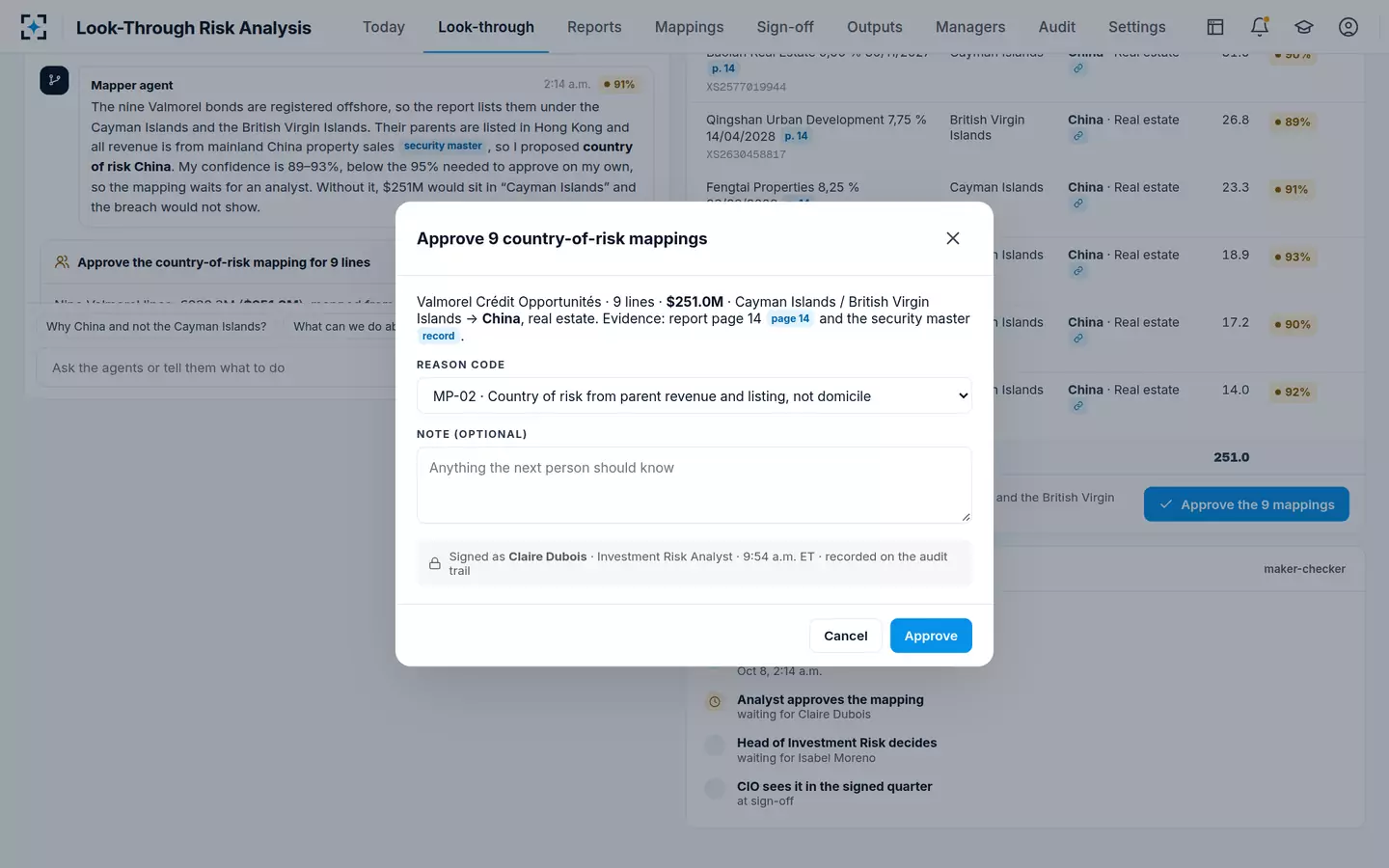
Take the first of the nine sample bonds. The French manager's quarterly report lists "Huaxin Property Group 7,25 % 15/03/2028" under "Îles Caïmans" at €41.2 million, 6.05% of the fund. The Reader agent extracts the line, keeps the French beside its English reading and cites page 14. The Mapper agent resolves the identifier against the security master, finds the parent listed in Hong Kong with all its revenue from mainland China property, notes that the data vendor agrees, and proposes country of risk China, sector real estate, $44.9 million at the portfolio's share.
Its confidence is 91%. The Mapper approves on its own only at 95% or more and $25 million or less a line, so this line, like the other eight, waits for a person. The analyst reads the evidence, approves all nine with reason code MP-02 (country of risk from parent revenue and listing, not domicile) and signs. Seconds later the limit test runs again.
In Look-Through Risk Analysis, approving country of risk China for nine Cayman and BVI bonds
Where the domicile view breaks a limit only after looking through
A country limit set in an investment policy is meaningless if the country comes from the domicile field. In the sample portfolio, China real estate at fund level is 0.4%, the one fund whose name says so. Looked through and mapped by country of risk, it is 3.2%, reached through ten funds of eight managers: a French credit fund ($251M), an Asia ex-Japan equity fund ($96M), the one China real estate fund ($58M), an Asian private credit fund ($41M) and six smaller positions in China, Asia, global and emerging-market funds.
China real estate: 0.4% at the fund level, 3.2% looked through, against a 2.5% limit
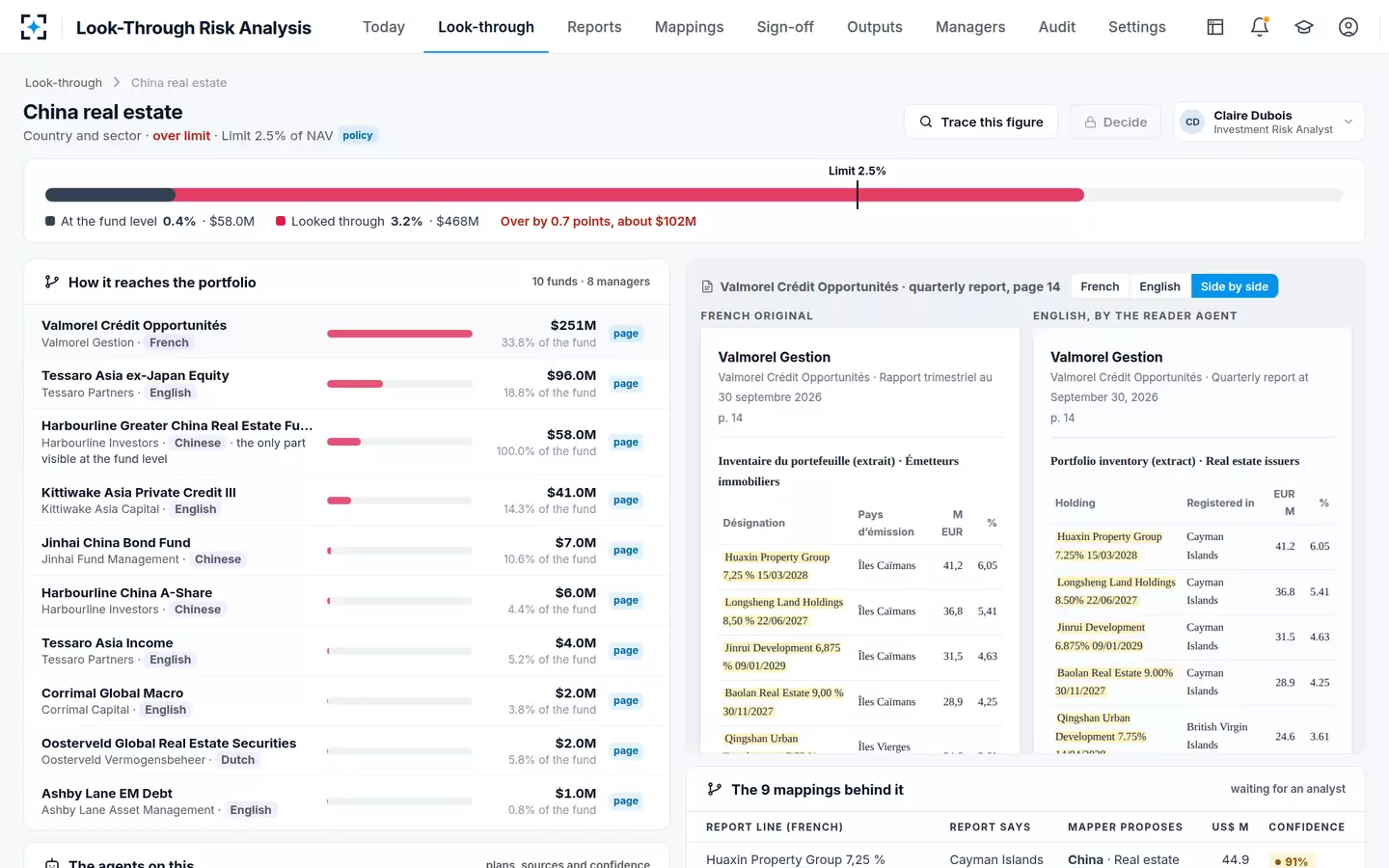
This is the general shape of the problem, not a quirk of one fund. Concentration that sits under every manager's own limits and over the investor's is what the look-through exists to find, and the issuer no single manager sees works the same arithmetic for a single company held across eleven funds.
How Look-Through Risk Analysis sets country of risk, and who decides
In the solution, the rule "never maps by domicile alone" is written into the Mapper agent's limits, not left to habit. Every line gets a proposed identifier, issuer, sector, country of risk and currency, with the evidence behind it: the report page, the security master entry, the data vendor's view where there is one. Where the report's country and the proposed country of risk differ, the line is flagged, and below 95% confidence or above $25 million it goes to an analyst with the reason it was flagged.
The analyst decides, with a reason code; the Head of Investment Risk decides any breach the decision reveals; and both decisions are logged with the evidence on the audit trail. The Mapper agent's full set of decisions, line by line, is the subject of its own guide. The insurer's regulatory files still carry the issuer address and CIC the templates ask for; the country of risk feeds the limits, the committee papers and the risk engine.
Questions people ask
What is country of risk?
Country of risk is the country whose economy, law and politics an exposure really depends on, usually where the issuer earns its revenue and holds its operating assets. The SEC's Form N-PORT describes it as the country "based on the concentrations of the risk and economic exposure of the investments". It can differ from the country where the issuer is registered.
Country of incorporation vs country of risk: which should a risk report use?
Risk limits, stress tests and concentration reports should use country of risk, because that is where losses would come from. Country of incorporation remains the right field for legal, tax and sanctions questions, and Solvency II's asset templates ask for the issuer's address. Keep both and label which one each report uses.
Is the Cayman Islands a country of risk?
Rarely for operating companies. In March 2026 issuers organized in the Cayman Islands accounted for $215 billion of US mutual funds' holdings, according to SEC staff statistics, yet the Cayman Islands did not appear among the ten largest countries of risk. Research tracing securities to their ultimate parents finds such issuers are often shell companies financing groups based elsewhere.
Does public N-PORT data include country of risk?
No. The public data sets carry the country where each issuer is organized (Item C.5.a). Country of risk (Item C.5.b) is collected by the SEC but listed in the form's instructions among the items it does not intend to make public in a form identifiable to any fund.
Which country does Solvency II's S.06.03 template use?
The country of issue in S.06.03 is the issuer's localisation, which the reporting regulation says "is assessed by the address of the entity issuing the asset". It is a reporting field, not a risk view, so an insurer typically needs country of risk in addition for its own limits.
How do you map an issuer with no clear single country?
Write a rule before you need it. Supranational issuers and genuinely global groups usually go to a separate bucket or to the head-office country, and assets with no issuer country, such as property, cash or alternatives inside a fund, should be shown as unassigned rather than spread pro rata.