The Tripartite Template, or TPT, is an industry-agreed spreadsheet format in which an asset manager lists a fund's holdings line by line, with the classifications an insurer needs to report and calculate Solvency II capital on a look-through basis. It is a convention, not a rule: no regulation requires a manager to send one, while Solvency II does require the insurer to look through and to report the result in templates such as S.06.03. When the file is complete, the insurer's work is checking and loading it; when it is missing or partial, every field has to be rebuilt from the manager's own report. Botminds' Look-Through Risk Analysis reads those reports to their holdings, drafts the insurer's TPT file and S.06.03 support from the signed look-through, and validates them before a person releases them.
The examples use a fictional sample multi-manager portfolio that reports to two insurance clients, one under Solvency II and one under Solvency UK.
The fields an insurer needs from a fund, mapped to the rule that asks and the page that holds them
| Field the insurer needs | Why: the rule that asks for it | Where it is when no TPT arrives |
|---|---|---|
| Fund identifier and the insurer’s holding | S.06.02 list of assets (Asset ID Code, Quantity, Total Solvency II amount) | The fund’s report cover and the insurer’s own custody or transfer agent statement |
| Each underlying line, with ISIN or other code | Article 84(1): the SCR on "each of the underlying assets" | Schedule of investments or portfolio inventory, usually an appendix |
| Underlying asset category | S.06.03 column C0030, a closed list from government bonds (1) to liabilities (L) | Instrument description and the section heading it sits under |
| Issuer country | S.06.03 column C0040: the issuer’s address | The report’s country column, or the issuer’s registered address; often not printed for property and cash |
| Currency | S.06.03 column C0050: reporting or foreign currency | Currency column of the schedule, or the security’s terms |
| Total amount | S.06.03 column C0060, scaled to the insurer’s share | Market value column, times the insurer’s share of the fund’s NAV |
| CIC code | S.06.02 and the look-through: listing country, category and sub-category | Built from the instrument type and its listing; rarely in the report itself |
| Issuer, issuer group and sector | S.06.02: issuer, ultimate parent and NACE sector | Security master and data vendor, matched on the identifier or the issuer’s name |
| Duration, rating and maturity | Spread and interest rate sub-modules (Article 176 and following) | Bond schedule columns (coupon, maturity), ratings from the security master |
| Fund-level borrowing and derivatives | Interest rate and currency risk; S.06.03 category L and A to F | Balance sheet and notes on borrowings and derivatives |
What is the Tripartite Template (TPT), and what is it not?
The TPT's value is that every manager who sends one fills the same columns in the same order, so an insurer holding dozens of funds can load them the same way. Its limit is that it is voluntary, and its quality is the manager's.
Three misunderstandings are common. The TPT is not a regulatory template: the supervisor never sees it, only what the insurer reports from it. It is not proof of a look-through: a file with a CIC code on every line can still carry the issuer's address where the insurer's risk policy needs its country of risk. And it does not move the obligation: Article 84 of Delegated Regulation (EU) 2015/35 puts the look-through on the insurer, which is why an insurer that cannot get a usable file still has to find the data, or fall back to the target allocation, or take the type 2 equity charge described in which look-through regime applies.
Which Solvency II obligations does a TPT feed?
A TPT exists to feed three things the insurer owes its supervisor: the capital calculation, the list of assets, and the look-through template. The capital calculation needs each underlying line classified for the market risk sub-modules. The list of assets, S.06.02, reports each fund once and says how the fund was treated in the SCR. The look-through template, S.06.03, reports the fund's contents by category, country and currency.
The fund-level treatment field is worth knowing because it tells the supervisor, fund by fund, whether the insurer actually looked through. Item C0292 of S.06.02, "SCR calculation approach for CIU", takes one of a closed list: "1 - CIUs for which a full look-through was applied for the purposes of SCR calculation in accordance with Article 84(1) of Delegated Regulation (EU) 2015/35", 2 and 3 for the simplified target-allocation approach with or without data groupings, and "4 - CIUs for which for the ‘equity risk type 2’ was applied" (Implementing Regulation (EU) 2023/894). A TPT that arrives late or incomplete turns a 1 into a 2, 3 or 4.
What is S.06.03? The look-through template, rule by rule
S.06.03, "Collective investment undertakings – look–through approach", is the Solvency II template that reports what sits inside an insurer's funds, aggregated by underlying asset category, issuer country and currency. Its general comments set four rules a TPT has to make possible.
The S.06.03 thresholds a fund file has to support
100%
of the value invested in funds must be reported in the template
90%
of fund value (minus CIC 8 and 9) identified by country before the look-through may stop
90%
of fund value identified by currency
30%
share of investments in funds above which S.06.03 is due every quarter, not only annually
The template "shall include information corresponding to 100 % of the value invested in collective investment undertakings", but the depth of identification is proportionate: "for the identification of countries the look–through shall be implemented in order to identify the exposures of 90 % of the total value of the funds minus the amounts relating to CIC 8 and 9", and similarly 90% for currencies. The order is fixed too: insurers start "from the major, considering the amount invested, to the lowest single fund and the approach shall be kept consistent over time". Funds of funds are not an exception: "In case of funds of funds the look–through shall follow the same approach", and the fund category "shall be used only for non–material residual values".
The frequency may change. In its final report of 30 March 2026 on the Solvency II reporting standards, EIOPA proposed that "undertakings and groups will not be required to report S.06.03 in Q1 and Q3 but only in Q2 and Q4", acknowledging that the template's "preparation requires a very large volume of data and entails significant effort (due to the very high level of detail per ISIN)" (EIOPA final report on supervisory reporting, March 2026). The draft goes to the European Commission, which "will decide on their endorsement"; EIOPA's view is that new templates would apply from the first quarter of 2027. Until then, the current quarterly rule stands.
The fields that matter for the SCR, and where each one comes from
For capital, the fields that move the number are the ones that decide which sub-module a line falls into and how hard it is shocked: asset category, listing (for type 1 or type 2 equity), credit quality step and modified duration (for spread risk), currency (for currency risk), and the issuer group (for concentration risk). A TPT that carries them saves the insurer a lookup; a TPT that omits them sends the insurer to the security master, line by line.
Two items are easy to lose. The first is fund-level borrowing. EIOPA's answer on leveraged alternative investment funds is explicit: "It has to be emphasised that there is no capital requirement for the AIF", instead the investments go to the relevant sub-modules and "The debt has to be included in the calculation of the capital requirement for interest rate risk and potentially the currency risk" (EIOPA Q&A 1212). A file that lists only the assets of a leveraged fund understates both the exposure and the interest rate position. The second is the issuer group: Solvency II's concentration sub-module treats every company in one corporate group as a single name (the hidden issuer), so an issuer captured without its parent cannot be aggregated.
What is a CIC code, and why is its country not a country of risk?
The Complementary Identification Code is the four-character classification Solvency II uses for every asset: two characters for where the asset is listed, one for the category and one for the sub-category or main risk. The first two characters "Identify the ISO 3166-1-alpha-2 country code where the asset is listed in", or XV, XL or XT for assets listed with a non-exchange price provider, not listed, or not exchange-tradable (Annex VI). The category runs from 1 (government bonds) through 9 (property) and 0 (other investments), with 4 for funds and letters A to F for derivatives; the fourth character refines it, such as 41 for equity funds and 42 for debt funds.
The reporting regulation adds one instruction that matters for look-through files: "When classifying an asset using the CIC table, undertakings shall take into consideration the most representative risk to which the asset is exposed to." A convertible, a structured note or a fund share is classified by its main risk, not its legal form. The CIC's country, on the other hand, is a listing venue. A Hong Kong-listed developer's bond issued from the Cayman Islands can carry a CIC beginning XL, an S.06.03 issuer country of KY and a country of risk of China, all correctly; country of risk versus country of domicile explains why the risk view needs its own field.
What if a manager does not send a TPT?
If a manager sends no TPT, the insurer, or the investment manager acting for it, has to rebuild each field from the manager's own documents, and the order of work is the same as for a TPT: holdings first, then classification, then a tie-out to the NAV. The manager's quarterly report or capital account statement usually holds the schedule of investments; the notes hold borrowings and derivatives; the cover page and statement hold the investor's share.
How Look-Through Risk Analysis rebuilds a fund file from the manager's report
Agent
Read the reportExtract every holding, the NAV, cash and borrowing, in the report’s own language, each value cited to its page.
Never: guess an unreadable value
Agent
Map each lineIdentifier, issuer and group, sector, country of risk, issuer country and currency, against the security master.
Never: map by domicile alone
Agent
Tie out to the NAVSum the holdings for the insurer’s share and explain any gap from the report: cash, receivables, accruals, par versus fair value.
Never: close a gap itself
Agent
Draft the client fileTPT lines with CIC codes, S.06.03 support by category, country and currency, estimates labelled.
A person decides
Validate and prepareRegulatory reporting checks the file against the client’s rules and prepares it.
A person decides
ReleaseA second person approves the release to the insurer.
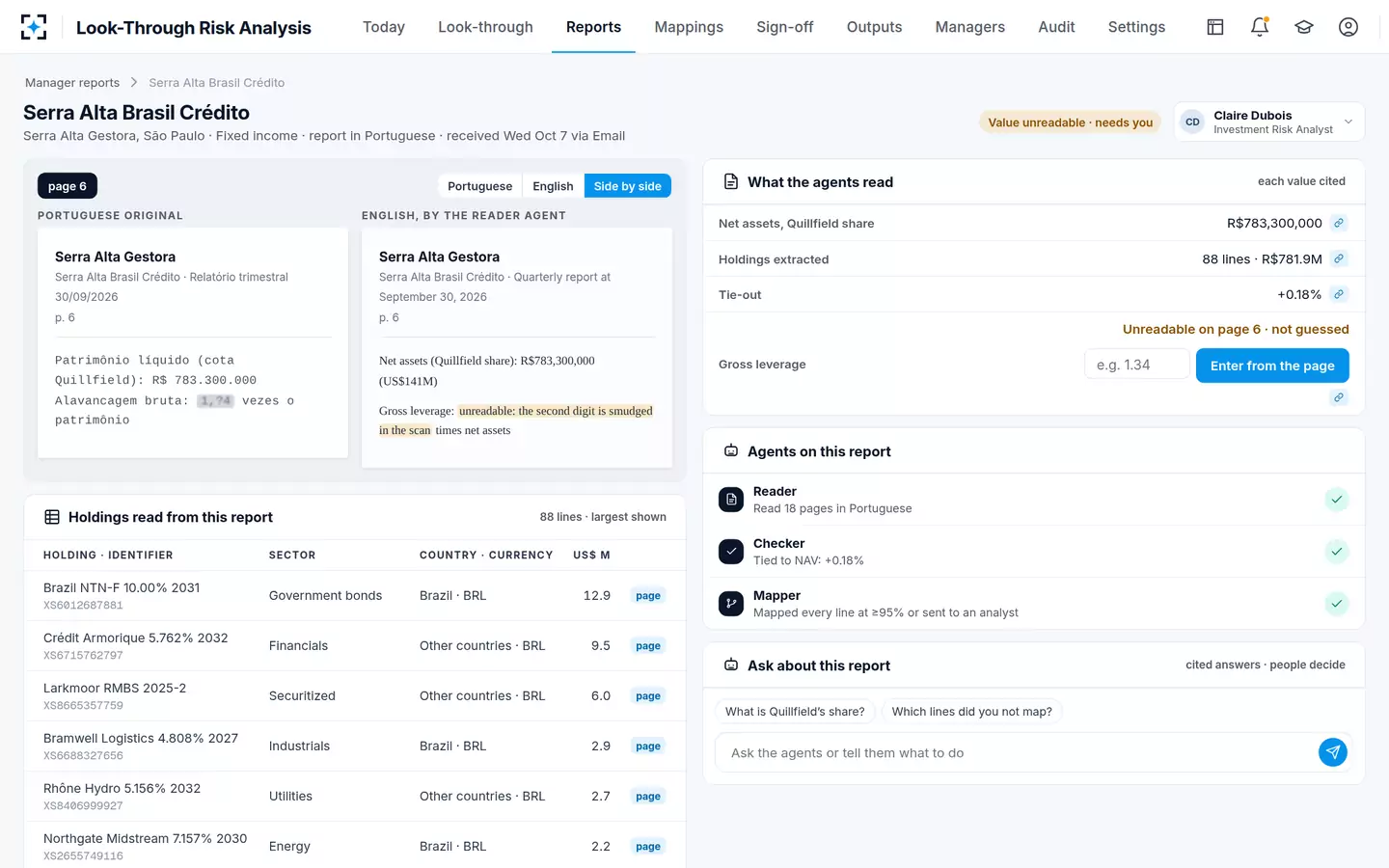
The hard cases are the ones a TPT would also have struggled with: scanned reports, reports in another language, private companies with no public identifier, and holdings listed at par where the NAV uses fair value. In the sample quarter, a Brazilian credit manager sent a scanned Portuguese report; the Reader agent read 88 lines and tied them to the NAV within 0.18%, but marked the fund's gross leverage on page 6 unreadable instead of guessing it, and an analyst entered it from the page with a reason code.
A scanned Portuguese report, read line by line, with one value marked unreadable
When the TPT is partial: fund-level debt, private assets and the residual
A partial TPT is more dangerous than a missing one, because it looks complete. Before loading any manager file, check four things against the manager's own report. Does the sum of the lines tie to the NAV for the insurer's share, within your tolerance? Is fund-level borrowing reported as a liability rather than netted away? Are private loans and unlisted equity carried with a category, a country and a currency, or parked in "other"? And is the residual in the fund category genuinely non-material, as S.06.03 requires?
Where a fund has not reported at all by the deadline, the honest answer is an estimate that says it is one. In the sample portfolio, 16 funds holding 6.9% of NAV, mostly private funds that report 45 to 75 days after quarter end, are carried at a roll-forward of their last report, labelled as an estimate on every screen and in every client file; in the sample Solvency II file the largest one appears as a single fund line marked “estimate”, not as invented holdings. The replay method in testing look-through reporting against a signed quarter checks each estimate once the real report arrives.
Checking a Tripartite Template file before it reaches the insurer
A TPT file sent to an insurer should pass the same checks whether the manager or the investor built it. The list below combines the validation the solution runs on every client file with the S.06.03 rules quoted above; each item prevents a mistake that would make the insurer's report wrong.
Validate a Tripartite Template file before release
- A CIC code on every line
Classified by the most representative risk, with a listing country, XL or XT.
- Identifiers that are valid
ISIN check digits pass; lines without a public identifier carry a consistent internal code.
- Holdings sum to the client’s share of NAV
Within tolerance, with the difference explained from the report.
- S.06.03 categories complete
Every line has an underlying asset category from the closed list; the fund category only for non-material residuals.
- Country and currency coverage
90% of value identified by country (excluding CIC 8 and 9) and by currency, unidentified remainder diversified.
- Estimates labelled
Funds not yet reported carried as estimates, flagged in the file, never presented as reported.
A Solvency II client file drafted by Look-Through Risk Analysis, with its validation
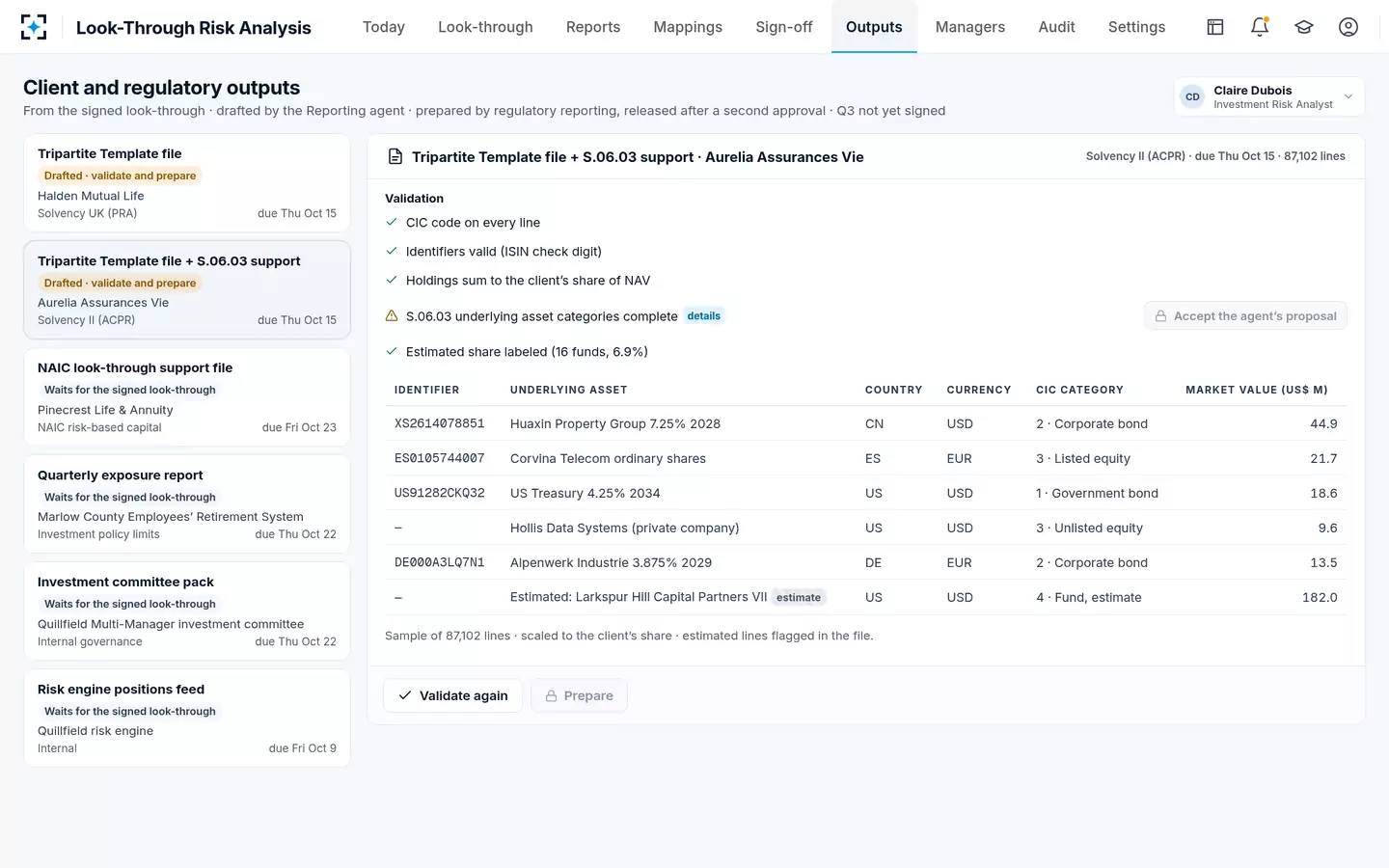
One warning in the sample file is worth reading: the S.06.03 category check is amber, with the agent's proposed fix waiting for a person to accept it. That is the design throughout. The agents draft and validate; the regulatory reporting manager decides what goes to the client, and a second person releases it.
Questions people ask
What is the TPT in Solvency II?
The Tripartite Template is an industry file format that asset managers use to send insurers a fund's holdings with the classifications Solvency II needs, such as CIC codes, categories, countries and currencies. It is not itself a Solvency II template; insurers use it to produce their own reports, including S.06.02 and the look-through template S.06.03, and to calculate the SCR.
Is a manager obliged to send a Tripartite Template?
Not under Solvency II, which places the look-through obligation on the insurer in Article 84 of Delegated Regulation 2015/35. Whether a manager sends a TPT depends on the agreement between them. Without it, the insurer rebuilds the data from the manager's reports, uses the target-allocation fallback where its conditions are met, or charges the fund as type 2 equity.
What is the difference between S.06.02 and S.06.03?
S.06.02 is the line-by-line list of the insurer's own assets, where each fund appears once with its CIC and, in item C0292, the SCR approach applied to it. S.06.03 reports what is inside those funds, aggregated by underlying asset category, issuer country and currency, covering 100% of the value invested in funds.
When does S.06.03 have to be reported quarterly?
Under the current reporting regulation, quarterly reporting applies when the ratio of collective investments to total investments is higher than 30%; otherwise the template is reported annually. EIOPA's March 2026 draft would limit quarterly reporting to the second and fourth quarters from 2027, subject to the European Commission's endorsement.
Which TPT fields matter most for the SCR?
The fields that decide the sub-module and the shock: underlying asset category, listing (type 1 or type 2 equity), credit quality step and modified duration for spread risk, currency for currency risk, and the issuer group for concentration risk. Fund-level borrowing matters too, because EIOPA requires it in the interest rate risk calculation.
What does "XL" mean in a CIC code?
The first two characters of a CIC give where the asset is listed. XL marks "Assets that are not listed in a stock exchange", XT assets that by their nature are not exchange-tradable, and XV assets listed in one or more countries but valued with a price provider that is not one of those venues.