Exposure analysis tools measure how much of a portfolio depends on one issuer, sector, country or currency, so the investor can hold each exposure against a limit. For an investor that holds funds, the decisive question is where the tool stops. A tool that classifies each fund once, by its label or mandate, sees a credit fund, an Asia equity fund and a global macro fund; it cannot see that the same telecom company sits in eleven of them. Each manager is within its own limits, and the investor is over its own. Botminds' Look-Through Risk Analysis reads every manager's report to its holdings, maps each line to its issuer and ultimate parent, and tests the investor's limits on the sum, with the path through funds and the report pages behind it.
The examples are from the solution's fictional sample portfolio: $14.62 billion invested through 38 external managers and 120 funds for pension and insurance clients, third quarter 2026.
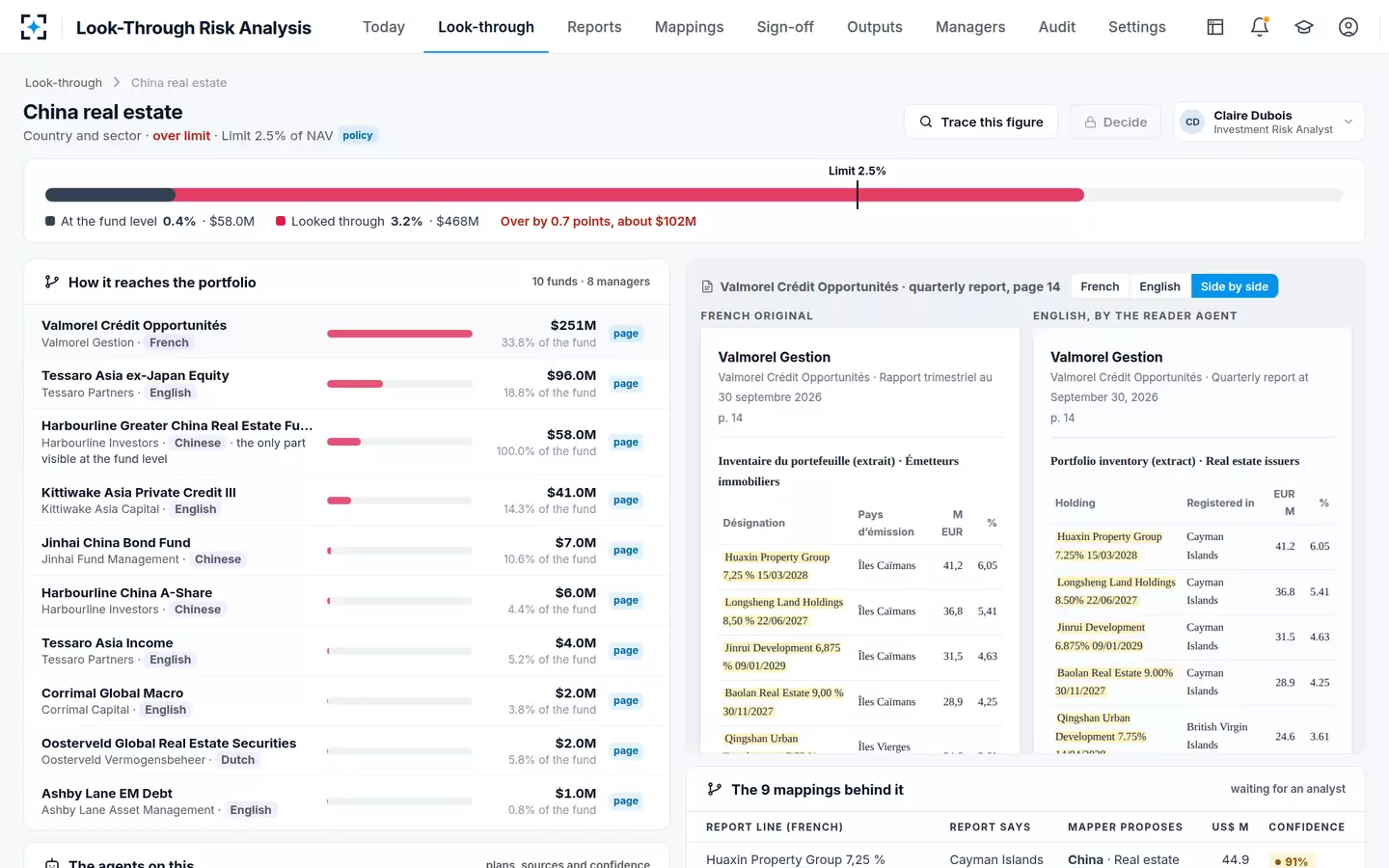
China real estate in the sample portfolio: $468M across ten funds, of which the fund-level view sees $58M
What is exposure analysis when you invest through managers?
Exposure analysis, for an investor that holds funds, is the measurement of what the investor depends on once every fund is replaced by its holdings. It answers questions a fund list cannot: how much of the portfolio rests on one issuer and its group, on one country's property market, on one currency, on leverage taken inside private credit funds. People search for the term from many fields, from audit to insurance; in investment risk it means the total portfolio exposure, measured through the funds.
The fund-level version, which classifies each fund by its mandate, is not wrong; it answers a different question, about allocation. It cannot answer concentration questions, because concentration is a property of what is inside the funds, and the inside is where the same names recur.
Why every manager can be inside its limit while you are not
Every manager tests its own fund against its own limits, and none of them can see the other funds an investor holds. A telecom bond at 2% of one credit fund, 1% of an equity fund and 0.5% of a multi-asset fund is unremarkable in each; across eleven funds it can be the investor's largest single-name exposure.
Fund rules do not close the gap and sometimes widen it. A UCITS that invests in other funds may, where its Member State allows, treat the underlying funds' assets as "not required to be combined for the purposes of the limits laid down in Article 52", the issuer diversification limits (Directive 2009/65/EC, Article 55). A UCITS fund of funds can therefore be compliant while the same issuer sits in several of its underlying funds. The investor that holds it, and other funds besides, is the only party placed to add it all up, as which look-through regime applies sets out regime by regime.
What is issuer concentration across funds? One telecom, eleven funds
Issuer concentration across funds is the investor's total exposure to one issuer and its group, summed over every fund that holds its bonds or shares. In the sample quarter, the Concentration agent's overnight run flagged Corvina Telecom, a fictional issuer: 1.8% of the portfolio, $264 million, through bonds and shares held by 11 funds of 8 managers, against a single-issuer limit of 1.5%. At fund level it was 0.0%: no fund is a Corvina fund.
The hidden issuer in the sample portfolio
1.8%
of the portfolio in one telecom issuer, looked through ($264M)
0.0%
visible at fund level
1.5%
the investor’s single-issuer limit
11
funds of 8 managers holding its bonds and shares
How much of each over-limit exposure a fund-level tool would show
China real estate, $468M looked through
- Visible at fund level · 12.4%
- Only visible after looking through · 87.6%
Corvina Telecom, $264M looked through
- Only visible after looking through (0% at fund level) · 100%
How do you find concentration across managers?
You find it by doing three things in order: look through every fund to its lines, map each line to an issuer and its ultimate parent, and add the lines up across all funds before testing any limit. Skip the first and the issuer is invisible; skip the second and its bonds and shares fall into different buckets; skip the third and each fund's slice looks small.
For insurers the regulation already prescribes this. Solvency II's market risk concentration sub-module is "calculated on the basis of single name exposures. For this purpose exposures to undertakings which belong to the same corporate group shall be treated as a single name exposure" (Delegated Regulation 2015/35, Article 182(1)), and the investments inside a fund go into it: EIOPA's answer on leveraged alternative investment funds lists "market risk concentration" among the sub-modules that take the fund's holdings (EIOPA Q&A 1212). The concentration charge starts above a relative threshold of 3% of the calculation base for single names rated at credit quality steps 0 to 2, and 1.5% for steps 3 to 6 (Article 185).
How do you aggregate exposures across managers? Ultimate parent first
Aggregate by ultimate parent, not by issuing entity, and include every instrument: bonds, loans, shares and derivatives referencing the name. Groups issue through many vehicles; a property group may issue from Cayman, BVI and Hong Kong subsidiaries, and a telecom group's bonds and its listed shares are the same credit. A tool that aggregates by issuing entity will show several small exposures where there is one large one.
The harder case is the line nobody can identify. EIOPA's guideline on data groupings is blunt about what an insurer must assume when a fund's single-name holdings are only known in groups: "undertakings should assume that all assets for which the actual single name exposure is not identified belong to the same single name exposure", and "Undertakings should aggregate exposures to groups referred to in paragraph 1.16 across all collective funds in which they are invested" (EIOPA Guidelines on look-through approach, Guideline 5). The prudent default, in other words, treats what you cannot see as concentrated. Full look-through is how an investor earns the right not to.
Fund-level exposure analysis against a looked-through one, on the same portfolio
Fund-level tool: The fund, classified once by mandate or label.
Looked-through, by ultimate parent: Every line inside every fund, scaled to the investor’s share.
Fund-level tool: Only issuers held directly.
Looked-through, by ultimate parent: Every issuer and its group, summed across all funds and instruments.
Fund-level tool: The fund’s domicile or regional label.
Looked-through, by ultimate parent: Each line’s country of risk, with evidence.
Fund-level tool: Classified as before.
Looked-through, by ultimate parent: Held at a labelled estimate until the report arrives.
Fund-level tool: Not possible: the breach is not visible.
Looked-through, by ultimate parent: The path through funds and managers, and the report pages behind each line.
Fund-level tool: China real estate 0.4%; Corvina Telecom 0.0%; no breach.
Looked-through, by ultimate parent: China real estate 3.2% against 2.5%; Corvina Telecom 1.8% against 1.5%.
What is a look-through limit, and what is fund of funds risk?
A look-through limit is an investment policy limit measured on the investor's holdings after looking through every fund, rather than on the funds themselves. The sample firm's policy sets a 2.5% look-through limit for any country and sector and 1.5% for any single issuer, and a 1.75x watch level for leverage inside private credit funds; all three can only be tested on looked-through data. In the sample quarter the leverage watch flagged private credit funds running at 1.9x, which no fund-level view would show either.
Fund of funds risk is the general name for what this page describes: the risks an investor takes on through layers of funds that no single layer measures. Concentration across managers is the most common; leverage stacked inside funds, overlapping fees and delayed information are the others. EIOPA's guidelines ask insurers to keep looking through, fund inside fund, until all material risk is captured, which is the regulatory way of saying that each layer has to be opened.
What exposure analysis tools must do to find the hidden issuer
To find an issuer no manager sees, an exposure analysis tool needs data no manager sends it in one place. The checklist below separates tools that can from tools that cannot.
What an exposure analysis tool must do to see across managers
- Look through every fund, including the ones with no file
PDF reports, capital account statements and foreign-language reports, not only structured feeds.
- Map to the ultimate parent
Bonds, loans and shares of one group in one bucket, whatever vehicle issued them.
- Set country of risk, not domicile
Otherwise offshore issuers move country exposure to the Cayman Islands.
- Add up before testing
Limits tested on the sum across all funds, not fund by fund.
- Show the path
Which funds, which managers, which report pages make up each exposure.
- Compare with the fund-level view
So the committee sees what looking through added.
- Keep estimates labelled
An unreported fund carried at a stated estimate, not dropped or copied.
- Leave the decision to a person
The tool finds and explains; the Head of Investment Risk decides what to do.
Look-Through Risk Analysis: the exposure, the path through ten funds, and the page that changed it
Deciding a breach that only exists after looking through
A breach found by looking through is still a breach, and it needs the same governance as any other: a decision by someone with the authority, a reason, and a trace on the audit trail. In the solution the Concentration agent finds and explains it; it never changes a limit or trades. The Head of Investment Risk chooses among escalating to the investment committee, asking manager research to engage the manager, putting it on watch, or accepting it within tolerance, with a reason code and a required note.
In Look-Through Risk Analysis, the Head of Investment Risk decides and signs
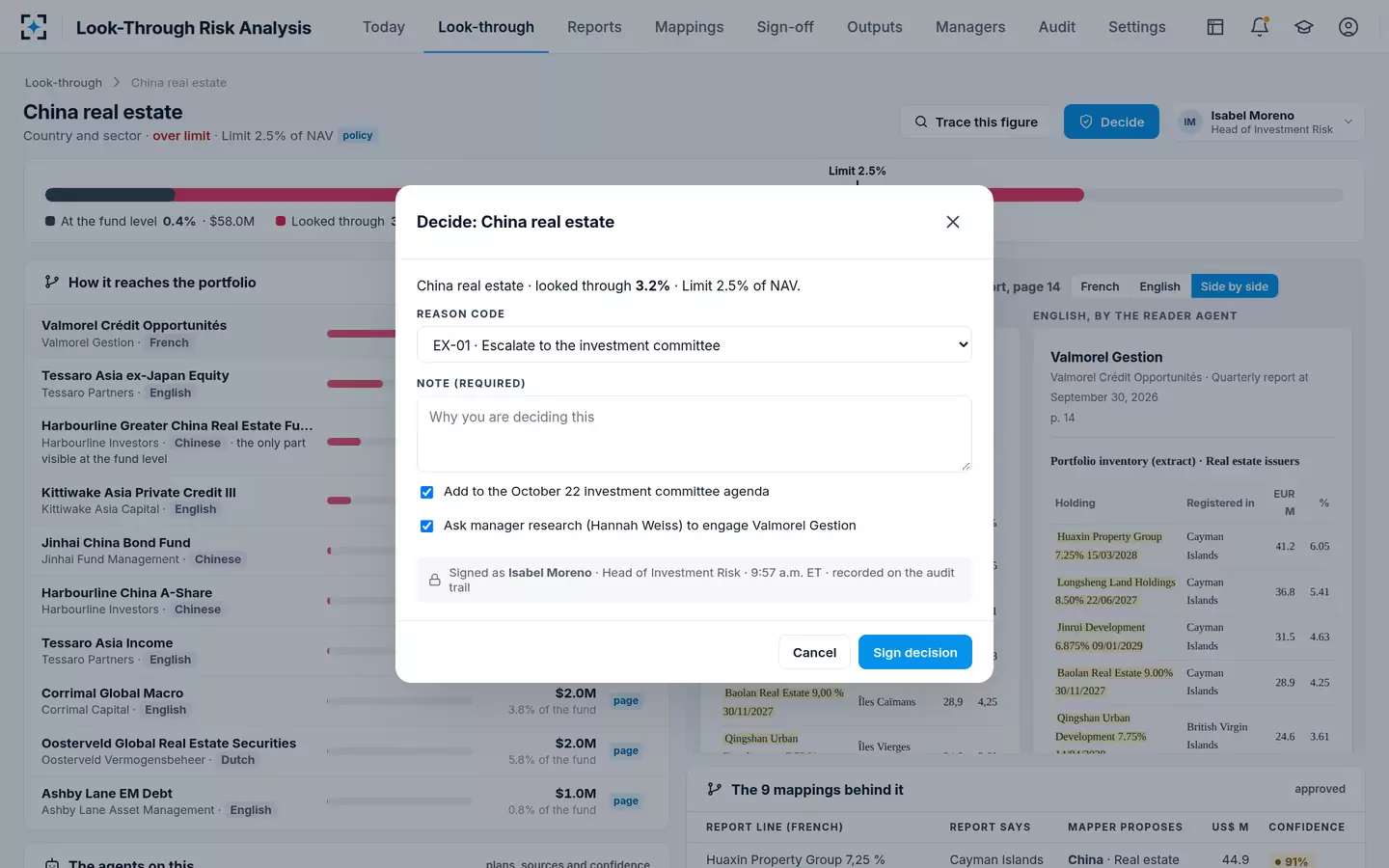
The order matters. In the sample, the China exposure became final only after the analyst approved nine country-of-risk mappings in the French credit fund; until then the Decide button stayed locked. That sequence, mapping approved by one person and breach decided by another, is what makes a look-through breach defensible in front of a committee. How the mapping is set is explained in country of risk versus country of domicile, and how to compare tools on the funds that hide these exposures in portfolio look-through tools compared.
Questions people ask
What is exposure analysis in investment risk?
It measures how much of a portfolio depends on each issuer, sector, country, currency and source of leverage, so each can be held against a limit. For an investor that holds funds, it is only complete once every fund is looked through to its holdings and the holdings are added up across funds.
How do you find concentration across managers?
Look through every fund to its lines, map each line to its issuer's ultimate parent and country of risk, add the lines across all funds and test the investor's limits on the totals. In the fictional sample, that found a telecom issuer at 1.8% against a 1.5% limit, held by 11 funds and invisible at fund level.
What is a look-through limit?
An investment policy limit tested on the investor's holdings after looking through each fund, rather than on the funds. Typical examples are single-issuer, country, sector and leverage limits; the sample firm uses 1.5% per issuer and 2.5% per country and sector.
Does Solvency II require insurers to aggregate issuer exposure across funds?
Yes, for the market risk concentration charge. Exposures to companies in the same corporate group are one single name under Article 182 of Delegated Regulation 2015/35, and the holdings inside funds are included through the look-through; where single names in a fund are unknown, EIOPA's Guideline 5 has insurers assume they are the same name.
What is fund of funds risk?
The risk an investor carries through layers of funds that no single layer measures: concentration across managers, leverage stacked inside funds, overlapping fees and information that arrives late. Each layer has to be looked through to measure it.