The look-through approach means measuring a holding in a fund by the securities, loans, property and derivatives the fund owns, line by line, instead of treating the fund as a single asset. Under Solvency II an insurer must calculate its capital requirement "on the basis of each of the underlying assets of collective investment undertakings and other investments packaged as funds"; a bank must do the same under the Basel framework or, without enough transparency, face a 1,250% risk weight. The work is hard because the data sits in each manager's report, in its own layout and often its own language. Botminds' Look-Through Risk Analysis reads those reports to their holdings and ties each fund to the manager's own NAV, so the rule can be applied every quarter rather than approximated.
This guide sets out which look-through regime applies to which investor, what each one asks for, and what happens when the data is not there. It quotes the regulations directly and links each one where it is used.
Why the look-through approach is a large-balance-sheet question
€3.13tn
of investment fund shares held by euro area insurers, Q2 2026 (provisional)
32.6%
of those insurers’ total assets of €9.62 trillion
49%
Solvency II type 2 equity shock on a fund that is not looked through, before the symmetric adjustment
1,250%
Basel risk weight where a bank has too little transparency into a fund
What is the look-through approach, in one sentence per regime?
In every regime the look-through approach replaces the fund unit with its contents, but the reason differs: insurers and banks do it to size capital, fund managers do it to respect diversification limits, and pensions do it so their own investment policy limits mean something. The definitions below are the regulators' own.
For insurers, Article 84(1) of Delegated Regulation (EU) 2015/35 is the whole rule in one line: "The Solvency Capital Requirement shall be calculated on the basis of each of the underlying assets of collective investment undertakings and other investments packaged as funds (look-through approach)." Article 84(2) extends it to indirect exposures to market, underwriting and counterparty risk that do not come through funds. For banks, the Basel Committee's 2013 standard says "banks should apply a look-through approach to identify the underlying assets whenever investing in funds" (BCBS 266). For UCITS and US registered funds there is no capital look-through at all; their rules cap how much of a fund may sit in other funds and, for AIFs, count exposure built up inside structures they control.
People also ask what "look through basis" means in a report. It means the figure was built from the underlying holdings: a 3.2% exposure to a country "on a look-through basis" is the sum of that country's securities across every fund, weighted by the investor's share of each fund. The alternative, "at fund level", classifies each fund once by its label or domicile.
Which look-through regime applies to you: a decision tree
Start from who you are, not from the fund. The same multi-asset fund can be looked through by an insurer for capital, by a bank for risk weights, and by the fund-of-funds manager that sold it for diversification limits, and each of them uses different rules and different fallbacks.
Which look-through approach applies, and what happens if you cannot apply it
An EU or EEA insurer calculating the SCR with the standard formula?
The ruleSolvency II, Delegated Regulation 2015/35, Article 84: calculate on each underlying asset.
If you cannot look throughTarget or last reported allocation, with data groupings on no more than 20% of assets; otherwise type 2 equity at 49% plus the symmetric adjustment.
A bank holding equity in a fund in its banking book?
The ruleBasel Committee, BCBS 266 (December 2013): look-through approach first, then the mandate-based approach.
If you cannot look throughFall-back approach: a 1,250% risk weight where there is not sufficient transparency.
A UCITS or an AIF that invests in other funds?
The ruleUCITS Directive Article 55 limits per underlying fund; AIFMD rules count exposure inside structures the AIF controls.
If you cannot look throughNo capital charge. A UCITS fund of funds may not even have to combine its funds’ holdings for issuer limits.
A US registered fund buying other funds?
The ruleInvestment Company Act section 12(d)(1)(A) limits of 3%, 5% and 10%, unless the fund relies on rule 12d1-4.
If you cannot look throughNo capital charge; the limits apply to the fund units, not the assets inside them.
A pension fund, endowment or other investor with no capital rule for funds?
The ruleYour own investment policy: issuer, country, sector and leverage limits written for the total portfolio.
If you cannot look throughThe limits are only as good as the look-through behind them; nothing charges you for not doing it.
The first two branches are capital regimes: failing the look-through costs money every quarter. The middle two are limit regimes: they decide what a fund may buy, not what it must hold against it. The last branch is where most pension funds sit, and it is the one where the look-through is purely a matter of good governance, which is why it is so often the first thing a stretched team approximates.
Solvency II Article 84: look through, or fall back to the target allocation
Under Solvency II, look-through is the default and there is one regulated fallback before the punitive charge. Article 84(3) allows that, where the look-through "cannot be applied", "the Solvency Capital Requirement may be calculated on the basis of the target underlying asset allocation or, if the target underlying asset allocation is not available to the undertaking, on the basis of the last reported asset allocation" (Delegated Regulation 2015/35).
The fallback has three conditions. The assets must actually be managed in line with that allocation, exposures must not be expected to vary materially over a short period, and any data groupings must be prudent and "do not apply to more than 20 % of the total value of the insurance or reinsurance undertaking's assets". EIOPA has said what each condition means in practice. The 20% is measured against the insurer's whole balance sheet: "When calculating the 20 % the denominator is equal to the total value of the assets of the insurance or reinsurance undertaking" (EIOPA Q&A 1382). A grouping is prudent when uncertainty is resolved against the insurer; EIOPA's own example takes a fund whose target is 60% investment grade and 40% below it and writes "A prudent grouping can be performed by assigning 60 % to CQS 3 and 40 % to CQS 6", the weakest step in each band.
The third condition is the one that bites. "Article 84(3) of the Delegated Regulation requires that the underlying assets are managed strictly according to the target allocation", and the insurer has to check it, EIOPA says, against prospectuses, offering documents and "information on the actual holdings of the fund". The fallback, in other words, still needs the holdings, at least once a year.
What happens if an insurer cannot look through a fund?
If neither the look-through nor the allocation fallback is possible, the whole fund becomes a type 2 equity. Article 168(3) puts in that class "the assets and indirect exposures referred to in Article 84(1) and (2) where a look-through approach is not possible and the insurance or reinsurance undertaking does not make use of the provisions in Article 84(3)", and Article 169(2)(c) shocks it by "the sum of 49 % and the symmetric adjustment".
That charge does not care what the fund holds. A fund of short-dated investment-grade bonds that the insurer cannot see through attracts the same shock as an unlisted equity fund. The cost of not looking through is therefore largest for exactly the funds insurers buy most for safety, which is the argument what looking through saves under Solvency II works through on one illustrative fund, in euros.
What is type 2 equity in Solvency II, and what changes in 2027?
Type 2 equity is everything in the equity sub-module that is not a type 1 equity, and type 1 is narrow: "equities listed in regulated markets in countries which are members of the European Economic Area (EEA) or the Organisation for Economic Cooperation and Development (OECD)", plus equities on multilateral trading facilities with an EU head office. Type 1 is shocked by 39% plus the symmetric adjustment; type 2, which also takes commodities, other alternative investments and the funds nobody could see into, by 49% plus the symmetric adjustment.
The symmetric adjustment moves both. It is half of the amount by which EIOPA's equity index exceeds its own three-year average by more than 8 points, so it is positive only when the index stands more than 8% above its three-year average; today it may not be lower than −10% or higher than 10%. On 30 September 2026 EIOPA's published value was 7.71%, so a fund charged as type 2 that day attracted a 56.71% shock (EIOPA, symmetric adjustment, September 2026).
Delegated Regulation (EU) 2026/269 changes three things that matter here, and "It shall apply from 30 January 2027". The band for the symmetric adjustment widens from ±10% to ±13% (what that does to the capital), so the type 2 charge on an unseen fund can range from 36% to 62%. The look-through for related investment vehicles now also covers those managing assets on behalf of "any other undertaking of the group". And a new Article 171d extends the long-term equity treatment to certain lower-risk funds, applying it to the equities inside a fund that can be fully looked through and to the fund units themselves where it cannot (worked on one fund; Delegated Regulation 2026/269). The 49% itself is unchanged.
What is the Basel look-through approach for funds?
The Basel look-through approach is the first of three methods a bank uses for equity investments in funds held in the banking book, and the other two are deliberately more expensive. The Committee's December 2013 standard set out "the "look-through approach" (LTA), the "mandate-based approach" (MBA), and the "fall-back approach" (FBA)", with "the degree of conservatism increases with each successive approach (as risk sensitivity decreases)" (BCBS 266).
The look-through approach risk-weights each underlying exposure as if the bank held it directly, and in the current Basel Framework it is only open when there is "sufficient and frequent information provided to the bank regarding the underlying exposures of the fund", checked by an independent third party such as a depository or custodian (Basel Framework, CRE60). The mandate-based approach assumes the fund is "invested to the maximum extent allowed under the fund's mandate in those assets attracting the highest capital requirements". The fall-back approach "applies a 1250% risk weight to the bank's equity investment in the fund". A leverage adjustment scales the fund's average risk weight, again "subject to a cap of 1250%". BCBS 266 took effect "from 1 January 2017"; CRE60, the consolidated version, is in force from 1 January 2023, and national implementations set their own dates.
The same idea, five price tags: look-through regimes side by side
| Regime | Who | What must be looked through | Price of not looking through | Depth |
|---|---|---|---|---|
| Solvency II, Art. 84 | EU and EEA insurers, standard formula | Every underlying asset of funds and other packaged investments, plus other indirect exposures | Allocation fallback within the 20% cap, else type 2 equity: 49% ± the symmetric adjustment | As many iterations as needed to capture all material risk (EIOPA Guideline 2) |
| Basel, BCBS 266 | Banks, equity in funds in the banking book | Each underlying exposure, risk-weighted as if held directly | Mandate-based approach, then 1,250% (fall-back) | Each underlying exposure; a leverage adjustment scales the result, capped at 1,250% |
| UCITS Directive, Art. 55 | UCITS buying other funds | Nothing for capital; limits apply to units of each fund | None; 10% per fund (up to 20%), 30% in non-UCITS funds | Combining underlying funds for issuer limits can be waived |
| AIFMD Level 2, Art. 6(3) | Managers of alternative investment funds | Exposure in structures the AIF controls that are set up to increase exposure | Understated leverage in the AIF’s own calculation | Structures controlled by the AIF |
| US section 12(d)(1)(A) and rule 12d1-4 | US registered funds buying funds | Nothing for capital; limits on fund units | None; 3% of a fund’s voting stock, 5% in one fund, 10% in funds unless relying on rule 12d1-4 | Rule 12d1-4 restricts three-tier structures |
UCITS, AIFMD and US fund rules: look-through without a capital charge
Fund managers meet the look-through as a limit test, not a capital charge, and the limits are looser than many investors assume. Under Article 55 of the UCITS Directive, a UCITS may hold other funds "provided that no more than 10 % of its assets are invested in units of a single UCITS or other collective investment undertaking. Member States may raise that limit to a maximum of 20 %", and investments in non-UCITS funds "shall not exceed, in aggregate, 30 % of the assets of the UCITS" (Directive 2009/65/EC).
The same article lets Member States excuse a fund of funds from adding up the assets of its underlying funds when it applies the Article 52 issuer diversification limits. A UCITS fund of funds can therefore respect every limit it has while the same issuer sits in five of its underlying funds. An insurer or pension holding that fund of funds inherits the blind spot unless it looks through itself, which is the case the issuer no single manager sees follows to a limit breach.
Alternative investment fund managers look through for leverage: "Exposure contained in any financial or legal structures involving third parties controlled by the relevant AIF shall be included in the calculation of the exposure where the structures referred to are specifically set up to directly or indirectly increase the exposure at the level of the AIF" (Regulation (EU) No 231/2013, Article 6(3)). US registered funds face section 12(d)(1)(A) of the Investment Company Act, which bars acquiring more than 3% of another fund's voting securities, more than 5% of total assets in any one fund, or more than 10% in funds generally, unless the fund relies on rule 12d1-4. By the SEC's 2020 estimate, about two in five registered funds hold at least one other fund (85 FR 73924).
How deep must you look? Funds of funds, money market funds and property funds
For Solvency II, EIOPA's Guidelines on the look-through approach, applicable since 1 April 2015, answer the three depth questions supervisors see most. On funds of funds: "Undertakings should perform a sufficient number of iterations of the lookthrough approach, where appropriate (e.g. where a fund is invested in other funds) to capture all material risk." On cash funds: "Undertakings should apply the look-through approach to money market funds." On property: where insurers invest in real estate through funds, "they should apply the look-through approach", so the property goes to the property sub-module rather than the equity one (EIOPA-BoS-14/171).
EIOPA has also confirmed the rule covers exchange-traded funds and other packaged products: "for investments packaged as funds a look-through approach has to be followed in the standard formula calculation of the SCR" (EIOPA Q&A 2422). Being listed does not change the rule. What varies is the effort: a European bond fund that sends a full holdings file is looked through in minutes, while a private credit fund that reports a quarterly PDF in Portuguese 60 days after quarter end needs someone, or something, to read it.
Before you rely on the Article 84(3) fallback for a fund
- Confirm the fund publishes a target allocation, or that you hold its last reported allocation
Without either, the only option left is type 2 equity.
- Test that the fund is managed strictly to that allocation
EIOPA expects evidence from the prospectus, offering documents and the fund’s actual holdings, at least annually.
- Check that exposures are not expected to change materially in the short term
A tactical or unconstrained mandate usually fails this condition.
- Make every grouping prudent
Durations and credit quality steps resolved against you, as in EIOPA’s CQS 3 and CQS 6 example.
- Count the total against the 20% cap
Numerator: investments treated with data groupings. Denominator: the insurer’s total assets.
- Keep the evidence for the supervisor
Article 88 also requires the simplification to be proportionate, so document why full look-through was not possible.
What every look-through regime asks of the data, and where Look-Through Risk Analysis fits
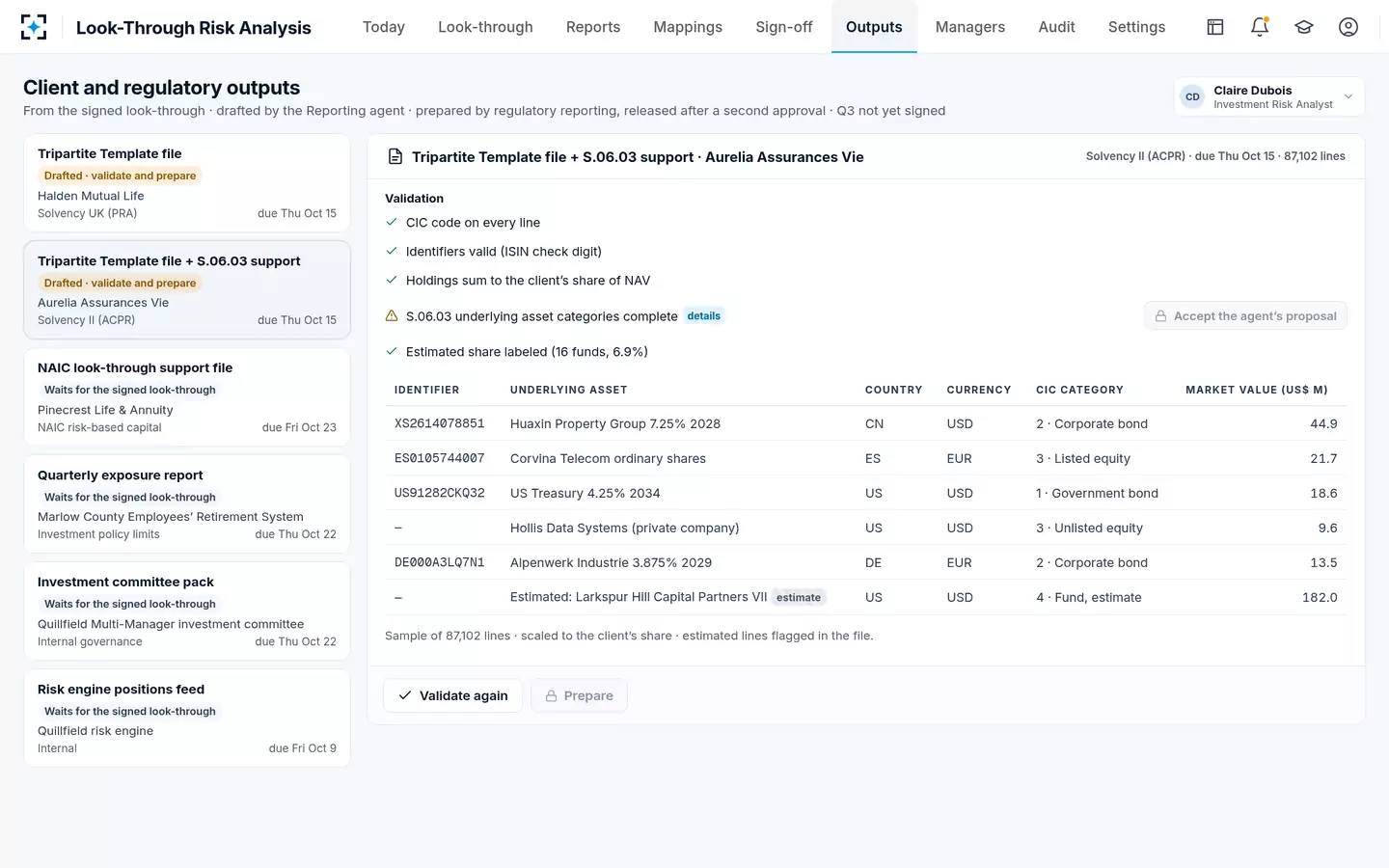
Whatever the regime, the look-through rests on the same five answers for each line inside each fund: what it is, who issued it (and who ultimately owns the issuer), where the risk sits, what currency it pays in, and how much of it the investor owns through its share of the fund. Insurers then need the line classified for Solvency II reporting; the Tripartite Template and S.06.03 field map sets out where each field comes from. The answer that breaks most often is the third, where the risk sits, because reports list where an issuer is registered; country of risk versus country of domicile explains why that matters.
Look-Through Risk Analysis does the reading and the first pass of that work. Its agents read each manager report, capital account statement, holdings file or Tripartite Template file in its original language and cite every line to its page; map each line to identifier, issuer, sector, country of risk and currency; tie each fund back to the manager's NAV; estimate the funds that have not reported and label the estimate; and test every limit on the looked-through positions. People approve the mappings, decide the breaches and sign the quarter.
Look-Through Risk Analysis on a sample portfolio: 120 funds unfolded to their holdings
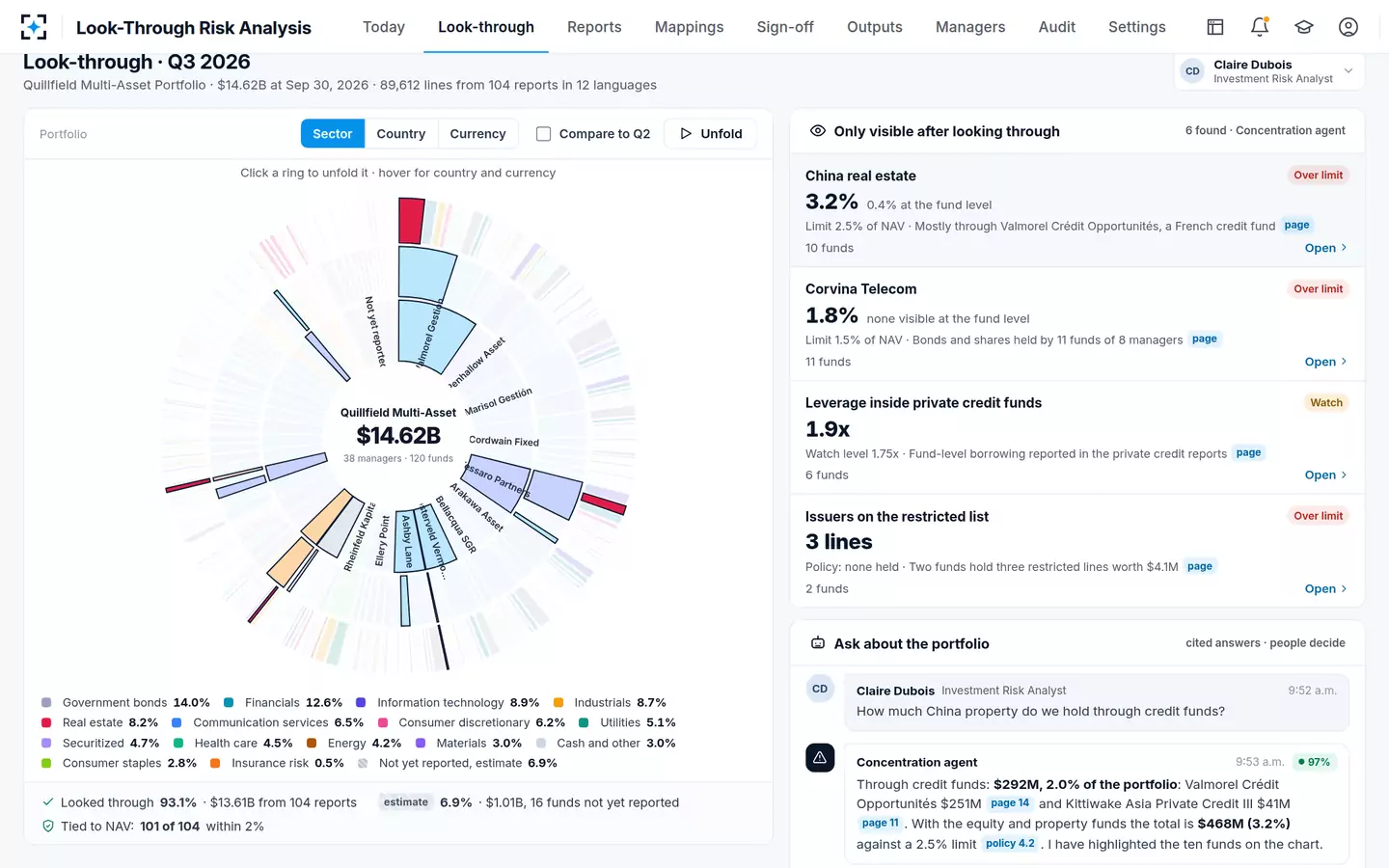
For an insurer, the output that matters is the one the regulation asks for: a full look-through where it is possible, an explicit, labelled estimate where a fund has not reported, and a list of what remains so the team can decide whether the Article 84(3) fallback or the type 2 charge applies. The solution's target is that 100% of NAV is either looked through to holdings or labelled as an estimate every quarter; it does not calculate the SCR, which stays in the insurer's own capital model; the solution supplies the signed positions and the client files.
One signed look-through, drafted into each client's regulatory file
Questions people ask
What does "look through basis" mean?
A figure on a look-through basis is built from the holdings inside each fund rather than from the funds' labels. A 3% exposure to an issuer on a look-through basis adds up that issuer's securities across every fund, weighted by the investor's share of each fund. Solvency II, the Basel fund framework and most investment policies use the term in this sense.
Is the look-through approach mandatory under Solvency II?
Yes, for insurers on the standard formula it is the default under Article 84(1) of Delegated Regulation 2015/35. Where it cannot be applied, Article 84(3) allows the target or last reported allocation, with data groupings on no more than 20% of total assets; anything else falls to type 2 equity at 49% plus the symmetric adjustment.
What is the difference between the look-through approach and the mandate-based approach?
Both are Basel methods for banks' equity investments in funds. The look-through approach risk-weights the fund's actual holdings; the mandate-based approach, used when the holdings are not available often enough, risk-weights the worst portfolio the fund's mandate would allow. If neither is possible the bank applies the fall-back approach, a 1,250% risk weight.
Do you have to look through money market funds?
For Solvency II, yes. EIOPA's Guideline 1 on the look-through approach says "Undertakings should apply the look-through approach to money market funds", so their deposits, bills and paper go to the spread, interest rate and concentration sub-modules rather than being treated as a single equity-like unit.
How many levels of a fund of funds do you look through?
As many as it takes to capture all material risk. EIOPA's Guideline 2 asks for "a sufficient number of iterations", and the Solvency II look-through template S.06.03 has funds of funds looked through the same way as any other fund, with the fund category used only for non-material residual values.
Does the 2027 Solvency II review change the 49% charge?
No. Delegated Regulation 2026/269, which applies from 30 January 2027, leaves the 49% in place but widens the symmetric adjustment band from ±10% to ±13%, so the charge on a fund an insurer cannot look through can range from 36% to 62% depending on equity markets.