A portfolio look-through tool turns a list of funds into a list of exposures: it brings in each fund's holdings, scales them to the investor's share, classifies every line and adds them up by issuer, sector, country, currency and leverage. There are three ways to do it. Tools that load structured holdings files and data feeds work well for funds that send them. Manual keying into spreadsheets works for anything, slowly. Agents that read managers' own reports, PDFs, capital account statements and scans in any language, work for the funds the other two struggle with. On clean files the three agree; on private funds, non-English reports and funds that report late they diverge sharply. Botminds' Look-Through Risk Analysis is an agent approach, built to read every manager report to its holdings and tie each fund to the manager's own NAV.
This guide compares the approaches on one fictional sample quarter, a $14.62 billion portfolio invested through 38 managers and 120 funds, and is explicit about where each one, including ours, runs out.
Three approaches to a portfolio look-through, compared on the funds that decide the choice
| Files and feeds | Manual keying | Agents reading reports | |
|---|---|---|---|
| Funds that send structured holdings files | Fast and accurate | Accurate, slow | Fast; the file is read as one more source |
| PDF quarterly reports and capital account statements | Not covered without a file | Covered, at days per quarter | Covered; each value cited to its page |
| Reports in other languages | Only if a file exists | Only languages the team reads | Read in the original, kept beside the English |
| Scanned or damaged pages | Not covered | Covered, by eye | Read where legible; unreadable values marked, not guessed |
| Private funds reporting 45 to 75 days late | The latest data the feed has, which may be last quarter’s | Rolled forward by hand | Estimated by a stated method, labelled, replaced on arrival |
| Funds of funds | As deep as the files go | One pass per layer, by hand | One pass per layer, from each fund’s report |
| Tie-out to the manager’s NAV | Depends on the tool | By hand, often at the end | Every fund, gaps explained from the report |
| Country of risk | The file’s country field | Analyst’s judgment | Proposed with evidence; disputed lines to an analyst |
| Main cost driver | Licences and chasing files | Analyst days | Review of the exceptions |
What does a portfolio look-through tool do?
A portfolio look-through tool does five jobs, and a buyer should check each: it gets the holdings of every fund, identifies and classifies each line, scales it to the investor's share, adds the result across funds, and shows how complete and how current that result is. Most tools are judged on the fourth job, the aggregation and the charts. The decisions are made by the first and the last: which funds the tool could actually see, and how it treats the ones it could not.
For investors with capital rules the stakes are explicit. An insurer under Solvency II must repeat the look-through as many times as it takes, through each fund held by a fund, to capture all material risk (EIOPA Guidelines on look-through approach; the look-through approach), and a fund it cannot see is charged as type 2 equity, as what looking through saves under Solvency II works out. For pensions the stakes are their own limits: a limit tested on incomplete holdings is a limit on part of the portfolio.
Three approaches: files and feeds, keying, or agents reading reports
Files-and-feeds tools load what managers and data providers already structure: Tripartite Template files, holdings extracts and, for US registered funds, public Form N-PORT data. Their strength is scale and repeatability on the funds they cover. Their weakness is that coverage is set by the managers, not by the investor; a private credit fund that reports a PDF capital account statement is invisible until someone keys it.
Manual keying covers everything a person can read and is the default for the hard funds. Its weakness is time and consistency: holdings are typed from PDFs in the manager's layout, mapped by whoever is on duty, and tied out at the end if at all. Agent-based tools read the manager's own documents the way an analyst would, line by line, and hand the exceptions to a person; their weakness is that they must earn trust line by line, which is why every value must cite its page and every mapping its evidence.
Where the approaches agree: funds that already send clean files
On a liquid fund that sends a complete, classified holdings file on time, the three approaches produce the same exposures, and choosing between them on those funds is choosing on price and convenience. The regulators' own direction of travel is to make such files more common: EIOPA is exploring access to the ECB's databases, including "Fund Look-through information", and, "Depending on the on-going ESMA work for development of a single data hub and harmonized European reporting of investment funds", says the S.06.03 template "might be deleted in the future" (EIOPA final report on supervisory reporting, March 2026).
For US registered funds a public file already exists. The SEC's Form N-PORT data sets hold every registered fund's holdings for the third month of each quarter, as downloading mutual fund holdings data explains, though their country field is the country of organization and the SEC does not publish "country of risk and economic exposure (Item C.5.b)" (Form N-PORT). Neither source reaches private funds.
Can manager reports in other languages be read automatically?
Yes, if the reading keeps the original beside the translation and marks what it cannot read. In the sample quarter, reports arrived in 12 languages, including a French credit fund whose page 14 listed developers' bonds under "Îles Caïmans", a 46-page Japanese equity report and a scanned Brazilian credit report in Portuguese. A files-and-feeds tool sees none of these without a file; manual keying sees the ones the team can read.
A Portuguese scan read line by line, with the one smudged value left for a person
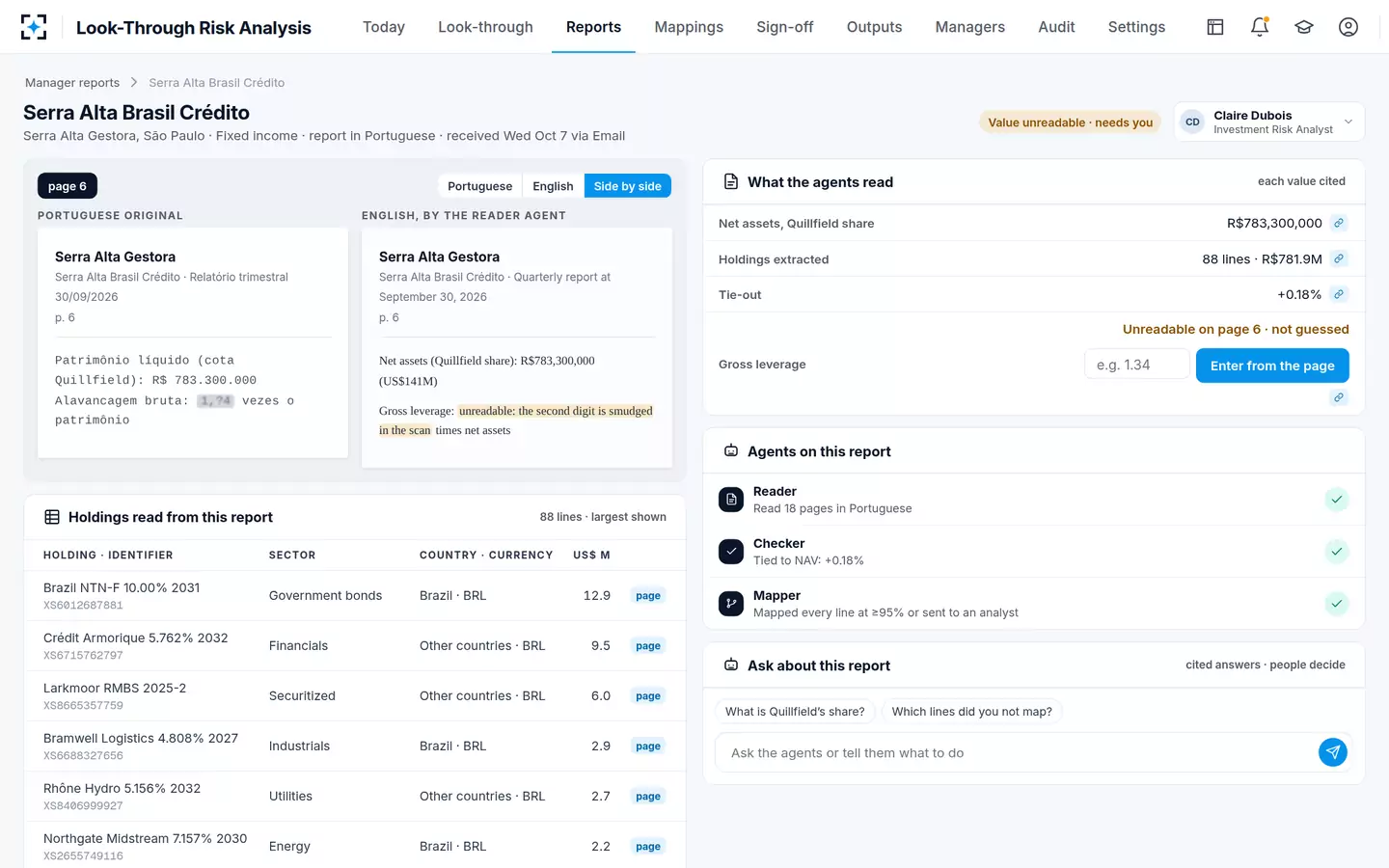
The test to apply to any tool claiming to read reports is the damaged page, not the clean one. Ask what it does with a smudged digit, a table split across pages, a figure in a footnote. The answer you want is the one above: it reads what is legible, cites every value to its page, and marks the rest for a person instead of guessing.
Private funds and late reporters: the share no feed covers
Every approach has to estimate at sign-off, because private funds report after most investors want to sign. In the sample, liquid funds are due within 10 business days and private funds 45 to 75 days after quarter end under their terms, while the quarter is signed on business day 7. On business day 6, 16 funds holding $1.01 billion, 6.9% of NAV, had not reported.
Why every look-through estimates at sign-off: the reporting calendar after a September 30 quarter end
- To sign-off9 days
- Liquid funds report14 days
- Not yet reported45 days
- Reports arrive by fund termsto day 75
The approaches differ in what they do about it. A feed can only deliver the latest holdings it has; for a fund that has not reported, that is last quarter's, and the question is whether the tool says so. A spreadsheet rolls forward whatever the analyst has time for. In the solution, the Gap agent estimates each unreported fund from its last holdings, capital calls and distributions since and matched market proxies, labels the estimate on every screen and file, and replaces it when the report lands, logging the variance; last quarter the sample's estimates were within 3.4% of the reported values on average.
The sample quarter that the comparison is run on
120
funds from 38 managers
12
languages among the 104 reports received
6.9%
of NAV in 16 funds not yet reported on business day 6, held at labelled estimates
101 / 104
reported funds tied to the manager’s NAV within 2%
Fund of funds software vs a look-through layer beside your systems
"Fund of funds software" usually means a platform that runs a fund-of-funds business end to end: commitments, capital calls, accounting, investor reporting. A look-through layer does one thing those platforms rarely do from documents: turn each underlying manager's report into classified holdings tied to that manager's NAV. The two complement each other; the platform knows what you own of each fund, the look-through knows what each fund owns.
Funds of funds are common enough that the distinction matters well beyond specialist managers. The SEC estimated in 2020 that "approximately 40% of all registered funds hold an investment in at least one fund" (85 FR 73924). For a pension or insurer, a fund of funds adds a layer to every look-through, and each layer is another set of reports to read.
How do you choose look-through software? Start from your hardest funds
Choose on the funds that cause you trouble today, not on a demonstration. List your funds by how they report, structured file, PDF, scan, language, private capital account, and test each candidate on a quarter you have already signed, starting with the worst ten. The method is in replaying last quarter's look-through reporting.
Questions to ask before you buy a portfolio look-through tool
- Which of our funds can it read on day one?
By report type and language, not by manager count. Ask for the list after a trial on your reports.
- What happens to a fund that sends no file?
Keyed by you, read by the tool, or left out?
- How are late funds treated, and is it visible?
A labelled estimate with a method, or last quarter’s data presented as current.
- Does every fund tie back to the manager’s NAV?
And who explains a gap over tolerance?
- Can every number be traced to a report page?
Including the lines an agent or an analyst changed, with who and why.
- How is country of risk set?
Copied from the file, or decided with evidence?
- Who approves what the tool proposes?
Thresholds by confidence and size, and a second approval for large bulk changes.
- What does it hand to our other systems?
Positions for the risk engine, client files, committee papers; nothing released without a person.
Where Look-Through Risk Analysis fits, and what it leaves to your other systems
Look-Through Risk Analysis sits beside the systems a look-through already depends on. It takes manager reports from portals, the risk mailbox, administrators and SFTP; the investor's holding in each fund from portfolio accounting and the custodian; identifiers, issuer hierarchy and sectors from the security master and data vendors; and it sends a positions feed from the signed look-through to the risk engine and client files over SFTP. It does not replace the security master, the data vendors, the risk engine or the capital model.
One question across 120 funds in Look-Through Risk Analysis, answered with the path through managers
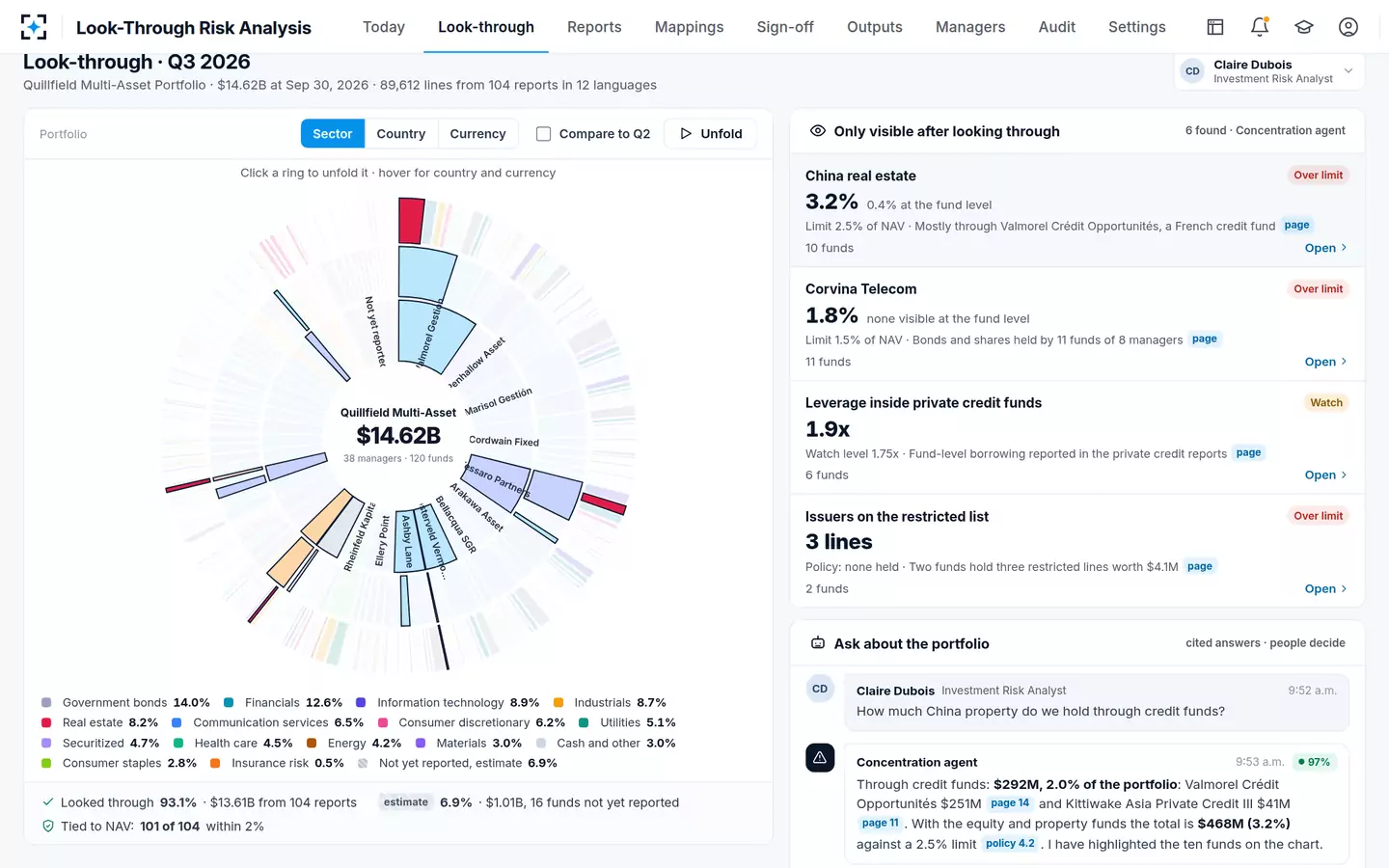
Where it is the wrong choice is worth saying plainly. A book made entirely of US mutual funds and ETFs that publish N-PORT data, or of managers who all send complete holdings files on time, gains little from report reading; a files-and-feeds tool, or the public data and a spreadsheet, will do. The case for agents grows with the share of the book in private funds, foreign-language reports and managers who send PDFs, which is exactly the share that today ends up keyed, rolled forward or left out. Where the decision rests on finding concentrations across managers, the issuer no single manager sees shows what each approach catches.
Questions people ask
What is the best portfolio look-through tool?
The one that reads the funds you struggle with today. Tools that load structured files are enough for books of liquid funds that send them; books with private funds, PDF reports and foreign-language managers need a tool that reads reports and labels estimates. Test candidates on a quarter you have already signed.
Can look-through software handle private funds?
Only if it reads capital account statements and quarterly reports, because private funds rarely send structured holdings files and file no public holdings data. It also needs a stated method for funds that report 45 to 75 days after quarter end, with the estimate labelled until the report arrives.
Is fund of funds software the same as look-through software?
No. Fund of funds platforms usually manage commitments, capital calls, accounting and investor reporting for the fund-of-funds vehicle. Look-through software turns each underlying fund's holdings into classified exposures. A fund-of-funds manager or investor typically needs both.
Can manager reports in other languages be read automatically?
Yes. In the fictional sample quarter the solution read reports in 12 languages, kept each original beside its English reading and cited every value to its page. Values it could not read, such as a smudged figure in a scanned Portuguese report, were marked and sent to an analyst rather than guessed.
How long does it take to switch look-through approaches?
The useful milestone is a replay: last quarter's reports run through the new approach and compared with the look-through you signed. That shows which funds it can read, how often its mappings agree with yours and where it needs settings changed, before it is used for a live quarter.