A mutual fund look through replaces each fund an investor holds with the securities inside it, and its accuracy is decided at one step: mapping each holding to an identifier, an issuer and its group, a sector, a country of risk and a currency. Reading the report gets the line onto a page; mapping decides which limit it counts against. Done by hand across tens of thousands of lines, mapping is where errors hide, because a wrong country or a missed parent looks exactly like a right one. Botminds' Look-Through Risk Analysis gives the job to its Mapper agent, with written limits on what it may approve alone, and sends every line outside those limits to an analyst with the evidence.
The lines below come from the solution's fictional sample portfolio: $14.62 billion across 38 managers and 120 funds, 89,612 holdings lines read from 104 manager reports in 12 languages in the third quarter of 2026.
One line from a credit fund's report, and the five decisions the Mapper makes on it
Identifier
ProposesNo ISIN or CUSIP in the report or the security master.
HowMatched on the issuer’s name, address and the manager’s description of the business.
Issuer
ProposesSakai Precision, a private company.
HowMatched to the company the manager describes; an analyst confirms it is the same one wherever it appears.
Sector
ProposesIndustrials.
HowFrom the manager’s description of the business.
Country of risk
ProposesJapan, the same as the report.
HowWhere the business operates, not only where it is registered; here they agree.
Currency
ProposesUS dollar.
HowThe currency of the instrument, from the report’s schedule.
What is issuer mapping in a mutual fund look through?
Issuer mapping is the step that turns a line of text in a manager's report into a position a risk system can aggregate: a security or loan with a known issuer, that issuer's ultimate parent, a sector, a country of risk and a currency. Without it, “Tallow Ridge 5,5 % 2029” in one fund’s report and “Tallow Ridge Holdings 5.5% 2029” in another’s are two unrelated strings.
The fields are not arbitrary. Insurers report each asset's issuer, "Issuer Group" (the ultimate parent), issuer country, currency and sector to their supervisor, and "For NACE sections A to N full four-digit reporting of the NACE codes is required" (Implementing Regulation (EU) 2023/894). Solvency II's concentration charge treats every company in a corporate group as one single name (Delegated Regulation 2015/35, Article 182). The SEC asks US funds for the country where the risk and economic exposure are concentrated, alongside the country of organization (country of risk vs domicile; Form N-PORT, Item C.5). A look-through that maps these well serves all three purposes; one that maps them loosely fails each in a different way.
One line, five decisions: the Mapper agent at work
The Mapper agent maps each line the Reader agent extracted, against the security master and the data vendor's reference data, and keeps, for each decision, what it proposed and why. The figure above shows a hard case on purpose: a private company with no public identifier, held by a credit fund, where the agent has to match on name, address and the manager's own description.
From a report line to a tested exposure in Look-Through Risk Analysis: who does what
Agent
Reader agentExtracts the line from the report in its original language and cites the page.
Never: guess an unreadable value
Agent
Mapper agentProposes identifier, issuer, sector, country of risk and currency, with evidence and a confidence.
Never: map by domicile alone
Agent
Approves alone, within limitsOnly at 95% confidence or more and $25M or less a line; every approval logged.
A person decides
Investment risk analystApproves, edits or returns everything else, with a reason code; bulk approvals over $50M need the Head of Investment Risk.
Agent
Concentration agentRe-tests limits on the mapped positions and explains the path through funds.
Never: change a limit or trade
A person decides
Head of Investment RiskDecides any breach the mapping reveals.
Can AI map holdings to issuers? Where it is reliable and where it is not
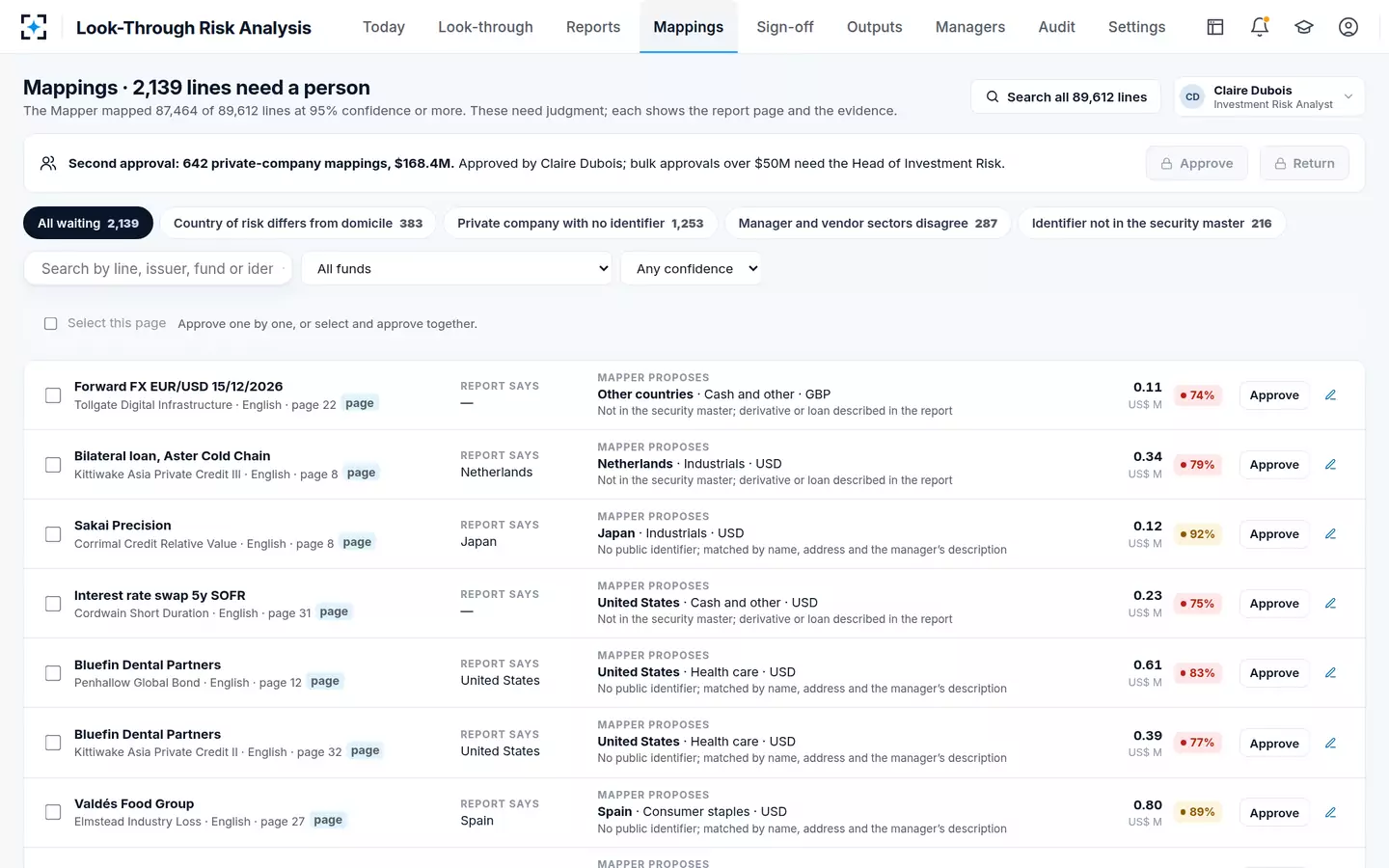
An agent maps reliably where the evidence is unambiguous: a line with an ISIN that exists in the security master, an issuer whose parent is known, a sector the manager and the data vendor agree on. In the sample quarter that was most of the book. The Mapper mapped 87,464 of 89,612 lines at 95% confidence or more, and sent 2,148 to a person.
The sample quarter's mapping in Look-Through Risk Analysis, in four numbers
97.6%
of lines mapped at 95% confidence or more (87,464 of 89,612)
2,148
lines sent to an analyst with the evidence
95%
confidence below which the agent may not approve alone
$25M
the largest line the agent may approve alone
Where it is not reliable is just as predictable. The lines that went to the analyst fell into four groups: lines whose country of risk differs from the domicile printed in the report, private companies with no identifier, lines where the manager's sector and the vendor's disagree, and identifiers not in the security master, often a derivative or a loan described only in words. None of these is a reading problem; each is a judgment, and a well-built agent says so instead of picking an answer quietly.
The 2,139 lines left for a person, grouped by the reason the agent was unsure
What confidence should an agent need before it approves a mapping?
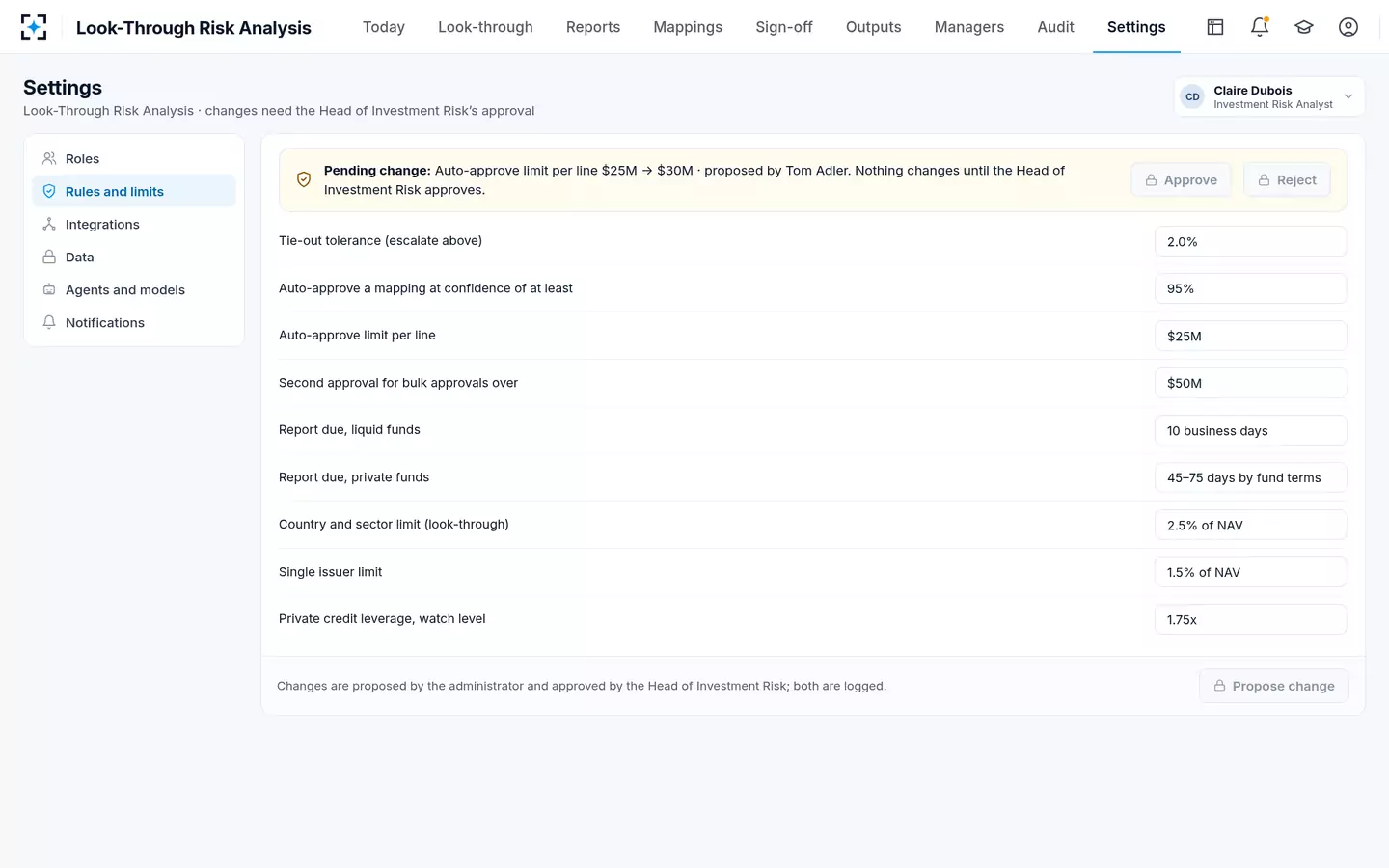
High enough that an analyst, sampling the agent's approvals, finds almost nothing to change, and paired with a size limit, because a confident error on a large line costs more than a doubtful one on a small line. The sample firm uses 95% and $25 million a line, and requires a second approver for bulk approvals over $50 million. Those are the firm's settings, not universal numbers.
The right numbers come from measurement. Set the threshold, let the agent run on a quarter you have already signed, and compare its approvals with your signed mappings; if the agent's approvals above the threshold disagree with yours more often than your own analysts disagree with each other, raise it. The settings screen keeps the thresholds under change control: in the sample, a proposal to lift the per-line limit from $25 million to $30 million is waiting, and "Nothing changes until the Head of Investment Risk approves."
Thresholds are settings, and a change needs the Head of Investment Risk
Never by domicile alone: a rule, not a habit
The single most expensive mapping error in a look-through is copying the country printed in the report. Reports list where an issuer is registered or addressed; risk limits need where its business is. The Mapper's limits include a flat rule, "Never maps by domicile alone", so a line from the Cayman Islands or the British Virgin Islands is either traced to its parent's country of risk with evidence or sent to an analyst.
In the sample quarter that rule surfaced nine bonds of Chinese property developers inside a French credit fund, $251 million listed under the Cayman Islands and the British Virgin Islands. Mapped by domicile, they would have stayed in "Cayman Islands"; mapped by country of risk, they moved China real estate from 0.4% at fund level to 3.2% of the portfolio, against a 2.5% limit. The reasoning and the market-wide evidence are in country of risk versus country of domicile.
What happens to a line with no identifier?
A line without a public identifier is the normal case in private credit, infrastructure and private equity funds, and it should be matched, not dropped. The Mapper matches on the issuer's name, address and the manager's description, proposes a sector and country of risk from that description, and gives the line a consistent internal code so the same company held by two funds is recognised as one issuer.
The last part matters more than it looks. In the sample book the same private dental group appears in two different funds, on page 12 of one report and page 32 of another. Unless both lines map to one issuer, the investor's exposure to that borrower is split in two and neither half looks large. EIOPA, analysing insurers' fund data, found that for property, cash and alternatives the issuer country is often not reported at all, "resulting in a higher proportion of “not-assigned” data" (EIOPA, Financial Stability Report, December 2025); the honest treatment of such lines is a visible "unassigned", never a guess spread across countries.
What should an analyst review in a look-through?
An analyst should review the lines where judgment changes the answer, and sample the rest. The checklist below is what a head of investment risk should be able to see, and test, before relying on any mapping agent, ours included.
Eight things to inspect in a mapping agent before you trust it
- A confidence threshold and a size limit
Both written down, both settings under change control, both visible on every approval.
- Evidence on every line
The report page, the security master entry and the vendor view, opened from the line itself.
- A written country of risk rule
Never the domicile field by default; a reason code whenever the two differ.
- Issuer group, not just issuer
Lines resolved to the ultimate parent, so a group’s bonds and shares across funds add up.
- A consistent code for unidentified issuers
The same private company in two funds is one issuer, not two.
- Unassigned shown as unassigned
No pro rata spreading of lines with no country or sector.
- Exceptions grouped by reason
So the analyst works country disputes, private companies and sector conflicts as batches with the right evidence.
- A measured agreement rate
The agent’s approvals compared with a signed quarter, by reason group, before go-live and after each change.
How accurate is automated holdings mapping? Measure it on your own quarter
No regulator or independent study publishes accuracy rates for automated holdings mapping, and a vendor's own figure on someone else's portfolio tells you little about yours. The accuracy that matters is measured on your reports, against mappings you have already signed.
The method is a replay. Take last quarter's manager reports, run them through the agent, and compare every mapped field with the signed quarter: identifier, issuer, group, sector, country of risk, currency. Count disagreements by reason group and by size, and for each one decide who was right using the report page. A mapping agent earns its threshold when its approvals agree with the signed quarter at least as often as two of your own analysts would agree with each other. The protocol, including what differences to accept, is set out in replaying last quarter's look-through reporting, and the effect on a single analyst's quarter in look-through analysis when one analyst covers 120 funds.
Questions people ask
What is a fund look through calculation?
It multiplies each holding inside a fund by the investor's share of that fund and adds the results across all funds by issuer, sector, country, currency or any other dimension. A $5 million holding in a fund of which the investor owns 10% counts as $0.5 million of the investor's exposure, converted to the investor's currency.
Can AI map fund holdings to issuers?
Yes, for most lines, when it works against a security master and reference data and keeps its evidence. In the fictional sample quarter the Mapper agent mapped 97.6% of 89,612 lines at 95% confidence or more; the remaining 2.4% were judgments, such as country of risk disputes and private companies without identifiers, that went to an analyst.
What confidence threshold should a mapping agent use?
Set it by measurement, not by default. Run the agent on a quarter you have already signed and raise the threshold until its approvals disagree with your signed mappings no more often than your own analysts disagree with each other. Pair it with a size limit per line; the sample firm uses 95% and $25 million.
What happens when the agent and the manager's report disagree on a country?
The line is flagged and, unless the agent is confident and the line is small, sent to an analyst with the report page, the security master entry and the agent's reasoning. The analyst decides and gives a reason code, such as country of risk from parent revenue and listing rather than domicile.
Should private companies without identifiers be left out of a look-through?
No. They should be matched on name, address and the manager's description, given a consistent internal code and kept in the exposure. Leaving them out understates private credit and private equity exposure, which is often where concentration builds.