Look-through reporting is everything built from a look-through: the exposure report to the investment committee, the limit tests, the risk engine's positions and each insurance client's regulatory files. You can trust it when two runs of the same quarter, from the same manager reports, agree, and when every difference between them can be explained from a page of a report. The fair way to test a new process, or a new tool, is therefore a replay: take a quarter you have already signed, rerun it from the same inputs, and compare issuer, country, sector and currency exposures and NAV tie-outs line by line. Botminds' Look-Through Risk Analysis is designed to be tested this way: every line it reads cites its page, every mapping keeps its evidence, and every decision sits on an audit trail you can compare with.
The examples use the solution's fictional sample portfolio, $14.62 billion across 38 managers and 120 funds.
Signed quarter against replay: what each comparison checks
The quarter you signed: Lines keyed per fund, and their total value.
What the replay must show: The same lines from the same report pages, or each missing and extra line explained by page.
The quarter you signed: Each fund’s holdings against the manager’s NAV, with the gaps accepted at sign-off.
What the replay must show: The same gaps, or smaller ones, each explained from the report: cash, receivables, accruals, par against fair value.
The quarter you signed: The issuer each line was booked to.
What the replay must show: The same issuer and ultimate parent, or a documented reason for a different one.
The quarter you signed: Often the country printed in the report.
What the replay must show: Country of risk with evidence; every change from the signed country listed for review.
The quarter you signed: As keyed.
What the replay must show: Matching, or a vendor and manager disagreement shown with both sources.
The quarter you signed: Funds rolled forward at sign-off.
What the replay must show: The same estimates, then compared with the reports that arrived later, variance logged.
The quarter you signed: Breaches found and decided.
What the replay must show: The same breaches, plus any the signed quarter missed, each with its path through funds.
How do you test look-through accuracy? Replay a quarter you already signed
Test it on a quarter whose answer you already know and defended. A pilot on the current quarter compares a new process with nothing; a replay compares it with a result that went to a committee and, for insurers, to a supervisor. Hold the inputs fixed: the same manager reports as they arrived, the security master as it stood, the same holdings in each fund and the same limits. Then any difference is the method's.
The replay also tests the signed quarter, which is the uncomfortable part. A manual look-through carries its own errors, and regulators who read look-through data say so about their own: EIOPA's analysis of insurers' fund holdings notes that "Exposures with look through are subject to some approximations amid completeness and limitation of the reporting" (EIOPA, Financial Stability Report, December 2025). Expect the replay to find mistakes in both directions, and decide each one from the report page, not from which run produced it.
What a replay compares, line by line and exposure by exposure
A useful replay compares at three levels, because each catches a different error. At line level it compares what was read: the same holding, the same value, the same identifier. At fund level it compares the tie-out to the manager's NAV. At portfolio level it compares the exposures the committee saw: issuer, group, country of risk, sector, currency and leverage, and the limit tests run on them.
The levels can disagree. Two runs can match at portfolio level while differing at line level, if errors cancel; they can differ at portfolio level while every line matches, if a mapping rule changed. A replay report should show all three, and the portfolio-level differences should each trace to the lines that cause them. Where the signed quarter mapped a Cayman-registered developer to the Cayman Islands and the replay maps it to China, the line difference is one field and the portfolio difference is a limit breach; country of risk versus country of domicile explains which one to believe.
What is a NAV tie-out in look-through reporting?
A NAV tie-out compares the sum of a fund's holdings, as read, with the net asset value the manager reports for the investor's share. It is the single best check that nothing was missed or misread, because the manager's NAV is the one number in the report the manager stands behind.
Tie-out against the manager's own NAV, with each gap explained from the report
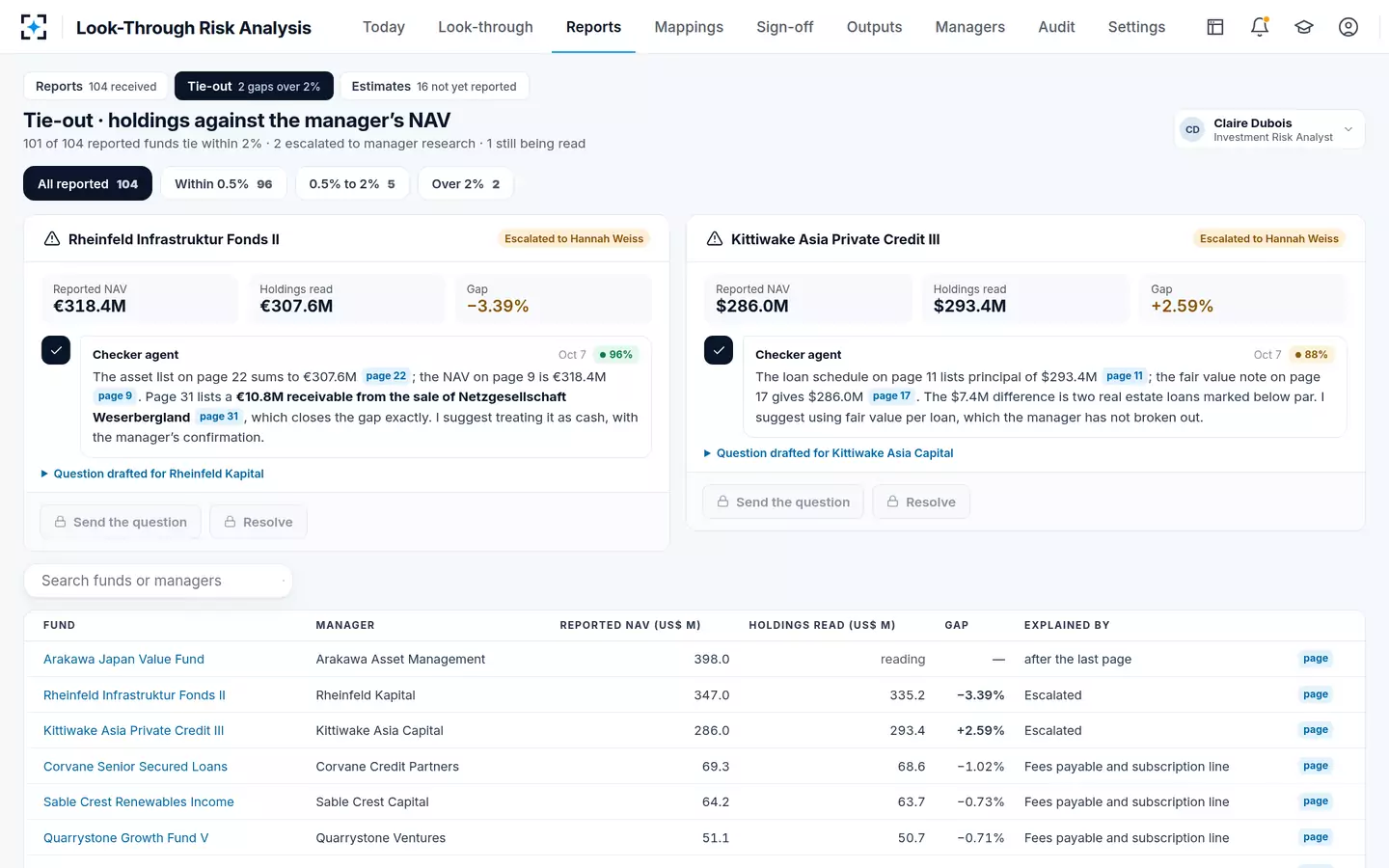
A gap is not always an error to be removed. In the sample quarter an Asian private credit fund reads $293.4 million of loans against a NAV of $286.0 million, +2.59%: the loan schedule on page 11 lists principal, the fair value note on page 17 gives $286.0 million, and the difference is two real estate loans marked below par. The right look-through uses fair value per loan, which the manager has not broken out. The Checker agent suggests exactly that and drafts the question; a person decides whether to adjust, to ask, or to carry the gap as a noted exception.
What tolerance should a tie-out use?
A tolerance is a policy, set before the quarter and applied to every fund; no regulation prescribes one for an investor's own look-through. The sample firm escalates any gap over 2% of NAV to manager research with an explanation, and reviews the band between 0.5% and 2% for patterns.
The sample quarter's tie-outs and estimates, as a replay would read them
96
reported funds tied within 0.5% of the manager’s NAV
5
funds between 0.5% and 2%, reviewed for patterns
2
funds over the 2% tolerance, escalated with a drafted question
3.4%
average difference between last quarter’s estimates and the reports that replaced them
Two rules make a tolerance meaningful in a replay. Compare unrounded figures in the fund's own currency, so foreign exchange and rounding do not hide a misread line. And test the explanation, not only the size: a 0.3% gap explained by "fees payable" should find fees payable in the report, on the page cited. A tolerance that accepts any small gap without its explanation lets a missing line through as long as it is small.
Which differences can you accept, and which you cannot?
Accept a difference only when it can be explained from a source page, and reject it when it cannot. The table below sorts the differences a replay typically finds into those two groups.
Differences a replay finds, and what to do with each
| Difference | Usual cause | Accept? | What to keep |
|---|---|---|---|
| A line value differs | A misread figure, in either run | No, until the page decides | The page, the correct value, which run was wrong |
| A line is missing in one run | A page skipped, or a continuation table not read | No | The page and the line; re-tie the fund |
| Country of risk differs | One run used the domicile printed in the report | Yes, if the evidence supports the new country | Reason code and evidence; re-run limits |
| Issuer group differs | Parent not resolved in one run | Yes, if the parent is documented | Parent and its source |
| Sector differs | Manager and vendor disagree | Yes, with a stated rule for which wins | Both sources and the rule applied |
| Fund-level debt missing | Liabilities netted or ignored | No | Borrowings from the notes, as a liability line |
| Estimate differs from the later report | Market moves, calls and distributions after the last report | Yes, as variance | Variance by fund, against the method used |
| Tie-out gap differs | Cash, receivables or valuation basis read differently | Only if explained by page | The explanation and the page |
Fund-level debt is in the reject column for a regulatory reason. EIOPA's answer on leveraged alternative investment funds says the fund's investments go to the market risk sub-modules and its borrowing counts in the interest rate charge, and possibly the currency charge (EIOPA Q&A 1212). A replay that matches every asset and omits the borrowing has matched the wrong thing.
How do you validate a look-through report before it goes to a client?
Validate it against the client's rules first and against the look-through second. For an insurer, the client file must satisfy the reporting regulation; for a pension, its investment policy; for both, the totals must tie to the client's share of each fund's NAV and the estimated share must be labelled.
A replay protocol, from the signed quarter to a decision
- Freeze the inputs
The manager reports as received, the security master as at quarter end, the investor’s holdings and the limits in force.
- Rerun reading, mapping and tie-out
With the thresholds you intend to use live, not looser ones for the test.
- Compare at line, fund and portfolio level
Every difference listed; portfolio differences traced to the lines behind them.
- Decide each difference from the page
Not from which run produced it. Note which run was right.
- Check the regulatory floors
For insurers: 100% of fund value reported, 90% identified by country and by currency.
- Re-run the limit tests
Breaches found by the replay and missed at sign-off go to the Head of Investment Risk.
- Measure, then set thresholds
Agreement rates by difference type decide the confidence and size limits for live use.
- Keep the replay
The comparison, the decisions and the evidence, for the auditor and the next replay.
The supervisor's own thresholds as a floor for any replay
For insurers, the reporting regulation sets a minimum any replay should meet before accuracy is even discussed. The S.06.03 template must cover all of the value invested in funds, with countries identified for 90% of fund value (excluding mortgages, loans and property) and currencies for 90%, and the unidentified 10% spread so that, for example, no single country takes more than 5% (Implementing Regulation (EU) 2023/894). EIOPA explained the stopping rule in 2019, under the earlier reporting regulation: "Basically, the look-through can stop when both conditions a) and b) are fulfilled", and insurers "should have a reasonable confidence that the 10% not identified by country is diversified across geographical areas" (EIOPA Q&A 1826).
Those are reporting floors, not risk standards. A replay that reaches 90% by country but leaves a single large private credit fund unidentified meets the template and may still miss the concentration the committee cares about. The supervisor's view is that the data matters enough to keep collecting it: EIOPA rejected cutting S.06.03 below twice a year because "any further reductions in its frequency would significantly constrain EIOPA’s ability to perform timely look-through analysis" (EIOPA final report, March 2026).
Running a replay on Look-Through Risk Analysis
The solution is built to be replayed. The Reader agent cites every extracted value to its page and keeps the original language beside the English; the Mapper keeps the evidence and confidence for every mapping; the Checker explains each tie-out gap from the report; the Gap agent labels every estimate and logs the variance when the report arrives; and the audit trail logs every reading, mapping, tie-out, estimate and decision, by people and agents, hash-chained so the chain can be verified.
Every reading, mapping, tie-out and decision in Look-Through Risk Analysis, on one hash-chained trail
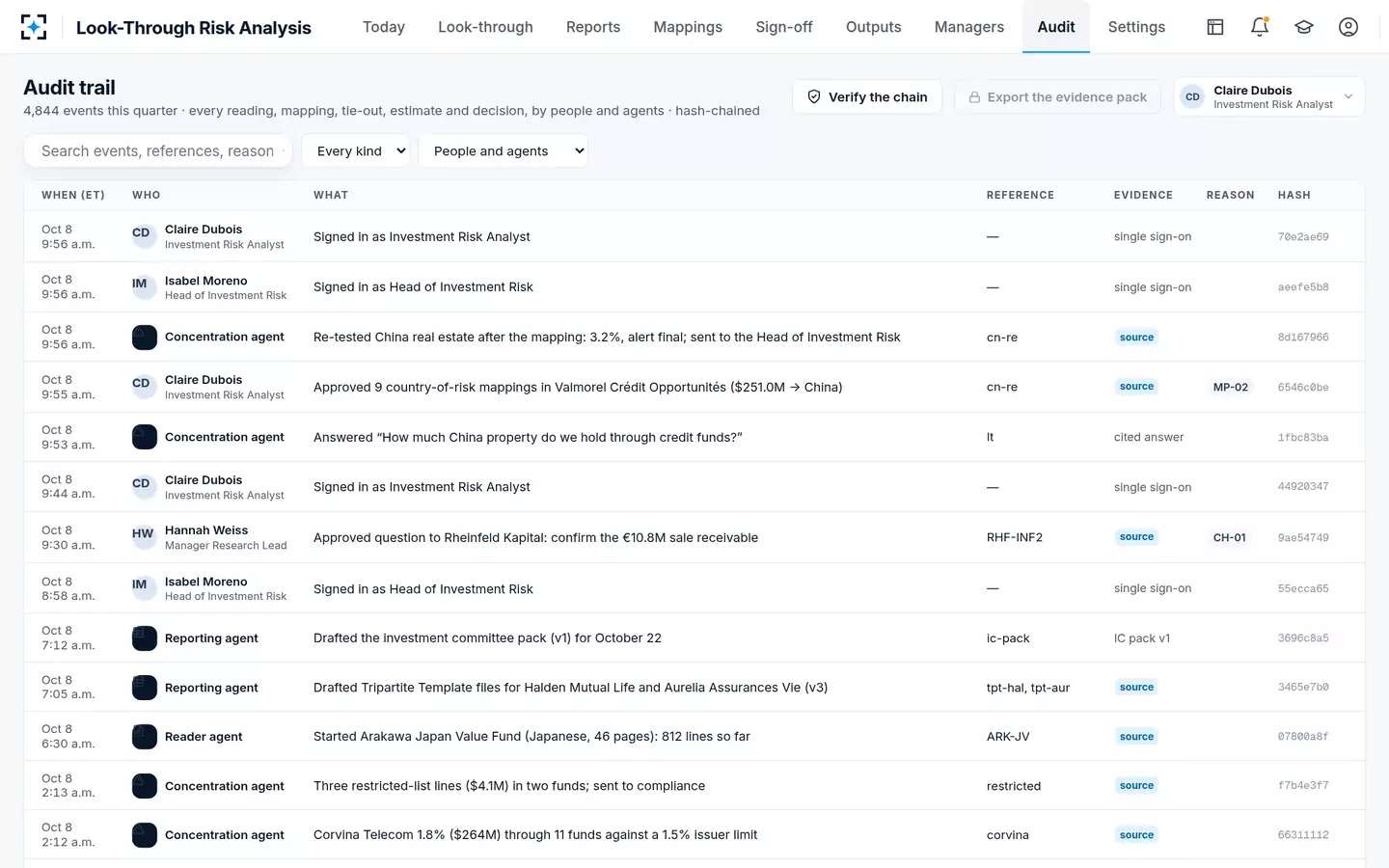
That trail is what makes the comparison cheap: a replay difference opens the page, the mapping evidence and the decision on both sides. A pilot on your own reports usually starts this way, with last quarter's manager reports and the look-through you signed; the Mapper agent's thresholds are set from what the replay measures, and the comparison of look-through approaches explains what to test first if you are choosing between tools.
Questions people ask
How often should look-through reporting be tested?
Before go-live, with a replay of at least one signed quarter, and again after any change to the mapping rules, thresholds or report sources. Many teams also replay a sample of funds each quarter, chosen from the largest and from those whose managers changed their report format.
What is Solvency II look-through reporting?
It is the insurer's reporting of what sits inside its funds, chiefly template S.06.03, which aggregates the underlying assets by category, issuer country and currency and must cover 100% of the value invested in funds. It is reported quarterly when funds exceed 30% of investments, and the SCR approach used for each fund is reported in S.06.02.
Can a look-through report be accurate if some funds have not reported?
Yes, if the unreported share is estimated by a stated method, labelled as an estimate in every report, and replaced with the variance logged when the report arrives. In the fictional sample, last quarter's estimates differed from the later reports by 3.4% on average.
Who should sign a look-through report?
Someone who neither prepared nor reviewed it. In the sample firm the investment risk analyst prepares, the Head of Investment Risk reviews and decides breaches, and the Chief Investment Officer signs; client files go out only after regulatory reporting prepares them and a second person releases them.
Does a matching portfolio total prove the look-through is right?
No. Errors at line level can cancel at portfolio level, and a total that ties to NAV can still carry wrong countries, sectors or issuers. That is why a replay compares lines, fund tie-outs and exposures separately and traces each portfolio difference to its lines.