A client service associate in wealth management is the person who makes a client meeting happen in the accounts: raising cash, preparing trade tickets for the advisor's approval, sending custodian forms, setting up distributions, scheduling the next meeting and filing what was sent. The seat is hard because the work arrives as a voicemail, a line in an email or a hallway "can you set up Robert's RMD?", and because the riskiest item, a wire, often comes with instructions that should not be trusted. Botminds' Client Meeting Preparation gives the associate each task already written: the account, the amount, the due date, the owner and, for a wire, the call-back it needs before anything moves.
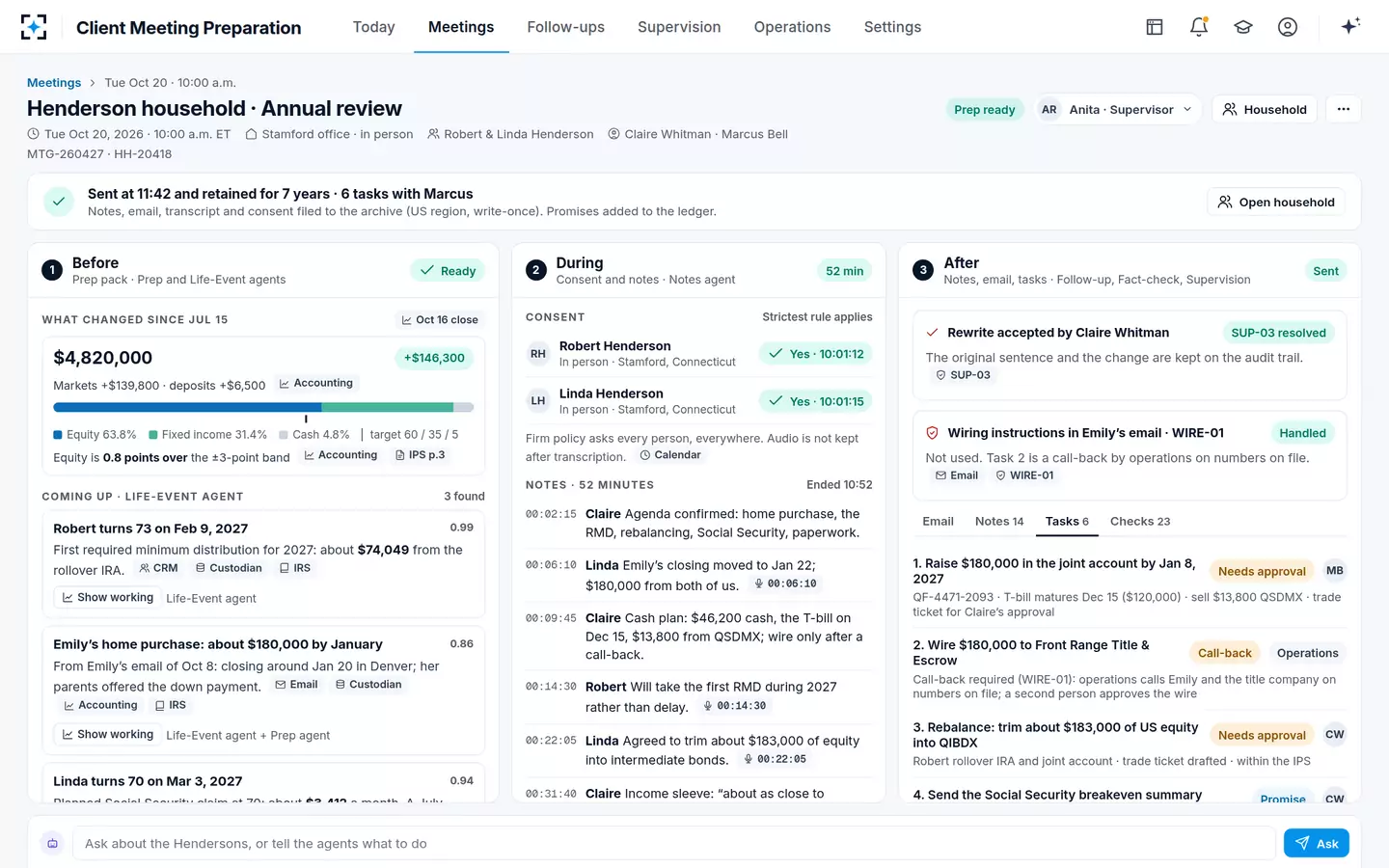
The meeting on this page is fictional sample data in the solution: the Henderson household's annual review with advisor Claire Whitman on October 20, 2026, and the associate on her team, Marcus Bell.
What leaves one client meeting and lands on the client service associate
Agent
Drafts six tasks from the meetingThe Follow-up agent writes each agreed action as a CRM task with owner, accounts, amounts and due date, citing the second of the meeting where it was agreed.
Never: sends, trades or moves money
Agent
Ties every figureThe Fact-check agent ties all 23 figures in the follow-up and tasks to the meeting or the source system; the closing date updated in the meeting, January 20 to 22, is carried through.
A person decides
Advisor approvesClaire approves the email, 14 notes and 6 tasks as their author.
A person decides
Supervisor checksBecause the message moves money and had a flagged sentence, a branch supervisor who did not write it approves it, with a reason.
A person decides
Associate works the tasksMarcus raises the cash, prepares the rebalancing ticket for approval, sends the beneficiary form and sets up the RMD.
A person decides
Operations calls back before the wireOperations calls the daughter and the title company on numbers already on file, and a second person approves the wire.
What does a client service associate do in wealth management?
A client service associate runs the operational side of an advisor's book: account paperwork, money movement, service requests, meeting logistics and the client's day-to-day questions, while the advisor owns the advice. Firms call the seat by different names, client associate, registered client associate, client service manager, and give it different scope; in some it holds securities licences and enters orders, in others it prepares and the advisor enters. What is constant is where much of the work starts: in a client meeting the associate may not have attended.
Before the meeting the same seat usually builds the prep: pulling the household from the CRM, performance from portfolio accounting, balances and open requests from the custodian, and recent email, for every meeting on the advisor's calendar; the sample advisor had 11 in one week. After it, the seat carries everything the meeting set in motion. The two halves compete for the same hours, and the half most likely to slip is the chasing: the form not yet returned, the promise not yet kept.
Official statistics barely see the seat. The US Bureau of Labor Statistics counts personal financial advisors, who "held about 299,400 jobs in 2025," with employment "projected to grow 1 percent from 2025 to 2035" (BLS), but its handbook has no occupation for the people who support them. The UK's regulator does count them. In firms that answered its 2025 survey, it found 19,415 "Other support" staff, defined as "Individuals supporting the financial adviser/paraplanner with administrative tasks," alongside 26,873 financial advisers and 5,665 paraplanners (FCA, April 2026).
Small UK advice firms employ almost one support person per adviser; large ones about half
After the meeting: the six tasks from one review
One 52-minute annual review produced six tasks in the sample. Listed with their owner and what each needs, they show why the associate's seat decides how fast a client sees the meeting's results.
Six tasks from one annual review, as the associate receives them
| Task | Owner | Details already in the task | What can go wrong |
|---|---|---|---|
| Raise $180,000 in the joint account by January 8, 2027 | Associate | $46,200 cash already there; a $120,000 T-bill maturing December 15; sell $13,800 of a municipal bond fund (trade ticket for the advisor's approval) | The T-bill proceeds are swept elsewhere; the sale happens before the advisor approves it |
| Wire $180,000 to the title company | Operations | Only after a call-back to the daughter and the title company on numbers on file; a second person approves | The wire goes to instructions copied from an email |
| Rebalance: trim about $183,000 of equity into intermediate bonds | Advisor | Accounts named; trade ticket drafted within the IPS | The trim and the cash raise sell the same lots twice |
| Send Linda's Social Security breakeven summary | Advisor | Promised by October 27 | A promise made in the meeting is forgotten |
| Set up Robert's 2027 RMD | Advisor's team | Taken during 2027, not delayed; amount confirmed on the December 31 balance | The distribution is never scheduled; the client owes an excise tax |
| Send the signed beneficiary form to the custodian | Associate | Signed in the meeting; confirm the custodian accepts it | The form sits in a folder; the old beneficiary stays on file |
Two of the six involve money moving and two involve a trade. Three depend on another: the cash raise needs the T-bill to mature, the wire needs the cash, and the rebalancing must not sell the lots the cash raise is using. A task list that says only "Henderson: raise cash, wire, rebalance" leaves the associate to reconstruct all of that from memory or a recording. A task that names the accounts, the amounts and the dependency does not.
Who sends the follow-up after a client meeting?
The advisor owns it; the associate often drafts it and files it. Whoever types it, the follow-up email is a communication the firm must keep, and at a FINRA member it is correspondence that falls under the firm's review procedures. FINRA lets a principal hand parts of that work to others, "a supervisor/principal may delegate certain functions to persons who need not be registered," but "the supervisor/principal remains ultimately responsible for the performance of all necessary supervisory reviews" (FINRA Rule 3110, Supplementary Material .08).
In the solution the split is fixed by design. Agents draft; the advisor approves every message as its author; a message with a flagged sentence or money movement then goes to a branch supervisor who did not write it; and only then is it sent and filed. The associate does not have to judge whether a sentence is promissory or whether a figure is right, because both checks have happened before the email reaches the send step. How a single number is checked on its way from the meeting to that email is traced in are AI notetakers safe?
Who enters meeting notes in the CRM?
Traditionally the associate, from the advisor's handwritten notes, a dictation or memory, and usually days later. That lag is where promises go missing: a breakeven summary promised "by next week" is not in the CRM, so nobody is reminded. In the sample, the Follow-up agent wrote 14 notes for the CRM and recorded each promise the advisor made, with its due date, and all of it entered the CRM as drafts the advisor approved with the email.
Notes also need the same care as the email. A summary that says "client wants $180,000 wired to the title company" invites someone to do exactly that. The sample notes instead say what was agreed and the condition attached: the wire waits for a call-back on numbers on file.
Why the wire is the riskiest task on an associate's list
$2.77bn
reported losses to business email compromise in 2024
21,442
business email compromise complaints to the FBI in 2024
$956,342
one 2024 case: a spoofed email asked home buyers to wire their closing funds
The wire is the riskiest task on the list
Money movement after a meeting is a fraud target because it is expected. The FBI's Internet Crime Complaint Center describes business email compromise as fraud run through hijacked email accounts, phone numbers and video-meeting apps, and recorded $2,770,151,146 of losses from it in 2024 (FBI IC3). Real estate closings are a known setting: in one 2024 case, buyers received a spoofed email asking them to wire $956,342 "to finalize the closing."
The SEC's examiners now name the next version of the threat. Their 2027 priorities single out "SI-generated phishing messaging and synthetic or deepfake voice and video used for social engineering" (SEC Division of Examinations). A call-back defeats a spoofed email only if the number dialled comes from the firm's own files, not from the email or the caller. That is the rule in the sample: wiring instructions received by email are masked and never used, operations calls the daughter and the title company back on numbers already on file, and a second person approves the wire.
Sent, kept and handed over: the associate's tasks, already specified
The books and records an associate's work creates
Almost everything an associate sends is a communication the firm must keep. For investment advisers, Rule 204-2(a)(7) covers written communications sent and received relating to "Any receipt, disbursement or delivery of funds or securities" and "The placing or execution of any order to purchase or sell any security," for at least five years (17 CFR 275.204-2). For broker-dealers, Rule 17a-4(b)(4) covers communications "(and any approvals thereof)," including "inter-office memoranda and communications," for three years (17 CFR 240.17a-4). The email to operations asking for the wire, the custodian's confirmation of the beneficiary form and the note to the client that the RMD is set up all fall inside those sentences.
The practical consequence is that associates should work in the firm's own systems, not in a personal text thread with a client, however friendly. The SEC's cases on off-channel communications turned on messages that were never captured; what those cases cost firms is covered in another series. In the sample, the email, notes, transcript, consent and the supervisor's decision were filed together, write-once, in the client's region, under the firm's seven-year policy.
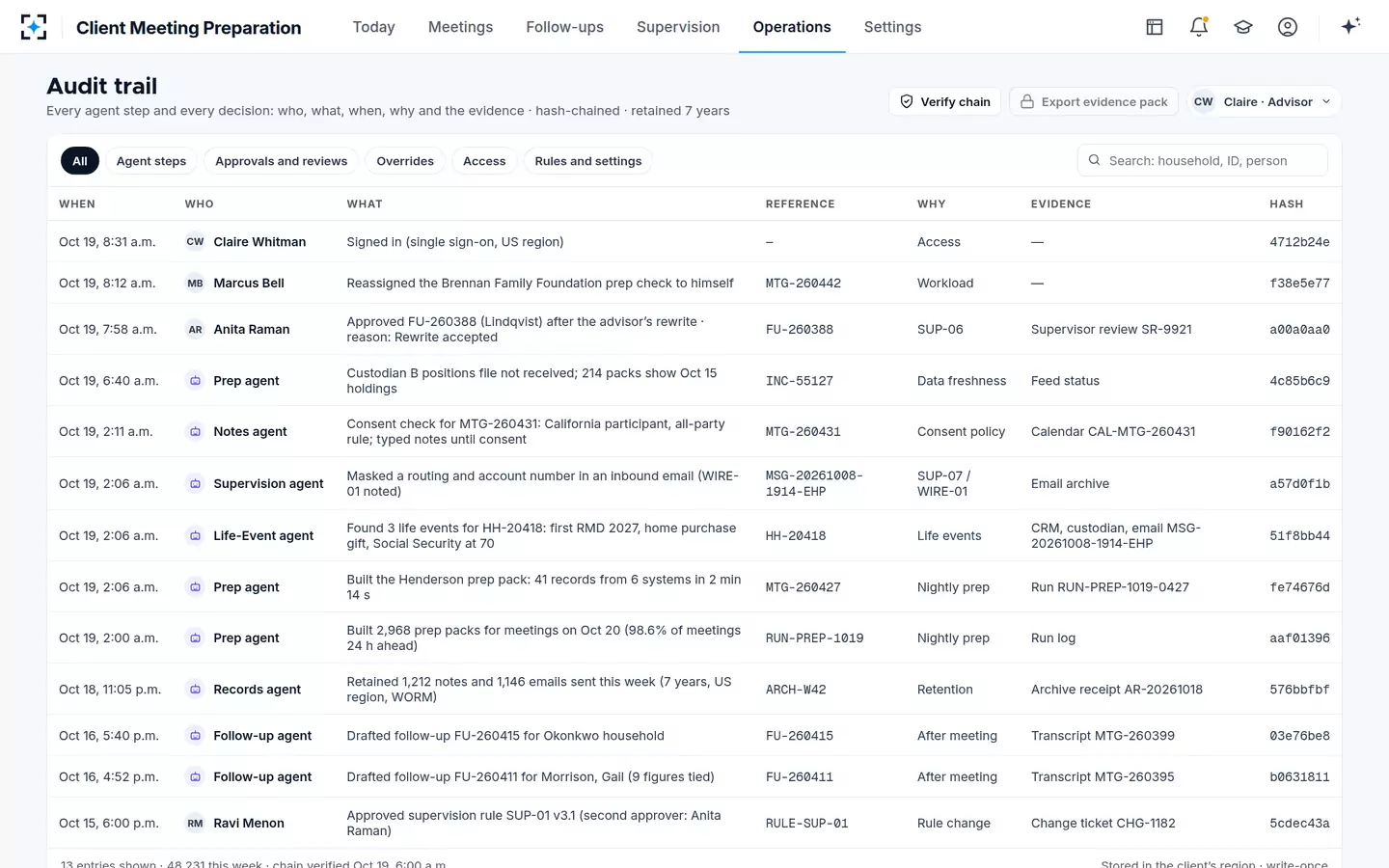
Keeping the communication is half of it; being able to show who did what is the other half. When a client disputes a wire or an examiner asks why a distribution was late, the associate's answer is a sequence: who drafted the task, who approved it, when the call-back happened and who released the funds. In the solution every agent step and every person's decision is written to a hash-chained audit trail with the reason and the evidence, and the sample firm's trail held 48,231 entries in one week. Compliance can export the trail for a household, a branch or a period.
Every step after the meeting, on one audit trail in Client Meeting Preparation
Client service associate job description, rewritten for agents
The job description most firms post lists the tasks above. With agents drafting the tasks, the seat changes shape: less transcription and chasing, more checking and exceptions. The people around the meeting change too.
How the seats around a client meeting change when agents draft the work
Today
Pulls data for each meeting, then rebuilds the agreed actions from notes, a voicemail or a line in an email.
With agents
Receives each task with accounts, amounts, due dates and conditions; works the exceptions.
Still theirs: Every action that touches an account, and the client's day-to-day questions.
Today
Writes the notes, the follow-up and the tasks after the meeting, often the next day.
With agents
Reads and approves a drafted follow-up, notes and tasks in which every figure is tied.
Still theirs: The advice, the wording to the client and the approval of every message.
Today
Reviews a sample of correspondence after it went out.
With agents
Sees flagged and money-moving messages before they go, with the sentence, the rule and the rewrite.
Still theirs: Approve, return or escalate, with a reason.
Today
Receives wire requests with instructions attached and a deadline.
With agents
Receives a wire task that requires a call-back on numbers on file and a second approver.
Still theirs: The call-back and the release of funds.
How fast should tasks reach the associate?
The same day as the meeting, if the follow-up is approved the same day; the sample firm's target is that the advisor approves the follow-up within one business day. In the week shown on its operations screen, 94.1% of follow-ups met that, against a 95% target, and the 31 drafts that missed it in one office became an escalation. That number belongs on an associate team's dashboard, because every hour a follow-up waits is an hour the tasks behind it cannot start. Which measures show that AI is working in a wealth business is the subject of another guide.
The sample review shows the whole span: the meeting ended at 10:52, the advisor approved at 11:24, the supervisor at 11:41, the email went at 11:42, and the six tasks were with the associate before lunch. To see them in the solution, open Client Meeting Preparation.
Questions people ask
What is a client service associate?
A client service associate supports a financial advisor's clients and accounts: paperwork, money movement, service requests, meeting logistics and follow-through on what was agreed. Some hold securities licences and enter orders; others prepare them for the advisor.
Is a client service associate the same as a paraplanner?
No. A paraplanner supports the advice itself, analysing and drafting recommendations; the FCA defines paraplanners as qualified to at least level 4. A client service associate supports the service and the accounts. The FCA's survey counts the two separately: 5,665 paraplanners and 19,415 other support staff in responding firms.
Can a client service associate send emails to clients?
Yes, within the firm's procedures. Those emails are communications the firm must keep, and at a FINRA member they are correspondence subject to review; a principal may delegate some review functions to unregistered staff but stays responsible for them.
Who is responsible if a wire goes to a fraudster?
The firm's procedures decide who must verify what, and that is why the call-back matters. A call-back on a number already on file, not one taken from the email, with a second person approving, is the control that the FBI's business email compromise cases show is needed.
What does a client service associate do after a client meeting?
Turns each agreed action into account work: raising cash, preparing trades for approval, sending forms, setting up distributions and scheduling the next meeting. In the sample annual review that was six tasks, three of them dependent on each other.