RMD tracking is the firm's process for knowing, for every client account subject to required minimum distributions, whether a distribution is due this year, how much, from which account, by what date, and whether it has been taken. The custodian's notice is the starting point, not the control: IRA trustees must send owners a statement by January 31 that an RMD is due, but the IRS does not require that reporting for IRAs of deceased participants, workplace plans run their own rules, and the first year's April 1 deadline sits outside the normal December cycle. A firm that relies on custodian notices alone tracks the easy cases and misses the ones that carry the 25% excise tax. Botminds' Client Meeting Preparation reads each household's accounts across the firm's systems before a review, and its Life-Event agent finds RMD ages, inherited accounts and the dates around them and costs them, so the decision is made in a meeting before the year it is due.
The rules here are the IRS's and the Internal Revenue Code's, linked where they appear. The household example is fictional sample data from the solution: Robert and Linda Henderson, reviewed on 20 October 2026.
The dates and rates an RMD process runs on
31 Jan
custodian statement to the IRA owner that an RMD is due this year
1 Apr
first-year deadline, in the year after the owner turns 73
31 Dec
deadline for every later year’s RMD
25%
excise tax on a shortfall; 10% if corrected within two years
What does RMD tracking have to cover for an advisory firm?
Every account type that can owe a distribution, every client who can owe one, and every step from the decision to the distribution landing. That means traditional, SEP and SIMPLE IRAs; employer plans such as 401(k), 403(b) and 457(b) accounts; and inherited accounts held as beneficiary. Roth IRAs and designated Roth accounts do not need RMDs while the owner is alive: the IRS says withdrawals "from Roth IRAs and Designated Roth accounts (401(k) or 403(b)) are not required until after the death of the account owner" (IRS RMD FAQs). Roth accounts inherited by a beneficiary do come into the rules.
Three facts drive the design. The amount is set by the prior December 31 balance, so an estimate made in a mid-year review will change. The deadline is December 31 except in the first year, when it is April 1. And the shortfall penalty falls on the client while the failure is usually the firm's process: a decision taken in a meeting that never became a task, a custodian form never sent, or a transfer that moved the money without the distribution.
What the custodian reports, and what it does not
IRA custodians carry a reporting duty, and its limits are where tracking gaps begin. Under the IRS's 2026 instructions, "for each IRA you held as of December 31 of the prior year, if an RMD is required for the year, you must provide a statement to the IRA participant by January 31," by one of two methods: stating the amount and the deadline, or stating that a distribution is required with "an offer to furnish the participant with a calculation of the amount of the RMD if requested" (IRS Instructions for Forms 1099-R and 5498). On Form 5498 the custodian checks box 11; it is "not required to report to the IRS the amount or the date by which the distribution must be made."
Which RMDs the custodian's statement covers, and which the firm must track itself
| Case | Custodian statement by 31 January | What the firm must add |
|---|---|---|
| Owner IRA, RMD due this year | Yes: amount and date, or a notice with an offer to calculate | Which IRA funds the total, and the amount if the custodian used the notice method |
| Owner turning 73 this year | Yes: box 11 is checked for the year of turning 73 | The decision to take it this year or by 1 April next year |
| Spouse sole beneficiary over 10 years younger | Amount may assume no such spouse | The joint life table amount, which is lower |
| Inherited IRA, non-spouse beneficiary | No: no reporting required for IRAs of deceased participants, until further guidance | The 10-year date and any annual distribution owed |
| 401(k), 403(b), 457(b) at an employer plan | Not under these IRA rules; the plan administers its own | Still-working status, 5% ownership, and each plan’s separate RMD |
| Accounts at several custodians | Each custodian reports its own accounts only | The household total and which account pays it |
The inherited-IRA row is the largest gap. The instructions say: "Until further guidance is issued, no reporting is required for IRAs of deceased participants (except where the surviving spouse elects to treat the IRA as the spouse's own)." A beneficiary's annual distribution can be owed with no January statement to remind anyone.
The first-year RMD: the deadline most likely to be missed
The first RMD is due by April 1 of the year after the owner turns 73; every later one by December 31. The IRS states the required beginning date as "April 1 of the year following the calendar year in which you reach age 73," and warns that waiting means "two required distribution dates: a withdrawal on April 1 of the year following the year you turn 73 and an additional withdrawal by December 31" (IRS, Retirement topics: RMDs). The custodian checks box 11 "for the year in which the IRA participant reaches age 73 even though the RMD for that year need not be made until April 1 of the following year."
Take the first RMD in the year of turning 73, or delay it and take two in one tax year
- First RMD, for 2027by 31 Dec 2027
- Second RMD, for 2028by 31 Dec 2028
- Nothing taken in 2027
- First RMDby 1 Apr 2028
- Second RMD, for 2028by 31 Dec 2028
A deadline that occurs once in a client's life is the one a December-cycle process misses. The decision to delay is a tax question: it can make sense in a final year of salary, and rarely for a retired client with steady income, because the two distributions stack. Either way it belongs on the agenda in the autumn before the client turns 73. Anything withdrawn during the year of turning 73 counts toward the first RMD (IRS Publication 590-B).
Inherited IRAs: the RMDs no January statement flags
Most non-spouse beneficiaries must empty an inherited account within ten years, and some must also take annual distributions in between. The IRS says "the entire balance of the deceased participant's account must be distributed within ten years," with exceptions for a surviving spouse, a minor child of the owner, a disabled or chronically ill beneficiary, and one not more than ten years younger than the owner (IRS RMD FAQs). Where the owner died on or after the required beginning date, the final regulations keep annual distributions during the ten years.
Those annual distributions are now enforced. After four years of relief for missed "specified RMDs" from 2021 to 2024, the IRS said the final regulations "will apply for purposes of determining RMDs for calendar years beginning on or after January 1, 2025" (IRS Notice 2024-35). A firm whose clients inherited IRAs from owners who had started RMDs has distributions due every year that no custodian statement is required to announce. The tracking has to hold the date of death, whether the owner had reached the required beginning date, the beneficiary's category and the tenth-year deadline.
Workplace plans, the still-working exception and the 5% owner
Employer plans follow different start rules from IRAs. The IRS says plan participants "can delay taking their RMDs until the year they retire," unless they are "a 5% owner of the business sponsoring the plan," while owners of traditional, SEP and SIMPLE IRAs must begin at 73 "even if they're retired" (IRS RMD FAQs). A client still working at 73 can therefore owe an IRA distribution and no 401(k) distribution in the same year, and a client who owns 5% of the employer owes both.
The tracking consequence is that an advisory firm must know employment status and ownership, not just account balances. A 401(k) left at a former employer is in RMD status from 73; one at the current employer may not be. Whether a client rolls a plan to an IRA changes which rule applies; the plan features an IRA rollover best interest analysis weighs covers that decision.
Aggregation: which account should fund the RMD?
For IRAs, any one account can pay the household's total; for 401(k) and 457(b) plans, each pays its own. "An IRA owner must calculate the RMD separately for each IRA they own but can withdraw the total amount from one or more of the IRAs," the IRS says, and the same applies to 403(b) contracts, while "RMDs from other plans, such as 401(k) and 457(b) plans, must be taken separately from each plan account" (IRS RMD FAQs).
Aggregation is where a firm adds value and where it creates risk. Taking the whole IRA total from the account holding cash avoids selling positions, but each custodian's statement then shows a distribution "missing" from its own accounts, and an operations team chasing those statements can double-pay. The tracking has to record the decision, the paying account and the accounts deliberately left untouched.
RMD starting age by when a person reaches the thresholds in the statute
| If the person | Starting age | Birth years, roughly |
|---|---|---|
| Reached 70½ before 1 January 2020 | 70½ | Born before 1 July 1949 |
| Reaches 72 after 2022 and 73 before 2033 | 73 | Born 1951 to 1959 |
| Reaches 74 after 2032 | 75 | Born 1960 or later |
From meeting decision to completed distribution: where the process fails
Most missed RMDs at a firm are a decision that never became an action. The flow below is the chain a tracking process has to close, and the place each link usually breaks.
One first-year RMD, from the review to the distribution
Agent
Find the eventThe Life-Event agent reads ages, account types and beneficiary status across the household and puts the first RMD on the review agenda, with an estimate on today’s balance.
Never: Never states an estimate as the final amount
A person decides
Decide in the meetingThe advisor and client decide: this year or by 1 April next year, and which account pays.
Agent
Write the taskThe follow-up and the task for the associate are drafted from the meeting, with the decision and the date.
A person decides
Approve and superviseThe advisor approves the follow-up; a registered principal reviews it before it is sent.
A person decides
Set up the distributionThe client service associate submits the custodian’s form once the 31 December balance sets the amount, and confirms it posted.
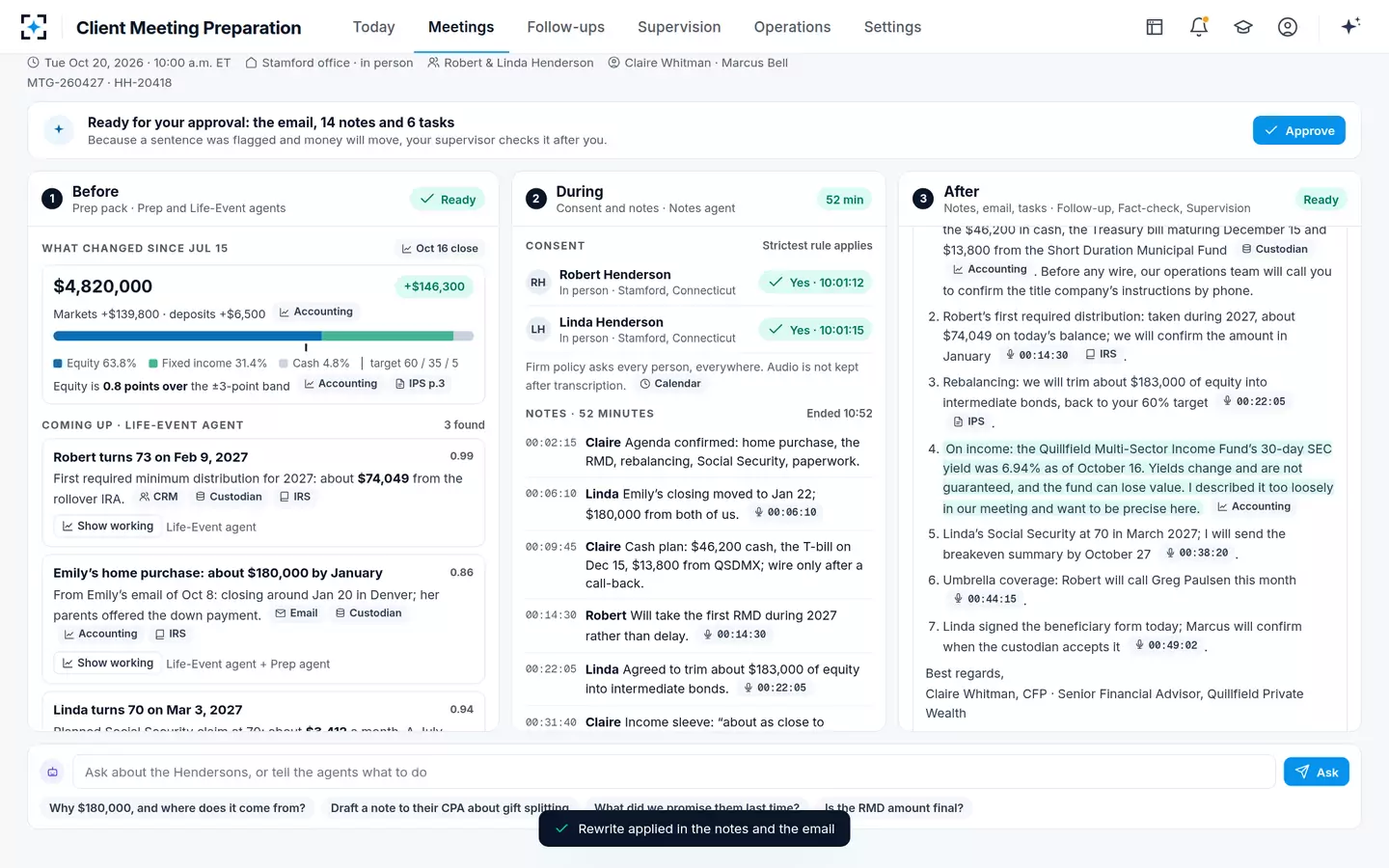
The sample shows why the amount must stay an estimate until January. In October 2026 Robert's rollover IRA held $1,962,300, so the solution estimated his first RMD at about $74,049: $1,962,300 divided by 26.5, the Uniform Lifetime Table divisor at 73 (Publication 590-B, Appendix B). The 2027 amount will use the 31 December 2026 balance, so the agent set a task to recalculate on 2 January. A follow-up that promised "$74,049" would have been wrong; one that said "about $74,049 on today's balance; we will confirm in January" was right.
A first RMD worded as an estimate, with a date to confirm
The cost of a miss, and what the waiver asks for
A shortfall is "subject to an excise tax of 25%, 10% if the RMD is timely corrected within two years," reported on Form 5329, and "the penalty may be waived if the account owner establishes that the shortfall in distributions was due to reasonable error and that reasonable steps are being taken to remedy the shortfall," with Form 5329 filed and a letter of explanation attached (IRS RMD FAQs). On the sample's first RMD, a full miss would cost about $18,500 at 25%, or about $7,400 if corrected in time (our arithmetic on the estimate).
The waiver depends on showing the error was reasonable and corrected, which is a documentation question. A firm whose tracking records when the RMD was identified, what was decided and why the distribution did not post can help a client write that letter. One whose tracking is a spreadsheet updated in December cannot.
RMD tracking software: what to look for
Look for tracking that starts from the household, not the custodian file, and that carries each RMD from identification to a posted distribution. The checklist below is what an operations leader should test in any tool, including a spreadsheet already in use.
Eight tests for RMD tracking across an advisory book
- Finds first-year RMDs a year ahead
Flags clients turning 73 (75 for later birth years) in the autumn before, with the delay decision as its own item.
- Tracks inherited accounts separately
Date of death, whether the owner had reached the required beginning date, beneficiary category and the tenth-year date.
- Knows employment and 5% ownership
So a current-employer plan is not flagged in error and a former-employer plan is not missed.
- Totals across custodians
One household view of IRA and 403(b) totals, with the paying account recorded.
- Separates estimate from amount
An estimate on today’s balance, recalculated on the 31 December value.
- Turns a meeting decision into a dated task
Owned by a named person, with the custodian form and the confirmation of posting.
- Keeps the evidence
When the RMD was identified, what was decided and by whom, for a waiver letter or an examiner.
- Handles the spouse more than ten years younger
Where the joint life table gives a smaller amount than the custodian’s default calculation.
Where Client Meeting Preparation fits
The solution puts RMDs into the meeting where they should be decided. Overnight before each review, its agents read the household's records across the firm's systems; the Life-Event agent finds RMD ages, inherited accounts, Medicare and Social Security dates and large gifts, costs each one and puts it on the agenda with its source. After the meeting, the follow-up and the associate's tasks are drafted from what was decided, the figures are tied to their records, and a supervisor reviews the message before it is sent. What the client service associate does after the meeting covers the hand-off.
What it does not do is calculate the final RMD, submit a distribution or give tax advice. The custodian computes and processes the distribution, the associate submits the form, and the client's tax adviser confirms choices such as delaying the first RMD. Starting a client review from what changed shows how RMDs sit beside the other items in a review.
Questions people ask
Do custodians have to tell clients about RMDs?
For IRAs, yes: an IRA trustee must send the owner a statement by 31 January for each year an RMD is required, giving either the amount and deadline or a notice with an offer to calculate it. Until further guidance, no such reporting is required for IRAs of deceased participants.
Does the IRS receive the RMD amount from the custodian?
No. The custodian checks box 11 on Form 5498 to show an RMD is required, but is not required to report the amount or date to the IRS. Boxes 12a and 12b are optional places to report the date and amount to the owner.
When do inherited IRA beneficiaries need annual RMDs?
Where the owner died on or after the required beginning date, the final regulations keep annual distributions during the 10-year period for most non-spouse beneficiaries. The IRS said the final regulations apply to RMDs for calendar years beginning on or after 1 January 2025, after relief for 2021 to 2024.
Can one IRA pay the RMD for all of a client's IRAs?
Yes. Each IRA's RMD is calculated separately, but the total can be withdrawn from one or more IRAs, and the same applies among 403(b) contracts. RMDs from 401(k) and 457(b) plans must be taken from each plan separately.
What is the penalty for a missed RMD?
An excise tax of 25% of the shortfall, reduced to 10% if corrected within two years, reported on Form 5329. The IRS may waive it if the shortfall was due to reasonable error and reasonable steps are being taken to fix it, with a letter of explanation.
Is the first RMD due by 1 April or 31 December?
The first may be taken as late as 1 April of the year after the owner turns 73, but then the second is still due by 31 December of that year. Taking the first in the year of turning 73 keeps one distribution in each tax year.