Financial advisor meeting prep is the work of gathering a household's accounts, changes, open requests and upcoming dates from every system that holds them, and turning that into an agenda and a few talking points before the client arrives. It is hard because the facts live in six places with six different as-of dates, and because the item that matters most, such as a child's house purchase mentioned in an email, is often in none of the reports. Botminds' Client Meeting Preparation gives the work to agents overnight: they read the CRM, portfolio accounting, the custodian, the email archive, the calendar and the planning tool, cite every line to its source, and leave the advisor to accept, edit or reject each talking point.
To show what that means in practice, this guide follows one prep through the solution on fictional sample data: the Henderson household's annual review at Quillfield Private Wealth, with advisor Claire Whitman, on Tuesday, October 20, 2026 at 10:00 a.m.
One prep looks back 97 days and forward 134
- Quiet months85 d
- Email12 d
- T-bill matures Dec 1556 d
- Cash ready Jan 824 d
- Closing14 d
- Robert 73, Feb 918 d
- Linda 70, Mar 322 d
What financial advisor meeting prep has to produce
Good prep produces five things: what changed since the last meeting, where the portfolio stands against the investment policy statement, what is coming up, what was promised last time and is still open, and up to five talking points with an agenda the client can see in advance. Everything else is supporting detail. A thick binder of performance pages is not prep; it is the material prep is made from.
In the sample, the change since July 15 is concrete. The household was worth $4,820,000 at the October 16 close, up $146,300, of which markets contributed $139,800 and deposits $6,500. Equity had drifted to 63.8% against an IPS target of 60/35/5 with a band of three points either way, so it sat 0.8 points outside the band. Coming up were Robert's first required minimum distribution in 2027, the daughter's home purchase, and Linda's planned Social Security claim at 70. Each line on the screen carries a chip naming its source, CRM, Accounting, Custodian, Email or IRS, that opens the item it came from and its as-of date.
The prep, with every line opening its source
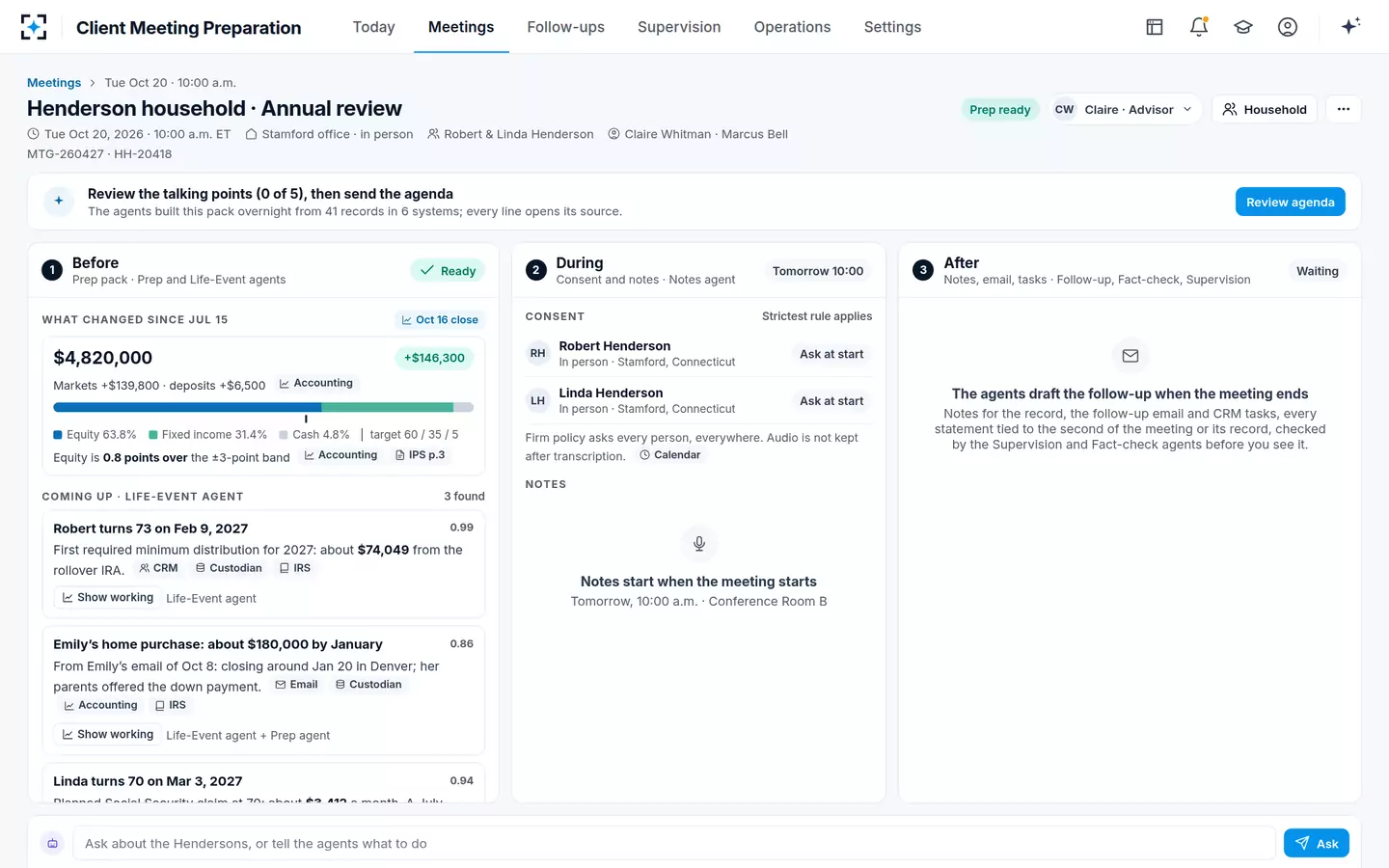
Which systems does meeting prep pull from?
Six, in most wealth firms, and each one answers a different question at a different time of day. The CRM holds the household, contacts, last meeting's notes and open service requests. Portfolio accounting holds valuations, allocation against the IPS, performance and tax lots, usually as of the last close. The custodian holds balances, positions, maturities and pending requests, refreshed by an overnight file. The email archive holds what the client actually said. The calendar says who is coming and from where. The planning tool holds goals and Social Security estimates, and is only as good as the financial planning balance sheet fed into it.
Six sources, six as-of times: what each contributes to one review's prep
| Source | What the prep takes from it | As of | What goes wrong if it is stale |
|---|---|---|---|
| CRM | Household, contacts, last notes, open requests, promises made | Live | A promise from the last meeting is missed, and the client notices |
| Portfolio accounting | Value, change since last review, allocation against the IPS, tax lots | Last market close | Drift is misstated; a sale is costed on the wrong lots |
| Custodian | Cash, positions, maturities, pending transfers | Overnight file | A maturing T-bill or a pending transfer is left out of the cash plan |
| Email archive | What the client wrote since the last meeting | Live | A money need or a date is learned in the meeting instead of before it |
| Calendar | Attendees and where each joins from | Live | A participant's consent rule is not checked in advance |
| Planning tool | Goals, projections, Social Security estimates | Last plan update | The talking points argue from an old plan |
The as-of column is the reason prep goes wrong in practice. A custodian file that arrives late leaves yesterday's positions in the prep; in the sample week one custodian's positions file was a day late for 214 households, and the agents marked the affected lines as stale instead of presenting them as current. An advisor reading a prep should never have to guess how old a number is.
How far ahead should meeting prep start?
Far enough ahead to fix what the prep finds, and late enough that its numbers are still true. Twenty-four hours is a common answer, and it is the default in the solution, with 48 hours or the morning of the day before as alternatives an advisor can pick without approval. Earlier prep gives the associate time to chase a missing document; later prep reads fresher balances. The right answer depends on what the prep is likely to trigger: if a meeting may lead to a trade or a transfer, a day's notice lets the paperwork be ready.
The sample firm's nightly run starts at 2:00 a.m. and built preps for 98.6% of the next day's meetings at least 24 hours ahead in the week shown. The ones it missed are the useful signal: a new advisor's transferred book where confidence fell below 0.80 for 22 households, and planning-tool exports that failed for seven. Those went to operations as escalations, not to the advisors as half-finished preps.
The trace: from the overnight run to the meeting room
Each step below happened in the sample, in this order. Agent steps are numbered; the steps where a person decides are marked.
Financial advisor meeting prep in Client Meeting Preparation, step by step
Agent
Monday 2:00 a.m. · nightly run startsThe Prep agent builds the preps for the next day's meetings, at least 24 hours ahead by default, and marks any source older than its freshness threshold.
Never: contacts a client or changes a source system
Agent
2:06 a.m. · the Henderson prepReads 41 items from six systems in 2 minutes 14 seconds: value and change since July 15, allocation against the IPS, open service items, last meeting's promises; drafts five talking points, each cited.
Agent
2:06 a.m. · life eventsThe Life-Event agent finds three: Robert's first RMD in 2027, about $74,049; a gift of about $180,000 toward the daughter's house closing around January 20, from her October 8 email; Linda's Social Security claim at 70.
Never: places a trade or moves money
Agent
2:06 a.m. · maskingThe daughter's email contains a title company's routing and account numbers. They are masked, and a rule records that wiring instructions received by email are never acted on.
A person decides
Monday morning · the advisor readsClaire Whitman opens the prep, clicks the Email chip to read the daughter's message beside it, and asks why $180,000 and where it would come from.
Agent
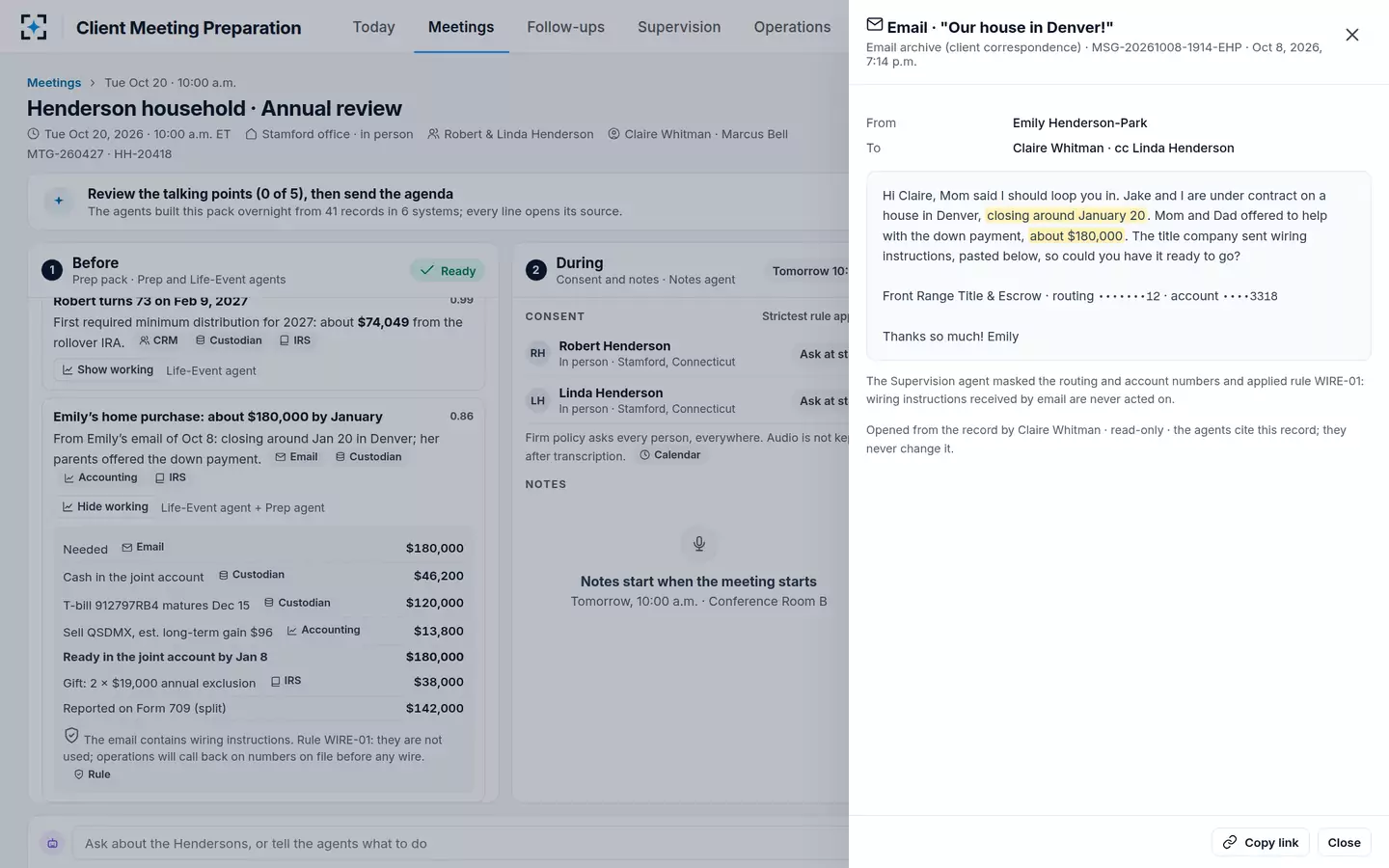
In place · the answerThe Life-Event agent answers with its sources: $46,200 of cash in the joint account, a $120,000 T-bill maturing December 15, and $13,800 from a municipal bond fund sold at an estimated $96 long-term gain.
A person decides
Monday · talking points and agendaThe advisor accepts, edits or rejects each of the five talking points and sends the agenda to the clients. Nothing goes to a client without her.
Agent
Tuesday 10:01 a.m. · consent, then notesThe Notes agent asks each person in the room; Robert says yes at 10:01:12 and Linda at 10:01:15, and only then do notes begin, each with speaker and time.
The email nobody filed: why prep has to read correspondence
The most consequential item in the sample prep came from an email, not a report. On October 8 the Hendersons' daughter wrote that she was under contract on a house in Denver, closing around January 20, that her parents had offered about $180,000, and that the title company had sent wiring instructions she pasted in. None of that appears in portfolio accounting, and a prep built only from positions and performance would have walked into the meeting without it.
The same email shows why reading correspondence needs care. A real estate closing is the classic setting for email fraud: the FBI's Internet Crime Complaint Center describes a 2024 case in which buyers "received a spoofed email from their supposed real estate agents requesting that they wire $956,342 to a U.S. domestic bank to finalize the closing" (FBI IC3, 2024 report). Prep that surfaces a money need should also surface the risk around it, which is why the solution masks the account numbers and turns any wire into a task that waits for a call-back on numbers already on file.
The email behind a figure, opened read-only beside the prep
What the advisor still decides
The agents assemble; the advisor judges. Three judgements stayed with Claire in the sample, and they are the ones no prep should take away. Whether to raise the gift at all, and how, with two parents who may not agree on it. Whether the 0.8-point equity drift is worth a trade now, given that the gift will need cash and the first RMD will draw on the IRA. And what to say about the income sleeve, a sentence that, as it turned out, she phrased too loosely in the meeting and corrected before the follow-up went out.
Confidence scores help her decide what to check. The RMD line carried 0.99; the gift, inferred from an email's "about $180,000" and "around January 20," carried 0.86. Below 0.80, the solution would have marked the line "to confirm" rather than present it. That is a design choice worth copying in any prep process, manual or not: say how sure you are next to each item.
One review's prep in Client Meeting Preparation, in numbers
41
items read from six systems for one annual review
134s
for the overnight build of that prep: 2 minutes 14 seconds
5
talking points, each accepted, edited or rejected by the advisor
0.80
confidence below which a line is marked to confirm
A financial advisor meeting prep checklist
Whether the prep is done by an associate, an advisor or agents, the same ten checks separate a prep that helps from one that only looks thorough.
Ten checks before a client review meeting
- State the change since the last meeting in dollars, split into markets and flows
A client asks "why is it up?" before anything else.
- Compare allocation with the IPS band, not just the target
Drift inside the band is not a talking point; drift outside it is.
- List last meeting's promises and their status
An unkept promise read back by the client costs more than any market move.
- Read correspondence since the last meeting
Money needs and dates arrive by email long before they reach a report.
- Find dated events in the next 12 months
RMDs, Medicare and Social Security dates, maturities, closings, tuition.
- Cost each money need against cash, maturities and tax lots
A need without a source is a worry; a need with a plan is an agenda item.
- Show each number's source and as-of date
A stale custodian file should be marked, not presented as today.
- Mask account numbers and never act on emailed wiring instructions
Real estate closings are a known target for email fraud.
- Check who is attending and from where
Consent to take notes may depend on where each person joins from.
- Write no more than five talking points, and send the agenda ahead
Clients who see the agenda bring the documents it needs.
How to prepare for a financial advisor meeting when you cannot automate yet
Start with the two sources most preps skip: correspondence and dates. Run a search of the client's emails since the last meeting for amounts, dates and the words "house," "tuition," "sell," "retire" and "wire." Then list each household member's birthdays that cross a threshold in the next year: 65 opens Medicare's enrollment window, and 73 is the age for a first RMD under current law, with the first one due by April 1 of the year after the client turns 73 (IRS). How a firm tracks first-year and inherited RMDs across a book is set out in RMD tracking for advisors.
Then measure. No regulator or independent study publishes how long advisors spend preparing for meetings, so the only reliable figure is your own: time-stamp the start and finish of prep for twenty consecutive reviews, split into gathering, reading and writing, and repeat after any change. The gathering share is the part agents remove; the writing share is the part they speed up; the reading share should not shrink much, because that is where the advisor's judgement lives.
The UK's regulator gives a sense of the volume involved. Its survey of advice firms counts about 31,000 advisers with an average of 150 clients each, and says 99% of firms still meet clients in person, with firms exploring AI "for example, for meeting notes, data extraction and analysis" (FCA, April 2026). A hundred and fifty households is a hundred and fifty preps a year at the least, and many more for clients seen twice. What changes in the meeting itself when prep starts from the change log is the subject of starting a client review meeting from what changed.
What FINRA expects when software prepares the meeting
Prep is internal, so it is not correspondence, but the summaries agents write are still subject to the firm's supervision of how it uses generative AI. FINRA's 2026 report lists "Summarization and Information Extraction" among firms' uses and warns that "Misrepresentation or incorrect interpretation of rules, regulations or policies or inaccurate client or market data can impact decision making" (FINRA, 2026 oversight report). An advisor who walks into a review with a wrong balance makes a worse recommendation; that is the risk the cited line, the as-of date and the confidence score are there to contain.
The agenda the prep produces is different: once it is sent to the client it is a communication the firm keeps and, at a FINRA member, correspondence. How to write one from the file, item by item, is set out in the financial advisor meeting agenda guide. To see the whole trace on the sample review, open Client Meeting Preparation.
Questions people ask
What goes in a client review prep?
The change in value since the last meeting, split into markets and flows; allocation against the IPS band; open requests and last meeting's promises; dated events coming up and the money they need; and up to five talking points with an agenda. In the sample prep that came to 41 items from six systems, each with its source.
How long should financial advisor meeting prep take?
No regulator or independent study publishes a figure, so measure your own: time twenty consecutive preps, split into gathering, reading and writing. Agents remove most of the gathering; in the sample, the overnight build for one review took 2 minutes 14 seconds, leaving the advisor's reading and decisions.
Who should prepare for a client meeting, the advisor or the associate?
Both, in different parts. The associate or the agents gather and reconcile; the advisor decides what to discuss and how. Talking points that will be said to a client should always be the advisor's to accept, edit or reject.
Should a prep include the client's emails?
Yes, because money needs and dates often arrive by email first. In the sample, a $180,000 gift toward a house closing was found in an email 12 days before the review. Account numbers in emails should be masked, and wiring instructions received by email should never be acted on without a call-back.
What is the difference between meeting prep and a meeting agenda?
The prep is the advisor's internal working view: sources, numbers, confidence and judgement calls. The agenda is the short list the client sees, and once sent it is a communication the firm keeps and, at a FINRA member, reviews under its procedures.