AI notetakers are safe enough for client meetings when three conditions hold: everyone in the meeting has agreed to the capture, the client data they hold is protected like any other customer information, and every figure they write is tied back to the second of the meeting it came from before it reaches the client or the CRM. The third condition is the one most often missed. Speech recognition makes errors, summaries can harden a loose remark into a promise, and a wrong number in a fluent paragraph is easy to approve. Botminds' Client Meeting Preparation was built for that risk: its Fact-check agent ties every number, date and named product in a draft to the transcript second or the system it came from, and its Supervision agent checks every sentence before the advisor approves the email.
The examples on this page are fictional sample data in the solution: the Henderson household's annual review with advisor Claire Whitman on October 20, 2026, a 52-minute meeting that produced 14 notes, a follow-up email and six tasks.
One figure's path from the meeting to the client's inbox, with the check at each hop
Agent
Spoken · 00:06:10Linda Henderson says her daughter's closing has moved to January 22. The Notes agent writes it with the speaker and the second it was said.
Never: captures anyone who has not consented
Agent
Compared with the prepThe prep said "around January 20", from the daughter's email. The Fact-check agent marks January 20 as updated by the meeting, citing 00:06:10.
Agent
Carried into the draftThe follow-up email and the cash task use January 22, and the cash is due January 8, two weeks before.
Agent
Tied, or sent to a personAll 23 figures in the email and tasks are tied to a second of the meeting or a source system. An untied figure would go to a person.
Never: keeps the likeliest reading of a figure it cannot tie
A person decides
Advisor reads and approvesClaire checks the cited moment in seconds and approves the email, notes and tasks as their author.
Agent
Written to the CRM and keptThe task enters the CRM as approved; the email as sent, the transcript and the consent are kept together, write-once.
Are AI notetakers safe? It depends on what happens to one number
Safety is not a property of the transcript as a whole; it is a property of each figure in it. A summary that captures the gist of a 52-minute meeting is useful even with a few misheard words. The same summary is dangerous if one of those words is an amount, a date, an account or a promise, because that word is the one that will be copied into the client's email, the associate's task and next year's prep.
The useful test is therefore narrow: pick one figure said in the meeting and follow it. Where was it said, by whom, and at what second? Did the notes keep it exactly? Did the email? Did the CRM? Was any check applied at each hop, and who would have caught an error? In the sample, the closing date changed during the meeting, from the "around January 20" in the daughter's email to January 22 in her mother's words, and the follow-up carried the new date with a pointer to 00:06:10. That is what safe looks like.
Which figures in AI notes matter most
Four kinds of words carry nearly all the risk in a client meeting's notes: amounts, dates, percentages and names. Amounts become instructions: the sample follow-up asked the associate to raise $180,000 by January 8. Dates become deadlines: a first required minimum distribution, a house closing, a maturing T-bill. Percentages become implied promises: a yield or a return said aloud reads very differently written down. And names select the thing acted on: the wrong fund, account or beneficiary turns a correct instruction into a wrong trade.
Everything else in a summary, the tone of the discussion, the order of topics, the client's mood, can be slightly off without harm. That asymmetry is why a notetaker's safety can be tested on a short list rather than the whole transcript, and why the solution's Fact-check agent concentrates on them: it ties every number, date and named product in a draft, and requires an exact tie for each. In the sample follow-up and tasks there were 23 of them.
How accurate are AI meeting notes?
Accurate enough to read, not accurate enough to trust without a check, and least accurate for some speakers. A peer-reviewed study of five state-of-the-art speech-recognition systems found "an average word error rate (WER) of 0.35 for black speakers compared with 0.19 for white speakers" (Koenecke et al., PNAS 2020). A later study of a widely used model found whole invented phrases in about one transcription in a hundred, and that "38% of hallucinations include explicit harms such as perpetuating violence, making up inaccurate associations, or implying false authority" (Koenecke et al., ACM FAccT 2024).
Two cautions keep those findings honest. The 2024 study tested the model in April and May 2023; when the authors re-ran the troublesome clips in December 2023, most had been fixed, and they found no comparable hallucinations in the other providers' services they tested on the same clips. And the errors concentrated in speakers with long pauses, a symptom of aphasia in their sample. The lesson for a firm is not that one product is bad but that error rates differ by system, by version and by speaker, so no vendor's headline accuracy describes your clients' meetings.
What research has measured about errors in automatic transcription
0.35
word error rate for Black speakers across five systems, against 0.19 for white speakers
1.4%
of transcriptions in one 2023 test contained hallucinated phrases
38%
of those hallucinations contained harms such as false authority
12 of 187
troublesome clips still hallucinated after a model update
What happens if AI notes are wrong?
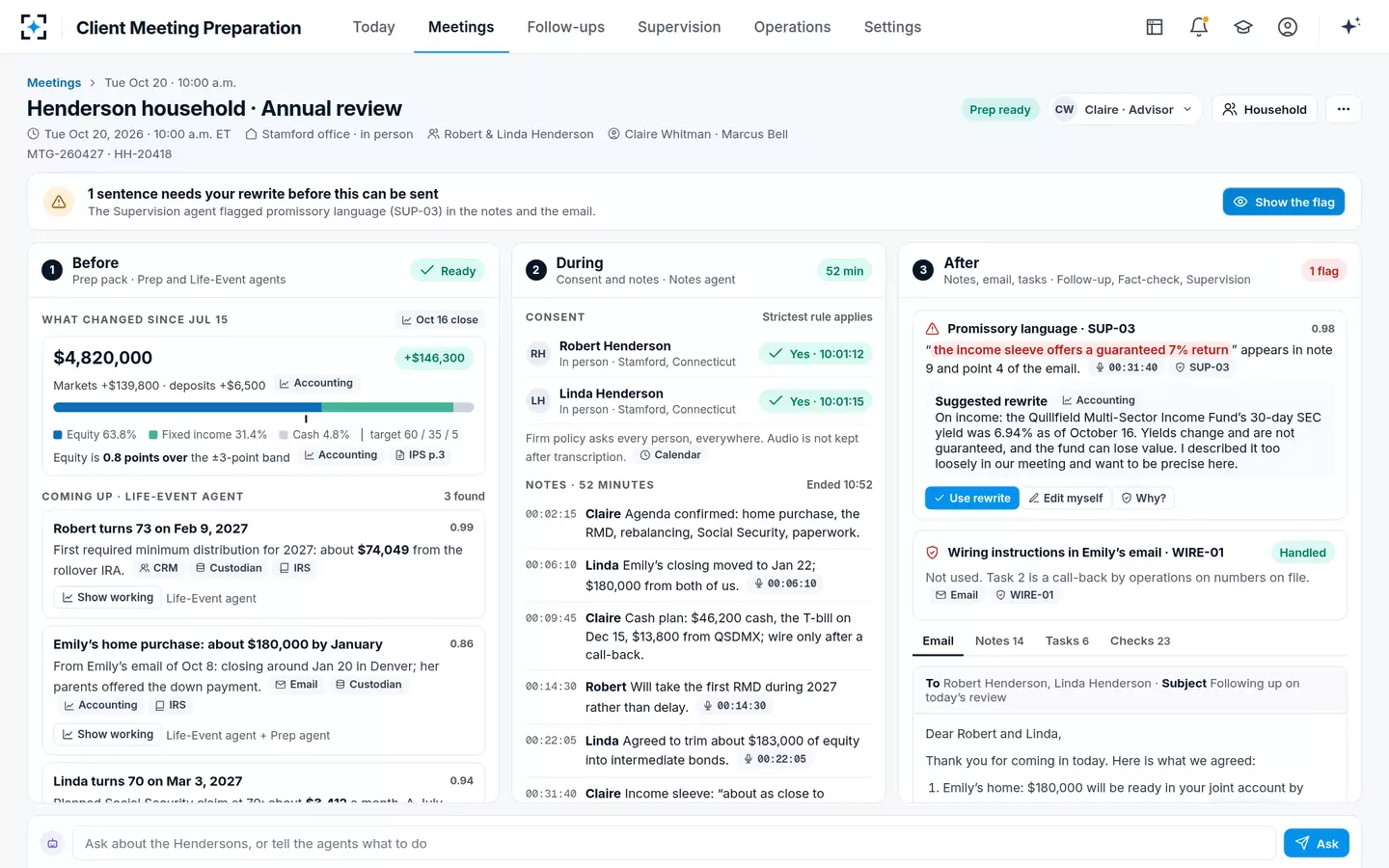
A wrong figure becomes a wrong instruction, and a loose remark can become a promise. The sample has both kinds of risk, and the second is the instructive one. At 00:31:40 Claire described the income sleeve as "about as close to guaranteed as it gets," a loose phrase said in conversation. The drafted note turned it into "the income sleeve offers a guaranteed 7% return": firmer than what she said, and with a number she did not say. NIST's profile for generative AI calls this failure confabulation: wrong or false content stated with confidence, the thing usually called a hallucination, which can mislead the reader (NIST AI 600-1, July 2024).
Roughly 1% of audio transcriptions contained entire hallucinated phrases or sentences which did not exist in any form in the underlying audio.
Koenecke et al., ACM FAccT 2024
Had it been sent, the sentence would have broken a content rule regardless of who wrote it. FINRA Rule 2210(d)(1)(B) bars any "false, exaggerated, unwarranted, promissory or misleading statement or claim" in a member's communications (FINRA Rule 2210). The Supervision agent flagged it in note 9 and in point 4 of the email under the firm's rule on promissory or guaranteed returns and proposed a rewrite: the fund's 30-day SEC yield of 6.94% as of October 16, that yields change and are not guaranteed, and that the fund can lose value. Claire accepted it and added that she had described it too loosely in the meeting.
A drafted note hardened a loose remark into a guarantee; Client Meeting Preparation flagged it
Who checks AI-drafted follow-ups?
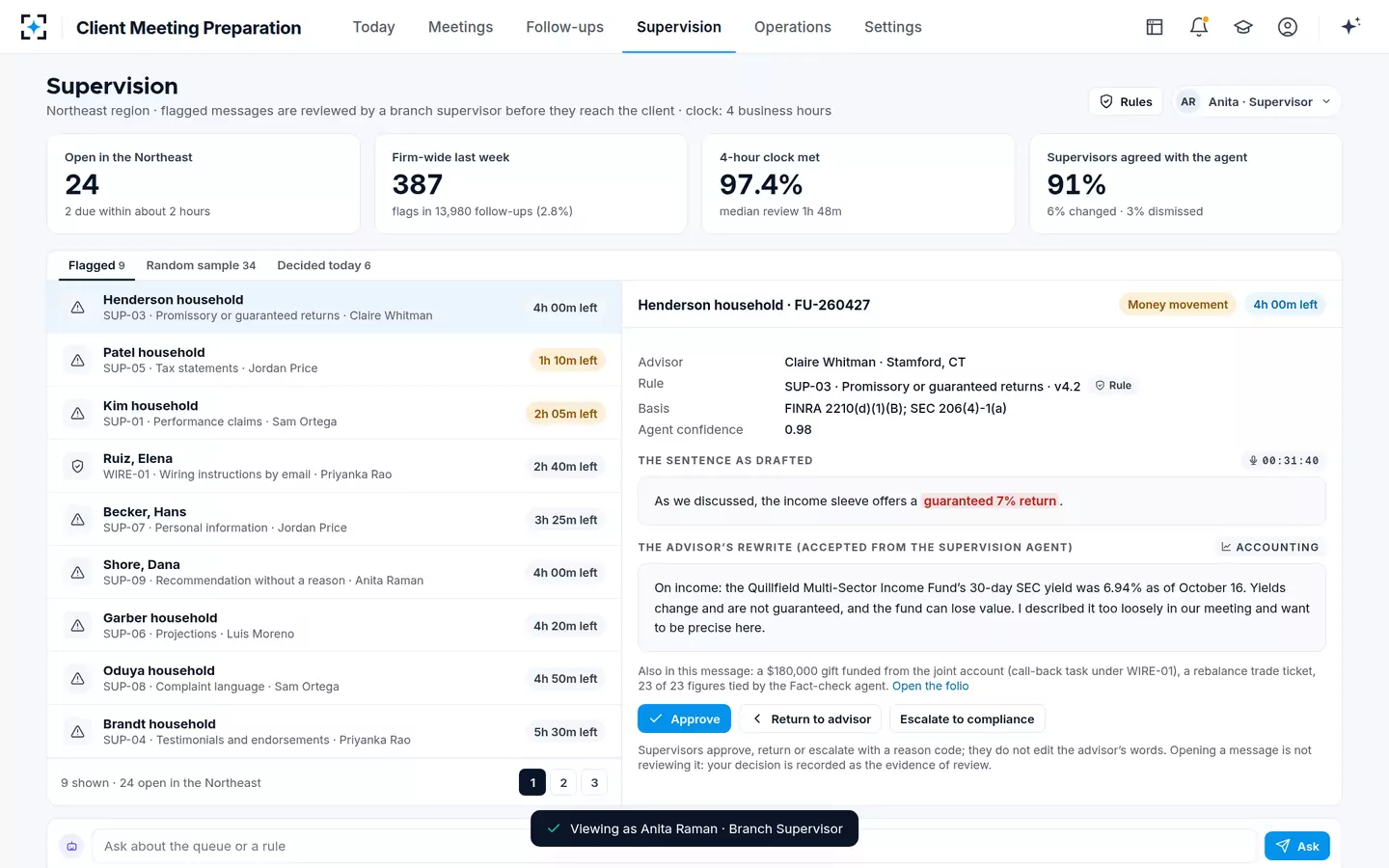
Agents check every draft; people approve every message. In the solution three checks run before the advisor sees the follow-up: the Fact-check agent ties each figure exactly or refuses it, the Supervision agent checks each sentence against the firm's versioned rules and proposes rewrites, and both mark what they could not resolve. The advisor then approves the message as its author. A message with a flagged sentence, or one that moves money or places a trade, also goes to a branch supervisor who did not write it.
That design follows FINRA's own vocabulary. Its 2026 oversight report suggests "validation and human-in-the-loop review of model outputs" and defines hallucinations as "instances where the model generates information that is inaccurate or misleading" (FINRA, 2026 oversight report). Rule 3110 adds what the human review must leave behind: evidence that names the reviewer, the communication and the date of review, because opening a message does not count as reviewing it (what the rules require; FINRA Rule 3110).
The supervisor's view: the sentence as drafted, the advisor's rewrite and the decision
An unchecked AI summary versus a tied draft
Unchecked AI summary: Appears in the summary as heard; found when the client replies, if then.
Draft with every figure tied: Fails to tie to the transcript second or the account; sent to a person before approval.
Unchecked AI summary: The older date from the prep or the email may survive.
Draft with every figure tied: Marked as updated by the meeting, with the second it changed.
Unchecked AI summary: Can be summarised into a firmer claim than was made.
Draft with every figure tied: The sentence is checked against content rules and linked to what was actually said.
Unchecked AI summary: Copied into the notes and the CRM.
Draft with every figure tied: Masked on capture; never used to move money.
Unchecked AI summary: The summary, and perhaps the audio.
Draft with every figure tied: The email as sent, each figure's source, the flags, the rewrite and who approved what, when.
Should audio be kept?
Usually not, if a time-stamped transcript is kept instead, but it is a decision for the firm to make deliberately. Audio is the best evidence of what was said, which is its argument for keeping it. It is also the most sensitive form of the meeting, holding voices, account numbers read aloud and family details, and every day it is kept is a day it can be breached or produced in litigation.
The rules mostly leave the choice to the firm. Among the SEC's broker-dealer rules, the communications provision mentions recordings only for those "required to be maintained pursuant to section 15F(g)(1)" of the Exchange Act (17 CFR 240.17a-4(b)(4)), a provision that concerns security-based swap dealers. In the sample firm's settings, audio is kept for zero days: it is discarded after transcription, and the transcript, with speaker and time on every line, is kept with the notes, the email and the consent for seven years. If consent is withdrawn mid-meeting, capture stops and the transcript so far is deleted.
Are AI notetakers compliant? The privacy risk and the vendor
A notetaker can be compliant; whether it is depends on how it is set up and who holds the data. Three questions decide it. Did everyone consent where the law requires it? Recording law ranges from the federal one-party rule to states that require every party's consent, and the safest policy asks every person. Is client data protected? Amended Regulation S-P requires firms to oversee service providers, including making sure they report a breach as soon as they can and within 72 hours of learning of it (17 CFR 248.30(a)(5)). And are the communications it helps produce kept and reviewed like any others? Those duties are set out, with the statutes, in AI note taker for financial advisors: what the rules require.
The vendor question is sharper for notetakers than for most software, because the product is often embedded in a video-call platform rather than bought on its own. FINRA's 2024 notice on generative AI applies "when leveraging the technology of a third party, including through embedded features in existing third-party products." A firm that has not chosen a notetaker may still have one switched on.
A safety test to run on your own meetings
No regulator or independent study publishes accuracy figures for AI notes of advisor meetings, so the only meaningful number is one a firm measures on its own. The test below takes a week and twenty meetings, and works on any product, including ours.
A one-week safety test for any AI notetaker
- Pick twenty consented meetings across advisors, accents and formats
In person, video and phone; one-to-one and couples; fast and slow speakers.
- List every figure said in each meeting from the audio, by hand
Amounts, dates, percentages, account names, product names, ages. This is the answer key.
- Count how many reached the summary exactly
An approximately right amount is a wrong amount in a client email.
- Count figures that appear in the summary but were never said
These are the dangerous ones: confident and unsupported.
- Check each figure can be traced to its second in the meeting
If the advisor cannot check it in seconds, the advisor will not check it.
- Plant one loose promise and one account number in a test meeting
See whether the draft hardens the promise and whether the number is masked.
- Withdraw consent mid-meeting in a test
Capture should stop and the transcript so far should be deleted.
- Ask the vendor where audio and transcripts are stored and for how long
And for the breach-notice commitment in writing.
Firms that run the test usually learn more from the second count than the first. A missed figure is visible as a gap; an invented one reads like the rest of the summary. That is why the measure that matters in production is not a word error rate but the share of figures in each draft tied to a source; in the sample review it was 23 of 23, and the design rule is that anything less goes to a person. Which measures show that AI is working are set out in their own guide; the full sample review is in Client Meeting Preparation.
Questions people ask
Can financial advisors use AI notetakers?
Yes. FINRA's rules are intended to be technology-neutral and no SEC or FINRA rule bans AI notes. Firms must meet recording-consent law, protect client data, keep and review the communications the notes feed, and keep promissory or misleading statements out of anything sent.
How accurate are AI meeting notes?
It varies by system, version and speaker. A PNAS study found average word error rates of 0.35 for Black speakers and 0.19 for white speakers across five systems, and a 2024 study found hallucinated phrases in about 1% of one model's transcriptions. Measure your own meetings rather than relying on a vendor's figure.
What is the biggest risk with AI meeting notes?
A confident, wrong or firmer-than-said statement that is copied into a client email. In the sample, a remark that an income fund was "about as close to guaranteed as it gets" was drafted as "a guaranteed 7% return" and flagged before it could be sent.
Is it safe to let an AI notetaker join client video calls?
Only if every participant has agreed where the law requires it, the vendor's storage and breach-notice terms are known, and the output enters the firm's archive and review. A notetaker embedded in a video platform can be switched on without the firm choosing it, so check settings as well as purchases.
Should firms keep the audio of client meetings?
The rules mostly leave it to the firm. Keeping a time-stamped transcript and discarding audio after transcription limits what can be breached while still letting a supervisor trace each figure; the sample firm keeps audio for zero days and the transcript for seven years.