AI for financial advisors is mostly used today for the work around the client meeting: summarising and extracting information, drafting notes and follow-ups, preparing for reviews and checking communications. Advisors keep using it when two things are true: each figure in a draft can be checked against its source in seconds, and the advisor, not the software, decides what reaches the client. When a draft has to be re-verified line by line, it saves nothing and is dropped. Botminds' Client Meeting Preparation is built on those two properties: every line its agents draft opens the item or the second of the meeting it came from, and while the advisor approves every message, the agents never send, trade, move money or contact a client.
Where this guide shows the solution, it uses fictional sample data: an advisor called Claire Whitman and the Henderson household's annual review. The research and regulatory sources are linked where they are used.
UK advice firms that will use AI in the advice process, and those that will or might
What do advisors use AI for?
Mainly for the work that surrounds advice rather than for advice itself. The UK's regulator, surveying more than 4,100 advice firms in 2025, found firms exploring AI to support client engagement, strengthen compliance and risk monitoring, and automate operations, with meeting notes, data extraction and analysis as its examples. Plans to use AI inside the advice process itself rise steeply with size: 14% of small firms, 38% of medium firms and 52% of large firms said they would (FCA, April 2026).
FINRA sees the same pattern among broker-dealers. Its 2026 oversight report lists "Summarization and Information Extraction" among the uses firms have adopted and notes that firms are after efficiency, chiefly in internal processes and finding information (FINRA, 2026 oversight report). In an advisor's week, that means four jobs: preparing for meetings from several systems, taking notes, drafting the follow-up and tasks, and answering questions about a household without opening five screens. All four end in something a person must read before it matters.
Will AI replace financial advisors?
Nothing in the official data suggests it so far. The US Bureau of Labor Statistics counts about 299,400 personal financial advisor jobs in 2025 and projects employment to grow 1% from 2025 to 2035 (BLS). The FCA reports UK adviser numbers "stable since 2021 at around 31,000," and that 99% of advice firms still meet clients face to face (FCA). Projections are not guarantees, but neither source describes a profession being automated away.
What the evidence does describe is a change in the work. Research on generative AI so far finds tasks reorganised around drafting and checking, with gains concentrated among less experienced workers; what to measure in the first year covers that research and how to test it inside a firm. For advisors, the practical version is simple: the parts of the job that are gathering and typing shrink, and the parts that are judgement, relationship and approval stay.
Why advisors stop using AI drafts
Because a draft that might be wrong anywhere has to be checked everywhere, and because people forgive software less than they forgive colleagues. Research on decision aids has a name for the second problem. In experiments published in Management Science, Dietvorst, Simmons and Massey found that people "often fail to use" algorithms "after learning that they are imperfect, a phenomenon known as algorithm aversion," even though the algorithms beat human forecasters (Management Science, 2018).
The same study found the cure. "Participants were considerably more likely to choose to use an imperfect algorithm when they could modify its forecasts, and they performed better as a result," and the preference held "even when participants were severely restricted in the modifications they could make." The experiments were forecasting tasks in a laboratory, not client meetings, so the transfer is an inference. But it matches what any rollout shows: advisors adopt a draft they can edit and approve, and resist one that arrives as a finished product.
This research suggests that one can reduce algorithm aversion by giving people some control—even a slight amount—over an imperfect algorithm's forecast.
Dietvorst, Simmons and Massey, Management Science 64(3), 2018
Three properties of a draft an advisor will trust
Every claim checkable in seconds, every unresolved item visible, and every send the advisor's. In Client Meeting Preparation those are design rules rather than settings. Each line of the prep and each figure in the follow-up carries a source chip that opens the account, the email or the second of the meeting it came from. A figure that cannot be tied exactly goes to a person instead of being guessed; a prep line below 0.80 confidence is shown as "to confirm". And nothing reaches a client until the advisor approves it as the author; a flagged or money-moving message also needs a supervisor who did not write it.
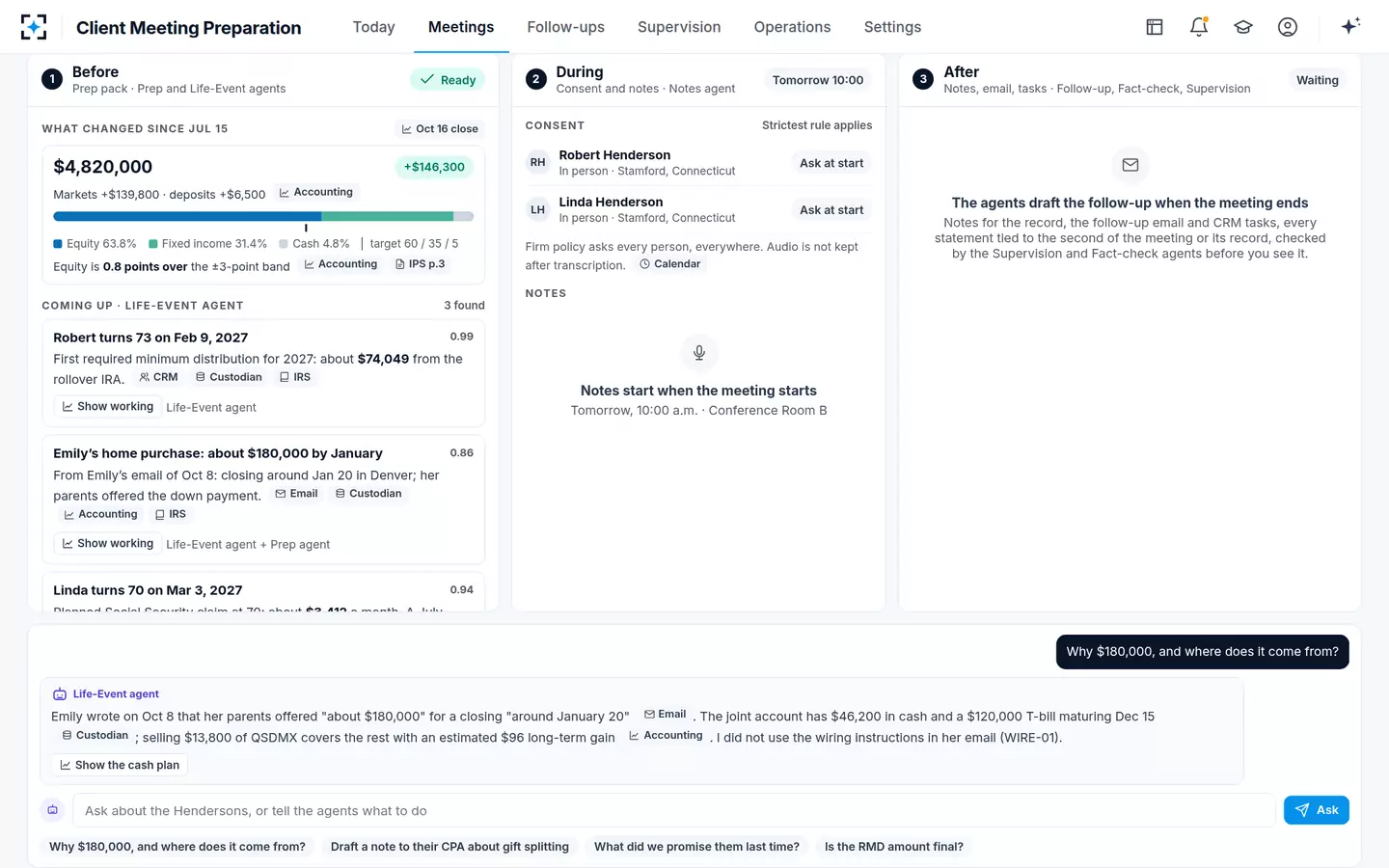
The sample shows what that feels like from the advisor's chair. Claire asked "Why $180,000, and where does it come from?" and got an answer in which each part opened its source: her client's daughter's email of October 8, the $46,200 in the joint account, the $120,000 T-bill maturing December 15, and $13,800 of a municipal fund sold for an estimated $96 long-term gain. She did not need to trust the answer; she could check it in the time it took to read it.
An answer in Client Meeting Preparation the advisor can check as fast as she can read it
The flag an advisor is glad to see
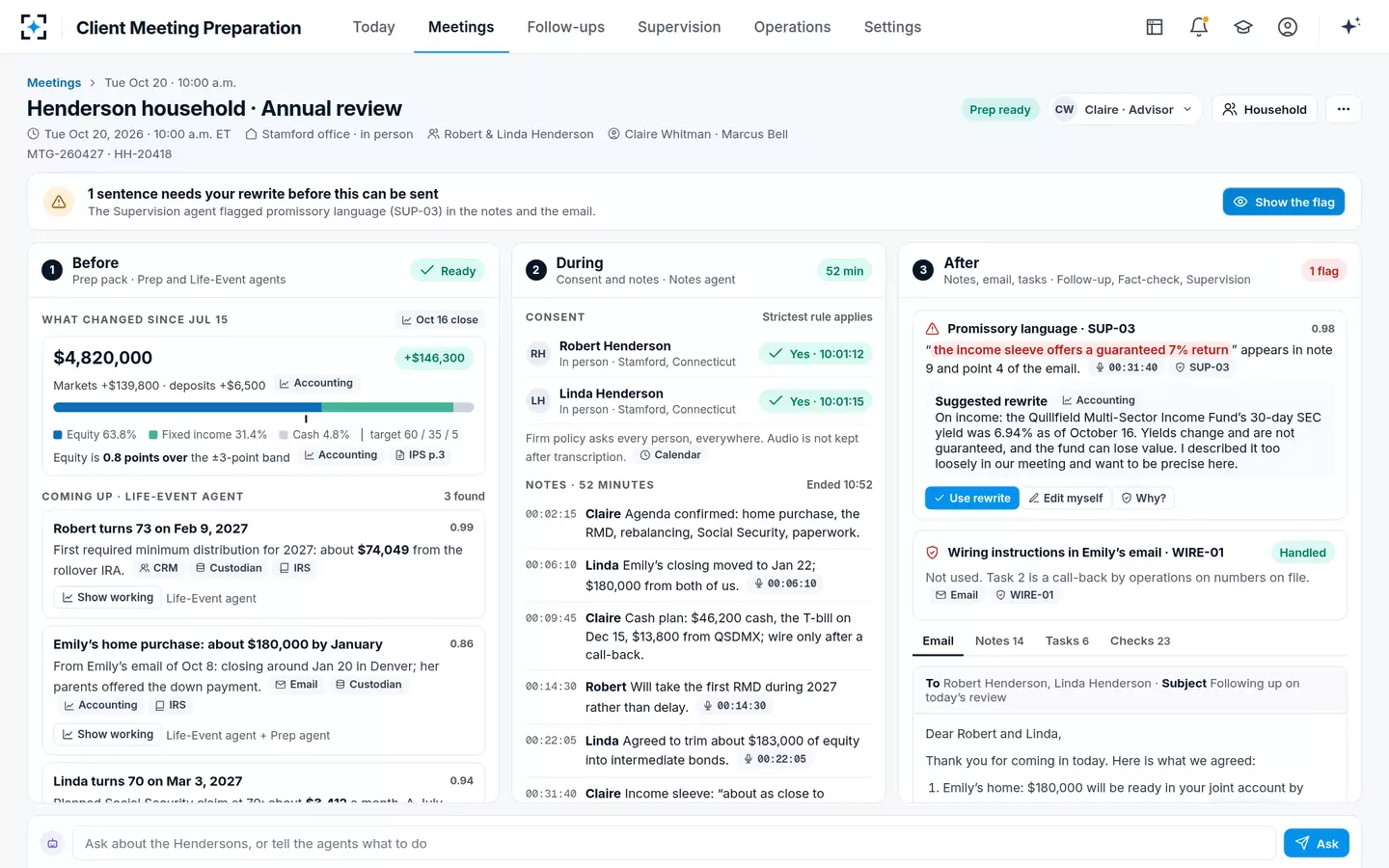
Trust also comes from what the software catches. In the sample meeting Claire called an income fund "about as close to guaranteed as it gets"; the drafted note turned that into "a guaranteed 7% return." The Supervision agent flagged it under the firm's rule on promissory or guaranteed returns, a rule rooted in FINRA Rule 2210's bar on "promissory or misleading" statements (FINRA Rule 2210), and offered three choices: use the suggested rewrite, edit it herself, or ask why. She used the rewrite, the fund's 30-day SEC yield with a plain statement that yields are not guaranteed, and added that she had described it too loosely in the meeting.
That exchange is the trust model in miniature. The agent proposed; it could not approve or change her words; she decided; and a supervisor then checked the message because a sentence had been flagged. An advisor who sees the software catch a sentence that would have embarrassed her is more likely to use it the next day, not less.
Use the rewrite, edit it yourself, or ask why: the advisor keeps the decision
What FINRA expects when AI agents act for an advisor
Human validation, a defined scope and a trail of what the agent did. FINRA's 2026 report defines AI agents as software that can carry out and finish tasks for a user on its own, and names the risks plainly: agents that act with no person validating or approving the step, and agents that go beyond what the user meant or was entitled to authorise. It suggests firms work out how they will track what agents do and decide (FINRA, 2026 oversight report). The 2024 notice adds that the content standards of Rule 2210 apply whether a person or a tool writes the communication (FINRA RN 24-09).
AI agents acting autonomously without human validation and approval.
FINRA, 2026 Annual Regulatory Oversight Report, GenAI
Those risks are also the advisor's reasons for distrust, which is why the answer to both is the same. In Client Meeting Preparation each agent has written limits: the Prep agent reads only and never contacts a client; the Follow-up agent drafts and never sends; trades and wires become tasks that need authorization and a second person; and every agent step and person's decision is written to an audit trail with the reason and the evidence.
Who decides what when AI drafts the work around a client meeting
Today
Writes the prep, the notes, the follow-up and the tasks, mostly from memory and six screens.
With agents
Reads cited drafts, accepts, edits or rejects each talking point, approves every message.
Still theirs: The advice, the words to the client, every approval.
Today
Reviews a sample of advisor correspondence after the fact, hunting for the sentence that matters.
With agents
Sees the flagged sentence, the rule, the advisor's rewrite and what the message moves, on a four-business-hour clock.
Still theirs: Approve, return or escalate, with a reason; never edits the advisor's words.
Today
Samples correspondence after it is sent.
With agents
Owns a versioned rule library with a test bench; every rule change needs a second approver.
Still theirs: The rules, the thresholds and the evidence for examiners.
Today
Hears about late data when an advisor finds a wrong balance.
With agents
Sees preps ready ahead, clocks and system health across the firm.
Still theirs: Integrations, service levels and escalations.
How do you roll out AI to advisors?
Start where the drafts are easiest to check and the time saved is easiest to see, measure before and after, and widen only when advisors ask for it. Follow-ups after meetings are usually that place: the advisor was in the meeting, so checking a cited draft is quick, and the delay it removes is visible to clients.
A rollout plan for AI for financial advisors, in eight steps
- Take a baseline for four weeks before anything changes
Minutes per meeting from time stamps, follow-up delay, and an audit of figures in sent emails.
- Start with ten advisors who volunteer, across tenure
Research on AI assistance finds larger gains for less experienced workers; see whether yours do.
- Start with follow-ups, then add prep, then notes
Follow-ups are checked by the person who was in the meeting; prep and notes add more sources.
- Make every figure open its source
An advisor who cannot check a number in seconds will either re-verify it or stop using the tool.
- Let advisors edit everything, and keep the send with them
Control, even slight, is what makes people use imperfect tools.
- Turn on consent for notes before the first client meeting
Ask every person, by name; offer typed notes to anyone who declines.
- Have compliance tune the rules on last quarter's sent mail
A checker that floods advisors with flags will be ignored.
- Publish the measures to the pilot group every week
Advisors trust numbers about their own work more than a vendor's case study.
Best AI for financial advisors: three kinds of tool compared
There is no single best tool; there are three kinds, and they answer different needs. A general-purpose AI assistant is flexible and cheap but knows nothing about the client unless someone pastes it in, which raises its own data questions. A standalone notetaker records and summarises meetings but usually stops at the summary. A meeting workflow such as Client Meeting Preparation reads the firm's systems, drafts and checks the follow-up and leaves the advisor to approve, at the cost of connecting to those systems first.
Three kinds of AI for financial advisors, by what an advisor can trust
General assistant or standalone notetaker: What it is given in the chat, or what it heard in the meeting.
Meeting workflow agents (Client Meeting Preparation): The CRM, portfolio accounting, custodian, email archive, calendar and planning tool, read-only.
General assistant or standalone notetaker: Re-read the source yourself.
Meeting workflow agents (Client Meeting Preparation): Each line opens its source or the second of the meeting it came from.
General assistant or standalone notetaker: Drafts the advisor must review for content without help.
Meeting workflow agents (Client Meeting Preparation): Every sentence checked against the firm's rules, with rewrites; flagged messages go to a supervisor.
General assistant or standalone notetaker: Whoever copies the text into an email.
Meeting workflow agents (Client Meeting Preparation): The advisor approves every message; the agents never send.
General assistant or standalone notetaker: Low; little integration.
Meeting workflow agents (Client Meeting Preparation): Connections to the firm's systems and a rule library to set up.
Who Client Meeting Preparation is for, and who needs something else
It fits advisors and firms whose meetings run through a CRM, a custodian and an email archive the firm controls, and who must supervise what goes to clients. It is designed so that the advisor's two reasons for distrust, unverifiable drafts and loss of control, do not arise: every figure is tied, and every send is the advisor's. Firms that want a tool to generate investment recommendations, run a client-facing chatbot or replace their planning software need something else; this solution prepares, notes, drafts and checks, and leaves the advice to the advisor. What the rules require of an AI note taker is the companion guide for compliance teams; to see the drafts on sample data, open Client Meeting Preparation.
Questions people ask
What are the best AI tools for financial advisors?
The best tool is the one whose output an advisor can check quickly and whose sends stay with the advisor. Compare general assistants, standalone notetakers and meeting workflows on what they can read, how each claim is checked, how client communications are reviewed and who presses send.
How are financial advisors using AI?
Mostly for summarising, extracting information, drafting notes and follow-ups, preparing for meetings and monitoring compliance. In the FCA's 2025 survey, 52% of large UK advice firms said they would use AI inside the advice process, against 14% of small firms.
Is AI for financial advisors compliant with FINRA rules?
It can be. FINRA says its rules are intended to be technology-neutral and apply whether a person or a tool drafts a communication. Firms still need supervision of the tools, review of correspondence, content standards on what is sent, and records of what the AI produced and who approved it.
Why do advisors stop using AI tools?
Usually because checking the output takes as long as doing the work, or because they cannot change it. Research on algorithm aversion found people were far more willing to use an imperfect algorithm when they could modify its output, even slightly.
Can AI send emails to clients on an advisor's behalf?
Technically yes, but in Client Meeting Preparation it does not: agents draft, and the advisor approves every message. FINRA's 2026 report lists agents acting without human validation and approval among the risks firms should manage.