A financial advisor meeting agenda should list, in order: anything new the client wants to raise, open requests and promises from last time, dated events in the next twelve months, what changed in the money since the last meeting, allocation and risk against what was agreed, fees and costs, and finally the decisions, owners and dates. Each item should be written from the client file, with the figure or date that makes it specific, so it can be closed in the meeting and repeated in the follow-up. That is why a good agenda takes preparation: its items live in the CRM, portfolio accounting, the custodian, the client's emails and the plan. Botminds' Client Meeting Preparation drafts it from those systems overnight, with up to five talking points the advisor accepts, edits or rejects before sending the agenda to the client.
The template below uses a fictional household of our own, Marit and Joost Achterberg. Later sections show the same structure in the solution's sample annual review, also fictional.
A financial advisor meeting agenda template, annotated with where each item comes from
Confirm the agenda; anything new since we last spoke? 5 min
Source: Calendar: both attending in person
Why here: Gives the clients the first word and catches a change no system holds.
Open items: the 529 plan transfer, and the Roth conversion estimate promised in July 5 min
Source: CRM open request, sent July 3 and not yet confirmed; last follow-up email, point 3
Why here: A promise read back by the client costs more than any market move.
Dates in the next 12 months: Marit's Medicare window opens February 1, 2027; Joost's first RMD year is 2027 15 min
Source: CRM dates of birth; IRS RMD rules; Medicare enrollment statute
Why here: Each needs a decision before the date, and one carries a permanent premium penalty if missed.
What changed: value since the last review, markets versus the $62,000 deposit from the rental sale 10 min
Source: Portfolio accounting at the last close; custodian deposit of September 30; the clients' email of September 12
Why here: Answers "why is it up?" before it is asked, and puts the new cash on the table.
Allocation and risk: equity at 66% against a 60% target and a five-point band 10 min
Source: Portfolio accounting; investment policy statement, page 2
Why here: Outside the band means a decision about a trade, and the new cash can do part of it.
Fees and costs this year, in dollars 5 min
Source: Custodian statements and advisory invoices
Why here: Clients rarely ask; a firm that shows it first is trusted more.
Decisions, owners and dates 10 min
Source: Written during the meeting
Why here: Every item above should end here as an action, an owner and a date the follow-up will repeat.
What should be on a financial advisor meeting agenda?
Seven blocks, each specific to the household: the client's own news, open items, dated events, what changed, allocation and risk, fees, and decisions. A template supplies the blocks; the client file supplies the content. "Review portfolio performance" is a heading, not an agenda item. "Value up since July: markets $139,800, deposits $6,500" is an agenda item, because a client can respond to it and the advisor can close it.
The order matters as much as the content. Clients arrive with their own question; letting them ask it first prevents it from colouring the rest of the meeting. Open items come next because they test whether the firm did what it said. Dated events come before market discussion because they carry deadlines, and the market discussion is more useful once everyone knows what money is needed when. Fees come near the end, plainly, and decisions close the meeting so that nothing agreed is left unassigned.
Why open requests and promises go first
Because they are the items the client remembers and the firm forgets. A transfer form sent in July and never confirmed by the custodian, or an estimate promised "next week" three months ago, will surface in the meeting whether or not it is on the agenda; on the agenda, it surfaces with a status and a fix. The UK regulator's review of ongoing advice made the same point about evidence: its good practice included "Appropriate record-keeping to make sure firms can evidence delivery of their services where provided" (FCA, February 2025). An agenda that opens with last time's promises is part of that evidence.
In the solution, promises are captured as they are made: the Follow-up agent records each promise the advisor makes, with its due date, and the next meeting's prep lists last meeting's promises. In the sample advisor's week, six promises were open and two were due.
Dated events: the agenda item clients remember
A date with a rule attached is the most valuable item an agenda can carry, because missing it costs money and catching it is visible to the client. Two examples from the template. Joost turns 73 in 2027, which makes 2027 the year of his first required minimum distribution, with a required beginning date of April 1, 2028, the April after the year he turns 73 (IRS) and a choice to make about whether to wait. Marit turns 65 on May 14, 2027, and Medicare's initial enrollment period runs seven months, starting three months before the month she turns 65 (42 U.S.C. 1395p(d)): February 1 to August 31, 2027.
Both belong on the October agenda, not on the agenda of the meeting after the date. RMD tracking for advisors covers the first-year deadline, inherited accounts and what custodian notices miss.
How long should a client review take?
No regulator sets a length; the agenda does. Sixty minutes is enough for an annual review of a household with a few decisions to make, if the time is spent on the items that need decisions. The split below is our suggestion for the template household: a quarter of the meeting on dated events, a sixth each on what changed, on allocation and on decisions, and short slots for open items, fees and the client's opening.
Where 60 minutes of a client review go, by agenda item
Suggested split for the template household
- Opening and news · 8%
- Open items · 8%
- Dated events · 25%
- What changed · 17%
- Allocation and risk · 17%
- Fees · 8%
- Decisions · 17%
Two adjustments are common. A household with nothing changed can do the review in half the time, and should be told so; the agenda then is short and the follow-up records that nothing needed a decision. A household facing a large event, a sale, an inheritance, a death, needs a separate meeting about it rather than a longer review.
Writing agenda items that close
An agenda item closes when it names the subject, carries the figure or date, and implies the decision. "RMD" does not close; "Joost's first RMD year is 2027: take it in 2027 or by April 1, 2028?" does. The same discipline makes the follow-up easy to write, because each closed item becomes one numbered point: what was decided, who will do it, by when.
Agenda items that stay open, and the same items written to close
Item that stays open: Portfolio review
Item written to close: Value since July: markets versus the $62,000 deposit; anything to change?
Item that stays open: Rebalancing
Item written to close: Equity at 66% against a 60% target and a five-point band: rebalance now, and with which cash?
Item that stays open: RMD planning
Item written to close: First RMD year is 2027: take it in 2027, or delay to April 1, 2028 and take two in one year?
Item that stays open: Medicare
Item written to close: Medicare window February 1 to August 31, 2027: who enrolls in what, and when?
Item that stays open: Fee review
Item written to close: What you paid this year, in dollars, and what it covered.
Item that stays open: Next steps
Item written to close: Each decision with an owner and a date, confirmed in writing within a business day.
Sending the agenda is a regulated communication
An agenda sent to a client is a written communication, and for a FINRA member it is correspondence. Rule 2210 defines correspondence as any written or electronic communication sent or made available to 25 or fewer retail investors in a 30-day period, and puts all of it under the supervision and review requirements of Rule 3110 (FINRA Rule 2210). Those supplementary rules let a firm decide on risk-based principles which correspondence is reviewed before it goes (FINRA Rule 3110); an agenda rarely needs pre-approval, but its content standards are the same as any email's.
For investment advisers, the agenda and its follow-up are part of the written communications kept under Rule 204-2, which covers those relating to any recommendation or advice, given or proposed (17 CFR 275.204-2). An agenda item that proposes a rebalance is advice proposed to be given. That is one more reason to write items precisely: the agenda will be read again, possibly by an examiner, long after the meeting.
A financial planning meeting agenda for a first meeting
A first meeting needs a different agenda, because there is no file yet. Its job is to build one. The blocks are: the client's goals in their own words; the facts a recommendation will rest on, such as age, income, net worth, tax status, investment experience, time horizon, liquidity needs and risk tolerance; the accounts and documents the client holds, including those the advisor will not manage; how the firm is paid and what services it offers; and what happens next. Firms serving retail investors must also deliver a relationship summary, Form CRS, early in the relationship, so the first agenda is the natural place for it.
The agenda for the second meeting, the first review, is where the structure above begins: open items from the first meeting come first, because there will be several.
A financial advisor client meeting checklist
Before the agenda goes out, and before the meeting starts, the same ten checks apply whatever the household.
Ten checks before a financial advisor sends a meeting agenda
- Every item carries a figure, a date or a name
If an item could appear on any client's agenda, it is a heading, not an item.
- Open requests and last meeting's promises are listed with their status
Read last time's follow-up before writing this time's agenda.
- Dated events in the next 12 months are on it
RMDs, Medicare and Social Security dates, maturities, closings, tuition.
- Change since the last meeting is split into markets and flows
Clients ask "why" before they ask "how much".
- Allocation is compared with the agreed band, not just the target
Inside the band is not a decision; outside it is.
- Fees are shown in dollars
From statements and invoices, for the year.
- No sentence promises or implies a return
Content standards apply to the agenda as to any client communication.
- Account numbers and personal identifiers are left out
An agenda is forwarded, printed and left on tables.
- Attendees and where they join from are known
If notes will be taken, consent may depend on where each person is.
- It goes at least a day ahead, with what to bring
Clients who see the agenda bring the documents it needs.
From the agenda to the follow-up: the same items, closed
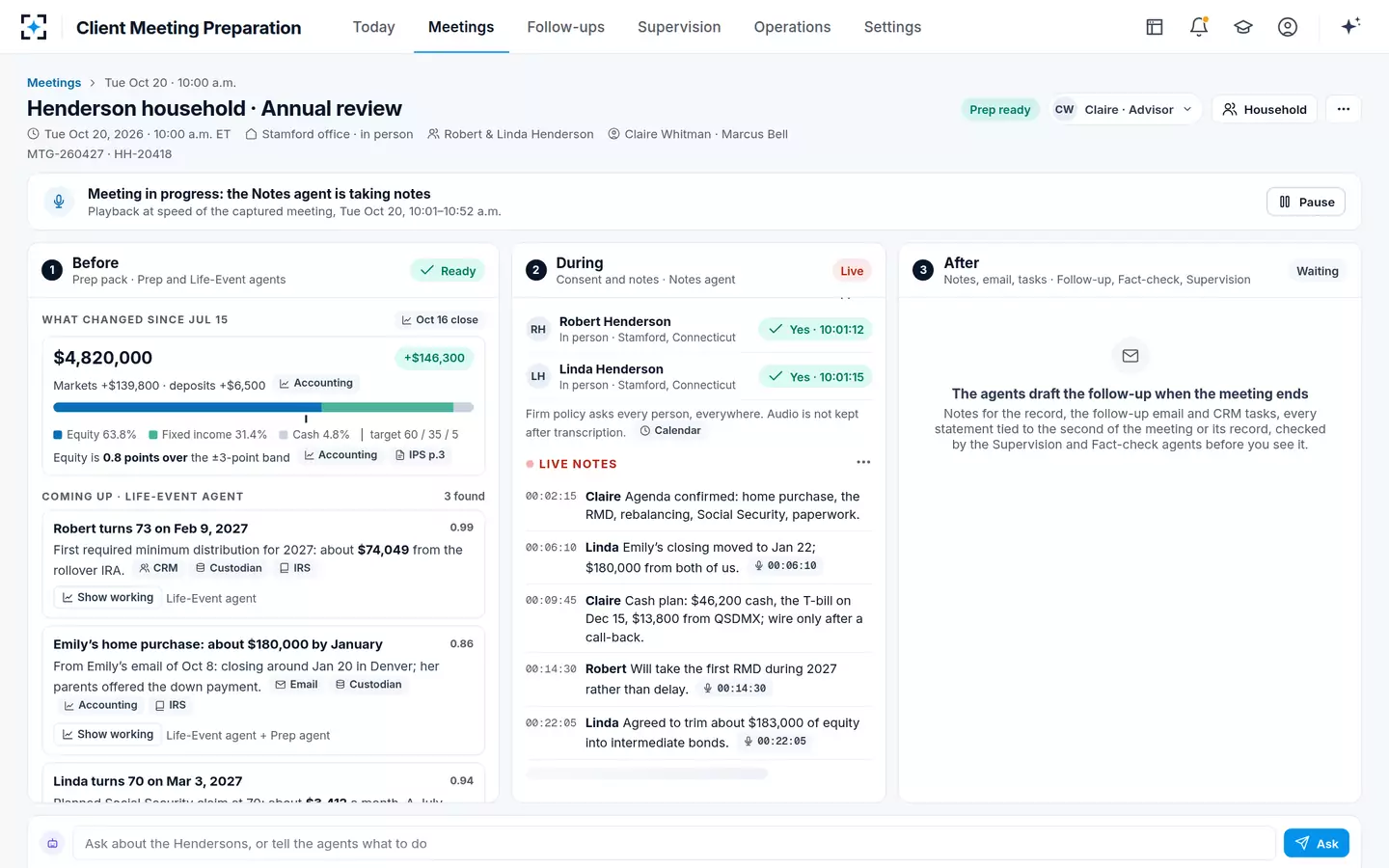
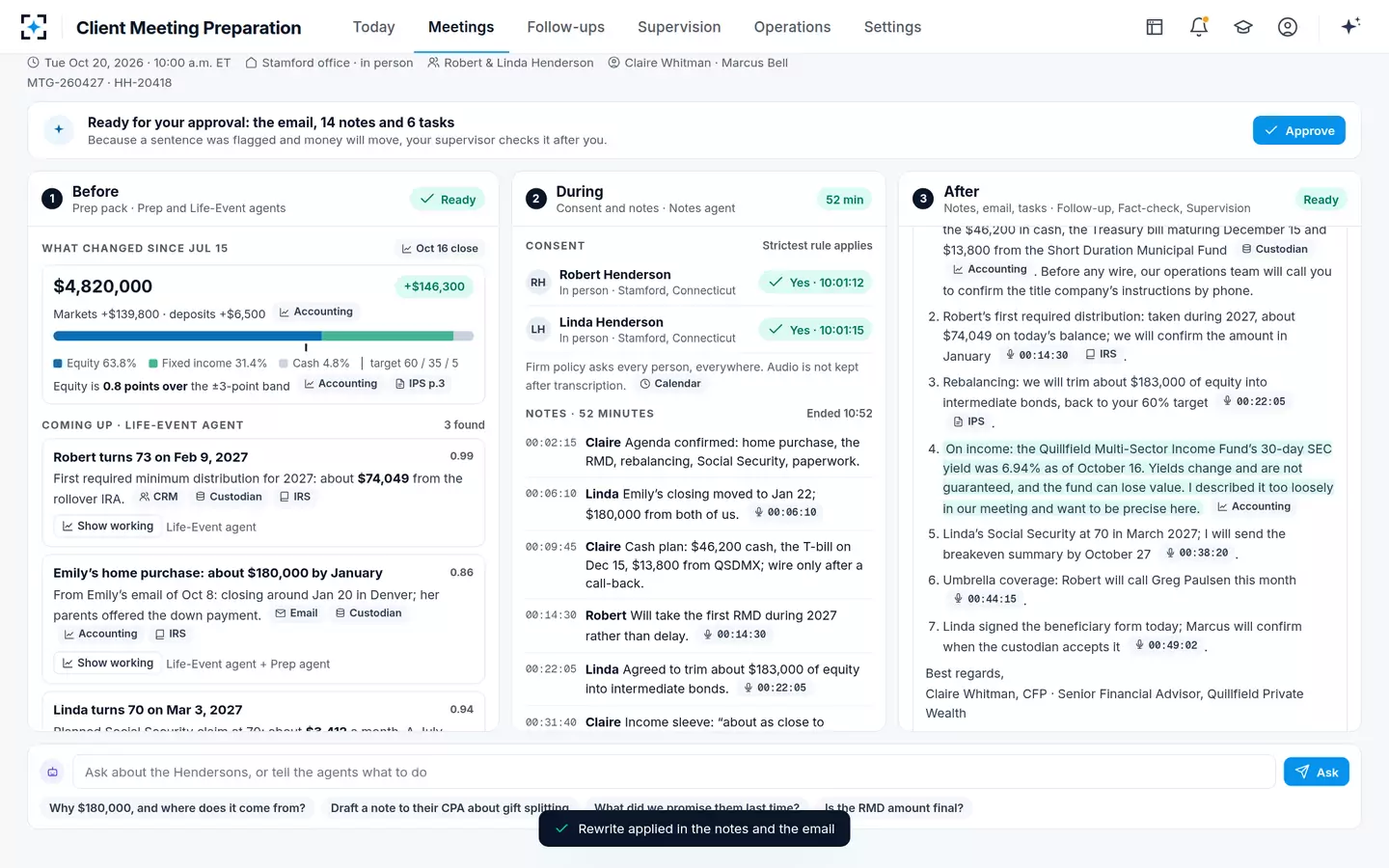
The follow-up should mirror the agenda, item by item, with each one closed. In the solution's sample annual review the advisor confirmed the agenda at the start of the meeting: "home purchase, the RMD, rebalancing, Social Security, paperwork." The drafted follow-up then carried seven numbered points covering those items, each tied to the moment in the meeting where it was decided or to the account it concerned: the cash plan for a $180,000 gift, the first RMD in 2027 at about $74,049 on that day's balance, a trim of about $183,000 of equity back to the target, a corrected sentence about an income fund, Social Security at 70 with a breakeven summary to follow, umbrella insurance, and the signed beneficiary form.
The agenda confirmed at minute two, in Client Meeting Preparation's live notes
The follow-up in Client Meeting Preparation closes each agenda item, with its source
How the prep behind that agenda was assembled is traced in financial advisor meeting prep, and why the meeting should open from the change log is argued in client review meeting: start from what changed. To see the sample agenda, notes and follow-up together, open Client Meeting Preparation.
Questions people ask
What is a good financial advisor meeting agenda template?
One with seven blocks in this order: the client's news, open items and promises, dated events in the next 12 months, what changed since the last meeting, allocation and risk against the agreed band, fees in dollars, and decisions with owners and dates. Fill each block from the client file so every item carries a figure or a date.
What goes on an annual review meeting agenda?
The same blocks, with the year's changes in front: value split into markets and flows, drift against the allocation band, dated events such as a first RMD or Medicare enrollment, and last year's promises. Fees for the year in dollars belong on it too.
Should the agenda be sent to the client before the meeting?
Yes, at least a day ahead, with a list of what to bring. Once sent it is a written communication the firm keeps and, at a FINRA member, correspondence under the firm's review procedures, so write it with the same care as any client email.
How is a financial review meeting agenda different from a first meeting agenda?
A first meeting builds the file: goals, the facts a recommendation will rest on, accounts held elsewhere, how the firm is paid, and the firm's relationship summary. A review starts from the file and leads with what changed and what is open.
How many items should a client meeting agenda have?
Few enough to close in the time. Seven blocks fit a 60-minute review if each carries one or two specific items; the sample review in this guide confirmed five topics and closed them in 52 minutes.