An AI note taker for financial advisors is allowed: FINRA has said its rules are meant to be technology-neutral, and no SEC or FINRA rule names meeting notes written by software. What decides whether a firm can use one is a short list of duties that already exist. Every person in the meeting must have agreed to the capture where the law requires it, the follow-up email it drafts must be kept and, at a FINRA member, reviewed under the firm's procedures, and nothing in that email may be promissory or misleading. Botminds' Client Meeting Preparation is built around those duties: its Notes agent captures a meeting only after each person has said yes, and its agents tie every figure in the drafted follow-up to its source and check every sentence before the advisor approves it.
The examples on this page come from the solution running on fictional sample data: Quillfield Private Wealth, its advisor Claire Whitman and the Henderson household's annual review. The rules come from the regulators' own texts, linked where they are used.
Six duties decide whether an AI note taker is usable, and none of them is about AI
Consent to capture
What appliesFederal law lets a party record with one party's consent (18 U.S.C. 2511(2)(d)); some states require every party's, such as Washington (RCW 9.73.030).
What the note taker must doAsk each person, by name, before capture starts; log who said yes and when; fall back to typed notes for anyone who has not.
Keeping what is sent
What appliesAdvisers keep written communications sent and received about advice, money movement and orders for five years (Rule 204-2); broker-dealers keep communications and their approvals (Rule 17a-4(b)(4)).
What the note taker must doFile the follow-up as sent, with its approvals, in the firm's archive; know which drafts and transcripts your policy also keeps.
Review of correspondence
What appliesFINRA members review correspondence under Rule 3110(b) and its risk-based supplementary material, evidenced in writing by a registered principal.
What the note taker must doRoute the drafted follow-up into the review the firm's procedures require, and capture who reviewed it, when and what they did.
Content standards
What appliesNo "false, exaggerated, unwarranted, promissory or misleading" statement in a member's communications (Rule 2210(d)(1)(B)), whoever or whatever drafted it.
What the note taker must doCheck every sentence of the drafted notes and email before the advisor approves it, not a sample afterwards.
Client data with a vendor
What appliesRegulation S-P requires oversight of service providers, which must report a breach to the firm within 72 hours (17 CFR 248.30(a)(5)).
What the note taker must doKnow where audio, transcript and notes are stored, for how long and by whom; contract for the 72-hour notice.
Accuracy
What appliesNo rule sets an error rate. FINRA lists accuracy among the risks firms should identify and mitigate when they use generative AI.
What the note taker must doTie each number, date and product name in the draft to the second of the meeting or the system it came from, or send it to a person.
What the rules say about an AI note taker for financial advisors
The rules say nothing specific, and that is the point regulators keep making. FINRA's Regulatory Notice 24-09 of June 27, 2024 reminds firms that its rules and the securities laws "continue to apply when member firms use Gen AI or similar technologies," and that Rule 2210's content standards for communications with the public apply whether a person or a tool produced the words (FINRA RN 24-09). The notice does not mention meeting notes at all. Its concern is broader: generative AI "has been marked by concerns about accuracy, privacy, bias, intellectual property," the four places a note taker can go wrong.
FINRA's 2026 regulatory oversight report goes further on how to use the technology, though still not on notes. It lists "Summarization and Information Extraction" among the uses firms have adopted, describes hallucinations as a model producing inaccurate or misleading information (are AI notetakers safe follows one through), and suggests "storing prompt and output logs for accountability and troubleshooting" and "tracking which model version was used and when" (FINRA, 2026 oversight report, GenAI). The SEC's examination priorities for fiscal 2027, published October 23, 2026, say registrants are building what the SEC calls "super intelligence (SI)" into more of their business, including client communications, and that examiners will ask whether firms still meet obligations the Division calls technology-neutral (SEC Division of Examinations).
So the question a chief compliance officer should put to any AI note taker is not "is this allowed?" but "show me how each duty in the table above is met, and where the evidence lives."
Do clients have to consent to AI notes?
Often yes, and the safe policy is to ask everyone. Recording law, not securities law, governs the capture itself. The federal wiretap statute lets a party to a conversation record it, or anyone record it once one party has consented in advance (18 U.S.C. 2511(2)(d)), so under federal law an advisor in the meeting can consent for the capture. State law can be stricter.
Washington, for example, makes it unlawful to record a private conversation "without first obtaining the consent of all the persons engaged in the conversation," and treats consent as obtained when one party has told everyone else in the conversation, in any reasonably effective way, that the conversation is about to be recorded," with the announcement itself recorded (RCW 9.73.030). A video review with a client in one state and a spouse dialling in from another is governed by more than one statute. We do not list the states here; call recording consent by state is covered in its own guide, and counsel should confirm the rule for each state a firm's clients sit in.
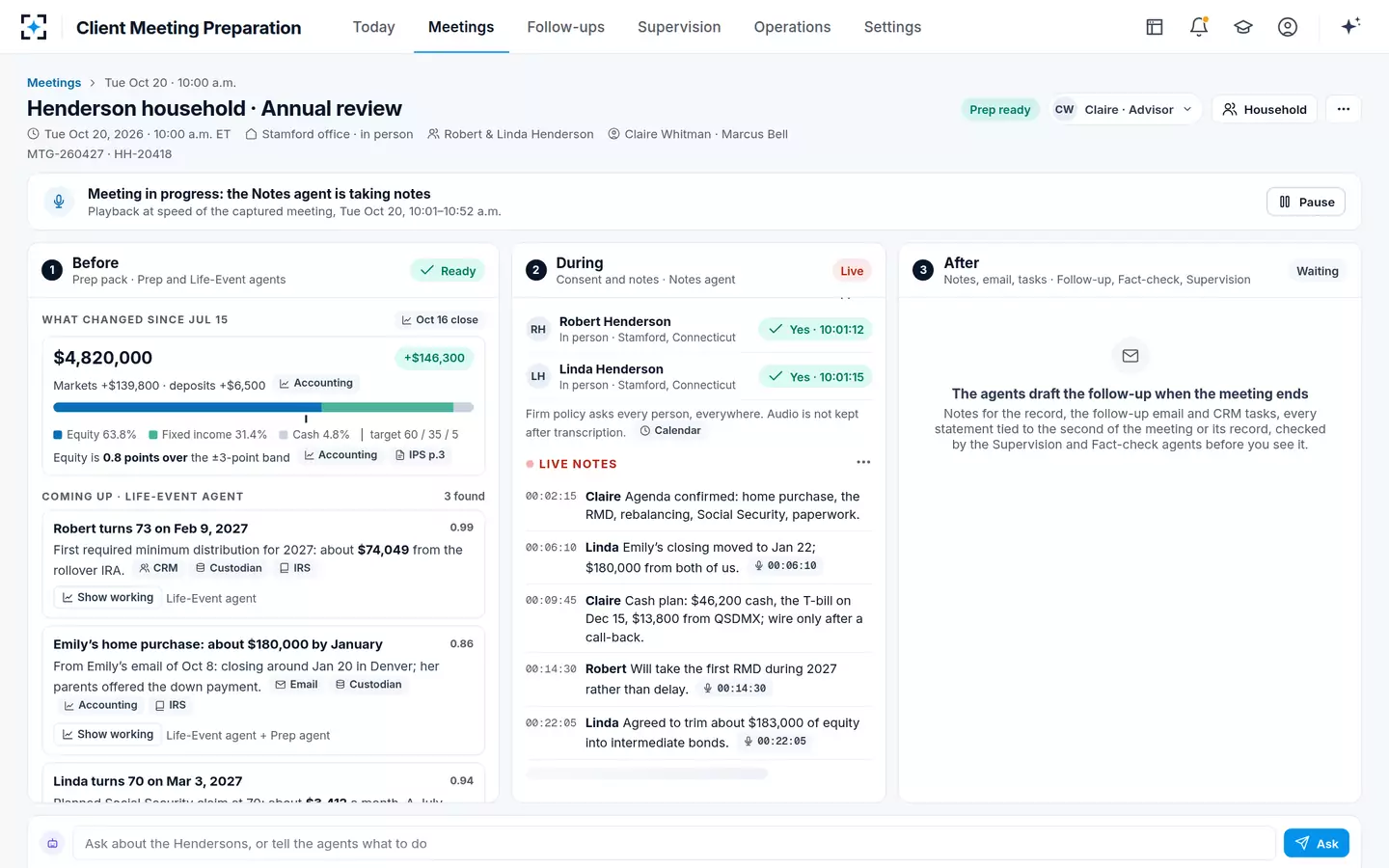
Firms that do not want to track fifty statutes adopt the strictest rule everywhere: ask every person, by name, before anything is captured. That is the default in Client Meeting Preparation. In the sample review, Robert Henderson says yes at 10:01:12 and Linda at 10:01:15, and live notes start only then; a withdrawal stops capture and deletes the transcript so far, and audio is not kept after transcription. One sample meeting that week, with a participant joining by video who had not consented, was flagged the day before and set to typed notes unless that person agrees.
Consent from each person, then notes with speaker and time
Are AI meeting notes books and records?
The follow-up email is, without doubt; the notes and transcript depend on what they are and what the firm's policy says. For investment advisers, Rule 204-2(a)(7) requires "Originals of all written communications received and copies of all written communications sent" relating to any recommendation or advice, any receipt, payment or delivery of funds or securities, and the placing of orders, kept for "not less than five years" (17 CFR 275.204-2). The text names communications sent and received. It does not mention transcripts or meeting notes.
Broker-dealers have a wider net. Rule 17a-4(b)(4) covers communications sent and received, and their approvals, internal memos included, relating to the business, for three years (17 CFR 240.17a-4). A summary that an AI note taker emails to an associate, or that an advisor forwards to operations, can fall inside that sentence. The practical rule most firms reach is to treat the notes as part of the client file and keep them with the follow-up, under the longer of the two schedules. Firm policy in the sample keeps notes, transcripts, consent and supervisor decisions for seven years, write-once.
The trap is the copy that never reaches the archive: a summary pasted into a personal app, or a transcript left in a vendor's cloud the firm does not capture. The SEC's off-channel communications cases are about exactly that gap, and what those cases cost firms is set out in another guide.
Does a principal have to review AI notes and follow-ups?
A FINRA member must review correspondence under written procedures, but not necessarily every message before it goes. Rule 2210(b)(2) says "All correspondence is subject to the supervision and review requirements of Rules 3110(b) and 3110.06 through .09" (FINRA Rule 2210), and Rule 3110(b)(4) requires that reviews "must be conducted by a registered principal and must be evidenced in writing" (FINRA Rule 3110). The supplementary material lets a firm decide the extent of review "By employing risk-based principles," and spells out what the evidence must show: it must "clearly identify the reviewer," the communication and "the date of review." It adds a sentence every vendor demonstration should be measured against: "Merely opening a communication is not sufficient review."
Internal notes that never leave the firm are not correspondence to a client, although the firm may still review them. The follow-up email to a household is correspondence, because it goes to 25 or fewer retail investors. An AI note taker therefore has to feed the firm's existing review, not bypass it. In Client Meeting Preparation the advisor approves every message as its author; a message with a flagged sentence, or one that moves money, then goes to a branch supervisor who did not write it, on a four-business-hour clock in the sample settings, and the supervisor's approve, return or escalate decision, with a reason, is what is kept as the evidence.
Merely opening a communication is not sufficient review.
FINRA Rule 3110, Supplementary Material .07
What does FINRA say about AI notetakers? The questions it expects firms to answer
FINRA has not issued guidance on AI notetakers by name, but its 2024 notice and 2026 report give a firm the questions to ask. They cover supervision ("a member firm must have a reasonably designed supervisory system tailored to its business"), accuracy, privacy and the third party: the notice reaches third-party technology too, features embedded in products the firm already uses included, which covers the note taker built into a video-call platform as much as a standalone app.
The 2026 report adds the controls it would like to see: outputs validated and reviewed by a person, prompt and output logs, and knowing which model version produced a given summary. For a note taker, that means a firm should be able to show, for any client email, the transcript lines it was drawn from, the model that drafted it and the person who approved it. A tool that produces only a polished summary, with no trail back to what was said, cannot answer an examiner's first follow-up question.
Why accuracy and data handling are where AI notes fail
0.35
average word error rate for Black speakers across five speech-recognition systems
against 0.19 for white speakers
72hours
for a service provider to tell the firm of a breach of a customer information system under amended Reg S-P
5years
minimum an adviser keeps written communications sent about advice, funds and orders
Accuracy is the duty buyers underrate
Speech recognition is good, not perfect, and its errors are not spread evenly. A peer-reviewed study of five state-of-the-art speech-recognition systems found they got about 35 words in 100 wrong for Black speakers against 19 in 100 for white speakers (Koenecke et al., PNAS 2020). A notetaker that mishears one word in five is still readable. A notetaker that mishears one figure, such as 1.9 million for 1.6 million, or January 2 for January 22, produces a follow-up that is fluent, confident and wrong.
No rule sets an acceptable error rate, and no regulator publishes one for AI meeting notes. The control that works is structural: every number, date and product name in a draft must point to the second of the meeting or the system it came from, and anything that cannot be tied goes to a person. That is how the Fact-check agent in Client Meeting Preparation works; it requires an exact tie, not a likely one. Following one figure from the meeting to the email shows the checks hop by hop.
What happens to wiring instructions, Social Security numbers and other things said aloud?
They get transcribed, and that is a risk of its own. Clients read out account numbers, mention a child's closing date, or forward an email from a title company with wiring instructions in it. A notetaker that faithfully copies those into a summary, and a CRM that faithfully stores the summary, has spread sensitive customer information into more systems than the firm meant to hold it in. Regulation S-P's safeguards rule asks for policies "reasonably designed to" protect customer information against unauthorized access (17 CFR 248.30); the less of it that is copied, the less there is to protect.
In the sample, routing and account numbers in a client's email are masked as soon as they are read, and a rule in the solution's library says wiring instructions received by email are never acted on: the wire becomes a task that waits for a call-back on numbers already on file and a second person's approval. The FBI's figures on email fraud in real estate closings explain why; the client service associate's guide covers the call-back in detail.
What to look for in the best AI note taker for financial advisors
The best tool for a regulated firm is the one that can prove each duty, not the one with the smoothest summary. The checklist below is the one we would use to test any product, including ours, on a firm's own meetings before a contract is signed.
Ten questions to put to any AI note taker before an advisor uses it with clients
- Does it ask each person for consent, by name, and log it?
One-party consent is the federal floor, not the rule in every state. A log with a time per person is the evidence.
- What happens when someone says no, or changes their mind?
Typed notes for that meeting, and deletion of anything already captured, should be automatic.
- Is audio kept, where and for how long?
Every day audio is kept is a day it can be breached or subpoenaed. Decide on purpose.
- Can each figure in the summary be traced to a moment in the meeting?
Speaker and time stamps per line are what make a summary checkable in seconds.
- What does it do with a figure it cannot tie?
The answer should be: send it to a person. Never: keep the likeliest reading.
- Does it check the drafted email for promissory or misleading language?
Rule 2210(d)(1)(B) applies to what goes out, whoever drafted it.
- Does the draft enter the firm's review, with the reviewer, date and action captured?
Rule 3110.07 lists what the evidence must identify.
- Is the email as sent archived with its approvals in the firm's own store?
A copy only in the vendor's cloud is a copy the firm may not be able to produce.
- Will the vendor tell you of a breach within 72 hours, and in writing?
Amended Regulation S-P expects it of service providers.
- Are prompts, outputs and model versions logged?
FINRA's 2026 report lists all three; an examiner may ask which model drafted a given email.
Where Client Meeting Preparation fits, and where it does not
Client Meeting Preparation is not a standalone note taker; it treats the notes as one step in a meeting's life. Before the meeting its agents build the prep from the CRM, portfolio accounting, the custodian, the email archive, the calendar and the planning tool. During it, the Notes agent captures only with consent. After it, agents draft the notes, the follow-up email and the CRM tasks, tie every figure and check every sentence, and the advisor approves. That is the right shape for a firm that supervises correspondence and wants one trail from prep to sent email. It is more than a firm needs if all it wants is a transcript of internal calls.
A transcript app and a supervised meeting workflow answer different questions
A standalone AI note taker: Often a banner or a bot joining the call; who agreed is not always logged per person.
Client Meeting Preparation: Each person asked by name before capture; typed notes for anyone who has not said yes; withdrawal deletes the transcript.
A standalone AI note taker: As heard. Errors surface when the client notices.
Client Meeting Preparation: Tied to the second of the meeting or the source system; an untied figure goes to a person.
A standalone AI note taker: Left to the advisor and to after-the-fact sampling.
Client Meeting Preparation: Every sentence checked against a versioned rule library with a suggested rewrite; flagged messages go to a supervisor who did not write them.
A standalone AI note taker: Depends on the vendor's settings and the firm's capture of them.
Client Meeting Preparation: Notes, email as sent, transcript, consent and the supervisor's decision, in the firm's region, write-once, for the firm's retention period.
A standalone AI note taker: Quick to start; light on integration; little to prove.
Client Meeting Preparation: Needs connections to the CRM, accounting, custodian and email archive; built for firms that must prove supervision.
Two limits are worth stating. First, the solution's checks are rules about language and ties to sources; they do not judge whether advice was suitable, which stays with the advisor and the firm's Reg BI or fiduciary review. Second, a firm that is an adviser but not a FINRA member is not bound by Rules 2210 and 3110; it may still want the same review, but it should say so in its own policies rather than borrow FINRA's.
The supervision rules an AI note taker's drafts are checked against
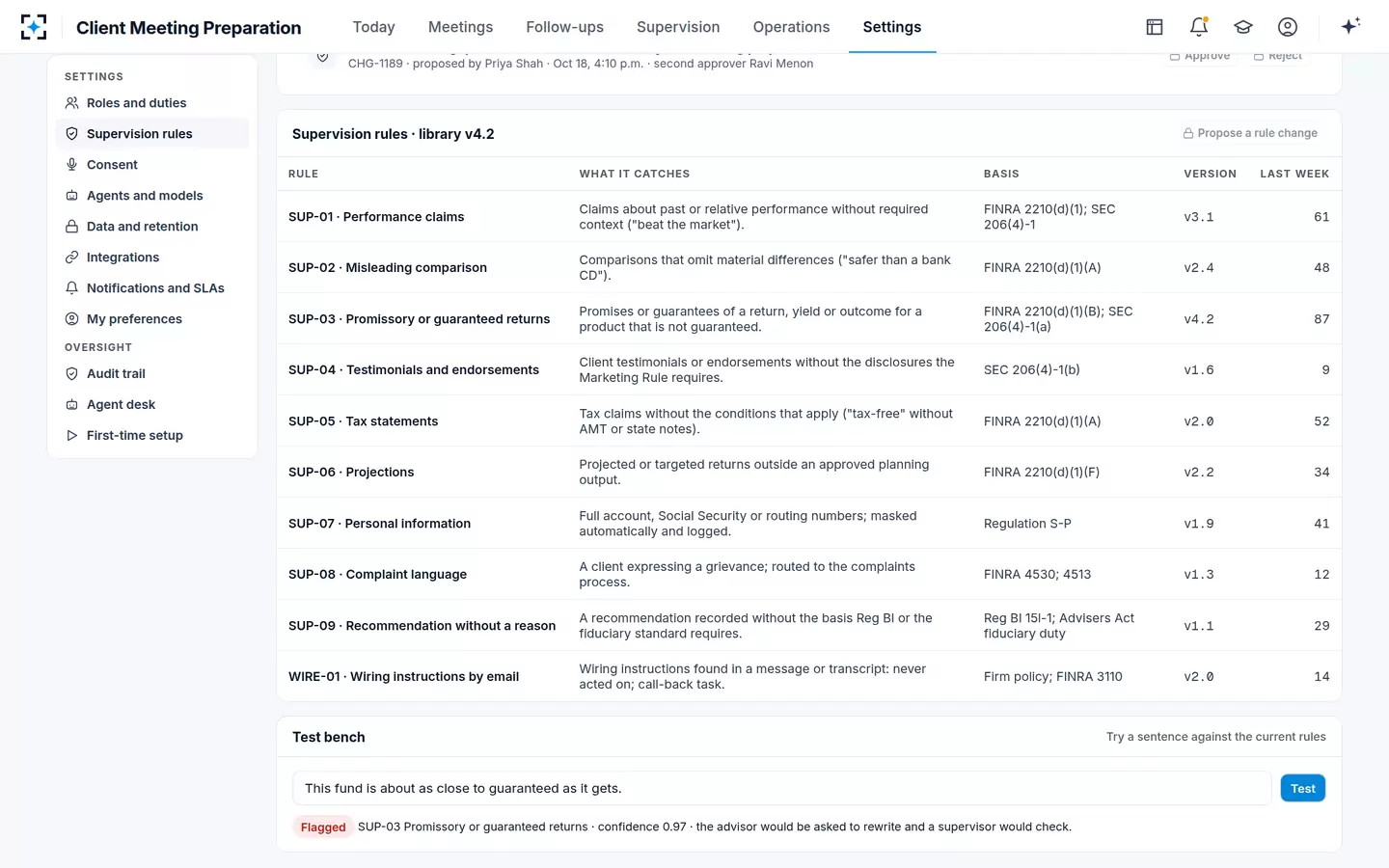
To see the whole chain on a sample review, from the prep the night before to the email sent at 11:42, start with financial advisor meeting prep, traced, or open Client Meeting Preparation.
Questions people ask
Can financial advisors legally use AI note takers?
Yes. No SEC or FINRA rule prohibits them, and FINRA's Regulatory Notice 24-09 says its rules are intended to be technologically neutral. The firm must still meet consent law for the capture, keep the communications the tool helps produce, review correspondence under its procedures and keep promissory or misleading statements out of anything sent.
What are the legal issues with an AI notetaker?
Four come up most: recording consent under federal and state law, retention of what is sent and of internal communications, the accuracy of what the tool writes, and the handling of client data by the vendor. Amended Regulation S-P requires firms to oversee service providers, which must report a breach within 72 hours.
Do I need to tell clients I am using an AI note taker?
Where state law requires every party's consent you must, and asking everyone is the simplest firm-wide policy. Washington's statute, for example, treats consent as obtained when the recording is announced to all parties in a reasonably effective manner and the announcement is itself recorded.
Should AI meeting notes be kept with the client file?
Most firms keep them. Rule 204-2 requires advisers to keep written communications sent and received about advice and money movement for five years, and Rule 17a-4(b)(4) extends broker-dealers' duty to inter-office communications; notes that are emailed or shared can fall inside both. Keeping them with the follow-up also lets a supervisor see what the email was drawn from.
Does every AI-drafted follow-up need principal approval before it is sent?
Not under FINRA's rules, which let a member decide the extent of correspondence review on risk-based principles. The review that is done must be evidenced, identifying the reviewer, the communication and the date. Many firms choose pre-approval for messages that move money or that a checker flags.
Can an AI note taker record a meeting with a client in another state?
It can if the consent rules of each place a participant sits are met. Federal law is a one-party rule, but some states require all parties' consent, so a firm-wide policy of asking every person avoids working out which statute governs each call.