AI in wealth management is now used for drafting, research, client communications and compliance monitoring, and the SEC's examiners say so in their own words. What the first year of a programme should be judged on is narrower than that list: a handful of outcomes that matter to clients and supervisors, each measured against a baseline taken before the pilot starts. Advisor minutes per meeting, follow-ups approved within a business day, the share of figures in client emails tied to their source, and how often supervisors agree with what the AI flagged tell a head of wealth whether the programme works; log-in counts do not. Botminds' Client Meeting Preparation, a set of agents that prepares each client meeting, takes consented notes and drafts and checks the follow-up, reports most of these measures directly, which makes it a useful case study in what to ask of any tool.
Where this guide shows results from the solution, they come from its sample data on a fictional wealth firm, Quillfield Private Wealth: 2,140 advisors and 15,412 client meetings in one week across three regions. They show what the measures look like, not what any customer achieved.
A first-year scorecard for AI in wealth management, applied to client meetings
Prep ready ahead
DefinitionShare of client meetings with a complete prep at least 24 hours before
BaselineTime-stamp when each prep is finished for four weeks before the pilot
Target or sampleSample firm: 98.6% in one week
Advisor minutes per meeting on prep and follow-up
DefinitionMinutes spent gathering, reading and writing, per meeting
BaselineTime twenty consecutive meetings per advisor, split into the three parts
Target or sampleYour own baseline; no published benchmark exists
Follow-up within one business day
DefinitionShare of meetings whose follow-up the advisor approved within one business day
BaselineCompare sent times with meeting end times in the email archive
Target or sampleSample firm: 94.1% against a 95% target
Figures tied to source
DefinitionShare of numbers, dates and product names in sent follow-ups traceable to the meeting or a system
BaselineHand-audit twenty sent follow-ups against the meetings
Target or sampleDesign rule: 100%, or the figure goes to a person
Flags and supervisor agreement
DefinitionFlagged sentences per 100 follow-ups; share of flags supervisors uphold
BaselineRun the rules over last quarter's sent mail before go-live
Target or sampleSample firm: 2.8% flagged; 91% upheld
Supervisor clock
DefinitionShare of flagged messages decided within the firm's review window
BaselineToday's review times for sampled correspondence
Target or sampleSample firm: 97.4% within 4 business hours
Promises kept on time
DefinitionShare of promises made in meetings closed by their due date
BaselineRead last quarter's follow-ups and count promises and outcomes
Target or sampleYour own baseline
Life events caught early
DefinitionDated events (RMDs, Medicare, maturities, closings) on an agenda at least a quarter ahead
BaselineList events that fell due last year and check when each was first discussed
Target or sampleDesign target: none missed
How are wealth managers using AI?
For drafting and communications first, compliance second, advice itself last. The SEC's Division of Examinations, in its priorities for fiscal 2027 published October 23, 2026, describes registrants using generative tools for research, drafting, coding and client communications, then for advice and portfolio management, and for compliance monitoring; the Division calls the technology "super intelligence (SI)" (SEC, FY2027 examination priorities). FINRA's 2026 oversight report puts "Summarization and Information Extraction" near the top of the uses it sees, and notes firms' focus on "efficiency gains, particularly with respect to internal processes and information retrieval" (FINRA).
The UK's regulator has numbers, from its 2025 survey of more than 4,100 advice firms. Firms are exploring AI to support client engagement, compliance and operational efficiency, and adoption rises with size. For compliance and business assurance, 10% of small firms, 27% of medium firms and 37% of large firms said they would use AI, with a further 35%, 54% and 59% considering it (FCA, April 2026). In other words, most firms are still deciding, which is exactly when a measurement plan is cheapest to set up.
AI in UK advice firms' compliance work: planned, considered, by firm size
10%
of small firms will use AI in compliance or business assurance
35% more are considering it
27%
of medium-sized firms will
54% more are considering it
37%
of large firms will
59% more are considering it
4,100+
advice firms answered the FCA's 2025 survey
What does the SEC say about AI in wealth management?
That existing obligations apply, and that examiners want to know what the technology does to outcomes. The same paragraph of the 2027 priorities says the Division wants to understand better how the technology changes outcomes, and asks whether firms still comply with obligations it calls technology-neutral (SEC). Elsewhere it lists firms' procedures for monitoring SI (what that means for Reg BI supervision) and their readiness for phishing and deepfake voice or video made with it.
FINRA's position is the same in different words. Its 2024 notice says its rules and the securities laws still apply when firms use generative AI (FINRA RN 24-09), and its 2026 report adds the control most relevant to measurement: keeping the prompts and the outputs, so that someone can account for them and fix what went wrong (what the rules require of AI notes). A programme that cannot show what its AI produced, and what people did with it, cannot answer the outcome question the SEC says it will ask.
Why adoption counts are the wrong first-year KPI
Because the research so far finds that use does not translate automatically into hours or earnings. A study linking AI-chatbot adoption surveys to Danish administrative records found that "most employers in exposed occupations have adopted chatbot initiatives, workers report productivity benefits," yet estimated "precise null effects on earnings and recorded hours at both the worker and workplace levels, ruling out effects larger than 2% two years after the launch of ChatGPT" (Humlum and Vestergaard, NBER working paper 33777, 2025). What moved, the authors found, was the structure of work, including "new tasks in content generation, AI oversight, and AI integration."
Technological change reshapes work well before it surfaces in earnings or hours.
Humlum and Vestergaard, NBER Working Paper 33777, 2025 (working paper)
Where gains have been measured, they are uneven. In a peer-reviewed study of 5,179 customer support agents, access to a generative AI assistant raised issues resolved per hour by 14% on average and by 34% for novice and low-skilled workers, with little effect on the most experienced (Brynjolfsson, Li and Raymond, Quarterly Journal of Economics, 2025). That is customer support, not advice, and the transfer is uncertain. Its lesson for a wealth firm is about measurement: an average hides the distribution, so a scorecard should report results by advisor tenure and by team, not only firm-wide.
Set the baseline before the pilot starts
No regulator or independent study publishes how long advisors spend preparing for meetings or writing follow-ups, so the only baseline that means anything is the firm's own, taken before the AI arrives. Four weeks is enough. Time twenty consecutive meetings per pilot advisor, split into gathering, reading and writing; pull the sent times of follow-ups from the email archive and compare them with meeting end times; and hand-audit twenty sent follow-ups for figures that cannot be traced to the meeting or a system.
Two cautions. Self-reported minutes saved are the least reliable measure in any AI programme, because people report what they expect; time stamps from systems are better. And the baseline should include the work the AI will create, not only the work it removes: reading a draft, checking a flag, accepting a rewrite. The Danish study's finding about new tasks applies inside a wealth firm too.
What KPIs show AI is working for supervision?
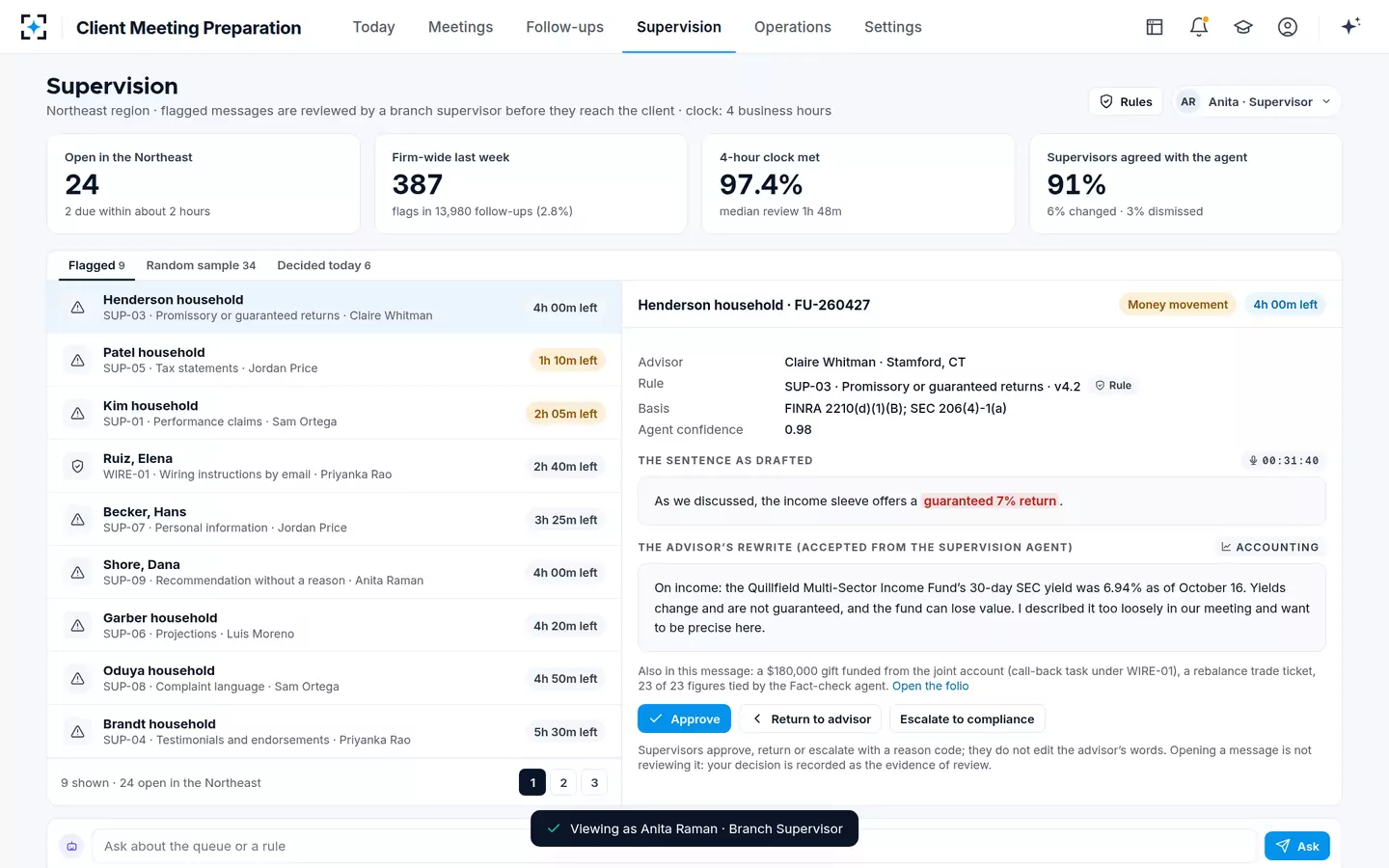
The flag rate, the share of flags supervisors uphold, and the time to a decision. A checker that flags too much trains supervisors to click through; one that flags too little is not checking. In the sample firm's supervision queue for one week, 387 sentences were flagged in 13,980 follow-ups, 2.8%. Supervisors upheld the agent's flag in 91% of cases, changed it in 6% and dismissed it in 3%, and decided 97.4% of flagged messages within the four-business-hour window, with a median of 1 hour 48 minutes.
What supervisors did with the agent's flags in one week, sample firm
Read with the flag rate, agreement is the measure that tells compliance whether a rule is tuned. If supervisors dismiss most flags on one rule, the rule is too broad; if they rarely see flags on a rule that matters, test it with planted sentences. The solution's rule library has a test bench for exactly that, and each rule change needs a second approver. The supervision queue also carries a random-sample tab, 34 messages in the sample branch's queue, which is how a firm can measure what the checker missed.
Supervision measures in Client Meeting Preparation: flags, the clock and agreement
What operations should watch every week
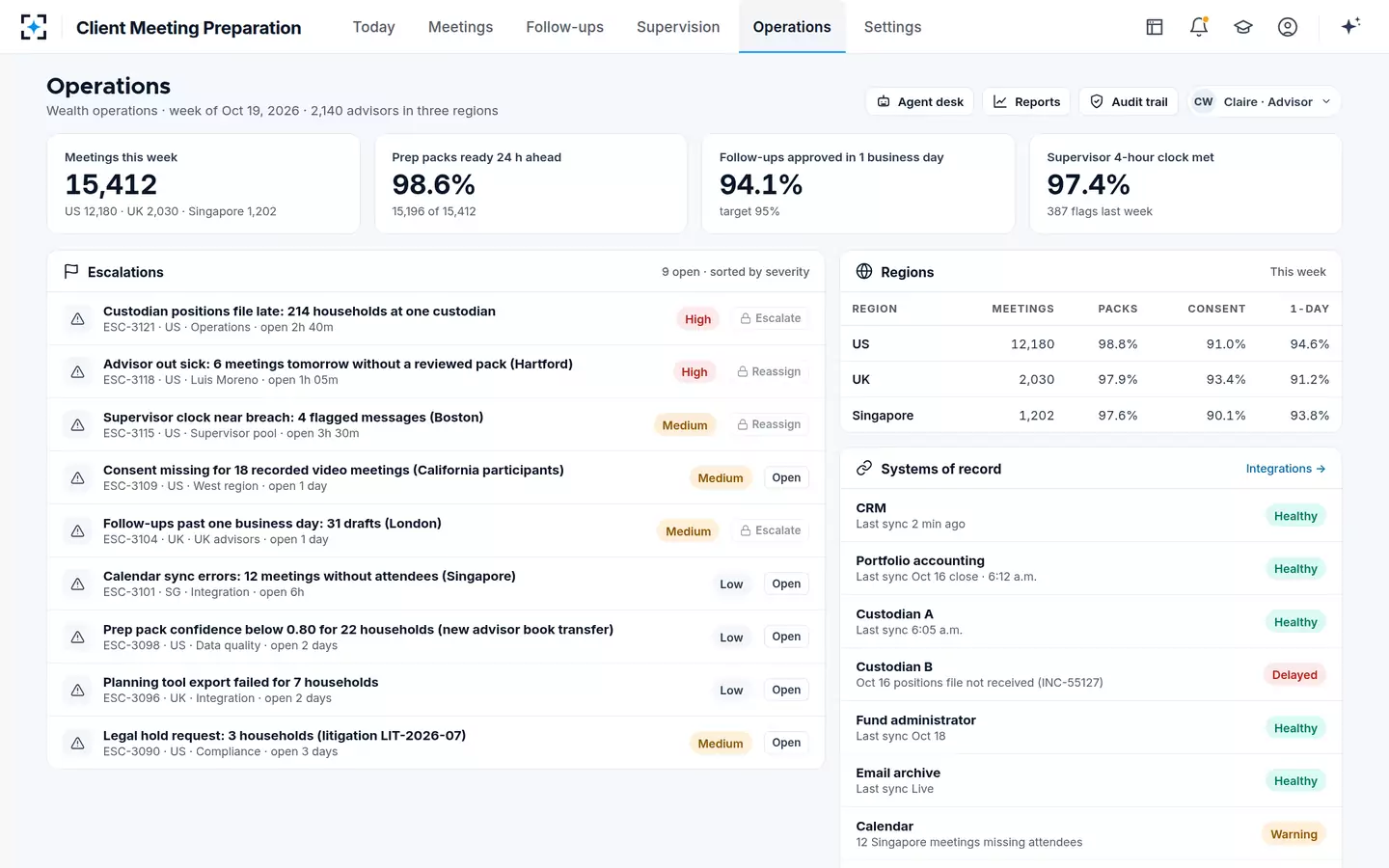
Operations owns the measures that fail quietly: preps not ready, follow-ups stuck, systems late. The sample operations screen shows them for 15,412 meetings in a week: preps ready 24 hours ahead for 98.6%, follow-ups approved within one business day for 94.1% against a 95% target, and the supervisor clock met for 97.4%. Below the headline numbers sit the causes, sorted by severity: one custodian's positions file late for 214 households, an advisor out sick with six meetings and no reviewed prep, 31 follow-up drafts past a business day in one office, consent missing for 18 recorded video meetings.
One week of client meetings at the sample firm, by the measures that matter
15,412
client meetings in one week across three regions
98.6%
with prep ready at least 24 hours ahead
94.1%
of follow-ups approved within one business day, against a 95% target
97.4%
of flagged messages decided within the supervisor clock
The weekly operations view in Client Meeting Preparation
Wealth management AI tools: questions to ask before buying
Ask how the tool will be measured before asking what it does. A vendor that cannot produce the scorecard above from its own logs is asking the firm to take the outcome on trust.
Eight questions for any vendor of AI in wealth management
- Which of our first-year measures does the product report from its own logs?
Time stamps, ties, flags and decisions should come from the system, not from surveys.
- Can we export prompts, outputs, model versions and decisions?
FINRA's 2026 report lists prompt and output logs and model version tracking among controls to consider.
- What happens to a figure the AI cannot trace to a source?
It should go to a person, every time.
- Who approves what reaches a client, and is that decision kept?
The approval is the supervision evidence; it must be kept with the message.
- Can compliance change a rule, and who approves the change?
Rules applied to every message need versioning and a second approver.
- How does it behave when a source system is late?
Stale data should be marked and escalated, not presented as current.
- Where is client data stored, and how fast will you tell us of a breach?
Amended Regulation S-P expects service providers to notify within 72 hours.
- Can we run it on our own meetings before we sign?
A pilot on the firm's own data is the only test of the baseline.
Where Client Meeting Preparation fits in an AI programme, and where it does not
It fits the part of the programme that touches clients most often: the meeting. Its agents prepare each meeting from six systems, capture notes only with every participant's consent, draft the notes, follow-up email and CRM tasks, tie every figure and check every sentence, and the advisor approves every message. That makes it a strong first-year candidate for firms that want measurable outcomes, because every one of the scorecard's measures comes from its own logs, and because the risk is bounded: agents never send, trade, move money or contact a client.
It is not a portfolio management system, a trading tool, a financial planning engine or a client-facing chatbot, and it does not replace the firm's CRM, custodian or email archive; it reads them and writes drafts back. It needs those connections to be useful, which is the main cost of starting. And its checks are about language and sources; whether a recommendation is suitable remains the advisor's and the firm's judgement. What makes advisors trust the drafts and how one figure is checked on its way to a client are covered in their own guides; to see the scorecard on sample data, open Client Meeting Preparation.
Questions people ask
What are the main AI use cases in wealth management?
The SEC lists research, drafting, coding, client communications, advisory and portfolio management functions, and compliance monitoring and surveillance. FINRA highlights summarization and information extraction. Client meetings combine several: preparing from many systems, notes, follow-up drafting and correspondence checks.
How do you measure the ROI of AI for financial advisors?
Take a baseline before the pilot, then measure the same things after: advisor minutes per meeting from time stamps, follow-ups approved within a business day, figures tied to source, flag and supervisor-agreement rates, and promises kept on time. Convert minutes to cost only once the time measure is reliable.
Does generative AI in wealth management reduce headcount?
The evidence so far does not show it. A 2025 NBER working paper on Danish data estimated effects of AI chatbots on earnings and recorded hours close to zero, ruling out effects larger than 2% two years after ChatGPT's launch, while work was reorganised around new tasks such as AI oversight.
What does FINRA expect firms to log when they use AI?
Its 2026 oversight report suggests keeping every prompt and output, recording which model version produced each output and when, and having people validate and review the outputs. Those logs are also the raw material for a KPI scorecard.
Which KPI should a firm watch first?
Follow-ups approved within one business day, because it moves only when prep, notes, drafting and review all work, and because every task behind a meeting waits on it. In the sample week it stood at 94.1% against a 95% target.