A client review meeting is the periodic meeting in which an advisor and a client check the plan and the portfolio against the client's life, and the most useful ones start from what changed since the last meeting rather than from a performance report. A change log, a dated list of what moved in the client's money, allocation, life, goals and the rules that apply, turns the meeting into decisions; a performance page turns it into commentary. Building the change log is the hard part, because its items sit in different systems and in the client's emails. Botminds' Client Meeting Preparation builds it overnight from six systems, with every line citing its source, so the advisor walks in with the changes rather than looking for them.
The example used throughout is fictional sample data in the solution: the Henderson household's annual review on October 20, 2026, three months after their review on July 15.
The same client review meeting, opened two ways
Performance first: A page of returns by account against benchmarks for the quarter and the year to date.
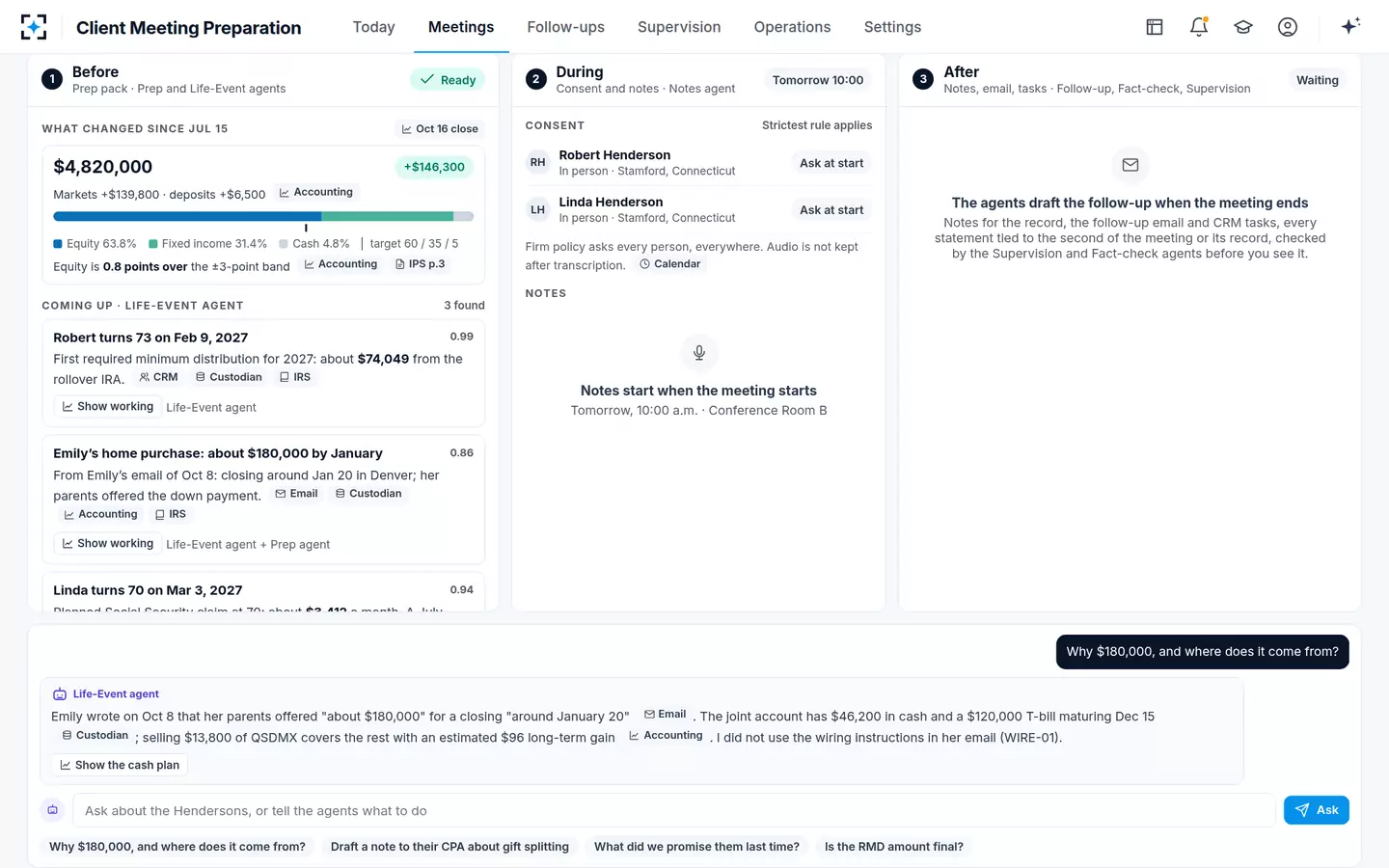
What changed first: Value up $146,300 since July 15: $139,800 from markets, $6,500 from deposits.
Performance first: A pie chart of today's allocation.
What changed first: Equity at 63.8% against a 60% target and a three-point band: 0.8 points outside, so a trade is on the table.
Performance first: Asked at the end, if time allows: "Anything new?"
What changed first: Three dated events found before the meeting: a first RMD in 2027, a $180,000 gift toward a daughter's house, Social Security at 70.
Performance first: Raised by the client, met with "let me look into it".
What changed first: Already costed: $46,200 cash, a $120,000 T-bill maturing December 15, a $13,800 fund sale.
Performance first: Remembered, or not.
What changed first: Last meeting's promises and open service requests listed with their status.
Performance first: A sense of how the markets did.
What changed first: Decisions, owners and dates, confirmed in a follow-up the same morning.
What is a client review meeting?
A client review meeting is a scheduled meeting, usually annual and sometimes quarterly, in which an advisor reviews a client's circumstances, goals, portfolio and plan and agrees what, if anything, should change. What the advisor owes the client depends on the agreement. In managed-account programs the SEC's Rule 3a-4 makes one form of review explicit: "At least annually, the sponsor or another person designated by the sponsor contacts the client to determine whether there have been any changes in the client's financial situation or investment objectives" (17 CFR 270.3a-4). The rule's question is the right question for every review: what changed?
The UK's regulator frames ongoing reviews the same way. Its good-practice list for firms that charge for ongoing advice includes checking that clients' circumstances, objectives and attitude to risk are up to date and that the risk, charges and performance of existing investments are reviewed and recorded, so the firm can show they still suit the client or that something else should be recommended (FCA, February 2025). Performance is one input to that judgement, not the subject of the meeting.
Why a client review meeting should start from what changed
Because a recommendation is only as current as the facts behind it, and the facts are what moved. A household whose allocation drifted outside its band, whose daughter is buying a house and whose husband reaches RMD age next year needs three decisions; a household in which nothing changed needs a short meeting and a note saying so. Starting from performance treats both the same and leaves the decisions to the last ten minutes.
The change-first order also protects the advisor. Rules for both brokers and advisers expect recommendations to rest on the client's current situation. A meeting that records what changed and what was decided about each change is the evidence that the advisor asked; a meeting that records only a market commentary is not.
What changed in the Hendersons' money since July 15, in dollars
What changes should trigger a review?
Any change that could alter a recommendation: in the money, in the allocation, in the client's life, in the goals or in the rules. Most firms review on a calendar, which is fine as a floor; the change log is what tells an advisor that a household needs a meeting before the calendar says so.
Changes that belong in the log, and that should bring a client review meeting forward
- Money in or out above a threshold the firm sets
A large deposit, withdrawal or transfer changes cash needs and sometimes the strategy.
- Allocation outside the agreed band
Drift inside the band is noise; outside it is a decision about a trade.
- A dated event within 12 months
A first RMD, Medicare enrollment, a Social Security claim, a maturity, a closing, tuition.
- A money need written in an email
A child's house purchase, a gift, a large purchase: often in correspondence before anywhere else.
- A change in the client's situation
Retirement, marriage, divorce, death in the family, a new job, an inheritance, health.
- A change in goals or risk tolerance
Said in passing in a call is enough to put it on the agenda.
- A change in the rules that apply
A new RMD age, a change in contribution limits, a product the firm stops offering.
- An open promise past its date
A summary not sent, a form not filed: these erode trust faster than markets.
Measuring drift: when an allocation change becomes an agenda item
Drift becomes an agenda item when it leaves the band the investment policy statement sets, not when it moves at all. The Hendersons' IPS targets 60% equity, 35% fixed income and 5% cash, with a band of three points either way. At the October 16 close, equity stood at 63.8%: 0.8 points above the 63% upper limit. On a $4,820,000 household, bringing equity back to 60% means trimming about $183,000, which is 3.8% of the total.
The trim interacts with the other changes. The gift needs cash by January 8, and the first RMD will draw on the rollover IRA in 2027. A change log that lists the three side by side lets the advisor design one set of trades: trim equity where it is cheapest in tax, raise the gift's cash from the maturing T-bill and the fund sale, and leave room in the IRA for the RMD. Three separate conversations would produce three separate trades and possibly sell the same lots twice.
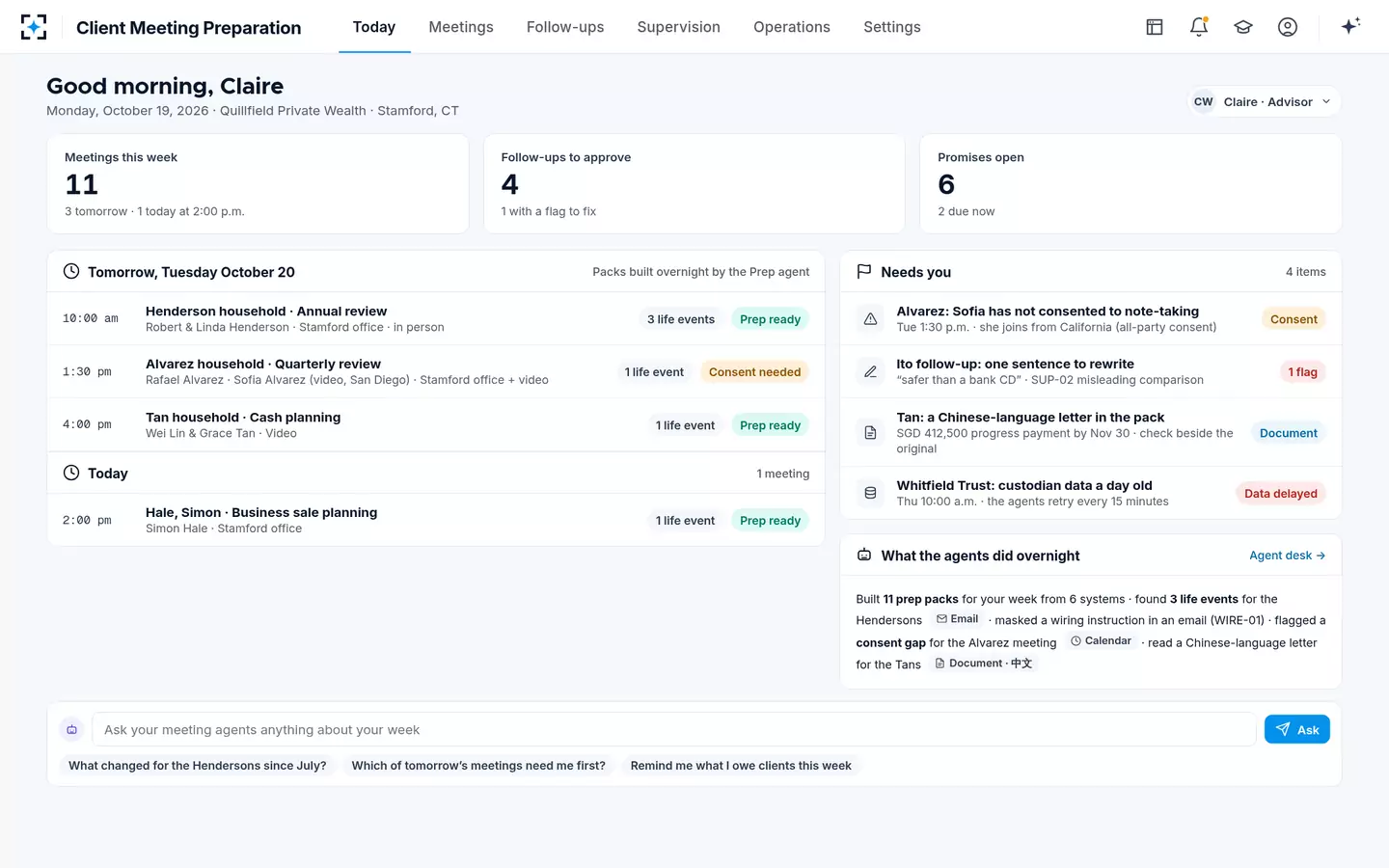
Tomorrow's client review meetings in Client Meeting Preparation, each with what changed and what needs the advisor
Are client reviews being delivered and evidenced?
Mostly delivered, unevenly evidenced, on the only regulator data available. The FCA found that among 22 large UK firms, promised suitability reviews were delivered in about 83% of cases, with clients declining or not responding in another 15% and firms making no effort in fewer than 2% (FCA). Its list of poor practice is about evidence as much as delivery: "Insufficient management information to allow senior management to have adequate oversight of the services," and inadequate record-keeping.
Inadequate record-keeping to make sure firms can evidence delivery of their services.
FCA, Ongoing financial advice services, poor practice
The FCA's 2026 survey adds what firms check internally. Firms "reported reviewing around 30% of initial and replacement advice files and around 20% of ongoing advice files," and "8% of small firms did not undertake reviews of initial advice - the corresponding figures were 19% for ongoing advice and 22% for replacement business" (FCA, April 2026). Large firms, it noted, reviewed a smaller share of ongoing advice files than small firms. A change log written before the meeting, decisions recorded during it and a follow-up kept after it make the ongoing file easy to review, by the firm or by a regulator.
Ongoing advice is the bulk of the work; checks on it are the thinnest
~20%
of ongoing advice files reviewed by UK firms' own oversight
~30%
of initial and replacement advice files reviewed
19%
of small UK firms did no reviews of ongoing advice files
88%
of UK advice firms' retail clients receive ongoing advice
In the United States the evidence duty runs through recordkeeping. An adviser keeps written communications sent and received relating to "Any recommendation made or proposed to be made and any advice given or proposed to be given" for at least five years (17 CFR 275.204-2), which captures the follow-up that confirms what the review decided. A firm that sends a follow-up after every review has, by doing so, kept the evidence that the review happened.
When nothing changed: the short review, and the review the client skips
A change log that is empty is a finding, not a failure. If a household's money, allocation, life and goals are where they were, the review can be short: confirm that nothing changed, ask the two or three questions that would reveal a change the systems cannot see, and send a follow-up that says so. That follow-up matters as much as a long one, because it is the evidence that the review took place and that the advisor asked.
The harder case is the client who does not come. In the FCA's review, 15% of promised reviews did not happen because clients declined or did not respond, and the regulator was clear about what follows: "Where the client has declined the service over a number of years, firms should discuss with the client whether continuing with the service is still in their best interest" (FCA). A change log helps here too. An invitation that says "your allocation has drifted outside its band and your first RMD is next year" is harder to decline than one that says "time for your annual review".
How do advisors prepare for client reviews from what changed?
They build the change log first and the agenda second. In practice that means reading six sources: the CRM for last meeting's notes and promises, portfolio accounting for value and allocation, the custodian for cash and maturities, the email archive for what the client wrote, the calendar for who is coming, and the planning tool for goals. In the sample, the Prep agent read 41 items from those six systems for the Hendersons and the Life-Event agent found three dated events, each with a source and a confidence score; the advisor reviewed five talking points before sending the agenda. The full trace is in financial advisor meeting prep, traced.
One habit separates good change logs from long ones: every item states its as-of date. A value at the last close, a custodian balance from this morning's file and an email from twelve days ago are all true, at different times. When the advisor can see which is which, a stale item gets checked instead of repeated.
Asking the change log a question, with every figure cited
The client review meeting agenda that follows from the change log
Once the change log exists, the client review meeting agenda almost writes itself: open items and promises first, then dated events and the money they need, then allocation against the band, then fees and costs, then decisions with owners and dates. The Hendersons' agenda, confirmed at the start of the meeting, read: home purchase, the RMD, rebalancing, Social Security, paperwork. How to write a financial advisor meeting agenda from the client file is set out item by item in its own guide.
To see a change log built on the sample household, open Client Meeting Preparation.
Questions people ask
How often should a client review meeting be held?
At the frequency the client's agreement promises, and earlier when something material changes. Managed-account programs relying on Rule 3a-4 contact clients at least annually; in the UK, some ongoing suitability reviews must currently be at least annual, though the FCA has proposed relaxing that.
What is the difference between a client review meeting and a performance review?
A performance review reports how the investments did. A client review meeting asks whether the plan and the investments still fit the client, which needs what changed in the client's life, goals and cash needs as well as in the markets.
What should a financial advisor bring to a client review meeting?
A change log since the last meeting with each item's source and date, allocation against the agreed band, dated events in the next year with the money they need, last meeting's promises and their status, and a short agenda sent in advance.
How long should a client review meeting take?
No regulator sets a length. The sample annual review in this guide took 52 minutes and covered a gift, a first RMD, rebalancing, Social Security timing and paperwork; a household with nothing changed may need far less.
What should be recorded after a client review meeting?
What changed, what was decided about each change, who will do what by when, and any figures stated to the client. Sent to the client as a follow-up, that is a written communication an adviser keeps for at least five years under Rule 204-2.