A financial planning balance sheet lists a client household's assets and liabilities at one date, with net worth as the difference, and for an advisory firm the arithmetic is the easy part. The work is sourcing: each line comes from a different document with its own date, some held at the firm and most held away, some in another currency, some describing the same account twice, and one misread line, such as a life policy's death benefit keyed where its cash value belongs, can move net worth by hundreds of thousands of dollars. A firm also needs more than one net worth figure, because the SEC's broker-dealer account record asks for net worth "excluding value of primary residence" while the planning view counts the home. Botminds' Financial Planning Data Gathering builds the balance sheet from the documents themselves: each line carries its value, its as-of date and the page it came from, and a paraplanner and a planner approve it before it reaches the planning software.
This guide is for the planning practice lead who sets the firm's data rules, the paraplanners who build the sheet and the compliance officer who tests it. It works through one balance sheet from the solution's sample household, a fictional couple who are clients of a fictional New York planning firm.
The balance sheet a firm is rebuilding, at national scale
$195.9T
net worth of US households and nonprofits, end of June 2026
$49.8T
of it in owner-occupied real estate, the largest nonfinancial asset
$14.0T
of home mortgages, most of household debt
$192,900
median family net worth in 2022; the mean was $1,063,700
What goes on a financial planning balance sheet?
Every asset at its current value and every liability at its outstanding principal, each with its date and source document, grouped the way the planning software expects. The Federal Reserve's quarterly household table shows the categories: deposits, debt securities, equities and fund shares, "Life insurance reserves" of about $2.2 trillion, pension entitlements, consumer durables, real estate, mortgages and consumer credit (Federal Reserve Z.1, September 11, 2026).
A planning balance sheet departs from the national one in two places, and the firm should write both choices down. The Fed counts defined benefit pension entitlements and cars, furniture and appliances at replacement cost; a planner normally leaves durables out and treats a pension as an income stream rather than an asset. Neither choice is wrong. A sheet that does not say which it made will be read two ways by two planners.
The sample household's balance sheet, each line with its source
| Line | Value | Where the value came from |
|---|---|---|
| Joint brokerage, held at the firm | $1,284,610.42 | Custodian feed, as of Oct 16 |
| Roth IRA, held at the firm | $186,402.77 | Custodian feed, as of Oct 16 |
| 401(k), held away | $512,000.38 | Quarterly statement, Sep 30, page 1 |
| 403(b), held away | $238,914.06 | Quarterly statement, Jun 30: stale, 111 days |
| Vested restricted stock units | $214,560.00 | Equity award summary |
| French insurance savings contract | $172,205.96 | €148,300.00 at 1.1612 (rate of Oct 16); value of Dec 31, 2025 |
| Savings and checking, another bank | $163,216.55 | Bank statement, Sep 30, pages 1–2 |
| Two 529 plans, one per child | $109,359.23 | Plan statements, kept apart by beneficiary |
| Rollover IRA | $94,377.12 | Statement, Sep 30; merge confirmed by the paraplanner |
| Whole-life policy, cash value | $86,240.00 | Annual statement, Jul 12, page 3 |
| Health savings account | $18,940.21 | Statement, Sep 2026 |
| Financial assets | $3,080,826.70 | Sum of the lines above |
| Liabilities: mortgage, auto loan and other debts | −$877,433.64 | Statements; auto loan at principal, not payoff |
| Home | $1,650,000 (estimate) | Clients' estimate; tax bill or appraisal requested |
Eleven of the sample's financial-asset lines sit at institutions other than the planning firm, typical of a household that has changed jobs and banks over twenty years, and three lines carry more judgment than arithmetic. The French contract is a value from the end of last year converted at a rate from this October, so the line has two dates. The auto loan is entered at its principal, $28,902.14, not at the payoff figure of $29,047.66 on the same statement page, because the planning field takes principal. And the home is the clients' estimate: kept, used, and marked as an estimate until a tax bill or appraisal arrives.
Which net worth does the firm need? Three definitions that disagree about the home
A firm that serves clients through a broker-dealer, a planning engagement and private placements needs three net worth figures, and they differ by the home. The Federal Reserve counts the home and its mortgage. The broker-dealer account record asks for "net worth (excluding value of primary residence)" and says nothing about the mortgage (17 CFR 240.17a-3(a)(17)). The accredited investor rule leaves out both the residence and the debt secured by it up to the home's estimated fair market value, but counts any mortgage above that value and any increase in that debt in the 60 days before the sale that did not come from buying the home (17 CFR 230.501(a)(5)(i)).
One household, three net worths, a million dollars apart
| Definition | Home | Mortgage | Net worth |
|---|---|---|---|
| Economic balance sheet, as the Federal Reserve measures it | Counted, $1,000,000 | Subtracted, $600,000 | $2,350,000 |
| Home value excluded, every debt subtracted | Left out | Subtracted, $600,000 | $1,350,000 |
| Accredited investor test, Rule 501(a)(5) | Left out | Left out, up to the home's value | $1,950,000 |
The spread is the compliance point. The same household can be recorded as worth $1.35 million or $2.35 million depending on a convention nobody wrote on the page, and an examiner comparing the account record, the plan and a subscription document will find all three. A firm's balance sheet should carry the home and its mortgage as separate lines and print each definition it derives, so a $1,950,000 eligibility figure and a $2,350,000 planning figure are visibly the same family.
The errors that move a client balance sheet most
Most balance-sheet errors are not arithmetic. They are a value read from the wrong line of the right document, an account counted twice because it appears on two documents, or an account left out because nobody asked for its statement. Applied to the sample household, each common mistake moves the financial-asset total by tens or hundreds of thousands of dollars.
What each common mistake would do to the sample household's financial assets
The largest is also the most common, because a client asked how much life insurance they have answers with the death benefit. Only the cash value belongs among assets; the life insurance policy review checklist reads a policy statement line by line. The duplicate is subtler. The sample questionnaire mentioned an "old IRA ~ $90K"; the documents held a rollover IRA statement at $94,377.12. The owner matched and the amounts were close, but not close enough for an automatic merge: the solution's Matching agent scored it 0.88 against the firm's 0.90 threshold and asked the paraplanner, who confirmed one account.
The balance sheet in Financial Planning Data Gathering, every line pinned to a page
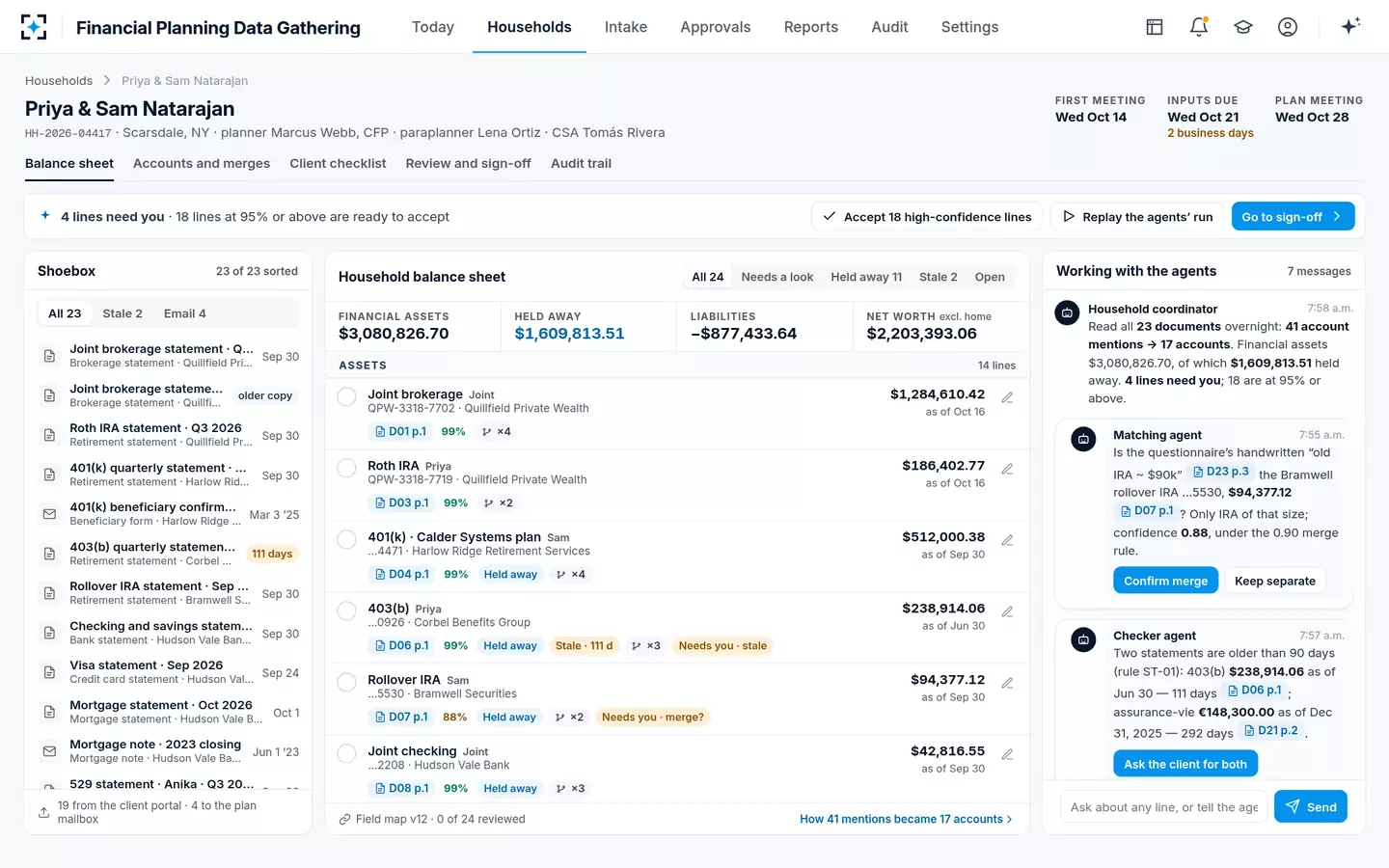
When two sources disagree, which value does the firm use?
The one the firm's written source-precedence rule picks, with the losing value kept beside it. A typical order puts a dated document ahead of a figure the client remembers, a newer document ahead of an older one, and the custodian feed first for accounts the firm itself holds. Without a written order, two paraplanners will pick differently for the same household, and nobody will know which number fed the plan.
The sample 401(k) shows why the losing value matters. The questionnaire said "about $450K"; the quarterly statement said $512,000.38. The statement is newer and wins under the sample firm's rule, and the questionnaire figure stays on the line as a mention, so the planner can see the client's own sense of the account was $62,000 low, which is itself a planning conversation. Held-away accounts are where most disagreements arise, and the held away assets guide covers the routes to that data.
Foreign accounts and equity awards: the lines with two dates
Foreign accounts are valued in US dollars at a named rate on a stated date, with the original-currency amount kept beside it. FinCEN's FBAR instructions convert each maximum value at the Treasury's published rate for the last day of the calendar year, or at another verifiable rate whose source is given (FinCEN, FBAR filing instructions), and the definition of a reportable account takes in "an insurance or annuity policy with a cash value" (31 CFR 1010.350(c)(3)(ii)). The sample's French contract had a total surrender value of €148,300.00 at December 31, 2025; the firm's rule converted it at 1.1612, the reference rate of October 16, 2026, to $172,205.96, and because the statement was 292 days old against a 90-day rule, a 2026 valuation went on the client request.
Equity awards need a convention. Vested shares and units are assets at market value; unvested awards belong in a separate schedule with their vesting dates. For restricted stock, IRS Publication 525 says that until the property is substantially vested, "it's owned by the person who makes the transfer to you, usually your employer" (IRS Publication 525, 2025). Read units and dates from the plan administrator's award summary, not a pay stub; net out shares withheld for tax at vesting; and keep company stock as its own line, because concentration is a planning issue whatever the convention. The sample household carries $214,560.00 of vested units as one line, held away at the employer's plan administrator.
How should the home be valued on a client balance sheet?
At a sourced value with its date, labelled as an estimate until a document supports it, and always on the sheet even where a derived net worth leaves it out. The home drives housing costs, insurance needs, estate planning and, for many households, retirement income, so a planning balance sheet that drops it to match the account-record definition loses the plan's largest asset. The Federal Reserve's survey puts the scale in context: 66.1% of families owned their primary residence in 2022, and the median net housing value, the home's value less debts secured by it, rose 44% between 2019 and 2022 to $200,000 (Federal Reserve, October 2023).
The firm's rule should say which documents can replace a client's estimate, such as a property tax assessment or an appraisal, how old each may be, and who may accept the client's figure in the meantime. In the sample, the clients' $1,650,000 estimate stays on the sheet marked as an estimate, a tax bill or appraisal is on the client request, and the paraplanner marks the line as the clients' estimate when signing the inputs. A planner reading the sheet sees the label before projecting a downsizing or a home equity line on that number.
Columns that make a client balance sheet auditable
An auditable balance sheet is defined by its columns, not its categories: for each line the owner, the institution, held at the firm or held away, the value, the as-of date, the source document and page, and a status such as confirmed, stale, estimated or merged. With those columns the sheet answers what a planner, a compliance reviewer or an examiner will ask without anyone reconstructing it from email.
A category template and an auditable template, for the same line
Category template: 401(k): $512,000
Auditable template: $512,000.38, quarterly statement page 1
Category template: Not recorded
Auditable template: As of Sep 30, 2026; 19 days old at review
Category template: Not recorded
Auditable template: One spouse; held away at the plan administrator, not in the custodian feed
Category template: Questionnaire said "about $450K"; unclear which was used
Auditable template: Statement wins under the firm's precedence rule; questionnaire kept as a mention
Category template: None
Auditable template: Read at 99% confidence; accepted by the paraplanner
The record matters because recommendations rest on it. For a broker-dealer, Regulation Best Interest requires a reasonable basis to believe a recommendation is in the best interest of a retail customer "based on that retail customer's investment profile", which includes "other investments, financial situation and needs" and "liquidity needs" (17 CFR 240.15l-1). A balance sheet whose lines cannot be traced to a document is a weak record of that profile.
The data rules a planning practice should write down before the next balance sheet
- Staleness windows by document type
For example 90 days for investment and bank statements, 13 months for insurance annual statements.
- Source precedence
For example: a dated document before a client-stated value, newer before older, with the losing value kept on the line.
- Merge threshold
How similar two account mentions must be before they are treated as one account without a person.
- Currency rule
Which reference rate, fixed when, and both dates shown on the line.
- Conventions
Durables in or out; pensions as income or asset; unvested awards on a schedule; home and mortgage as separate lines.
- Net worth definitions derived
Planning, account record (excluding the residence), accredited investor, each labelled.
- Who signs
A paraplanner signs the inputs and a planner approves them before the push to planning software.
How Financial Planning Data Gathering builds the balance sheet
The agents read and merge, a Checker agent re-reads every value independently and applies the firm's staleness rules, and the paraplanner settles what is left with a reason before a planner approves. In the sample run the Intake agent sorted 23 documents, the Extraction agent read 112 values with their pages, one document in French, and the Matching agent turned 41 account mentions into 17 accounts, keeping two 529 plans apart by beneficiary.
The balance sheet filling in: read, merged, then re-read and checked for dates
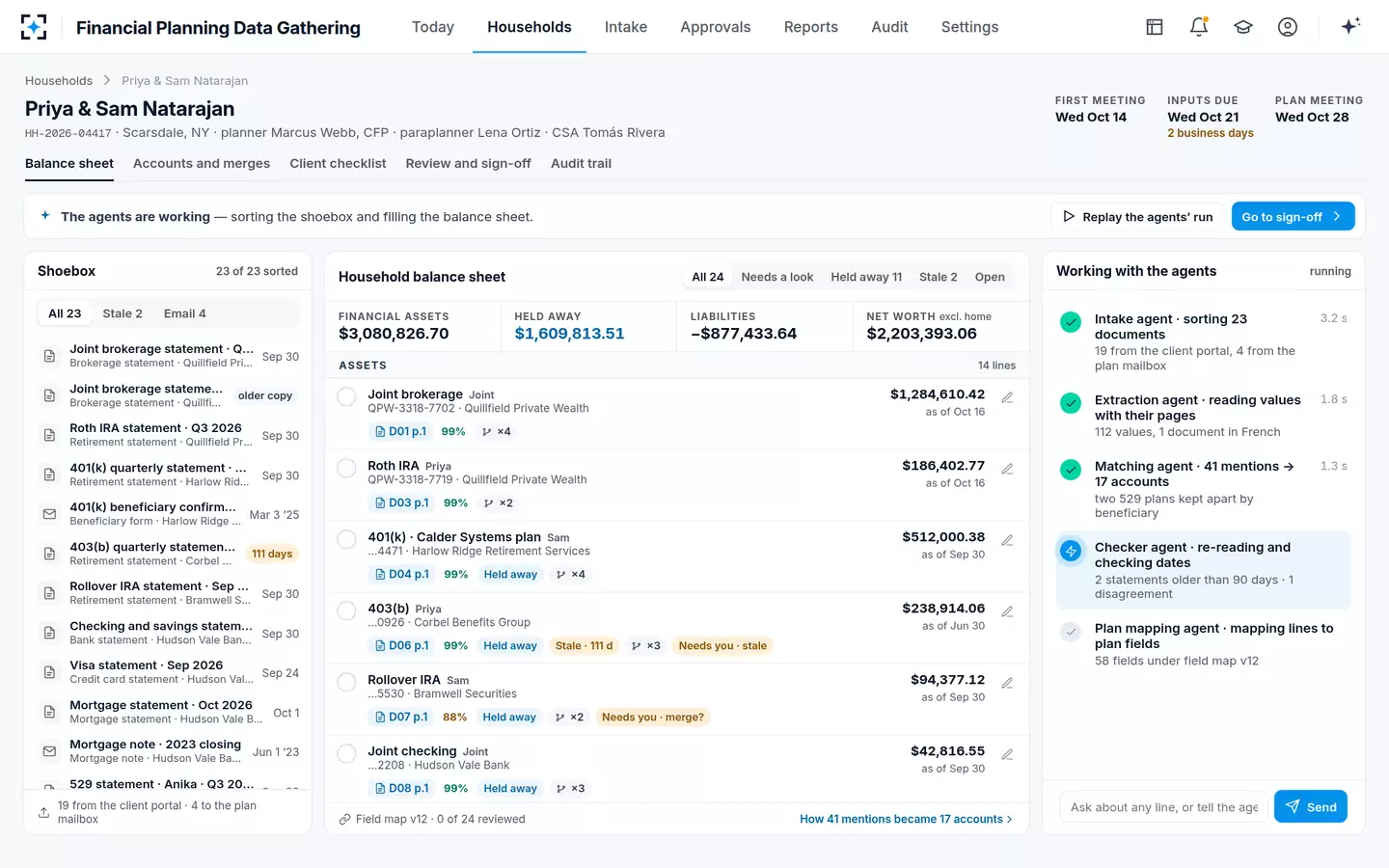
After approval the lines are pushed to 58 fields in the planning software and every field is read back to confirm it landed. The document a household is asked for, and why a request list should ask only for what is missing, is in the financial planning fact finder guide; the whole household's path is on the Financial Planning Data Gathering page.
Questions people ask
When reviewing a client's net worth, how is the family home treated?
It depends on the purpose. The Federal Reserve counts the home and its mortgage; the broker-dealer account record under Rule 17a-3 asks for net worth excluding the value of the primary residence; the accredited investor test excludes the home and the mortgage up to its value. A planning balance sheet should show the home and mortgage as separate lines and label each derived figure.
Should cars be on a financial planning balance sheet?
The Federal Reserve counts vehicles and other durables, and the SCF found 86.6% of families owned a vehicle in 2022, with a median value of $27,700. Many planners leave them out because they depreciate and are rarely sold to fund goals; the car loan belongs among liabilities either way.
How often should a client balance sheet be updated?
At least whenever the plan is reviewed, and each line whenever its source document is replaced. Investment statements are usually quarterly and insurance statements annual, so written staleness windows, such as 90 days and 13 months, decide when a line must be refreshed before the plan uses it.
Which exchange rate should a firm use for a client's foreign account?
A named, verifiable rate with its date, recorded beside the original-currency amount. FinCEN's FBAR instructions use the Treasury's rate for the last day of the calendar year; for a planning snapshot many firms use a current reference rate, but either way the rate and its source should appear on the line.
How should unvested stock awards appear?
On a separate schedule with vesting dates, not in net worth. Until restricted property is substantially vested, IRS Publication 525 treats it as owned by the transferor, usually the employer. Vested units belong on the balance sheet at market value, net of shares withheld for tax.
Does accredited investor net worth include the home?
No. Under Rule 501(a)(5) the primary residence is excluded, and mortgage debt up to the home's estimated fair market value is not counted as a liability. Debt above that value, and any increase in the 60 days before the sale not from buying the home, is counted.