A financial planning questionnaire is the form a client fills in before or at the first meeting, covering their household, income, assets, debts, insurance, goals and attitude to risk, and it is the most common way planners start collecting data. Its weakness is that completeness is easy to check and accuracy is not: every field can be filled, every total can add up, and the 401(k) balance can still be a rounded figure from a statement the client last opened in spring. The fix is to treat each answer as the client's statement and tie it to a document wherever a document exists. Botminds' Financial Planning Data Gathering does that tying: its agents read the household's statements and match each one to the questionnaire's answer, so the planner sees both, with the page that decides between them.
The examples come from the solution's sample household, Priya and Sam Natarajan, fictional clients whose questionnaire was complete and whose documents disagreed with it on three counts.
Three answers on one completed questionnaire, and how far each was from the document
What is a financial planning questionnaire?
It is the client-completed part of a firm's data gathering: a structured set of questions about who is in the household, what they earn and own and owe, what they want and how much risk they will accept. Firms use it as a template, a fillable PDF or Word file, or an online form in a client portal. Some separate a short intake form, a longer fact finder and a risk questionnaire; others combine them.
No US rule prescribes a questionnaire, but the rules define what it is gathering. Under Regulation Best Interest the retail customer investment profile covers, at a minimum, the customer's age, holdings elsewhere, finances and needs, tax status, objectives, experience, time horizon, liquidity needs and risk tolerance (17 CFR 240.15l-1(b)(2)), and broker-dealers must keep a record of the information collected from each retail customer under that rule (17 CFR 240.17a-3(a)(35)). The questionnaire is often the first version of that record, which is why its weaknesses matter beyond the plan. The financial planning fact finder guide maps each section to the document that confirms it.
Why a complete questionnaire can still be wrong
Because the client is answering from memory, and memory rounds, lags and forgets. A completed form proves that every question received an answer. It does not prove that the answers match the statements, that they describe today rather than last quarter, or that two answers about the same account agree with each other.
Europe's securities regulator writes the point into its suitability guidelines. General guideline 4 says that firms “should take reasonable steps and have appropriate tools to ensure that the information collected about their clients is reliable and consistent, without unduly relying on clients' self-assessment,” and the supporting text puts the responsibility on the firm: clients are expected to provide correct, up-to-date and complete information, “However, firms need to take reasonable steps to check the reliability, accuracy and consistency of information collected about clients” (ESMA35-43-3172, 23 September 2022). The guidelines apply to firms under MiFID II, not to US planners, but the reasoning travels: a firm that relies on a self-reported balance has not checked it.
Firms should take reasonable steps and have appropriate tools to ensure that the information collected about their clients is reliable and consistent, without unduly relying on clients’ self-assessment.
ESMA, Guidelines on certain aspects of the MiFID II suitability requirements, general guideline 4
How accurate are client questionnaires? What the research shows
Less accurate than they look, even on the things people should know best. A study that linked survey answers in the US Health and Retirement Study to employer pension records found that “Half of respondents with linked pension data correctly identify plan type, and fewer than half identify, within one year, dates of eligibility for early and normal retirement benefits” (Gustman and Steinmeier, NBER Working Paper 7368, 1999; later a chapter in a Brookings volume, 2004). The authors add that respondents “do better in reporting pension values, but the unexplained variation is still considerable.”
That is a finding about pensions and benefit rules, not about a planning questionnaire specifically, and it is a working paper rather than a journal article. But it describes exactly the fields a planning questionnaire leans on: what kind of plan a client has, when they can draw from it, and roughly what it is worth. If half of respondents cannot name their plan type, a questionnaire that asks them to is collecting a guess.
Should planners trust self-reported balances?
As leads, yes; as inputs, no. A self-reported balance tells the planner an account exists and roughly how large it is, which is valuable when no statement has arrived. It should never be the value the plan uses when a statement is available, and when it is the only value it should be marked as the client's estimate.
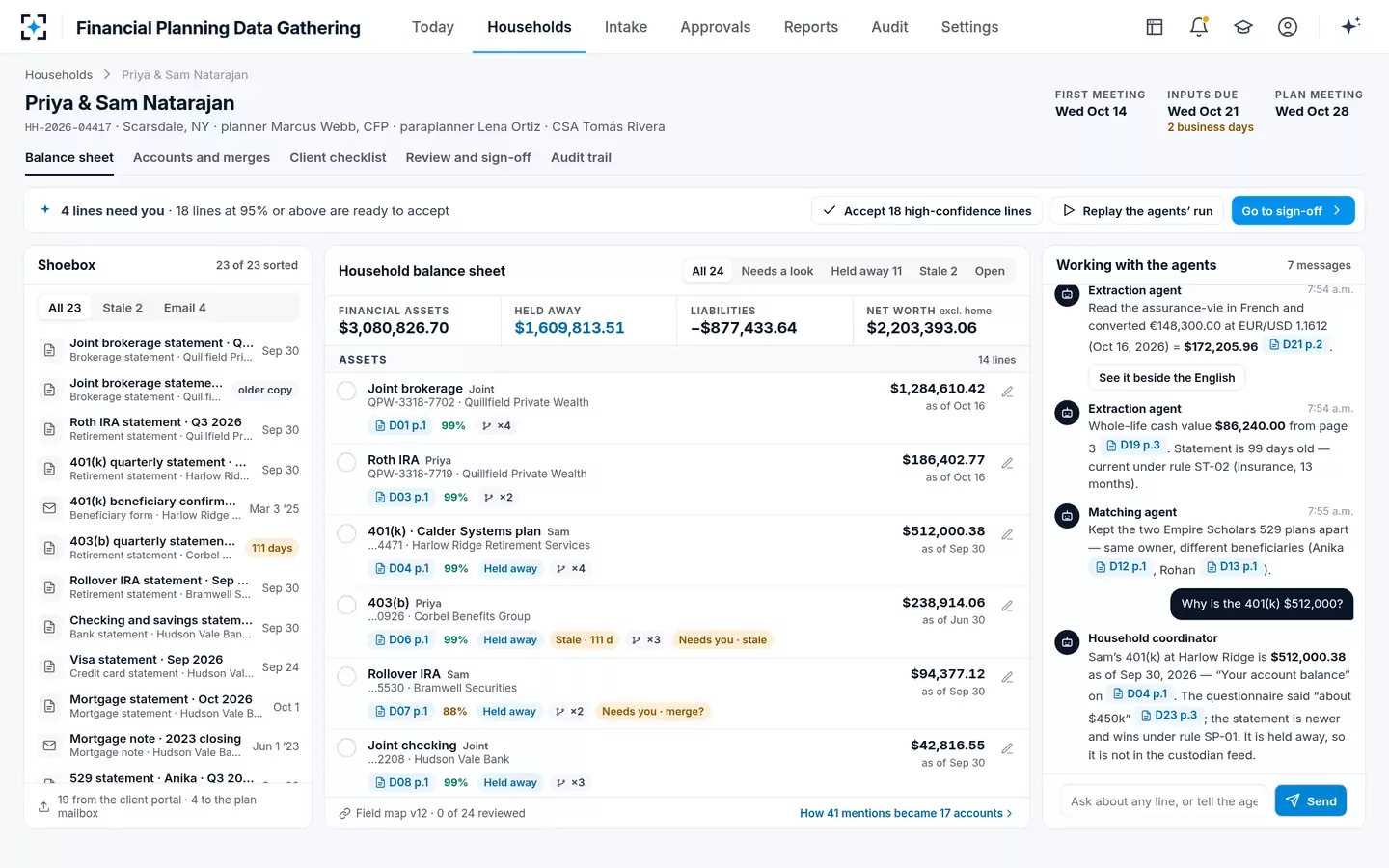
The sample household's questionnaire shows the three ways a self-reported figure goes wrong. The 401(k) was rounded and old: “about $450K” against $512,000.38 on the latest quarterly statement. The IRA was described rather than identified: “old IRA ~ $90K” could only be matched to the $94,377.12 rollover IRA after a person confirmed it, because the description lacked an institution or account number. And the home value was a new estimate, $1,650,000, against $1,500,000 already on file: not wrong, but not evidence either. The solution's source-precedence rule ranks the custodian feed, then statements, then account aggregation, then the questionnaire, so the statement wins automatically and the questionnaire's figure stays visible as a mention.
The questionnaire's answer, kept beside the statement that replaced it
What do ESMA's rules say about client information?
Three things that any planning firm can use, whatever its regulator. Collect facts rather than opinions where facts exist. Check the information for consistency as a whole and go back to the client about contradictions. And make sure any tool the client uses to answer is fit for purpose.
On consistency, the guidelines tell firms to “view the information collected as a whole,” to be “alert to any relevant contradictions between different pieces of information collected,” and to “contact the client in order to resolve any material potential inconsistencies or inaccuracies” (ESMA, paragraph 51). On tools, where firms rely on questionnaires or risk-profiling software, they “should ensure that they have appropriate systems and controls to ensure that the tools are fit for purpose and produce satisfactory results” (paragraph 49). On pre-filled answers, the client must be able “to review and, if necessary, correct and/or complete each of the pre-filled answers” (paragraph 47).
Self-assessment against a factual question: ESMA's own examples
Avoid asking: Whether clients believe they have sufficient funds to invest.
Ask instead: “factual information about their financial situation, e.g. the regular source of income and whether outstanding liabilities exist”.
Avoid asking: Whether a client feels comfortable with taking risk.
Ask instead: “what level of loss over a given time period the client would be willing to accept”.
Avoid asking: Whether a client feels sufficiently experienced to invest in certain products.
Ask instead: “what types of products the client is familiar with and how recent and frequent his trading experience with them is”.
Avoid asking: Whether a client has sufficient knowledge of a product type.
Ask instead: Questions that assess real knowledge, for example multiple-choice questions with a right answer.
How to design a financial planning questionnaire that gets accurate answers
Ask for documents where documents exist, ask for facts where they do not, and ask about attitudes last. ESMA's design list is a good template: firms should consider “the most common reasons why investors could fail to answer questionnaires correctly,” avoid “misleading, confusing, imprecise and excessively technical language,” avoid batteries of items collected through a single question, think about the order of questions, and generally not offer the possibility not to reply, particularly when collecting information on the investor's financial situation (ESMA, paragraph 22).
The same questionnaire field, written three ways
| Field | Weak question | Better question | Best: a document |
|---|---|---|---|
| Workplace retirement plan | Retirement savings (approx.) | Plan type, employer, last statement balance and its date | Upload the latest quarterly statement |
| Life insurance | Amount of life cover | Death benefit, cash value and any loan, each separately | Upload the annual policy statement |
| Debts | Total debts | Each loan: lender, principal, rate, payment, maturity | Upload the latest loan statements and the mortgage note |
| Income | Household income | Each earner: salary, bonus, other income | Upload two recent pay stubs and the last tax return |
| Foreign assets | Any foreign investments? Yes / No | Each account, pension or insurance contract abroad, with its country | Upload the statement in its original language |
| Risk tolerance | Are you comfortable with risk? | What fall in value over a year would you accept? | No document: record the answer as the client’s |
How do you check a financial planning questionnaire?
Tie each answer to its document, date each value, and read the whole for contradictions. The check is mechanical for most fields and a judgement for a few, which is why it divides naturally between software and a person.
Seven checks before a questionnaire answer becomes a plan input
- Find the document behind the answer
Statement, policy, pay stub or tax form; if none exists yet, mark the value as the client’s estimate.
- Compare the value and the date
Record both figures and both dates; the newer, documented value normally wins under a written precedence rule.
- Confirm it is the same account
Match on institution, owner, plan name and last digits; never merge accounts with different owners or beneficiaries.
- Look for accounts the questionnaire missed
Tax return interest payers, W-2 deferral codes and beneficiary forms often reveal them.
- Read the whole for contradictions
A cautious risk answer beside an aggressive goal, or a stated income that does not match the pay stubs, goes back to the client.
- Ask only for what is missing
A short request for stale, missing or estimated items, not the generic list again.
- Keep the questionnaire as the client’s statement
It records what the client said and when; replacing its numbers is not deleting them.
The last check is easy to skip and matters most for supervision. A broker-dealer must keep the information it collected under Reg BI, and a planner's own file should show what the client said as well as what the documents showed, so a later reviewer can see why the plan used the figure it did.
Financial planning questionnaire or risk questionnaire: which part has no document?
Only the attitudes: goals, priorities, time horizon and tolerance for loss. Everything about money held, earned or owed has a document; how a client feels about losing money does not. That is the part of the questionnaire worth the most care, and ESMA's guidance is specific: rather than asking whether a client is comfortable taking risk, ask what loss over a given period they would accept, and use graphs, percentages or concrete figures when asking how they would react if their portfolio fell (ESMA, paragraphs 46 and 48).
Separating the two parts also shortens the meeting. If the factual sections arrive as documents before the first meeting, the planner can spend the meeting on the questions only the client can answer. The AI paraplanner guide shows which of the checking tasks above can move to agents and which should stay with the paraplanner.
How Financial Planning Data Gathering checks the questionnaire
The solution keeps the firm's questionnaire as one source among many. Its Extraction agent reads the questionnaire like any other document, with page citations; its Matching agent matches each answer to the accounts found in statements, pay stubs and the tax return, and records the questionnaire's figure as a mention; and the firm's precedence rule decides which value the plan uses. Anything the questionnaire mentions that no document confirms, such as estate documents from 2017 that were never sent, goes on the short client request the Checklist agent drafts, which a person approves before it reaches the client.
The client request built from the gaps: four items, each with the reason it is asked
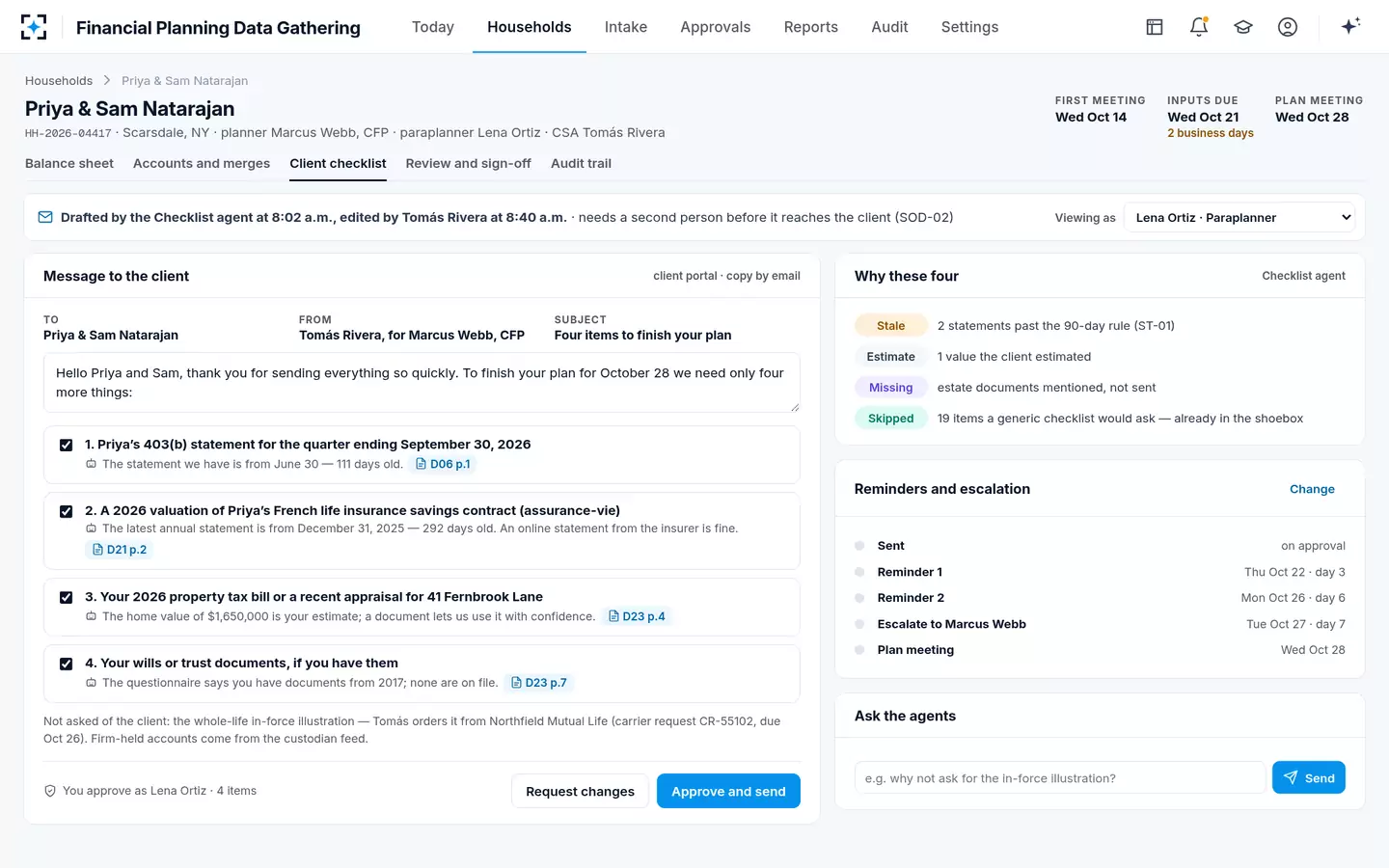
The result for the planner is a questionnaire that is neither ignored nor trusted blindly: every answer is either confirmed by a document, replaced by a newer one with the reason shown, or marked as the client's estimate. The overview of Financial Planning Data Gathering shows the same household from intake to approval.
Questions people ask
What should a financial planning questionnaire include?
Household members and key dates, income, every account and its institution, insurance, debts, property, estate documents, foreign assets, goals, time horizon and attitude to risk. Under Reg BI the investment profile it feeds has nine named factors, from age and holdings elsewhere to liquidity needs and risk tolerance, and anything else the client discloses.
Is there a financial planning questionnaire template?
Many firms publish their own as a PDF or Word file, and no US regulator prescribes one. The better templates ask for the document behind each financial answer and keep risk and goals as a separate section; ESMA's suitability guidelines also say the possibility not to reply should generally not be available when collecting information on a client's financial situation.
Is a financial planning client intake form the same as a questionnaire?
Usually not quite. An intake form is the short first contact, with names, contact details and the reason for the meeting; the questionnaire is the longer set of financial and goal questions. Both should record answers as the client's statements, to be confirmed by documents.
How do you handle a client who refuses to answer financial questions?
Record the refusal and limit the advice to what the information supports. ESMA's guidelines acknowledge that a client may be unwilling to disclose their full financial situation, but say firms remain responsible for having the information a suitability assessment needs, and that an agreement signed by the client limiting that responsibility would not be compliant.
Can AI fill in a financial planning questionnaire?
It can fill the factual parts from the client's documents and show where each value came from; it should not answer the questions about goals and risk tolerance, which are the client's own. In Financial Planning Data Gathering the agents read the documents and the questionnaire side by side, and a paraplanner settles any difference with a reason before the inputs are approved.