The best financial planning software for advisors is the system that fits the firm's planning style, that its planners already know how to use well, and that receives complete, current and traceable inputs for every household. Most comparisons stop at the first two: features, projections, reports, price. The third decides whether the plans are right, and it is mostly not a feature of the planning software at all; it is how the household's statements, policies and tax forms become the software's fields. Botminds' Financial Planning Data Gathering is built for that step. Its agents read the documents with every value cited to its page, a paraplanner and a planner approve, and the inputs are pushed into the planning software the firm already runs and read back field by field, so the go-live is a field map beside the planning system, not a migration.
This guide does not rank products. It sets out what to test in any planning system, where the data comes from, and how to judge a tool that feeds it.
From a household's documents to the planning software, with Financial Planning Data Gathering in between
Agent
ReadStatements, policies, pay stubs, tax forms and the questionnaire are sorted to the household and every value is read with its page.
Never: guesses a household or passes a low-confidence value without a person
Agent
MatchMentions of the same account across documents and feeds are merged, with the reason; the firm’s precedence rule picks the value.
Never: merges different owners or beneficiaries
Agent
CheckA second, independent reading; staleness rules applied; disagreements shown with both values.
A person decides
Paraplanner signsSettles each open line with a reason code and signs the review of the household’s inputs.
Agent
PreviewEach approved line is mapped to a planning-software field through a versioned field map; the preview shows each field’s current and new value.
A person decides
Planner approvesA different person approves the push after seeing every field that will change.
Agent
Push and read backThe fields are written to the planning software in one step and every one is read back.
Never: pushes without approval; the read-back must match 100%
What is the best financial planning software for advisors?
There is no single answer, because planning systems are built for different jobs: goals-based planning and conversation, detailed cash-flow modelling, tax and estate depth, or client-facing collaboration. The right one is the one whose method matches how the firm plans, whose reports its clients understand, and whose data model can hold every kind of asset its households bring.
Two questions are worth asking before any feature list. First, what will the system do when its inputs are wrong? Every planning tool projects confidently from whatever it is given; none can tell that a death benefit was typed into a cash-value field. Second, who will put the inputs in, and how? If the honest answer is that a paraplanner will re-key them from statements, then the cost and accuracy of every plan depend on that paraplanner's afternoon, whichever system is chosen.
Financial planning software for advisors: what it needs from you
A comprehensive planning system needs the household's people and dates, income, every account with its holdings and tax treatment, insurance, debts, property, estate details, goals and assumptions. That is the same list a regulator expects an adviser to know: Regulation Best Interest builds the investment profile from, among other things, the client's age, holdings elsewhere, finances and needs, tax position, time horizon, need for liquidity and tolerance for risk (17 CFR 240.15l-1(b)(2)).
What planning software needs, and where each input usually comes from
| Input | Usual source | What goes wrong when re-keyed |
|---|---|---|
| Firm-held accounts and holdings | Custodian feed | Rarely wrong; occasionally late |
| Held-away retirement accounts | Plan statements, aggregation | Stale balances; plan type and contribution rate missed |
| Bank accounts | Statements, aggregation | Last month’s balance |
| Life insurance | Annual policy statement | Death benefit entered as cash value |
| Equity awards | Award summary | Unvested units counted as assets |
| Debts | Loan statements and notes | Payoff entered instead of principal; rate or maturity wrong |
| Foreign accounts | Statements in the original language | Left out, or converted at an unknown rate |
| Income | Pay stubs, W-2, tax return | Gross and net confused; bonus omitted |
| Goals and risk | The conversation and questionnaire | Not a re-keying problem: record as the client’s answer |
How do you get data into financial planning software?
Through four doors: the custodian feed for accounts the firm holds, an account aggregation service for accounts the client links, manual entry for everything else, and, increasingly, a document-reading layer that prepares the manual part and pushes it through an integration. Most firms use all four, and the planning file is only as good as the weakest.
The custodian feed is reliable for what it covers and covers only firm-held accounts. Aggregation covers what clients link, through an interface or by screen scraping with the client's credentials; FINRA's investor guidance notes that many aggregators work with little regulatory oversight (FINRA, January 12, 2024), and the guide to account aggregation service providers compares it with reading statements. Manual entry is where the cost and the errors are, which is why the document layer matters.
Re-keying into planning software, and feeding it
Re-keyed by hand: A paraplanner, from a PDF on the other screen
Read, approved and pushed: An agent reads it with its page; a person accepts it or settles it with a reason
Re-keyed by hand: Found when the totals look wrong, if at all
Read, approved and pushed: Merged with a stated reason; uncertain merges are questions to a person
Re-keyed by hand: Noticed at the plan meeting
Read, approved and pushed: Flagged against the firm’s written rules before review
Re-keyed by hand: Whatever was typed
Read, approved and pushed: A field-level preview of every value that will be created or updated
Re-keyed by hand: None beyond the screen
Read, approved and pushed: Each field read back from the planning software after the push
Re-keyed by hand: Email and memory
Read, approved and pushed: Who changed what, when, why and against which page
Does financial planning software read statements?
Ask the vendor, and test it on your own documents, because the answer varies and changes. Planning systems are built to model, and their data import is usually designed around feeds and structured files. Reading arbitrary statements, policies and foreign-language documents with citations, merging the same account across them and applying a firm's staleness rules is a different job, and it is often done better by a layer in front of the planning system than inside it.
Whichever does it, the tests are the same. Plant errors in a sample of past households: a policy statement where the death benefit sits next to the cash value, an IRA described in the questionnaire and present as a statement, a 403(b) statement four months old, a foreign contract in its own language. Count what the tool catches, what it gets wrong and what it sends to a person. The AI paraplanner guide lists ten checks for any tool that reads client documents.
The push preview: every planning-software field, its current value, its new value and its source page
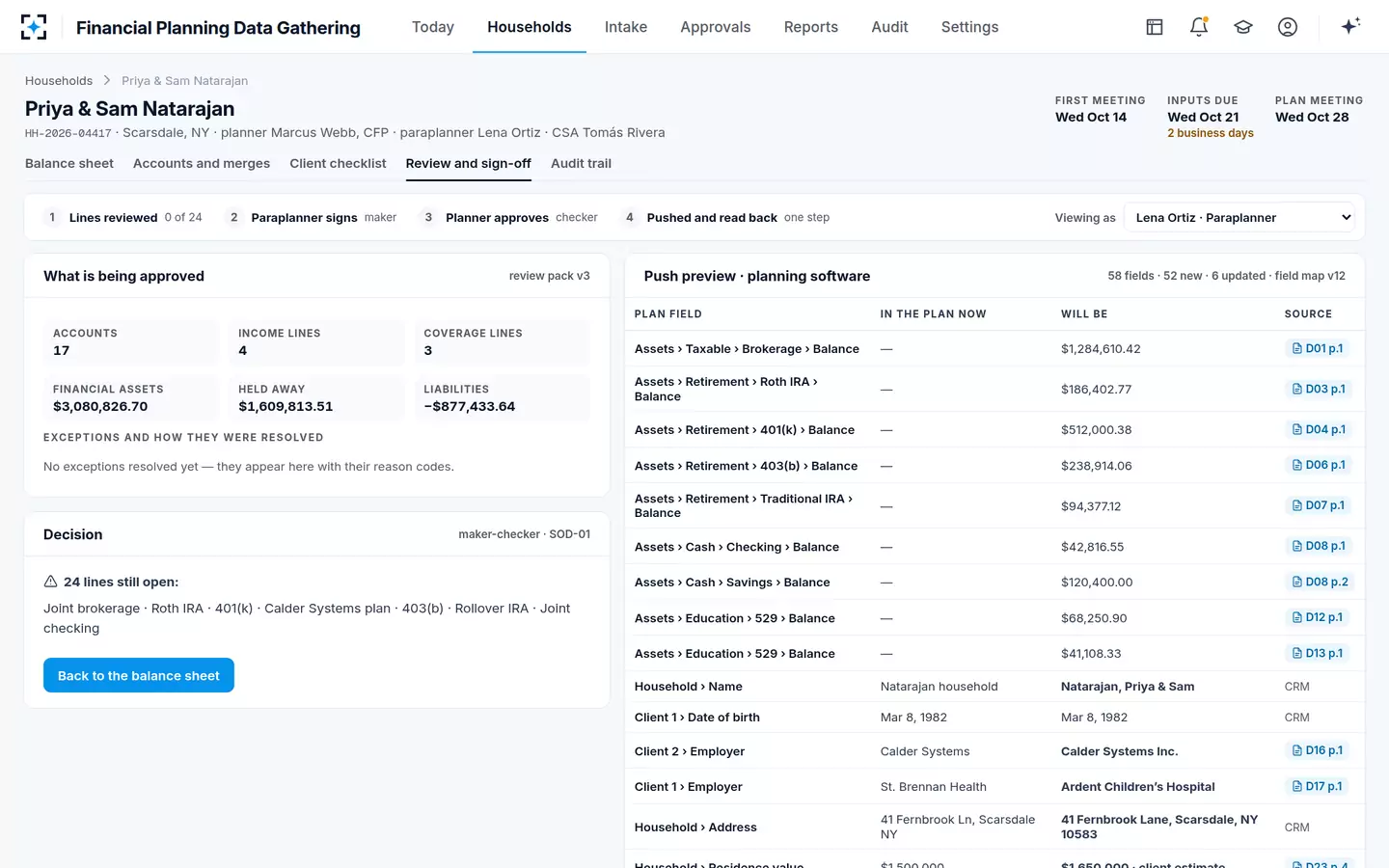
What to evaluate when choosing financial planning software
Judge the planning method first and the data path second, and give the data path real weight. A system with excellent projections and a weak path for held-away, insurance and foreign data will be fed by re-keying for as long as the firm uses it.
A buyer's scorecard for planning software and whatever feeds it
| Area | What to test | Why it matters |
|---|---|---|
| Planning method | Run three of your own households through a trial: one simple, one with held-away and insurance, one with foreign assets | Shows whether the model fits how your planners work |
| Data model | Can it hold cash value and death benefit separately, unvested awards, foreign currency, owner and beneficiary? | A missing field becomes a workaround, and workarounds become errors |
| Integration | Is there a documented way to write and read client facts, with field-level results? | Without it, every input is typed by hand |
| Change history | Does it record who changed a value, when, and from what? | Examiners and successors will ask |
| Access and security | Roles, single sign-on, data location, breach notice terms | The firm’s Regulation S-P program must cover it |
| Records | Can plans, inputs and communications be retained and exported? | Advisers keep most required books and records for five years or more |
| Exit | Can you export every household’s data in a usable form? | Switching later should not mean re-keying again |
AI financial planning software: inputs or advice?
Separate the two before buying, because the risks are different. AI that reads documents into inputs is checked against the page it read; AI that recommends is checked against the client's interests, and regulators examine it as advice. The SEC's Division of Examinations says that when it reviews automated investment tools it generally assesses whether representations are fair and accurate, whether operations and controls are consistent with disclosures, and whether the algorithms produce advice that fits each investor's profile or stated strategy (SEC, fiscal 2027 examination priorities).
That sentence is also the case for good inputs. An algorithm can only produce advice consistent with an investment profile if the profile is right; a stale 403(b), a duplicated IRA or a death benefit in a cash-value field breaks the consistency before any model runs. Financial Planning Data Gathering is on the inputs side of that line: it reads, merges, checks and drafts, and leaves modelling and recommendations to the planning software and the planner.
Data security and records when software holds client documents
Every system that stores client statements is inside the firm's Regulation S-P program. Under the SEC's 2024 amendments, covered firms must maintain written safeguards for customer information and an incident response program, notify affected customers within 30 days of becoming aware of unauthorized access, and oversee service providers, who must report a breach of a customer information system they maintain within 72 hours; larger firms have complied since December 3, 2025 and smaller firms since June 3, 2026 (SEC, May 16, 2024; 17 CFR 248.30). Its examiners have said they will evaluate those response programs, including how customers are notified and how service providers are overseen (SEC, fiscal 2027 priorities).
Records run the other way. An investment adviser keeps written communications relating to its advice and most other required records for at least five years (17 CFR 275.204-2). A planning workflow that can show, for each input, the document, the page, the person who accepted it and the approval behind the push is easier to defend than one that can show only the final number.
The firm's data rules as settings: versioned, and each change approved by a second person
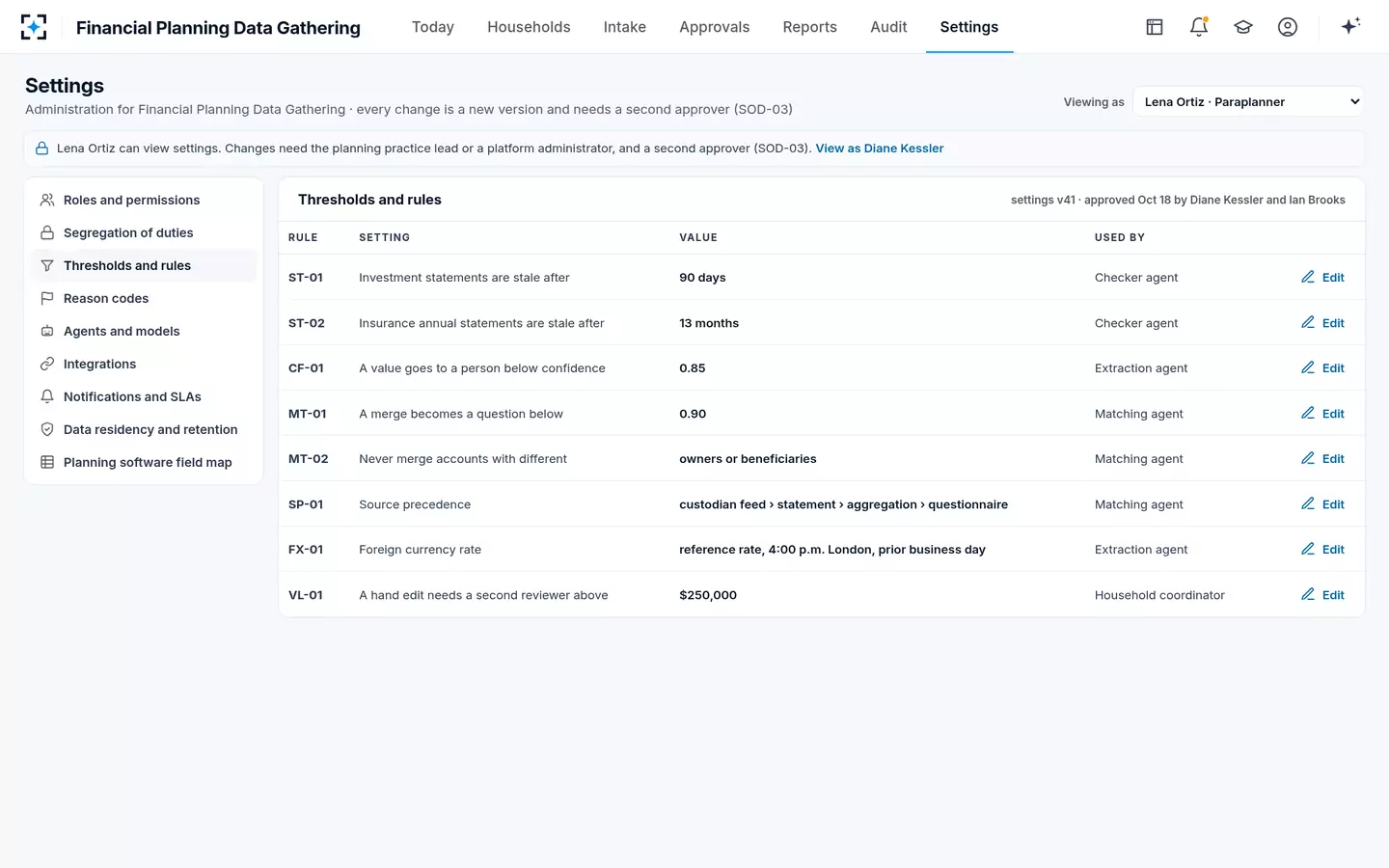
How long does it take to go live beside your planning software?
It depends less on the planning software than on what the firm brings: its data rules written down, a field map for its planning system, and a sample of past households to test on. Because the document layer sits beside the planning system rather than replacing it, nothing is migrated and planners keep working in the tool they know.
What a firm brings to a go-live beside its planning software
- Its data rules, written down
Staleness by document type, confidence and merge thresholds, source precedence, currency rule and the hand-edit limit that needs a second reviewer.
- A field map for its planning software
Each balance-sheet line type mapped to a named field, versioned so that a change is approved and traceable.
- A sample of past households
Documents and the inputs the firm approved by hand, to measure the readers field by field before relying on them.
- Its roles and approvals
Who signs, who approves, who may change rules; the signer of a review cannot approve its push.
- Its client request wording
How the firm asks clients for documents, so drafted requests read like the firm.
- Its retention and security terms
Retention periods and Regulation S-P service-provider terms, agreed before any live client data flows.
Where Financial Planning Data Gathering fits beside the planning software, and where it stops
It fits between the household's documents and the planning software: reading, merging, checking, drafting the client request, and pushing approved inputs with a read-back. It works with the systems a planning practice already runs: the planning software for client facts through a versioned field map, the CRM for households and tasks, the custodian feed for firm-held accounts, account aggregation for linked held-away accounts, the document vault for originals and the client portal and plan mailbox for documents in and approved requests out.
It is not planning software. It does not project, model taxes, compare scenarios or produce the plan report, and it does not replace the firm's choice of planning system. The overview of Financial Planning Data Gathering shows the full sequence for one household.
Questions people ask
What do financial advisors use for financial planning?
A planning system for modelling and reports, a CRM, the custodian's systems for firm-held accounts and often an account aggregation service for held-away ones. The inputs to the planning system still come largely from client statements and the questionnaire, which is where most re-keying happens.
Does planning software meet books-and-records rules on its own?
Not by itself: the adviser, not the vendor, is responsible for keeping required records, generally for at least five years under 17 CFR 275.204-2. The firm should confirm that plans, inputs and related communications can be retained and exported for that period, and that changes to inputs can be traced.
Can AI financial planning software give advice?
Some tools aim to, and the SEC's examiners review automated advice tools for whether their algorithms lead to recommendations consistent with investors' profiles. Financial Planning Data Gathering does not give advice; it prepares cited, approved inputs for the firm's planning software and planners.
Does switching planning software mean re-entering every client?
Often it does, unless the firm can export structured data and map it into the new system. A document layer with a versioned field map reduces the pain, because the cited source of every input remains available to push again into a new set of fields.
What data security rules apply to financial planning software?
For SEC-registered advisers and broker-dealers, Regulation S-P as amended in 2024: written safeguards, an incident response program, customer notice within 30 days and oversight of service providers, which must report breaches within 72 hours. All firms had to comply by June 3, 2026.