How much to charge for financial planning starts with what a plan costs the firm to produce, and no US regulator or independent study publishes either a price table or a cost benchmark, so each firm has to measure its own. The fee can be fixed per plan, hourly, a share of assets under management or commissions on products, and whichever the firm chooses must appear in its Form ADV Part 2A brochure with its fee schedule. The cost side is hours times the loaded cost of the people who spend them, and a large share of those hours goes on data gathering before any advice: collecting statements, re-keying balances, reconciling duplicates and chasing what is missing. Botminds' Financial Planning Data Gathering moves that part to agents, with every value cited to its source page, and leaves the modelling, the conversation and the approvals with the planner, which changes the cost a fee has to cover.
This guide is for the owner of an advisory firm and the planning practice lead setting or reviewing a planning fee. Its worked figures come from the solution's fictional sample firm, whose own 2025 estimate put first meeting to plan inputs ready at 16 business days.
In the sample firm's own estimate, most of a household's 16 days went on waiting, chasing and re-keying
How do advisory firms charge for financial planning?
In one of four ways, or a mix. The SEC's investor education site describes them: some planners "charge either a fixed fee or an hourly fee for the time it takes to develop a financial plan, but don't sell investment products; some are paid by commissions on the products they sell; and, others use a combination of fees and commissions" (Investor.gov, Financial Planners). Many advisory firms also fold planning into a fee based on assets under management. Each model prices a different thing and rewards the firm for a different behaviour, which is why the choice is a business decision before it is a number.
Four ways a financial plan is paid for, and what each one prices
| Model | What the client pays for | What it rewards the firm for | Where it is disclosed |
|---|---|---|---|
| Fixed fee for the plan | A defined scope of plan | Finishing the scope efficiently | Fee schedule, Form ADV Part 2A Item 5 |
| Hourly fee | The time it takes to develop the plan | Time spent, so clients will ask for an estimate of hours | Fee schedule, Item 5 |
| Share of assets managed | Ongoing management, often with planning included | Assets under management | Fee schedule and how fees are deducted, Item 5.A–B |
| Commissions on products | Products bought through the planner | Product sales; a conflict the brochure must explain | Item 5.E and the relationship summary |
A fixed fee needs the tightest cost control, because the firm absorbs every overrun. That makes it the model in which data hours matter most: a household that arrives with eleven held-away accounts, a foreign insurance contract and an equity award costs far more to gather than one with two accounts at the firm's custodian, and a single fixed price either overcharges the second or loses money on the first. Firms that fix the fee usually tier it by complexity, and the tiers should follow measured hours, not intuition.
What must the firm disclose about its planning fee?
An SEC-registered adviser's brochure must "Describe how you are compensated for your advisory services", "Provide your fee schedule" and "Disclose whether the fees are negotiable" (Form ADV Part 2A, Item 5.A). Items 5.B and 5.C require it to explain whether fees are deducted from client assets or billed, how often, and what other fees a client may pay, which is where a planning fee bundled into an ongoing advisory fee has to show up.
Two drafting choices save trouble later. Define "plan" in the fee schedule by scope, because the same word covers a one-off retirement projection and a full plan with tax, insurance, estate and investment analysis. And if the firm prices by tier, state what moves a household between tiers, such as the number of accounts or the presence of a business, so that a client who is re-tiered after the documents arrive can see why.
What does a financial plan cost the firm to produce?
The cost of one plan is the sum of four terms, and a firm can fill each from its own time study and payroll without an industry benchmark. The data term is the one that grows with every account a household holds; the advice term is the one clients believe they are paying for.
The cost of one financial plan, term by term
Data work
Σ hours (request, sorting, reading, reconciling, entry) × loaded hourly cost of whoever does it
From the time study; usually paraplanner and associate time, sometimes planner time.
The term agents can shrink most
Advice work
Hours (modelling, report, meetings) × loaded hourly cost
Planner and paraplanner time on the plan itself.
The term to protect
Review and rework
Hours checking + hours fixing lines changed at review or after the meeting
Count the lines changed; each is a cost and a risk.
Falls when every value is cited
Systems and data
Planning software, aggregation and storage per household per year
Per-household share of licences and data feeds.
Mostly fixed
The salary input has a public anchor. The median annual wage of US personal financial advisors was $105,070 in May 2025 (BLS Occupational Outlook Handbook), about $50.51 an hour over a 2,080-hour year before benefits, overhead and non-billable time, all of which a loaded rate adds. Every hour a planner spends re-keying statements is priced at that rate whether the client sees it or not.
What an hour of advice-firm time is worth, where it is published
$105,070
median annual wage of US personal financial advisors, May 2025
$50.51
the same wage per hour over a 2,080-hour year, before benefits and overhead
150
clients per adviser in the FCA's typical UK adviser profile
£2,000
revenue per client per year in the same profile
The revenue side has one published benchmark for scale. The FCA's 2025 survey of UK advice firms describes a typical adviser with about 150 clients, £250,000 of assets per client and £2,000 of revenue per client (FCA, April 2026). That is annual revenue across all services, not the price of a plan, and UK only, but it frames the economics: a firm earning about £2,000 a year from a client cannot spend many paraplanner days re-keying that client's statements and still make money on the relationship.
How much of a plan's cost is data entry? Run a time study
Only a time study can say, because the answer differs by firm, by household and by how documents arrive. It needs a log kept for a sample of households, time-stamped from email and the CRM where possible, with paraplanners recording working minutes by stage.
A time study: what to log for each household
| Stage | Start event | End event | Log |
|---|---|---|---|
| Request | First meeting ends | Request list sent | Elapsed hours; items requested |
| Collection | Request sent | Last document received | Elapsed days; documents; reminders sent |
| Sorting and reading | First document opened | All values entered in the working file | Working minutes by person; documents; values |
| Reconciling | First conflict found | All conflicts settled | Working minutes; conflicts and how each was settled |
| Checking and approval | Inputs ready for review | Inputs approved | Working minutes; lines changed at review |
| Entry | Approval | Inputs in the planning software | Working minutes; fields entered; errors found later |
Two numbers come out of it. The first is the share of working hours spent reading, re-keying and reconciling, as opposed to modelling and writing; that share, times the loaded rate, is the data term of the worksheet. The second is the count of lines changed at review, which measures how often the data work was wrong and prices the cost of finding an error at the plan meeting instead of before it. Both should be measured by complexity tier, because a fee schedule tiered on accounts held needs to know what each extra account costs.
How long does a financial plan take to produce?
Measure two numbers separately: elapsed days from first meeting to plan meeting, and working hours by stage. Elapsed time is mostly waiting on documents and on calendars; working time is mostly reading, re-keying, modelling and writing. The fee covers working hours, but elapsed time sets how many plans a team can carry at once, which caps revenue as surely as the fee does.
The sample firm's baseline and its design target: the waiting shrinks, the checking stays
| Stage | 2025 baseline, by hand | Design target with the agents |
|---|---|---|
| Sending the request list and waiting on the client | 6 days | 2 days |
| Sorting files and working out which account each one is | 2 days | 0.2 days |
| Re-keying balances, policy values, loans and income | 3 days | 0.5 days |
| Chasing missing and stale statements | 3 days | 1.5 days |
| Checking and approving the inputs | 1.5 days | 0.6 days |
| Entering them in the planning software | 0.5 days | 0.2 days |
| First meeting to plan inputs ready | 16 days | 5 days |
The target's assumptions are worth reading before believing it. Waiting falls from six days to two because the client is asked for four specific documents instead of a generic list. Re-keying falls to half a day because documents are read automatically. Checking and approving shrinks least, from 1.5 days to 0.6, because that is where people still decide. A firm evaluating the claim should measure its own baseline on the same stages first, then compare on its own households.
Where to cut a plan's cost without cutting the advice
Cut the hours that are not advice. Three changes do most of the work: ask for documents rather than numbers, ask for less by not requesting what is already on file, and stop re-keying by reading documents automatically with citations. None of them shortens the modelling, the conversation or the review.
The request is the cheapest place to start. The sample household was asked for four items, not a generic list of thirty, because nineteen of the generic items were already in its documents; each item came with its reason, and reminders were set for days three and six with escalation to the planner on day seven. Regulators favour the same approach for a different reason: ESMA's suitability guidelines say firms should ask clients for facts about their finances rather than whether they believe they have sufficient funds (ESMA35-43-3172, paragraph 46). The financial planning questionnaire guide sets out how to ask for documents first and attitudes last.
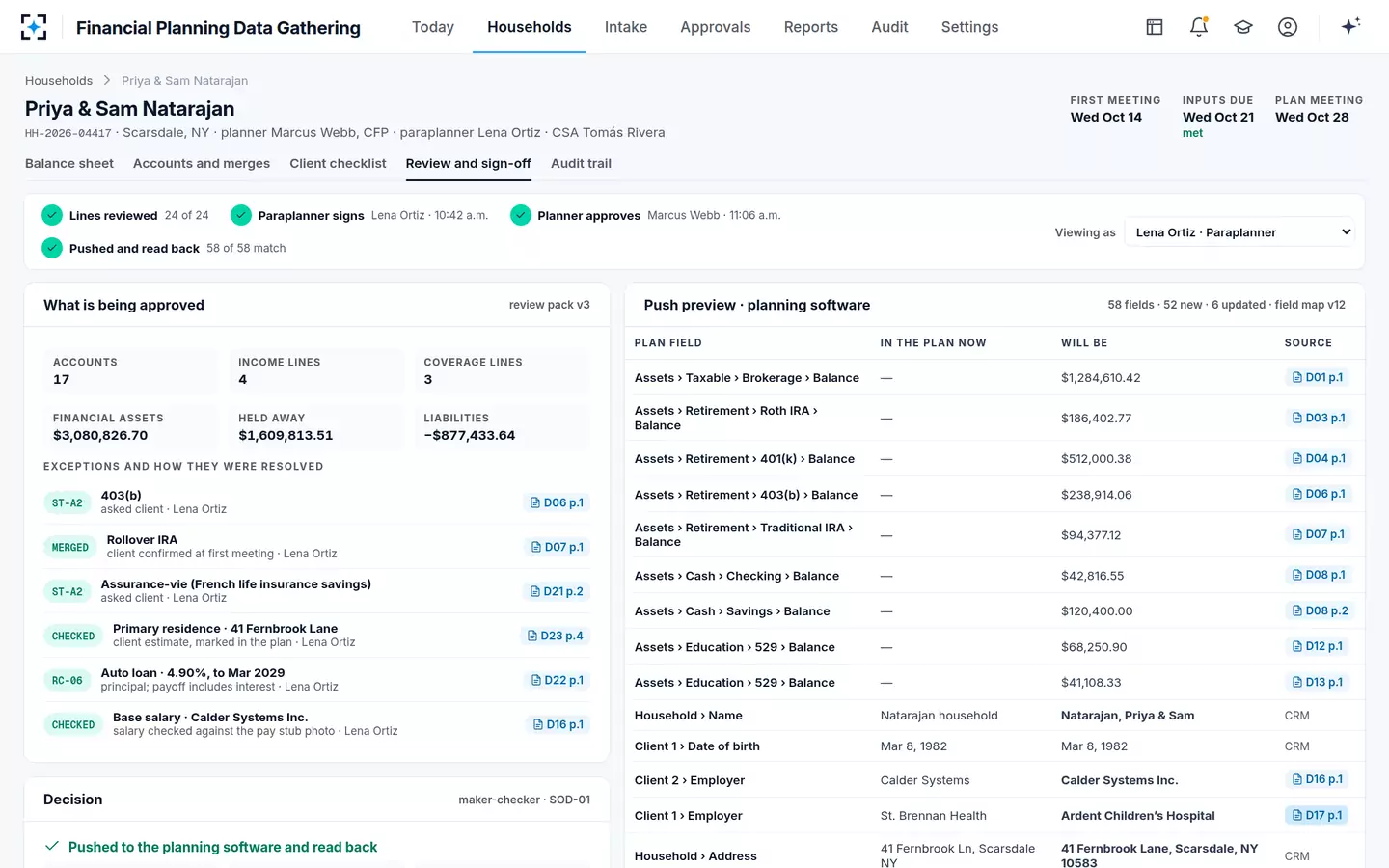
Approved, pushed and read back: the checking time that stays, made visible
Setting the fee: from cost per plan to a price per tier
Once the worksheet is filled, the fee follows from three decisions: the margin the firm needs on a plan, the complexity tiers the cost data supports, and whether planning stands alone or sits inside an ongoing fee. For a standalone fixed fee, price each tier at its measured cost plus margin, and re-measure after any change in how data is gathered, because a cut in data hours either lowers the price, raises the margin or frees capacity for more plans.
For planning bundled into an assets-based fee, the same worksheet answers a different question: below what level of assets does a household's planning cost exceed the planning share of its fee? That threshold is often where a firm sets its account minimum. Either way the brochure must carry the fee schedule and say whether fees are negotiable, and a firm that changes its tiers has a brochure to update.
What the cost worksheet tells each pricing model
| Model | Question the worksheet answers | What lowering data hours does |
|---|---|---|
| Fixed fee | Does each tier cover its measured cost and margin? | Lowers cost per plan; the firm keeps the difference or cuts the price |
| Hourly | What estimate of hours to give the client by tier | Lowers the client's bill directly; fewer hours billed |
| Assets-based with planning included | Below what asset level planning costs more than its share of the fee | Lowers the minimum the firm can serve profitably |
| Commission or mixed | What planning costs the firm before any product revenue | Lowers the cost that product revenue has to recover |
Where Financial Planning Data Gathering changes the cost of a plan
It moves the data term of the worksheet to agents and leaves the advice term alone. The Intake agent sorts every upload to its household; the Extraction agent reads every value with its page; the Matching agent merges duplicate accounts and explains why; the Checker agent re-reads and applies the staleness rules; the Checklist agent drafts a request for only what is missing; and the Plan mapping agent pushes approved values and reads them back. People decide every open line and approve every push.
The sample firm's design target is plan inputs ready in five business days from first meeting, against its own baseline of sixteen. The test that settles it is a sample of the firm's own households, measured with the time study above before and after. How the agents and people divide the paraplanning work is set out in AI paraplanner: which tasks move to agents, and one household's path from first meeting to plan is on the Financial Planning Data Gathering page.
Questions people ask
How much should an advisor charge for a financial plan?
Enough to cover the firm's measured cost per plan at its complexity tier, plus margin. No US regulator publishes a price table or a cost benchmark, so the figure has to come from the firm's own time study and payroll; the fee schedule must then appear in the Form ADV Part 2A brochure.
Should a planning firm charge a flat fee or by the hour?
A flat fee suits firms that can predict hours by tier and want a simple price; the firm absorbs overruns. Hourly suits unusual households and firms that cannot yet predict hours; clients will ask for an estimate. Investor.gov describes both as common among planners who do not sell products.
What does Form ADV require a firm to say about planning fees?
Item 5 of Part 2A requires the firm to describe how it is compensated, provide its fee schedule, say whether fees are negotiable, explain how fees are deducted or billed and how often, and describe other fees clients may pay. Item 5.E requires disclosure of the conflict where its people are compensated for selling securities.
How many hours does a comprehensive financial plan take?
No official US figure exists, and it varies with household complexity and how documents arrive. A time study on a sample of the firm's own households, logging working minutes by stage, gives the number a fee should rest on.
What share of planning time is data gathering?
Each firm has to measure it. In the fictional sample firm's own estimate, request, waiting, sorting, re-keying and chasing took about 14 of the 16 business days from first meeting to plan inputs ready, before modelling began; that is elapsed time, not hours worked.
Does cutting data hours lower the fee?
It depends on the model. Under hourly billing it lowers the client's bill directly; under a fixed fee it lowers the firm's cost and the firm chooses whether to pass it on; under an assets-based fee it lowers the account size the firm can serve profitably.