An AI paraplanner, as the term is used in advice firms, is software that takes over part of a paraplanner's work: reading client statements, policies and tax forms, entering the values into the planning software, matching accounts and drafting requests for missing documents. It does not replace the paraplanner, because the tasks that make the role accountable, deciding which of two conflicting figures is right, accepting an estimate and signing that the inputs are ready, are judgements that stay with a person. The useful question is therefore not whether AI can do paraplanning but which tasks move and how each is checked. Botminds' Financial Planning Data Gathering is built on that division: seven agents read, merge, check and draft, with every value cited to its page, and a paraplanner and a planner decide.
The split below covers the twelve tasks of data gathering, from the first upload to the push into the planning software, as the solution divides them on its fictional sample firm.
Twelve data-gathering tasks: which move to agents, which are shared, which stay with people
Sort each upload and email to its household
Agent
Classification with a stop: two possible households go to a person, never a guess.
Split combined PDFs and name each document
Agent
Finding first pages, institutions and statement dates is pattern work.
Read balances, contributions, policy values and loan terms
Agent
Every value carries its page and region; low-confidence values go to a person.
Read a foreign-language statement and convert it
Agent
Shown beside the English, at a rate the firm’s rule names, with its date.
Re-read every value independently and dispute differences
Agent
A second reader that reports evidence and never overrides a person.
Merge the same account seen on several documents
Shared
Automatic above the firm’s threshold; below it, or across owners, a question to the paraplanner.
Flag stale statements against the firm’s rules
Agent
Date arithmetic against written, versioned rules.
Draft the request to the client for what is missing
Shared
The agent drafts; a person edits; a different person approves before it is sent.
Decide which of two conflicting values is right
Person
A judgement about the document, the field and the client, with a reason code.
Accept a client’s estimate for this plan
Person
Whether the clients’ $1,650,000 for their home is good enough depends on what the plan will do with it.
Sign the review of the inputs
Person
The paraplanner’s accountability, and the evidence that the inputs were checked.
Approve the push to the planning software
Person
A different person from the signer; the agent pushes only after approval, and reads every field back.
What is an AI paraplanner?
It is a re-division of tasks, not a new member of staff. Most of a paraplanner's data work, opening documents, finding the right line, typing it into the right field and checking the date, is reading, and reading with citations is something software can now do and a second reader can verify. The rest of the job, judging, reconciling, approving and explaining, is where the paraplanner's accountability lies, and it does not move.
The distinction matters when buying. A product described as an AI paraplanner can mean a drafting assistant for plan reports, a model that answers technical questions, or a reader that fills the planning software. They solve different problems. Data gathering is the part of the job where the hours are and where errors are hardest to see later, and it is the part this guide is about.
Which paraplanning tasks can AI do reliably?
The ones with a checkable answer on a page. If the right value is printed on a statement and the task is to find it, read it and put it in the right field, an agent can do it and cite the page, and a second agent can re-read it without seeing the first reading. If the right answer depends on what the plan is for, or on choosing between two documents that disagree, the agent can lay out the evidence but a person should decide.
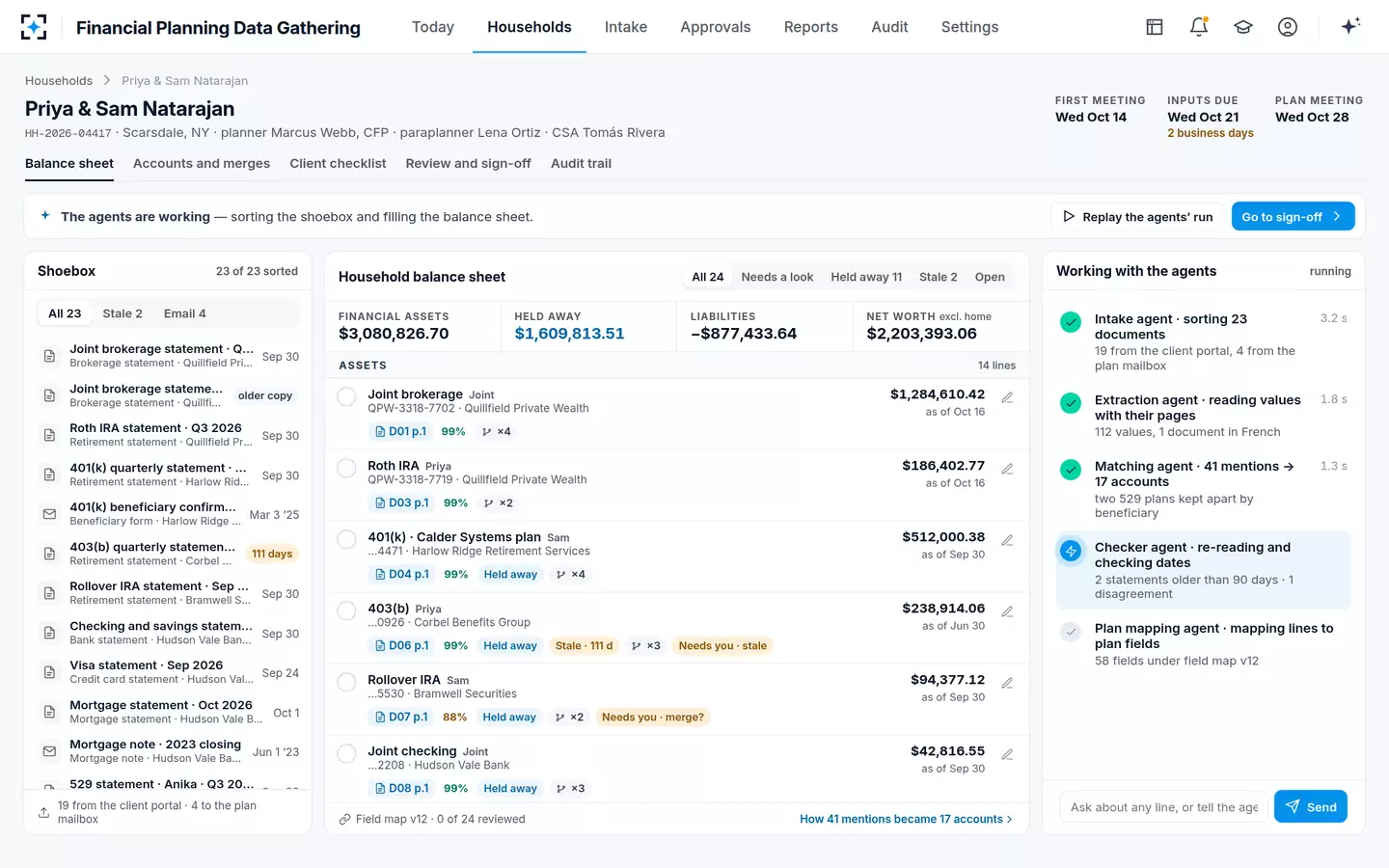
The sample household shows both kinds on one morning. Agents read 112 values from 23 documents and merged 41 account mentions into 17 accounts, including keeping two 529 plans apart because their beneficiaries differed. Four lines went to the paraplanner. One was a merge the agent scored at 0.88, under the firm's 0.90 threshold. One was a disagreement on a single page: an auto loan statement showing a principal of $28,902.14 and a payoff of $29,047.66, where the right figure depends on what the planning field expects. Two were stale statements, where the agents could flag the age but only a person could decide to ask the client.
What should never be automated in financial planning?
Anything that commits the firm to the client: sending a message, approving inputs, and choosing between values in a way that changes the plan. The solution's agents never push to the planning software, never send to a client and never approve; they never guess a household, and never merge accounts with different owners or beneficiaries.
One household through Financial Planning Data Gathering: what each agent may do, and where people decide
Agent
Intake agentSorts portal uploads, mailbox email and vault files; splits combined PDFs; matches each document to its household.
Never: guesses a household; two candidates go to a person
Agent
Extraction agentReads balances, holdings, contributions, beneficiaries, policy values and loan terms, each with page, region and confidence, in the document’s own language.
Never: passes on a value below 0.85 confidence without a person
Agent
Matching agentMerges mentions of the same account across statements, pay stubs, the tax return, the questionnaire and the feeds, and says why.
Never: merges different owners or beneficiaries
Agent
Checker agentRe-reads every value independently, ties it to statement totals and feeds, applies the staleness rules and disputes the first reading when they differ.
Never: overrides a person
A person decides
Paraplanner settles and signsResolves each open line with a reason code, accepts or rejects estimates, and signs the review.
Agent
Checklist agentDrafts a short client request for only what is missing, stale or estimated, and re-runs the household when the client uploads.
Never: sends to a client; a person approves every message
A person decides
Planner approvesA different person from the signer approves the push, seeing every line, every exception and the exact fields that will change.
Agent
Plan mapping agentPushes the approved fields to the planning software and reads every one back.
Never: pushes without approval; the read-back must match 100%
Two rules in that sequence do most of the work. The person who signs the review cannot approve its push, so every household's inputs pass two people. And the push is read back field by field: in the sample household, 58 fields were pushed, 52 new and 6 updated, and all 58 were read back from the planning software and matched before the receipt was filed.
Can AI read client statements accurately?
Accurately enough to be useful only if accuracy is designed in and measured, not assumed. Three design choices separate a reader a firm can rely on from one it cannot: every value cites the page and region it came from, so a person can check it in one click; a second, independent reading compares against the first and reports disagreements rather than hiding them; and confidence thresholds send uncertain values to a person instead of into the plan.
The measurement part belongs to the firm. Before relying on any reader, run it on a sample of the firm's own past households whose inputs were checked by hand, and count field by field: right, wrong, or sent to a person. Repeat whenever the model or prompt changes. In the solution's sample firm, the audit trail records the promotion of a new Extraction agent version together with its evaluation result and an approval reference, so the version that read a household's documents can always be traced. A vendor's accuracy claim on someone else's documents is not a substitute.
The run, replayed: each agent's step, and the four lines left for the paraplanner
What do regulators say about AI in advice firms?
That existing obligations apply, and that examiners are looking. FINRA's Regulatory Notice 24-09 reminds members that its rules and the securities laws still govern what they do with generative AI, and that a firm using such tools “as part of its supervisory system” should address technology governance, including model risk management (FINRA, June 27, 2024). The SEC's Division of Examinations calls the technology “super intelligence (SI)” in its fiscal 2027 priorities, and lists back-office operations among the uses of it whose monitoring policies it will prioritise in examinations, alongside fraud detection, AML and Reg BI compliance and trading (SEC, October 2026). What makes advisors trust drafts prepared this way, and how firms measure it, is in AI for financial advisors.
In the UK, the FCA's survey of advice firms gives a sense of pace. Firms are exploring AI for client engagement, compliance and operational efficiency, but fewer say they will deploy it inside the advice process soon (FCA, April 2026).
UK advice firms that say they will use AI, by where it is used and firm size
14%
of small firms will use AI within advice processes; 33% more are considering it
38%
of medium firms will use it within advice processes; 43% are considering it
52%
of large firms will use it within advice processes; 43% are considering it
46%
of large firms will use AI to support other business functions; 16% of small firms will
Paraplanning software or an AI paraplanner: what to test before buying
Test the tool on your own files, with errors you planted, and judge it on what it does when it is unsure. A demonstration on clean sample statements proves very little; the households that cost paraplanners time are the ones with a stale 403(b), a policy statement in French, an IRA the client described from memory and a combined 38-page scan.
Ten checks for any AI tool that will read client documents into a plan
- Every value cites its page and region
Open any number and land on the highlighted line of the source. No citation, no input.
- A second, independent reading
Disagreements between two readings are shown with both values, not silently resolved.
- Thresholds the firm sets and versions
Confidence, merge and staleness rules are settings with a change history and a second approver, not vendor constants.
- Never merges different owners or beneficiaries
Two 529 plans for two children must stay two accounts; ask to see how the tool explains a merge.
- Clean handling of the unreadable
Password-protected files, blurred photos and combined scans go to a person with a one-click request, never a guess.
- Foreign-language documents and currencies
The original shown beside a translation; conversion at a named rate with its date.
- No client message without a person
Drafts only; a person who did not edit the draft approves it.
- A push preview and a read-back
See the exact fields that will change before approval, then confirm each one in the planning software afterwards.
- A record you can keep
Who changed what, when, why and against which page, retained at least as long as your books-and-records rules require.
- Service-provider terms that match Regulation S-P
Your incident response program must cover a provider that holds client documents, including prompt notice to you of a breach.
Client data, records and the service-provider question
An AI tool that reads client statements is a service provider holding customer information, and the rules treat it that way. Under the SEC's amendments to Regulation S-P, adopted May 16, 2024, covered firms must keep written policies and procedures for an incident response program and notify affected individuals within 30 days of becoming aware of unauthorized access to or use of customer information; larger firms have complied since December 3, 2025 and smaller ones since June 3, 2026 (SEC, May 16, 2024). The firm's policies must also require service providers to notify it no later than 72 hours after becoming aware of a breach of a customer information system they maintain (17 CFR 248.30).
Records matter in the other direction. If an agent reads a balance into a plan, the firm should be able to show later where the balance came from and who accepted it. An investment adviser keeps written communications relating to its advice, and most other required books and records, for at least five years (17 CFR 275.204-2). A tool whose working history disappears when the session ends leaves the firm with inputs it cannot explain.
Where Financial Planning Data Gathering fits, and where it does not
It fits the data half of paraplanning: from the documents a household sends to approved inputs in the planning software, with every value cited, every merge explained, every exception settled with a reason and every field read back. It keeps a hash-chained audit trail of every action by people and agents, retained for six years in the sample firm's settings, and compliance can export a household's evidence on demand.
It does not build the plan, run projections, choose products, write the plan report or give advice. Those stay with the paraplanner, the planner and the planning software the firm already uses; the guide to choosing financial planning software explains why the integration matters more than the brand. The overview of Financial Planning Data Gathering follows one household end to end.
Questions people ask
Will AI replace paraplanners?
Not the role, but much of its data work. Reading, matching and drafting can move to agents; deciding between conflicting values, accepting estimates and signing remain human judgements. In the FCA's 2025 survey, only about 14% of small UK advice firms said they will use AI within their advice processes, so most firms are at the exploring stage.
Can AI enter data into planning software?
Yes, if it maps each approved value to a named field and confirms the result. In the sample household, 58 fields were pushed after a paraplanner signed and a different person approved, and all 58 were read back from the planning software and matched. A tool that pushes without approval or without a read-back should not be trusted with plan inputs.
Who approves plan inputs prepared by AI?
A person, and preferably two. In Financial Planning Data Gathering the paraplanner signs the review and a different person, the planner, approves the push; the screens block the signer from approving. Every edit, rejection and approval carries a reason code.
Is it safe to upload client statements to an AI tool?
Only if the tool sits inside your data-protection program. Under the amended Regulation S-P, firms must oversee service providers that hold customer information and require them to report a breach within 72 hours, and firms must notify affected customers within 30 days. Ask any vendor how it meets those terms before sending a single statement.
What is paraplanning software?
Usually the planning software itself, plus tools for gathering data, researching products and drafting reports. An AI layer can sit in front of it to read documents into its fields. The SEC's fiscal 2027 examination priorities say examiners will review policies for monitoring super intelligence in back-office operations, so whichever tool a firm uses, its controls should be written down.