A life insurance policy review checklist for a financial plan confirms eight facts from each policy's annual statement before it enters the planning software: owner, insured and beneficiaries; policy type; statement date; net cash surrender value; outstanding loans; death benefit including riders and paid-up additions; premium; and whether an in-force illustration is needed for projections. The point of the checklist is placement. The net cash surrender value is an asset on the household balance sheet; the face value, the death benefit, is coverage and belongs in the insurance analysis, never in net worth. A firm that gets it wrong overstates a client's assets by the gap between the two, which on a typical whole-life policy is most of the face amount. Botminds' Financial Planning Data Gathering reads each policy value from the statement with its page, applies the firm's staleness rule and pushes cash value and death benefit into different fields of the planning software.
This guide is for the paraplanners who key plan inputs, the planners who approve them and the planning practice lead who sets the firm's data rules. The examples come from the solution's sample household, a fictional couple whose whole-life policy shows a $1,000,000 death benefit and an $86,240.00 cash value on the same page.
How often a client file holds a cash value policy, and how large it is
16.1%
of US families held cash value life insurance in 2022, down from 19.0% in 2019
$9,700
median cash value among families holding it, 2022
$55,400
mean cash value among families holding it, up 17%
$2.2T
household life insurance reserves in the national accounts, end of 2025
What should a life insurance policy review checklist cover for a financial plan?
It should cover the facts that decide where each policy lands in the plan and whether the number is current, not whether the client bought the right product. That is a different review, with different evidence. For plan inputs the evidence is one document: the policy's annual statement, which under the NAIC's illustrations model regulation shows, where applicable, the current death benefit, annual contract premium, current cash surrender value, current dividend and how it was applied, and any outstanding loan (NAIC Model Regulation 582).
Eight things to confirm from every policy statement before it enters the plan
- Owner, insured and beneficiaries
The owner holds the cash value; the insured's death triggers the benefit; the beneficiaries receive it. They are often three different parties.
- Policy type
Term, whole life, universal or variable life. Only permanent policies carry a cash value.
- Statement date
Insurers report once a policy year; a firm rule such as the sample firm's 13 months says when to ask for a newer one.
- Net cash surrender value
The asset figure. If only "cash value" is printed, check for loans and surrender charges.
- Outstanding loans and loan interest
Record once: netted in the asset, or listed as a liability.
- Death benefit, including paid-up additions and riders
The coverage figure for the insurance analysis.
- Premium and how it is paid
A cash-flow line; a lapse risk if premiums stop on a universal life policy.
- What the next years look like
For projections, request an in-force illustration from the carrier; the annual statement shows today's values only.
Cash value or face value: which number goes in the client's net worth?
The net cash surrender value goes in net worth; the face value never does. Face value is a promise payable to beneficiaries at death; cash value is money the owner can reach now by surrender, withdrawal or a policy loan. The Federal Reserve measures household wealth the same way: its survey counts a policy as an asset only when it has a cash value that can be withdrawn, and "measures the value of such policies according to their current cash value, not their death benefit", excluding term policies, "which provide only a death benefit" (Federal Reserve, October 2023).
Face value and cash value: two numbers, two jobs in the plan
Face value (death benefit): The amount the insurer pays to the beneficiaries when the insured dies, adjusted for any rider, loan or paid-up additions.
Cash value: The savings value built up inside a whole-life or universal life policy, available to the owner during the insured's life.
Face value (death benefit): The beneficiaries, at death.
Cash value: The owner, now: by surrender, withdrawal or a policy loan.
Face value (death benefit): No. It is not an asset of the living household.
Cash value: Yes, as a financial asset, net of any policy loan.
Face value (death benefit): Insurance analysis: survivor needs, estate liquidity.
Cash value: Net worth, and liquidity available in an emergency.
Face value (death benefit): Paid because of death, generally not taxable to the beneficiary.
Cash value: On surrender, proceeds above the owner's cost in the policy are income.
The error is common because the client and the statement both invite it. A client asked how much life insurance they hold answers with the death benefit, because that is what they bought, and a questionnaire field labelled "life insurance" will receive that figure. On the sample policy the face value is more than eleven times the cash value; keying the face amount as an asset would overstate the household's financial assets by $913,760.00, the size of a large retirement account, and every projection built on it.
Cash value, cash surrender value, net cash surrender value: the lines on a statement
Statements print several values, and the plan needs the net cash surrender value. The NAIC's universal life model regulation defines the terms: "Cash surrender value" means "the net cash surrender value plus any amounts outstanding as policy loans", and "Net cash surrender value" means "the maximum amount payable to the policyowner upon surrender" (NAIC Universal Life Insurance Model Regulation). A universal life statement also shows a "policy value", which differs from the surrender value by any surrender charge.
The values on a permanent policy statement, and which one the plan needs
| Value | What it means | Plan use |
|---|---|---|
| Face amount or total death benefit | Payable at death, including paid-up additions | Coverage: survivor and estate analysis |
| Policy value (universal life) | The account to which interest and charges are applied | Context only; not what the owner can take |
| Cash surrender value | Net cash surrender value plus any policy loans | Context; shows the gross value before loans |
| Net cash surrender value | The most the owner could receive on surrender today | The asset line on the balance sheet |
| Outstanding policy loan | Borrowed against the cash value, with interest | Already netted in the net value; record it, do not subtract it twice |
Surrender has a tax side the plan should flag even if it does not deduct it. IRS Publication 525 says that on surrender for cash the owner "must include in income any proceeds that are more than the cost of the life insurance policy", the cost being, in most cases, premiums paid less refunded premiums, rebates, dividends and unrepaid loans not already taxed (IRS Publication 525, 2025). A plan that treats cash value as emergency liquidity should note the embedded gain on a mature policy.
One statement, read line by line for the plan
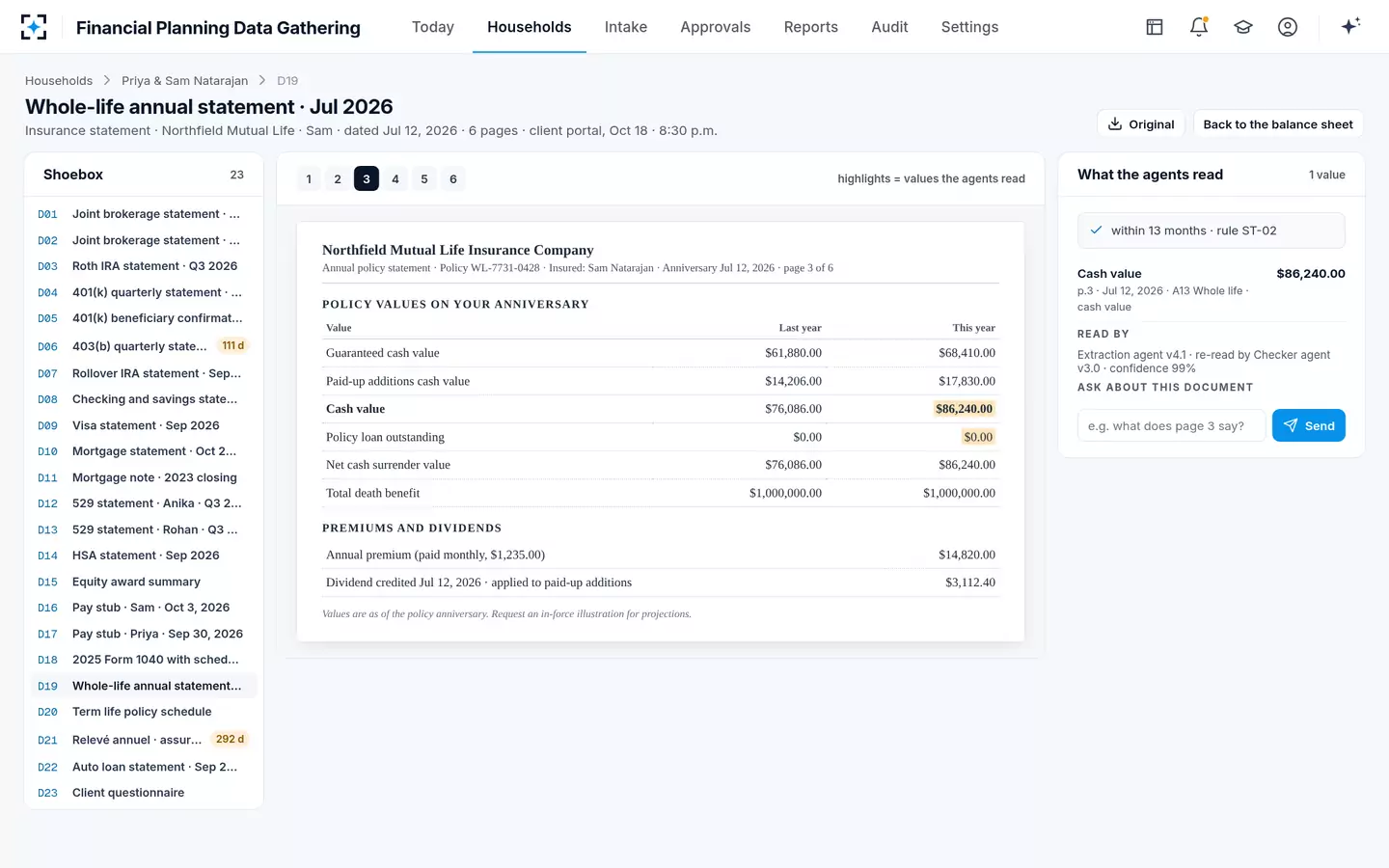
The annual statement carries every value the checklist needs on one or two pages, which is why it is the document to request rather than a carrier's online summary. The sample household's whole-life statement shows how each line maps to the plan.
One page of the sample whole-life statement, annotated for the plan
| Line on page 3 | This year | What the paraplanner does with it |
|---|---|---|
| Guaranteed cash value | $68,410.00 | Part of the cash value; the guaranteed floor |
| Paid-up additions cash value | $17,830.00 | Part of the cash value, bought with dividends |
| Cash value | $86,240.00 | The asset line on the balance sheet |
| Policy loan outstanding | $0.00 | Confirms nothing to net off |
| Net cash surrender value | $86,240.00 | Equal to cash value here: no loan, no surrender charge |
| Total death benefit | $1,000,000.00 | The coverage line, not an asset |
| Annual premium | $14,820.00 ($1,235 a month) | Cash-flow line in the budget |
| Dividend credited Jul 12, 2026 | $3,112.40, applied to paid-up additions | Explains the growth in cash value and death benefit |
The source page behind the policy line, with the values the agents read highlighted
How old can a policy statement be before the firm asks for a new one?
Older than an investment statement, because insurers report once a policy year. A firm rule that applies a 90-day limit to every document will chase clients for insurance statements that do not exist yet; one that applies no limit will carry a universal life value from two anniversaries ago. The sample firm in the solution accepts insurance annual statements for 13 months, the policy year plus a month for delivery, against 90 days for investment statements.
The rule should be written down, versioned and applied by policy type. Whole-life cash value moves on a guaranteed schedule plus dividends, so a statement near the end of its window is still close. Universal and variable life values move with credited interest, charges and markets, and a lapse risk on an underfunded universal life policy will not show on a year-old statement at all; for those, the firm may want a current-value request from the carrier when the plan is built.
Owner, insured, beneficiary: whose asset is it?
The cash value belongs to the policy's owner, which is not always the client. A policy owned by an irrevocable trust is generally not the household's asset, though its death benefit still matters to the estate plan; a policy owned by a business belongs on the business's balance sheet; a policy on one spouse owned by the other changes which column the cash value sits in. The checklist's first line exists because the planning software has one field per policy and three parties to describe.
Loans need the same discipline. A policy loan should appear once: either the balance sheet uses the net value and records the loan as context, or it uses the gross value and lists the loan as a liability. The Federal Reserve takes the second approach in its survey, counting loans on cash value policies among "other" debt. Either works; doing both understates net worth, and the firm's data rules should name the one it uses.
Contracts held abroad: the policy clients forget to mention
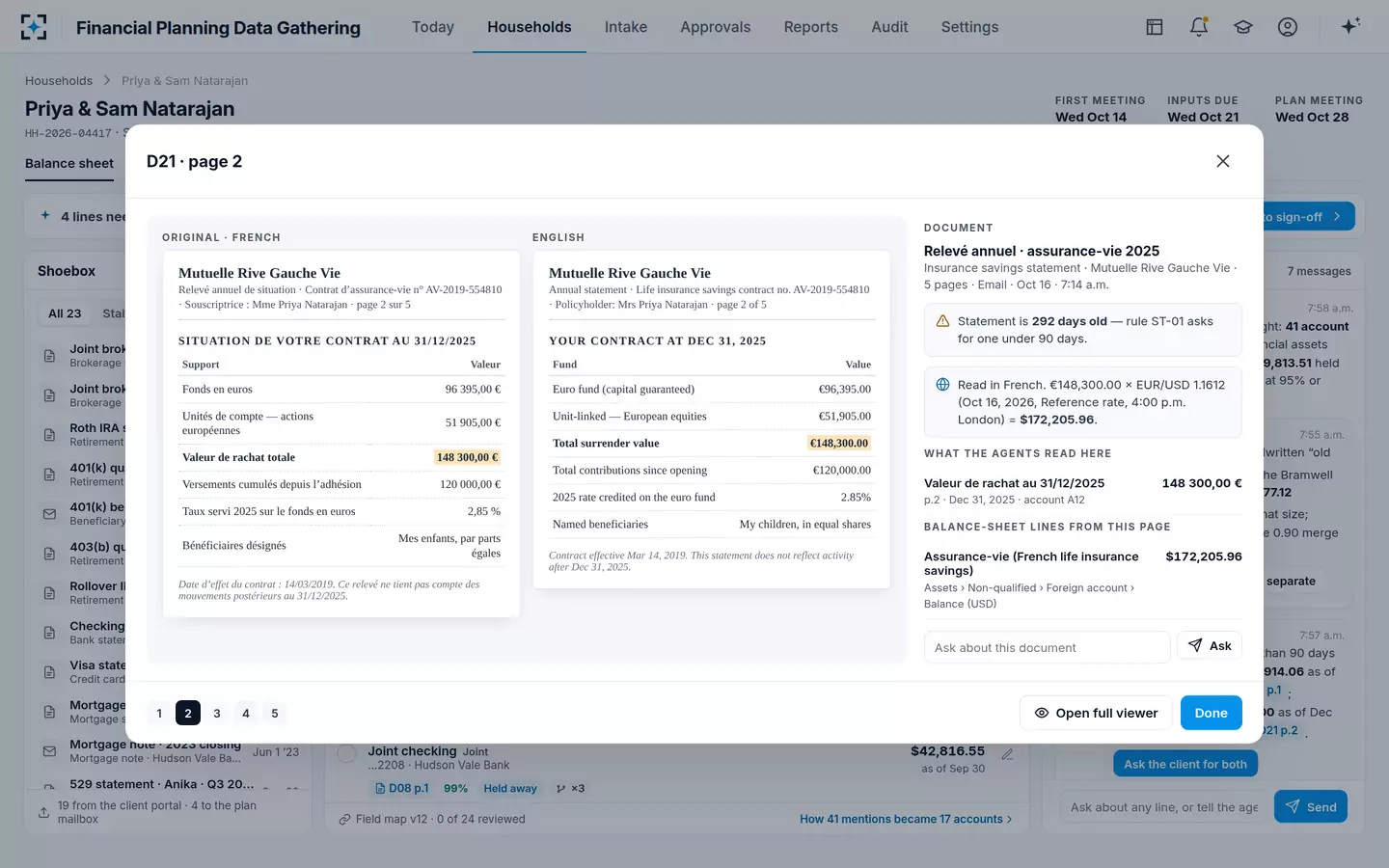
Insurance contracts held abroad are easy to miss because clients think of them as savings, not insurance, and they rarely appear in account aggregation. US reporting law treats them as accounts: for the FBAR, a reportable financial account includes "an insurance or annuity policy with a cash value" (31 CFR 1010.350(c)(3)(ii)). A planning firm that finds one should record the value in the original currency, convert it at a dated rate and flag the reporting question for the client's tax preparer.
A French insurance savings contract, read in French and shown beside the English
Why the firm should keep the page behind every policy value
Because the recommendation rests on it. For a broker-dealer, Regulation Best Interest requires "reasonable diligence, care, and skill" to have "a reasonable basis to believe that the recommendation is in the best interest of a particular retail customer based on that retail customer's investment profile", and the profile includes "other investments, financial situation and needs, tax status" and "liquidity needs" (17 CFR 240.15l-1). A cash value keyed as a death benefit, or a year-old universal life value, is a wrong fact in that profile.
The defence in an examination is the source: which statement, which page, which date, who keyed it and who approved it. A firm that re-keys values by hand rarely keeps that link. The financial planning balance sheet shows what one misread policy line does to the net worth figure the whole plan rests on, and the financial planning fact finder sets the policy statement among the other documents a household should send.
How Financial Planning Data Gathering reads the policy line
The solution reads each policy statement, puts each value on the right side of the plan and leaves the judgment calls to the paraplanner and the planner. Values read below the firm's confidence setting, 0.85 in the sample, go to a person rather than into the plan, and the in-force illustration a planner needs for projections is requested from the carrier rather than the client.
One life policy, from the client's statement to the planning software
Agent
Extraction agentReads policy type, owner, values, loans and death benefit from the annual statement, each with its page and region.
Never: Fills a value the statement does not show
Agent
Checker agentRe-reads the values independently and applies the firm's insurance staleness rule, 13 months in the sample.
A person decides
ParaplannerResolves anything below the confidence setting or stale, and signs the inputs: cash value as an asset, death benefit as coverage.
A person decides
Financial plannerApproves the plan inputs before they are pushed.
Agent
Push and read-backWrites each value to its own field in the planning software and reads every field back to confirm it landed.
The rules behind each step, the staleness windows, the confidence threshold and the source-precedence order, are settings the practice lead owns and changes with an approval. The whole household's path through review and sign-off is on the Financial Planning Data Gathering page.
Questions people ask
Is life insurance cash value included in net worth?
Yes, the net cash surrender value is, as a financial asset of the policy's owner. The death benefit is not. The Federal Reserve's Survey of Consumer Finances values policies "according to their current cash value, not their death benefit" and excludes term policies entirely.
What is the difference between cash surrender value and net cash surrender value?
The NAIC's universal life model defines cash surrender value as the net cash surrender value plus outstanding policy loans, and net cash surrender value as the maximum amount payable to the owner on surrender. The plan's asset line uses the net figure.
Does term life insurance belong on the client balance sheet?
No. Term insurance provides only a death benefit and has nothing to surrender, so it belongs on the coverage side of the plan alone, in the survivor-needs analysis.
When should an advisor request an in-force illustration?
When the plan projects a permanent policy forward, especially a universal life policy whose values depend on credited interest and charges. The annual statement shows today's values; the NAIC model requires annual reports without an illustration to say one may be requested each year without charge.
Should a policy loan be subtracted from net worth?
Once, and only once. Use the net cash surrender value, which already reflects the loan, or use the gross value and list the loan as a liability, as the Federal Reserve's survey does. Subtracting it in both places understates net worth.
Is a foreign insurance policy reportable for a US client?
For the FBAR, a reportable financial account includes an insurance or annuity policy with a cash value (31 CFR 1010.350(c)(3)(ii)). A planning firm should record the value with its currency and conversion date and flag the reporting question to the client's tax preparer.