Held-away assets, also called assets held away or held-away accounts, are the investments and accounts a client owns at institutions other than the advisory firm's own custodian: an employer 401(k) or 403(b), an IRA at another broker, savings at another bank, the cash value of a life policy, shares in an employer's equity plan, an account abroad. The firm's systems see only what it holds, through the custodian's daily feed; everything else is invisible unless someone collects it. That is why held-away assets are the usual gap in a financial plan, and why Botminds' Financial Planning Data Gathering reads every held-away account from the client's own statements, each line with its date and source page, before the plan is built.
In the solution's sample household, a fictional New York couple with $3.08 million of financial assets, more than half of the money was held away.
More than half of the sample household's financial assets were invisible to the firm's feed
All financial assets, $3,080,826.70
- Held at the firm: joint brokerage and Roth IRA · 48%
- Held away: eleven lines at other institutions · 52%
The held-away half, $1,609,813.51, by type
- 401(k) and 403(b) · 47%
- Insurance cash value and a French savings contract · 16%
- Two 529 plans, a rollover IRA and an HSA · 14%
- Vested stock units · 13%
- Bank savings and checking · 10%
What are held away assets?
Held-away assets are any assets the client owns that the firm does not hold, administer or receive data for directly. The definition is operational rather than legal: an asset is held away from a particular firm, so the same 401(k) is held away for the client's planner and held at the plan's recordkeeper.
The line usually follows custody. Where an adviser has custody of client assets, the rule requires a reasonable basis to believe the qualified custodian sends each client an account statement “at least quarterly” (17 CFR 275.206(4)-2(a)(3)), and the same custodian sends the adviser a daily file of positions. Accounts outside that relationship generate statements too, but they go to the client. The firm sees them only if the client forwards them, links them through an aggregation service, or uploads them.
Held away does not mean unadvised. Many planners give advice on a 401(k) they cannot trade, and some manage held-away accounts under their advisory agreement. Billing on held-away assets is a separate question, set by the advisory contract and described in the fee section of the adviser's brochure, where Form ADV Part 2A asks the adviser to explain how it is paid and to give its fee schedule (Form ADV Part 2A, Item 5).
What is a held away account? The usual list, and where each one's data lives
A held-away account is any single account in that category: one 401(k), one bank savings account, one policy. Each type has a natural document that confirms it, and a natural way of going missing.
Held-away accounts by type: the confirming document and how each goes missing
- Employer retirement plans: 401(k), 403(b), 457(b)
Quarterly statement from the recordkeeper. Goes missing when the client has left the employer; the W-2’s box 12 deferral codes show which plans are live.
- IRAs at other firms, including rollovers
Monthly or quarterly statement; Form 5498 for the December 31 value. Goes missing when the client describes it from memory, as “old IRA, about $90K”.
- Bank deposits
Bank statement. Rarely missing, often stale: the balance in the fact finder is last month’s.
- Equity compensation
Award summary from the plan administrator. Goes missing because clients think of it as pay, not as an account.
- Cash value life insurance
Annual policy statement. Goes missing, or is entered at the death benefit instead of the cash value.
- Education and health accounts
529 and HSA statements. Goes missing when a grandparent owns the 529 or the HSA sits with the employer’s provider.
- Accounts and contracts abroad
Statement in the original language. Goes missing because the client does not count a foreign pension or insurance savings contract as an account.
- Annuities and other insurance-company contracts
Annual contract statement. Goes missing when the household’s money sits with an insurer rather than a broker.
Why do held-away assets matter in a plan?
Because the rules, and the plan, are about the whole client. Under Regulation Best Interest the retail customer investment profile includes the customer's “other investments” alongside age, financial situation, tax status and risk tolerance (17 CFR 240.15l-1(b)(2)), and FINRA's suitability rule lists the same factor for recommendations it still governs (FINRA Rule 2111). A recommendation or plan built only on the custodian feed is built on part of the client.
The planning consequences are concrete. Asset allocation computed on held-here money alone can be wildly off when a large 401(k) sits in a single target-date fund elsewhere. Concentration in employer stock lives almost entirely in held-away award accounts. Required minimum distributions, beneficiary designations and Roth conversion room depend on retirement accounts the firm may not hold. And insurance cash values and foreign contracts change both net worth and the estate picture.
A plan built only on the custodian feed is a plan for the part of the client the firm already holds.
How big is the held-away gap in a typical household?
No regulator or independent study publishes the share of advised households' assets held away. What the Federal Reserve does publish is how widely the main held-away categories are owned across US families, and the answer is: very widely, and in large amounts where they exist.
The categories that usually sit outside the firm, across US families
54.3%
of families held a retirement account in 2022
$334,000
mean value of those retirement accounts, among families holding one
21%
held stocks directly, the largest change on record
16.1%
held cash value life insurance
Retirement accounts are the core of it. The SCF counts IRAs, Keogh accounts and employer accounts “such as 401(k), 403(b), and thrift savings accounts”; they were held by 54.3% of families in 2022, with a conditional median of $86,900 and a mean of $334,000 (Federal Reserve, October 2023). For a household whose earners are still working, the employer plan is by construction held away from an independent planner. Firms can measure their own gap: for each household, sum held-away lines over all financial assets, and track the share whose held-away statements are older than the firm's staleness rule.
How do advisors get held-away data?
There are four routes, and most firms use all of them: the client's own statements, account aggregation, direct data from a recordkeeper or plan sponsor, and the client typing figures into a portal or questionnaire. They differ in coverage, freshness and what they prove. Once the data is in, the same holdings feed the proposal's overlap and fee analysis, which portfolio x-ray tools compared takes apart.
Four routes to held-away data, and what each can show a reviewer
| Route | Coverage | Freshness | What it proves later |
|---|---|---|---|
| Client statements (upload or email) | Anything the client receives a statement for, in any language | The statement date; quarterly for most investment accounts, yearly for insurance | The page itself: value, date, owner and often beneficiary |
| Account aggregation | Accounts the client links and the provider supports | As often as the connection refreshes, while it works | A data feed record; depends on the provider keeping history |
| Recordkeeper or sponsor data | One plan, where an arrangement exists | Often daily | A feed record from the plan’s own books |
| Client-typed figures | Anything the client remembers | Unknown | Only that the client said it |
Aggregation is the route most firms reach for first, and it is good at what it covers. FINRA's investor guidance describes it as gathering a client's holdings in one place, either through an application programming interface or by screen scraping with the client's own logins, and warns that many aggregators work with little regulatory oversight (FINRA, January 12, 2024). Whether a given provider can reach insurance contracts, equity award accounts or accounts abroad varies, and any account the client declines to link is outside it by definition. The trade-offs are set out in the guide to account aggregation service providers.
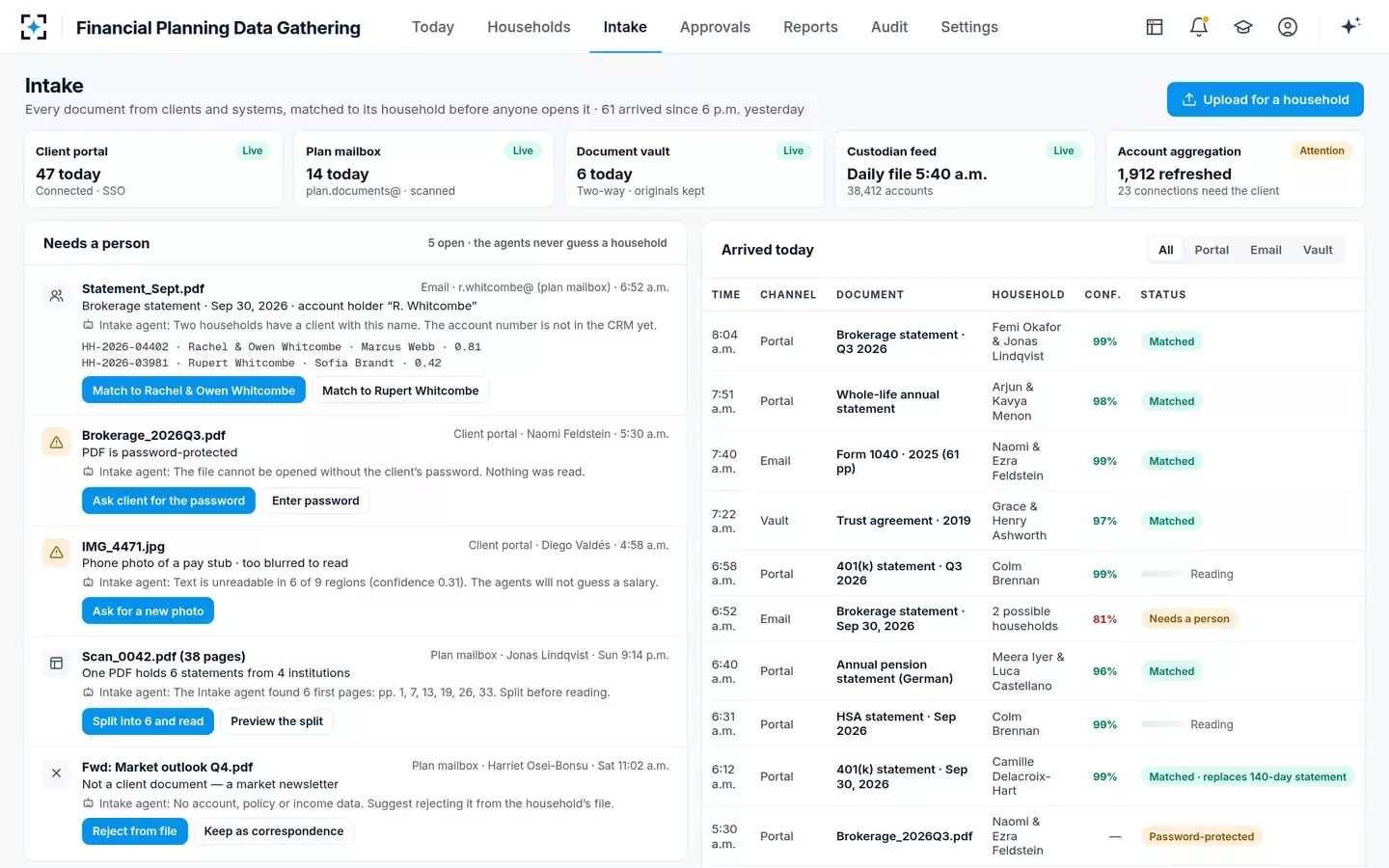
Five ways in: the custodian feed covers the firm's accounts, everything else arrives as documents or links
What goes wrong when held-away data is stale or missing?
The plan is computed on numbers that are no longer true, and nobody notices until the client does. A held-away statement is current on the day it is printed and ages from there, so a fact finder that collected it three months ago is three months stale on the day the plan is built.
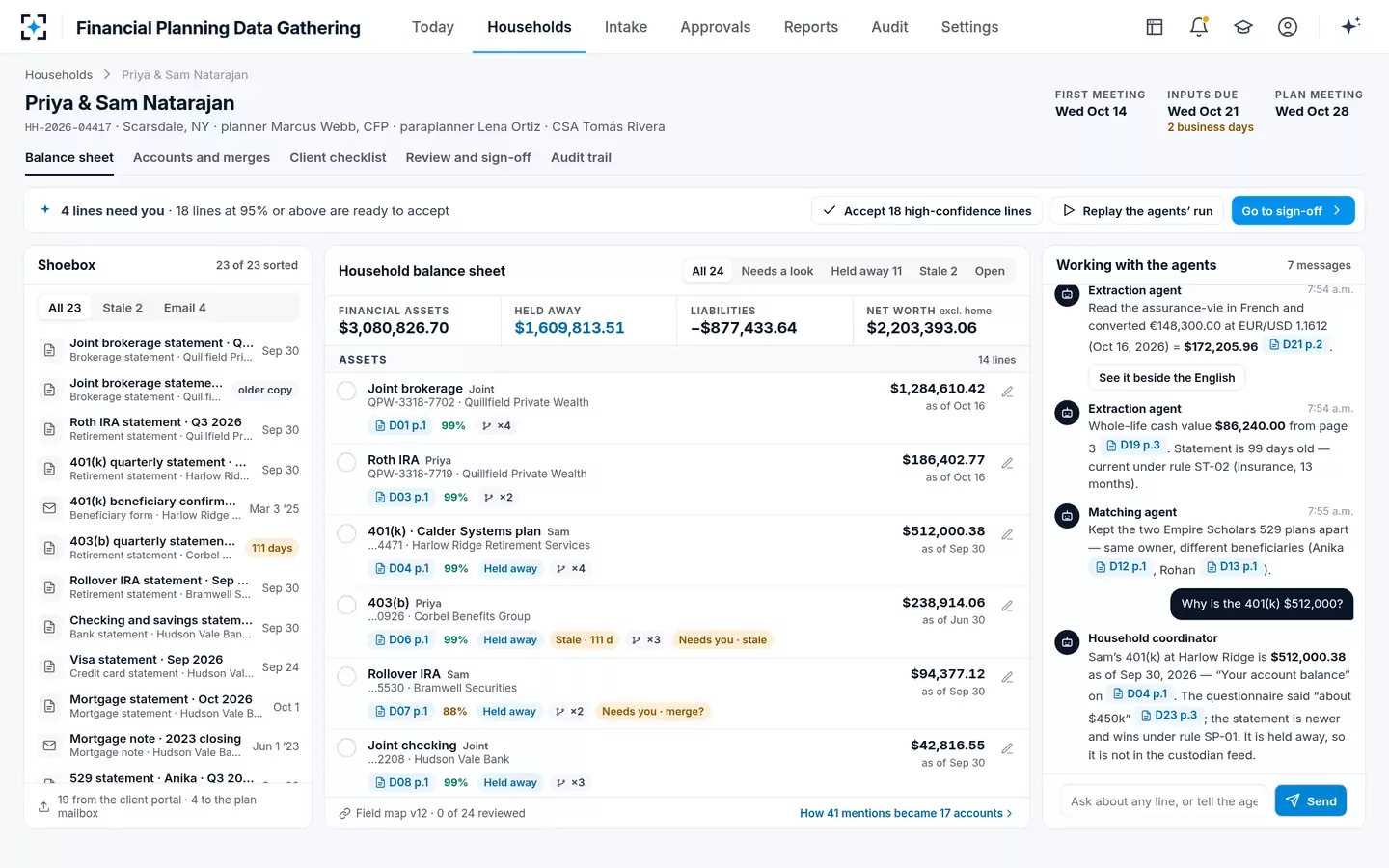
The sample household shows the pattern on a single morning. Its 403(b) statement was dated June 30 and was 111 days old when the solution read it on October 19, beyond the firm's 90-day rule. Its French insurance savings contract showed a December 31, 2025 value, 292 days old. The questionnaire's 401(k) figure, “about $450K”, was $62,000.38 below the quarterly statement. None of the three was blank. Each was simply older or rougher than it looked, and the client request that went out asked for exactly those things rather than everything.
“It is held away, so it is not in the custodian feed”: a held-away line, explained with its page
Which held-away accounts change the plan most?
The ones that move a planning decision, not just the net-worth total. Size matters, but so does what the account is: a held-away line can carry a concentration, a beneficiary, a tax treatment or a reporting duty that no firm-held account would reveal. Walking the sample household's eleven held-away lines by the decision each one touches shows why a plan built on the custodian feed alone would be wrong in kind, not only in amount.
The sample household's held-away lines, by the planning decision each one changes
| Held-away line | Value | What it changes in the plan |
|---|---|---|
| 401(k), Sam | $512,000.38 | Retirement income, asset allocation and the beneficiary on file; the largest single held-away line |
| 403(b), Priya | $238,914.06 | Same decisions, on a balance 111 days old until the new statement arrives |
| Vested stock units | $214,560.00 | Concentration in one employer’s shares, and the tax already paid at vesting |
| French insurance savings contract | $172,205.96 | Currency exposure, estate planning abroad, and a foreign account the client may need to report |
| Savings and checking, another bank | $163,216.55 | Emergency reserve and short-term goals |
| Two 529 plans | $109,359.23 | Education funding, per child; owner and beneficiary checked separately |
| Rollover IRA | $94,377.12 | Retirement accounts the household controls directly, and future rollover and conversion choices |
| Whole-life cash value | $86,240.00 | Liquidity, and the gap between this asset and the $1,000,000 of cover it sits under |
| HSA | $18,940.21 | Health costs now and in retirement |
Two rows deserve a second look. The stock units are the household's only single-company position of size, and they sit entirely outside the firm: an allocation report from the custodian feed would show a diversified portfolio and miss the concentration. The French contract is held away twice over, outside the firm and outside the country, and the US rules treat an insurance policy with a cash value as a foreign financial account, so the planner has a reporting question to raise as well as a value to convert. The life insurance policy review checklist reads that kind of statement line by line.
Held-away assets and client data security
Collecting held-away data means holding more of the client's information, and some routes mean holding their credentials. Under the SEC's amended Regulation S-P, every covered broker-dealer and registered adviser must maintain written policies and procedures that address administrative, technical and physical safeguards for customer information, run an incident response program, and notify affected customers within 30 days of becoming aware of unauthorized access; larger firms had to comply from December 3, 2025 and smaller ones from June 3, 2026 (SEC, May 16, 2024; 17 CFR 248.30). The SEC's examiners have said they will review those programs, including how firms notify customers and oversee the service providers that hold customer data (SEC Division of Examinations, fiscal 2027 priorities).
For held-away data the practical consequences are simple. Prefer documents and credential-free connections to stored passwords. Keep the original statement as received, so a value can be traced without asking the client again. And treat any outside service that reads client statements, an aggregation provider or an AI tool, as a service provider the firm must oversee.
How Financial Planning Data Gathering handles held-away accounts
The solution treats the custodian feed and the client's documents as sources of equal standing and records which one supplied each line. Its Intake agent picks up statements from the client portal, the plan mailbox and the document vault and matches each to its household. The Extraction agent reads the balance, holdings, contributions and beneficiaries with their pages, in the document's own language. The Matching agent merges a held-away account seen on several documents, such as the 401(k) that appeared on the statement, a beneficiary confirmation, a pay stub and the questionnaire. A Checker agent applies the firm's staleness rules and puts anything stale on the client request.
The firm's source-precedence rule, a versioned setting approved by a second person, decides which source wins when they disagree: in the sample firm, custodian feed, then statement, then aggregation, then questionnaire. Every held-away line on the household balance sheet shows its chip, its date and its page, and the paraplanner and planner approve the lot before it reaches the planning software. The financial planning balance sheet guide shows the whole sheet; the overview of Financial Planning Data Gathering follows one household from the first meeting to the plan.
Questions people ask
What does assets held away mean?
It means assets the client owns at institutions other than the advisory firm, so the firm's custodian does not hold them or send data on them. Typical examples are employer 401(k) and 403(b) plans, IRAs and bank accounts elsewhere, equity award accounts and insurance cash values. In the solution's sample household they were 52% of financial assets.
Are held-away assets included in assets under management?
Not automatically. Whether an adviser counts or bills on an account depends on whether it actually manages it under the advisory agreement, and the adviser's brochure must describe how it is compensated and provide its fee schedule under Form ADV Part 2A Item 5. For planning, held-away assets are always part of the picture whether or not they are managed or billed.
Why can't my advisor see my 401(k)?
Because the plan's recordkeeper holds it, not the advisor's custodian, and the statements go to you. The advisor sees it only if you send the statement, link the account through an aggregation service, or the firm has a data arrangement with the plan. Retirement accounts were held by 54.3% of US families in 2022, so this is the most common held-away account there is.
Is a held-away account less safe?
Not in itself: it is held by its own institution under that institution's rules. The risk sits in how its data reaches the advisor. FINRA warns that screen scraping requires your login credentials and that many aggregators operate under limited regulatory oversight, which is why statements and credential-free connections are the safer routes.
How often should held-away balances be updated?
At least each time the plan is reviewed, and whenever a statement passes the firm's staleness rule. Investment statements are usually quarterly, so a 90-day rule, the sample firm's setting, means asking for each new quarter's statement before a plan meeting.