A portfolio x-ray tool takes a list of holdings and shows what sits inside them: asset allocation, sector and regional weights, investment style, the largest underlying stocks, fund-to-fund overlap and each fund's expense ratio. It is fast and useful, and it is only as complete as the holdings list typed or imported into it. What an x-ray does not see is everything that is not a holding: the wrap fee charged on the account, a custody fee on page five of a foreign statement, a share class that was due to convert, a cost basis that is missing, a fund that is a foreign investment company for tax purposes. So the choice for an advisor analysing a prospect is not "x-ray or no x-ray" but which of three approaches — an x-ray tool, a manual second-opinion review of the statements, or agents that read every statement page — covers what the proposal has to defend. Botminds' Investment Proposal Generator is the third; this guide compares all three honestly, row by row.
The examples use the solution's sample data on fictional people: a prospect with 17 holdings across a wrap account, a rollover IRA and a Zürich private bank account.
Three approaches to analysing a prospect's portfolio, Investment Proposal Generator among them, row by row
| Portfolio x-ray tool | Manual review of the statements | Agents reading every statement page | |
|---|---|---|---|
| Input | A holdings list, typed or imported from a feed. | The statements, read by a person. | The statements — PDF, scan or photo, any language — read and reconciled to each total. |
| Fund costs | Expense ratios from the tool's fund data, often by share class. | From each prospectus, if the reviewer looks them up. | From each fund's own prospectus fee table for the class held, with page and date. |
| Account fees: wrap, custody, IRA | Not seen unless entered by hand. | Found if every page is read. | Read from the statements and added to the all-in cost. |
| Share-class terms | Class shown if the identifier is right; conversion dates not. | Found if the reviewer checks purchase dates and the prospectus. | Class, purchase date and conversion terms compared; missed conversions flagged. |
| Overlap and concentration | Strong: the tool's core output. | Rough, unless the reviewer has holdings data. | Look-through from published holdings, dated per fund. |
| Foreign and illiquid holdings | Covered only if the tool's fund data includes them. | Spotted by an experienced reviewer. | Flagged and referred: likely foreign funds to tax, illiquid products left in place. |
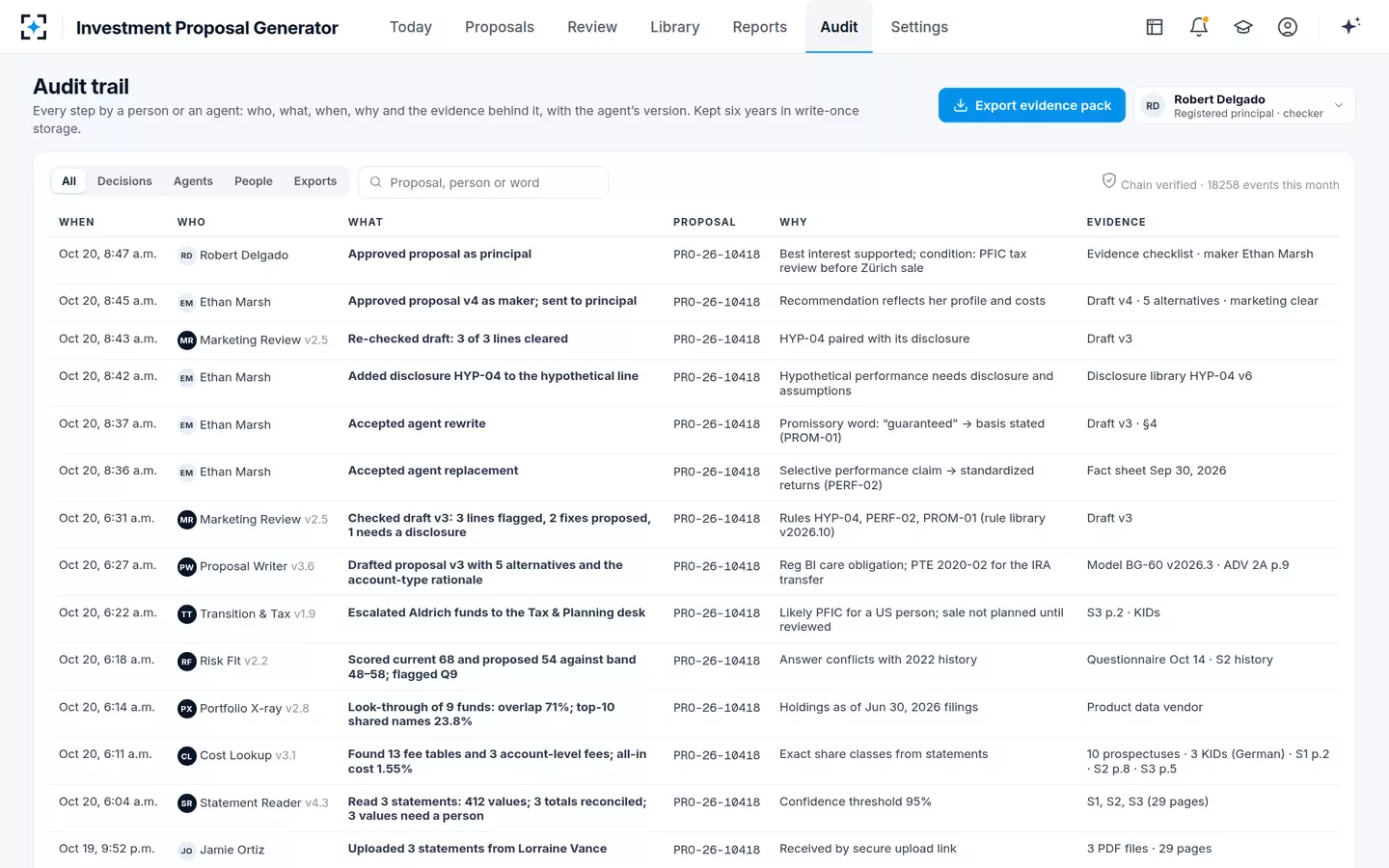
| Evidence kept | A report. | Notes and a spreadsheet. | Every figure linked to its page; every step logged with who and why. |
What does a portfolio x-ray show?
A portfolio x-ray shows the composition of a set of holdings looked through to the securities inside them: how much is in stocks, bonds and cash; in which sectors, regions and styles; which companies make up the largest exposures; how much the funds duplicate each other; and what the funds charge. Its value is speed and consistency — the same holdings produce the same picture every time — and it is the right tool for a quick conversation about diversification.
Its arithmetic is sound when the inputs are. Overlap and look-through exposure are calculated by adding weights across funds, which the guide to how a mutual fund overlap tool calculates overlap works through. But the inputs are the holdings as entered, and fund-level data that is dated. The SEC notes that for mutual funds, investors see Form N-PORT holdings only for the last month of each fiscal quarter (SEC, Form N-PORT Reporting, proposed rule, February 2026), so any x-ray's look-through is a snapshot of the recent past.
What does a portfolio x-ray miss?
A portfolio x-ray misses whatever is not in its holdings list or its fund data: fees charged by the account rather than the fund, terms written on the statement rather than in a database, and holdings its data provider does not cover. For the sample prospect, those gaps were worth more each year than her advisory fee would be on the proposed portfolio.
What a holdings-only view would not have shown for one sample prospect
$13,104a year
wrap fee on one account, charged outside the funds
$1,810a year
custody fee on page 5 of a German statement
$1,594a year
saved by a C-share conversion that was due and never happened
2funds
likely foreign investment companies for a US person, sent to the tax desk
The same prospect, seen by an x-ray of holdings and by reading every statement page
Holdings x-ray: Fund expenses weighted by holding: 0.88% a year.
Every statement page read: Fund expenses plus a 1.25% wrap fee, a 0.35% Swiss custody fee and IRA and trading fees: 1.55%, $36,776 a year.
Holdings x-ray: A C share at 1.79% shown as a holding.
Every statement page read: The same C share, bought March 12, 2018, past its conversion date to a 1.04% A share.
Holdings x-ray: Nine overlapping large-cap funds; top names looked through.
Every statement page read: The same, plus a direct stock at 9.8% of assets with no cost basis on the statement — a request drafted to the prospect.
Holdings x-ray: Two Swiss funds, if the data provider covers them.
Every statement page read: Two Swiss funds read in German and flagged as likely foreign investment companies for tax review.
Holdings x-ray: A non-traded REIT at its last reported value.
Every statement page read: The REIT valued at the sponsor's December 31, 2025 estimate, repurchases suspended: it cannot move.
Approach 1: the portfolio x-ray tool, and the rules on analysis tools
An x-ray tool is the fastest approach and the right one when the holdings are clean, domestic and in one or two accounts, and the conversation is about allocation rather than cost. Its limits are the inputs it is given, and the rules on how its output may be shown to clients.
For broker-dealers, FINRA Rule 2214 governs an "interactive technological tool that produces simulations and statistical analyses", and requires that a communication using one "describes the criteria and methodology used, including the investment analysis tool's limitations and key assumptions", "explains that results may vary with each use and over time" and, "if applicable, describes the universe of investments considered in the analysis" (FINRA Rule 2214). For advisers, the SEC Marketing Rule excludes an interactive analysis tool from the definition of hypothetical performance only if the adviser, among other things, "Discloses that the tool generates outcomes that are hypothetical in nature" (17 CFR 275.206(4)-1(e)(8)(ii)(A)). A screenshot of an x-ray's projected outcomes pasted into a proposal without those disclosures has left the protection the rules give the tool.
Approach 2: the manual second-opinion review
A manual review — an experienced advisor or analyst reading every statement page and looking up every fund — finds what an x-ray misses, and its quality depends entirely on the reviewer's time and diligence. It is the right approach for a single complex prospect when the reviewer has an afternoon, and the wrong one when the same reviewer has six prospects a week.
It also carries the reviewer's own leanings. In an audit study where trained auditors posing as clients met advisers with different starting portfolios, Mullainathan, Noeth and Schoar found that "Advisers encourage returns-chasing behavior and push for actively managed funds that have higher fees, even if the client starts with a well-diversified, low-fee portfolio" (NBER working paper 17929, not peer reviewed). A second opinion is only as independent as its method. Writing the method down — every fee traced, every cheaper alternative shown — is what keeps a manual review honest, whoever does it.
Approach 3: agents that read every statement page
Agents that read every statement page combine the x-ray's speed with the manual review's coverage, and add a trail showing where each figure came from. In Investment Proposal Generator, the Statement Reader reads PDFs, scans and photos in their original language and reconciles each statement to its total; the Cost Lookup agent prices each holding from its own prospectus for the exact share class and adds the account fees; the Portfolio X-ray agent looks through the funds for overlap and concentration; values under the 95% confidence setting stop for a person.
Investment Proposal Generator's Portfolio X-ray: today's holdings against the proposal
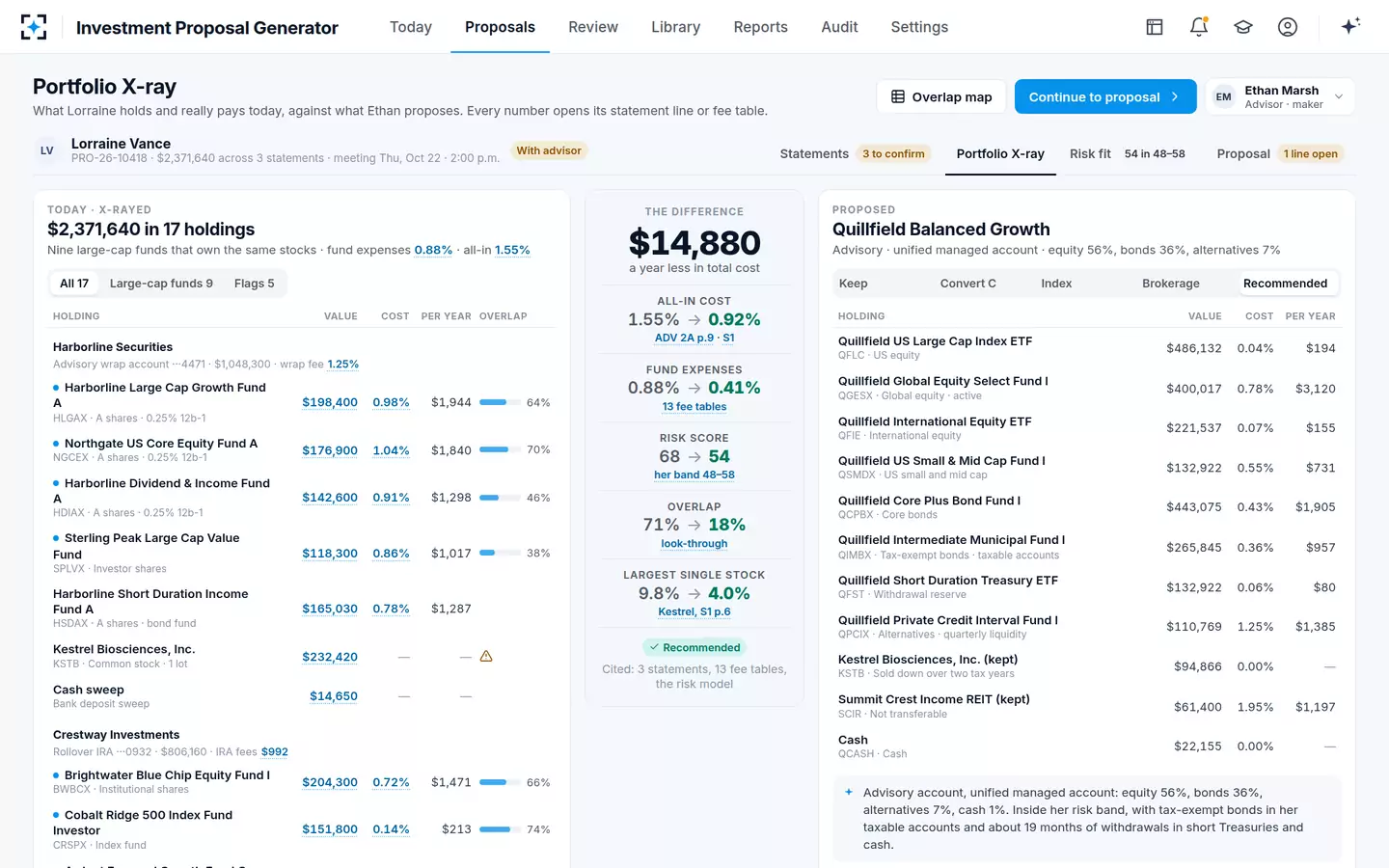
The approach has its own limits, and they should be stated as plainly as the x-ray's. The agents depend on the statements the prospect provides: a missing page is a missing input, which is why the reader asks for it rather than estimating. Look-through still relies on published fund holdings with their lag. And the agents do not choose the recommendation, give tax advice or send anything to a client; the advisor and a principal do those, with every step recorded.
Every step by a person or an agent, with the evidence and the reason
Foreign holdings: the line an x-ray cannot draw
Foreign-domiciled funds are where a holdings-only view is weakest, because the issue is not what the fund holds but what it is for a US taxpayer. A foreign corporation is a passive foreign investment company if it meets either of two tests, which the IRS states: an income test, "75% or more of the corporation's gross income for its tax year is passive income", or an asset test, "At least 50% of the average percentage of assets ... held by the foreign corporation during the tax year are assets that produce passive income or that are held for the production of passive income" (IRS, Instructions for Form 8621).
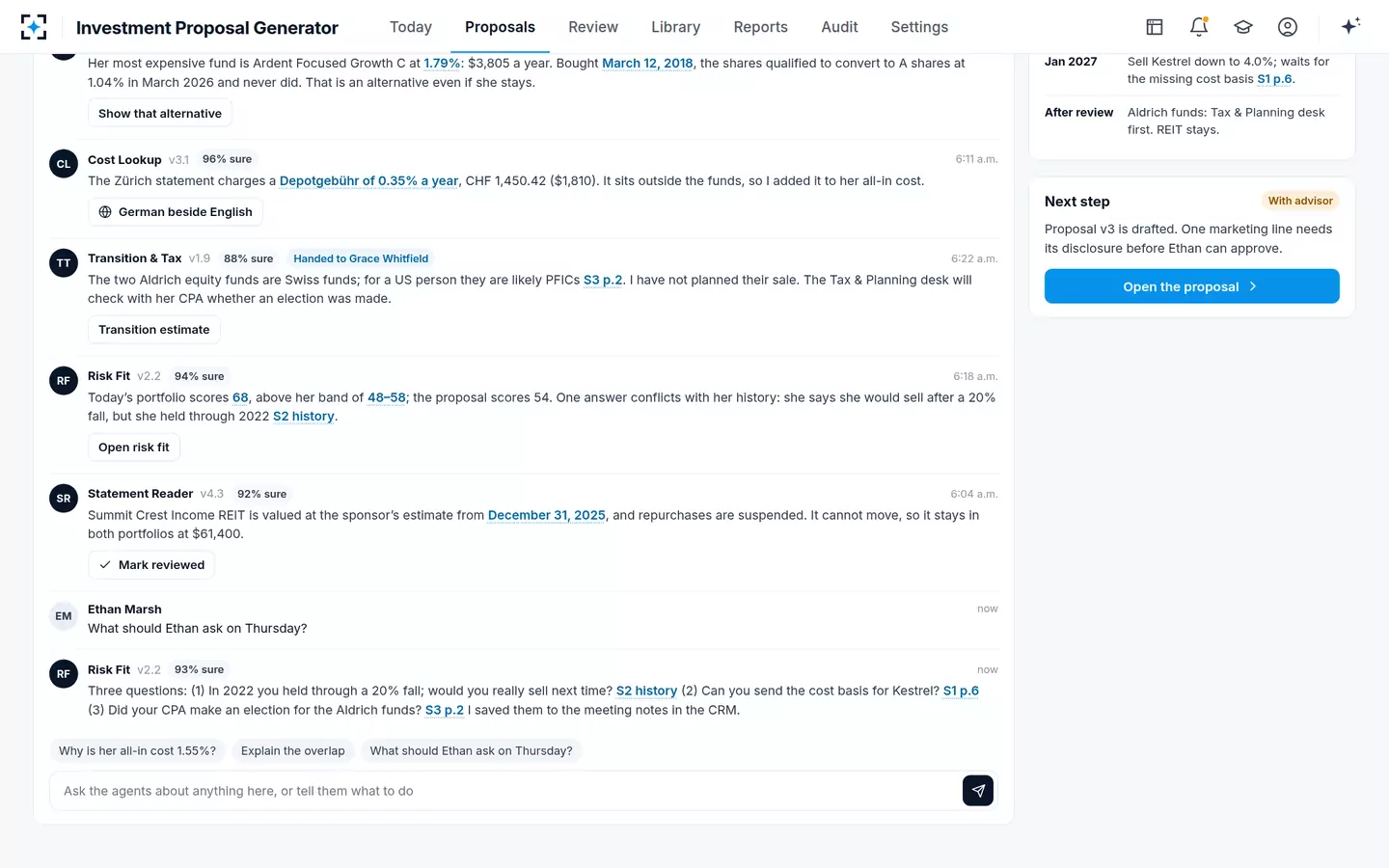
For a proposal, the consequence is procedural. A separate Form 8621 is generally required for each such fund, and selling one can carry tax treatment that depends on elections the client may or may not have made years ago. In the sample, two Swiss equity funds held at a Zürich bank were flagged as likely foreign investment companies and handed to the firm's tax desk to check with the client's accountant; the agents did not plan their sale, and the principal's approval carried a condition that the tax review come first.
A likely foreign investment company, handed to the tax desk rather than sold
Second opinion portfolio review checklist
Whichever approach is used, a second opinion on a portfolio should answer the same questions, in the same order, with the source of each answer. The checklist covers the gaps the comparison above exposes.
A second opinion portfolio review: nine questions with a source for each
- Do the holdings reconcile to each statement's total?
If not, a page or a position is missing.
- What does each fund cost, for the class held?
From the fund's own prospectus fee table, with its date.
- What does each account charge outside the funds?
Wrap, advisory, custody, IRA and maintenance fees from the statements and agreements.
- Is any share class due to convert, or eligible for a cheaper class?
Purchase dates against the prospectus terms; household holdings against breakpoints.
- How much do the funds overlap, and what is the largest single-company exposure?
Looked through, with each fund's holdings date.
- Are there foreign funds, illiquid products or missing cost bases?
Each needs separate handling before any sale is planned.
- How does the portfolio score against the client's own risk answers?
And does any answer conflict with what the client actually did?
- What would moving cost?
Deferred sales charges, surrender charges and gains, by position.
- What are the alternatives, including changing nothing?
Each priced the same way, with the reason for or against.
How to choose between the three approaches
Choose by what the proposal must defend. If the conversation is about allocation and diversification, and the prospect's holdings are clean and domestic, an x-ray tool is enough and the fastest route. If the proposal must defend a cost comparison, an account-type recommendation or a rollover — the recommendations examiners ask about — the analysis has to read the statements, and the choice is between a person doing it and agents doing it with a person checking. That choice turns on volume: one complex prospect a month is a manual review; several a week, with scans and foreign paper, is where agents earn their place.
Price is the last criterion and the hardest to compare, because vendors don't publish prices and quote them per firm. Compare instead on what each approach reads, on your own files: take ten past prospects, run each approach, and count the fees found, the share-class issues caught and the figures with a source you can open. How an investment proposal generator's agents are limited, and what to ask of any vendor, is set out in the guide to the seven agents and what none may do.
Questions people ask
What is a portfolio x-ray?
An analysis that looks through a set of holdings, especially funds, to the securities inside them, and reports allocation, sector, region, style, overlap, top holdings and fund costs. It is built from a holdings list and fund-level data, so it reflects what was entered and when the funds last published their holdings.
Is there a free portfolio x-ray tool?
Whether a tool is free or paid matters less than what it reads. Any x-ray built from a holdings list will miss account-level fees, share-class conversion dates and foreign tax status unless someone enters them, so check those three gaps before relying on its cost figure.
What is a second opinion portfolio review?
An independent review of an existing portfolio, usually by a prospective advisor, covering cost, risk, overlap, concentration and suitability against the client's goals. A thorough one reads every statement page and prices every fund by share class; the audit study of advisers cited above is a reason to write the method down, because reviewers bring their own leanings.
Can an advisor show a client x-ray output in a proposal?
Yes, with the disclosures the rules require. FINRA Rule 2214 requires a description of the tool's criteria, methodology, limitations and key assumptions, and a statement that results may vary; under the SEC Marketing Rule, an adviser's interactive tool must disclose that its outcomes are hypothetical to stay outside the rule's hypothetical-performance conditions.
Does a portfolio x-ray include advisory fees?
Usually not, unless they are entered by hand: x-ray tools work from holdings and fund data, and advisory, wrap and custody fees are charged by the account. In the sample, the account-level fees came to $15,906 of the prospect's $36,776 a year.
How current is a portfolio x-ray?
As current as its holdings data. Mutual funds publish holdings quarterly with a lag of up to 60 days, so look-through can reflect positions several months old; many ETFs publish daily. A good x-ray shows the date for each fund.