An investment proposal, in wealth management, is the document an advisor gives a prospect recommending how their money should be invested and why — as distinct from a business plan written to raise money from investors. A good one has seven parts: where the prospect stands today, with every holding and its full cost; what the advisor found; what is recommended and why it fits; the costs of every alternative considered, including keeping things as they are; the risk fit; what moving will cost; and the disclosures and sign-off. Each part has to prove something, and each claim needs a source the reviewing principal — and later an examiner — can open. This investment proposal example walks through one proposal section by section. It was drafted by Botminds' Investment Proposal Generator for a fictional prospect on the solution's sample data, and every person, firm and fund in it is invented.
The prospect, Lorraine Vance, 61, a retiring anesthesiologist, brought three statements worth $2,371,640: an advisory wrap account, a rollover IRA and her late husband's account at a Zürich private bank, in German.
A sample proposal from Investment Proposal Generator, annotated: what each section says and must prove
Where you are today
“You hold $2,371,640 across three accounts … Together you pay about $36,776 a year, or 1.55% of your assets, in fund expenses and account fees.”
Must prove
Every holding read and reconciled to three custodians' totals; the cost built from 13 fee tables and 3 account-level fees.
What we found
“Nine of your funds invest mostly in the same large US companies … One stock, Kestrel Biosciences, is 9.8% of your assets. Your Ardent Focused Growth shares are in a class that costs 1.79% a year and could have converted to a cheaper class in March 2026.”
Must prove
Each finding names its page: the overlap map's holdings date, the statement line for the stock, the purchase date and the prospectus for the share class.
What we recommend
“… in an advisory account: about 56% stocks spread across US and international markets, 36% bonds (with tax-exempt bonds in your taxable accounts), 7% alternatives and 1% cash … keeps about 19 months of withdrawals in short-term Treasuries and cash.”
Must prove
The reason ties to her own answers: withdrawals from January 2027, a top tax bracket, limiting large losses.
Costs, and the alternatives we considered
A table of five options — keep as is, keep and convert the C shares, an index-only model, a brokerage account, the recommendation — each with its cost a year, risk score and why or why not.
Must prove
Every cheaper option is shown, with the reason it was not chosen.
Risk
“Today's mix scores 68 on our risk scale, above the range of 48–58 that matches your answers … It scores 54, inside your range.”
Must prove
Scores against the questionnaire band; stress tests labelled hypothetical, with their disclosure.
Moving
The single stock sold down to 4.0% over two tax years; the Zürich funds held for the tax desk; the non-traded REIT left where it is.
Must prove
The cost of moving estimated per position; what cannot be assessed is referred, not planned.
Disclosures and sign-off
Standardised 1-, 5- and 10-year net returns; the hypothetical disclosure attached; approval by the advisor as maker and review by a principal.
Must prove
Performance shown the way the rules require; maker and checker, each with a reason.
What does a good investment proposal look like?
A good investment proposal reads as an argument with its evidence attached: short sections in plain words, every number underlined to its source, and a comparison table that includes the options the advisor did not choose. It is not long for the sake of it. In the sample, the client-facing text fits on a few pages; the evidence behind it — 29 statement pages, 13 fund fee tables, a holdings file, a risk questionnaire — sits one click away rather than in an appendix nobody reads.
What stands behind one sample proposal
29pages
of statements read, from three custodians
16fee sources
13 fund fee tables and 3 account-level fees
5options
compared on the same numbers, from keeping everything to the recommendation
3lines
of marketing language fixed or held before approval
Section 1, where you are today: every figure from a statement
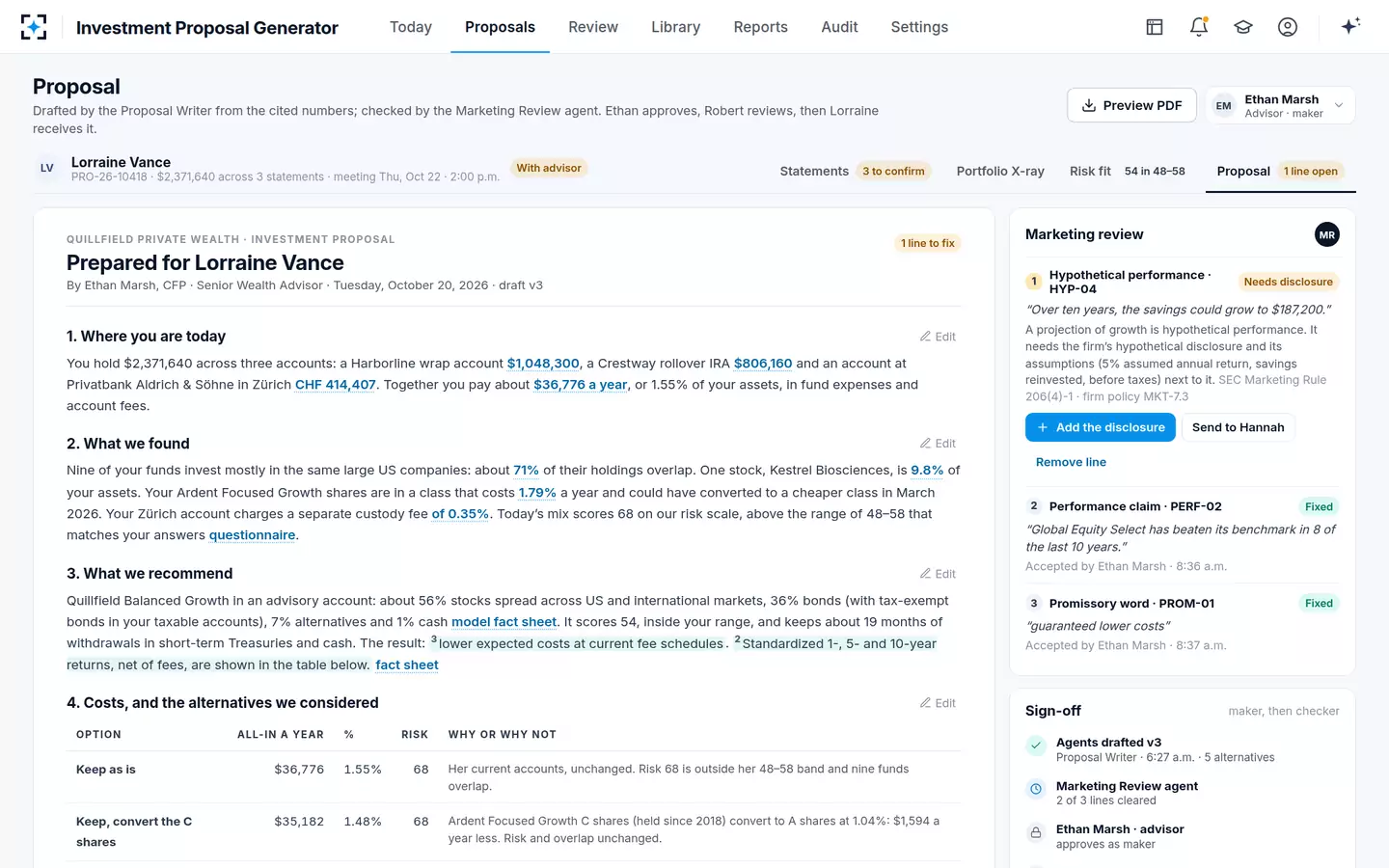
The opening section states the prospect's position in one paragraph and must be checkable to the cent. The sample reads: "You hold $2,371,640 across three accounts: a Harborline wrap account $1,048,300, a Crestway rollover IRA $806,160 and an account at Privatbank Aldrich & Söhne in Zürich CHF 414,407. Together you pay about $36,776 a year, or 1.55% of your assets, in fund expenses and account fees."
Three things make that paragraph sound. Each account total is the custodian's own printed total, matched by the positions read from it. The Swiss franc balance is converted at a named closing rate, 1.2480 dollars per franc on September 30, so the dollar total can be recomputed. And the $36,776 is the sum of four sourced layers — fund expenses, the 1.25% wrap fee, a Swiss custody fee and IRA and trading fees — not a rate applied to the total. The arithmetic of those layers is set out in portfolio cost analysis for a prospect's held-away accounts.
Section 2, what we found: findings with their pages
The findings section turns the reading into a short list of things the prospect did not know, each with its source. In the sample: nine funds investing mostly in the same large US companies, with about 71% of their holdings overlapping; one stock at 9.8% of her assets; a C share that "could have converted to a cheaper class in March 2026"; a custody fee of 0.35% on the Zürich account; and a risk score of 68 against a range of 48–58 that matched her answers.
Each finding is a claim a principal will test, so each carries its page: the overlap figure carries its holdings date; the stock its statement line; the share-class finding its purchase date and the fund's prospectus. The findings that matter most in practice are the ones invisible on a summary page — the custody fee on page 5 of a German statement, a share class that should have changed, a single stock spread through nine funds. A finding without a source is an opinion, and a proposal should not need opinions in this section.
The proposal as Investment Proposal Generator drafted it, with its marketing review beside it
Section 3, what we recommend: the reason in the client's terms
The recommendation says what to do and why it fits this person, and the "why" must point back to what the prospect said. The sample recommends a managed advisory account of about 56% stocks across US and international markets, 36% bonds with tax-exempt bonds in her taxable accounts, 7% alternatives and 1% cash. It scores 54, inside her range, and keeps about 19 months of planned withdrawals in short-term Treasuries and cash.
Each element maps to an answer on her questionnaire: withdrawals of $96,000 a year from January 2027 (the cash reserve), a top federal bracket and two taxable accounts (the municipal bonds), and "limiting large losses while still growing" as what matters most (the risk level). That mapping is what turns a model portfolio into a recommendation for one person; a reason that described the model's features instead of her answers would not.
Section 4, costs and the alternatives we considered
The comparison table is the section a principal reads first, because it is where a recommendation is either defended or exposed. It shows every option on the same cited numbers: annual cost in dollars and percent, risk score, and a plain reason for or against.
The sample proposal's alternatives table
| Option | All-in a year | Risk score | Why or why not |
|---|---|---|---|
| Keep as is | $36,776 · 1.55% | 68 | Risk 68 is outside her 48–58 band, and nine funds overlap. |
| Keep, convert the C shares | $35,182 · 1.48% | 68 | Saves $1,594 a year with no other change; risk and overlap unchanged. |
| Index-only advisory model | $14,508 · 0.61% | 55 | Lower cost. Not chosen: no tax-exempt bond sleeve for her taxable accounts and no active downside management, which she asked for. |
| Brokerage account, same funds | $10,874 · 0.46% | — | The cheapest option; kept on file with the reason it was not recommended. |
| Recommended advisory account | $21,896 · 0.92% | 54 | Inside her band; tax-exempt bonds where taxable; overlap 71% → 18%; largest stock 9.8% → 4.0%. |
Two rows deserve attention. The second, "keep and convert", is the cheapest change available and costs the prospect nothing but a signature; showing it proves the advisor looked for value inside the current accounts, not only for a reason to move them. The fourth is cheaper than the recommendation, and the proposal says so. A principal reviewing this table can disagree with the reasons, but cannot say the cheaper options were hidden. The fee layers behind each row are calculated step by step in the portfolio cost analysis.
Section 5, risk fit and stress tests labelled hypothetical
The risk section compares today's and the proposed portfolio with the band the prospect's own answers produce, and shows what each might have lost in a past crisis — labelled as hypothetical. In the sample, today's portfolio scored 68, ten points above her band of 48–58, mostly because of 77.9% in equities and 9.8% in one stock; the proposal scored 54.
Risk fit: both portfolios against her band, with stress tests labelled hypothetical
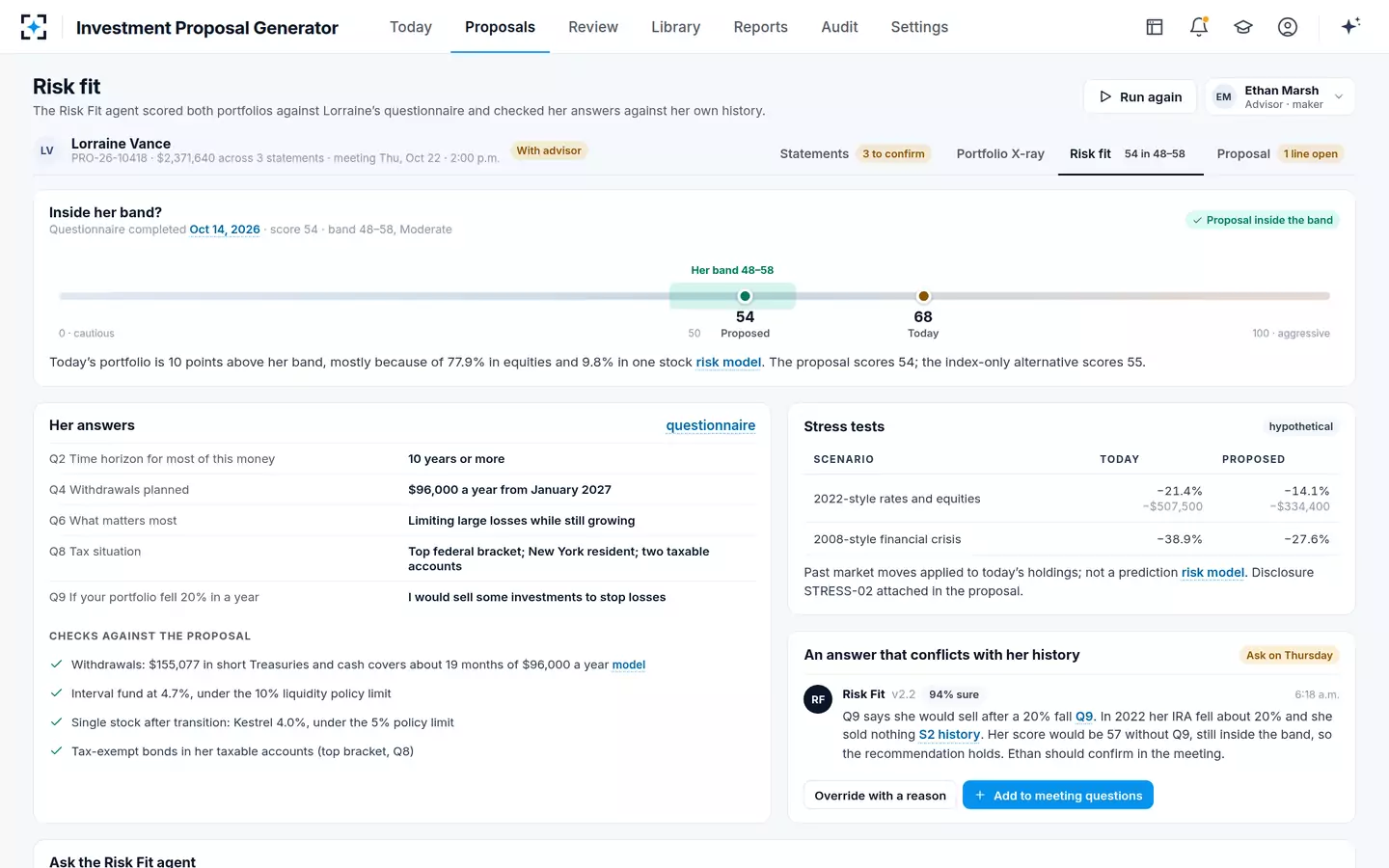
The section also shows how a good proposal handles an awkward answer. She said she would sell after a 20% fall; her own statements show she held through a fall of about that size in 2022. The proposal does not change her answer or her score. It notes that without that answer her score would be 57, still inside the band, and puts the question on the meeting agenda. The stress tests — "2022-style" and "2008-style" — are past market moves applied to today's holdings, and the proposal says plainly that they are not a prediction.
Section 6, moving: what the transition costs
A recommendation to move money is incomplete without what moving costs. SEC staff count among the costs to weigh the price of getting out of an investment, such as deferred sales charges or liquidation costs, the tax, and what those costs will do over the client's horizon (the care obligation's cost test; SEC staff bulletin on care obligations).
The sample's transition section is short because most of the work is in what it declines to do. The single stock is sold down from 9.8% to 4.0% over two tax years, waiting for a missing cost basis the prospect was asked to send. Two Swiss equity funds, likely passive foreign investment companies for a US person, are not sold until the tax desk has checked with her accountant whether an election was made — the IRS requires a separate Form 8621 for each such holding, and "The entire amount of gain from the disposition of a section 1291 fund is treated as an excess distribution" (IRS, Instructions for Form 8621). A non-traded REIT, valued at its sponsor's estimate with repurchases suspended, stays where it is. The principal's approval carried a condition: tax review before the Zürich sale.
Section 7, disclosures: performance shown the way the rules require
Disclosures belong next to the figures they qualify, not in a block at the end. For performance, the SEC Marketing Rule sets the format for any adviser's advertisement: gross performance only with net performance "With at least equal prominence", and results for one, five and ten years, equally prominent and running to at least the latest calendar year-end (the rule's detail is in gross and net performance under the Marketing Rule; 17 CFR 275.206(4)-1(d)(1)–(2)). That is why the sample replaced a fund's claim to have "beaten its benchmark in 8 of the last 10 years" with standardised 1-, 5- and 10-year net returns.
Projections need more. The sample's line "Over ten years, the savings could grow to $187,200" — $14,880 a year at an assumed 5%, reinvested, before taxes — was held until the advisor attached the firm's hypothetical-performance disclosure with those assumptions. For broker-dealer communications, FINRA's content standards separately prohibit promissory and exaggerated claims (FINRA Rule 2210(d)(1)), which is why "guaranteed lower costs" became "lower expected costs at current fee schedules". The treatment of net and gross figures is examined further in gross and net performance under the Marketing Rule.
What should never be in an investment proposal?
Some lines should never appear in an investment proposal, however persuasive they read, because each either cannot be supported or is restricted by the rules on communications. The checklist is the sample's marketing review, generalised.
Seven things that should never be in an investment proposal
- A projection without its assumptions
Return assumed, period, reinvestment, before or after tax, and the risks of relying on it.
- A selective performance claim
"Has beaten its benchmark in 8 of the last 10 years" instead of standardised 1-, 5- and 10-year returns.
- A promise
"Guaranteed lower costs" is a promise; "lower expected costs at current fee schedules" is a statement.
- A fee without a source
Every cost should trace to a fee table, agreement or statement page.
- A missing alternative
Especially a cheaper one, or keeping things as they are.
- A changed client answer
If an answer conflicts with the client's history, ask; do not re-score it.
- A sale nobody costed
Deferred sales charges, surrender charges, gains and foreign-fund tax all belong in the transition section.
How long should an investment proposal be?
No rule sets a length. A proposal should be as long as the evidence requires and no longer: the sample's seven sections fit on a few pages because the detail — statement pages, fee tables, the overlap map — is linked rather than pasted. What should not vary is the presence of every section. A two-page proposal that includes the alternatives table and the cost of moving is better than a twenty-page one that does not. What the advisor needs to gather before any of it can be written is listed in the inputs to a portfolio proposal.
Questions people ask
What is the difference between an investment proposal and a financial plan?
A financial plan projects a household's goals, cash flows and retirement income over decades. An investment proposal recommends a specific change to how money is invested now, comparing today's holdings with the recommendation and its alternatives on cost and risk. Many firms produce both, and the proposal often implements part of the plan.
Should an investment proposal include past performance?
It can, but for an investment adviser any performance shown must follow the Marketing Rule's conditions, including net performance alongside gross and 1-, 5- and 10-year periods. Many proposals rely instead on costs, risk fit and stress tests clearly labelled hypothetical.
What is an investment proposal outline?
Seven sections: where you are today, what we found, what we recommend and why, costs and the alternatives considered, risk fit, the cost of moving, and disclosures with sign-off. Each section should name the source of its figures.
Who signs an investment proposal?
The advisor who makes the recommendation. Many firms also require a registered principal or supervisor to review it before delivery, especially when it recommends an account type, a rollover or complex products; in the sample, the advisor approved as maker and a principal reviewed as checker, each with a reason.
Does an investment proposal need to mention conflicts of interest?
The firm's disclosures of conflicts sit in its relationship summary and brochure, which the proposal should reference. Where the recommendation itself involves a conflict — a proprietary model, a higher-fee account than an available alternative — saying so next to the recommendation is clearer than relying on documents the client may not reread.