C shares convert to A shares when the fund's prospectus says they do: many mutual funds that sell a level-load C class convert it automatically to the same fund's A class once the shares have been held for a stated number of years, which removes the C class's higher ongoing distribution fee from then on. Not every fund has a conversion feature, the holding period differs from one fund family to another and can depend on how the shares are held, and a conversion due on paper can fail to happen when the purchase date is not tracked. So a C share in a prospect's portfolio is a clock. Before a proposal calls the position expensive, or recommends selling it, the advisor needs the fund's own conversion terms, the purchase date and the cost of each class. Botminds' Investment Proposal Generator reads both from the statements and the prospectus; the guide below shows what to read and what a missed conversion costs.
The worked example uses the solution's sample data on fictional people and funds: a prospect who bought C shares of a growth fund on March 12, 2018, at a total annual expense of 1.79%, in a fund whose A shares cost 1.04%.
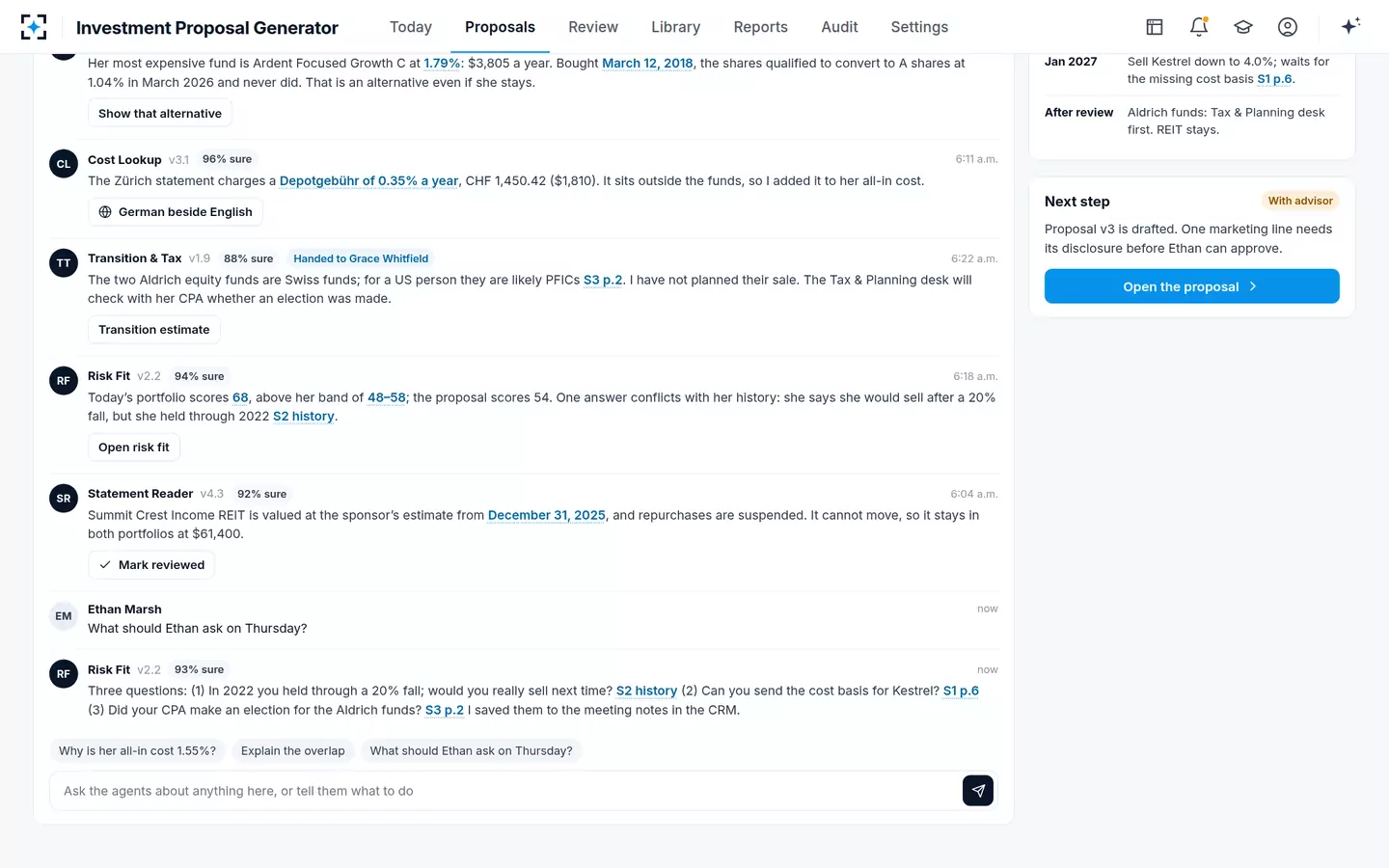
One sample C-share position: the conversion that was due, and the one that happened
- C share at 1.79%Mar 2018 – Mar 2026
- Still C7 mo
- C share at 1.79%Mar 2018 – Mar 2026
- A share1.04%
Do C shares convert to A shares?
Some do and some do not; the fund's prospectus decides. Where a fund offers automatic conversion, the SEC's registration form requires the prospectus to describe the sales loads and distribution fees of both the class sold and the class it becomes: if a fund offers "shares that provide for mandatory or automatic conversions or exchanges from one Class to another Class", it must provide the load and 12b-1 information "for both the shares offered and the Class into which the shares may be converted or exchanged" (Form N-1A, Item 12(c)(3)). The prospectus is where to look first, and the only place the answer is authoritative.
The answer can also depend on the intermediary, because conversion relies on someone knowing how long each lot has been held. If shares moved between firms or were bought in several lots, check that the original purchase dates moved with them. That is why the purchase date on the statement, or in the transfer records, is a proposal input in its own right.
How long before C shares convert to A shares?
There is no single holding period. Each fund sets its own in its prospectus, and the period can differ between fund families, between funds in one family, and between the way shares are held. A guide or tool that quotes one number of years for all C shares is guessing; the only reliable answer is the prospectus for the fund and class held, dated to when the shares were bought.
Two practical consequences follow for a proposal. First, read the conversion clause in the current prospectus and check whether it applies to shares bought before that prospectus's date, and to the way these shares are held. Second, compute the date each lot becomes eligible from the purchase date. In the sample, the prospect's C shares were bought on March 12, 2018 and, under that sample fund's terms, became eligible to convert in March 2026; on the statement read in October they were still C shares.
Investment Proposal Generator finds a conversion that was due and never happened
Why do C shares cost more?
C shares usually cost more each year because they carry a higher distribution (12b-1) fee in place of the up-front sales charge an A share takes at purchase. The SEC's investor bulletin on fund classes describes the trade: Class C shares "might have a 12b-1 fee and a contingent deferred sales load (CDSL)", typically for a short period, and "Because Class C shares generally have a higher 12b-1 fee than other load bearing classes, you could end up paying more if you hold these shares for a long time." Class A shares may carry a front-end load, a percentage of the purchase price, which can be reduced when the investor qualifies for a discount (how breakpoints earn it; SEC Office of Investor Education and Advocacy, Mutual Fund Classes).
Class A and Class C shares of the same fund: the trade-off a conversion ends
Class A: Front-end sales charge, reduced at breakpoints for larger or aggregated purchases; sometimes waived.
Class C: Usually no front-end charge; the whole amount is invested.
Class A: A 12b-1 fee that is generally lower than the C class's.
Class C: A higher 12b-1 fee, paid out of fund assets for as long as the shares are C shares.
Class A: Set by the fund; see its prospectus.
Class C: A contingent deferred sales charge if sold within the fund's stated period.
Class A: The higher cost is paid once, up front.
Class C: The extra cost accumulates each year until the shares are sold or converted.
Class A: The same pool of securities.
Class C: The same pool of securities: only the fees differ.
The same bulletin makes the point that turns this into a proposal question: "Keep in mind that the share class with the lowest initial fees may not be the share class with the lowest fees over time." A C share bought for a short horizon can be the cheaper choice; a C share held for a decade usually is not, which is exactly why many funds convert them, and why a conversion that does not happen is a cost the client keeps paying.
What a missed C-share conversion costs
A missed conversion costs the difference between the two classes' annual expense ratios, on the value of the position, for every year the shares stay in the wrong class. It is a small percentage that compounds into real money, and it is invisible on a statement that does not print expense ratios.
One sample position: the annual cost as a C share, and as the A share it qualified for
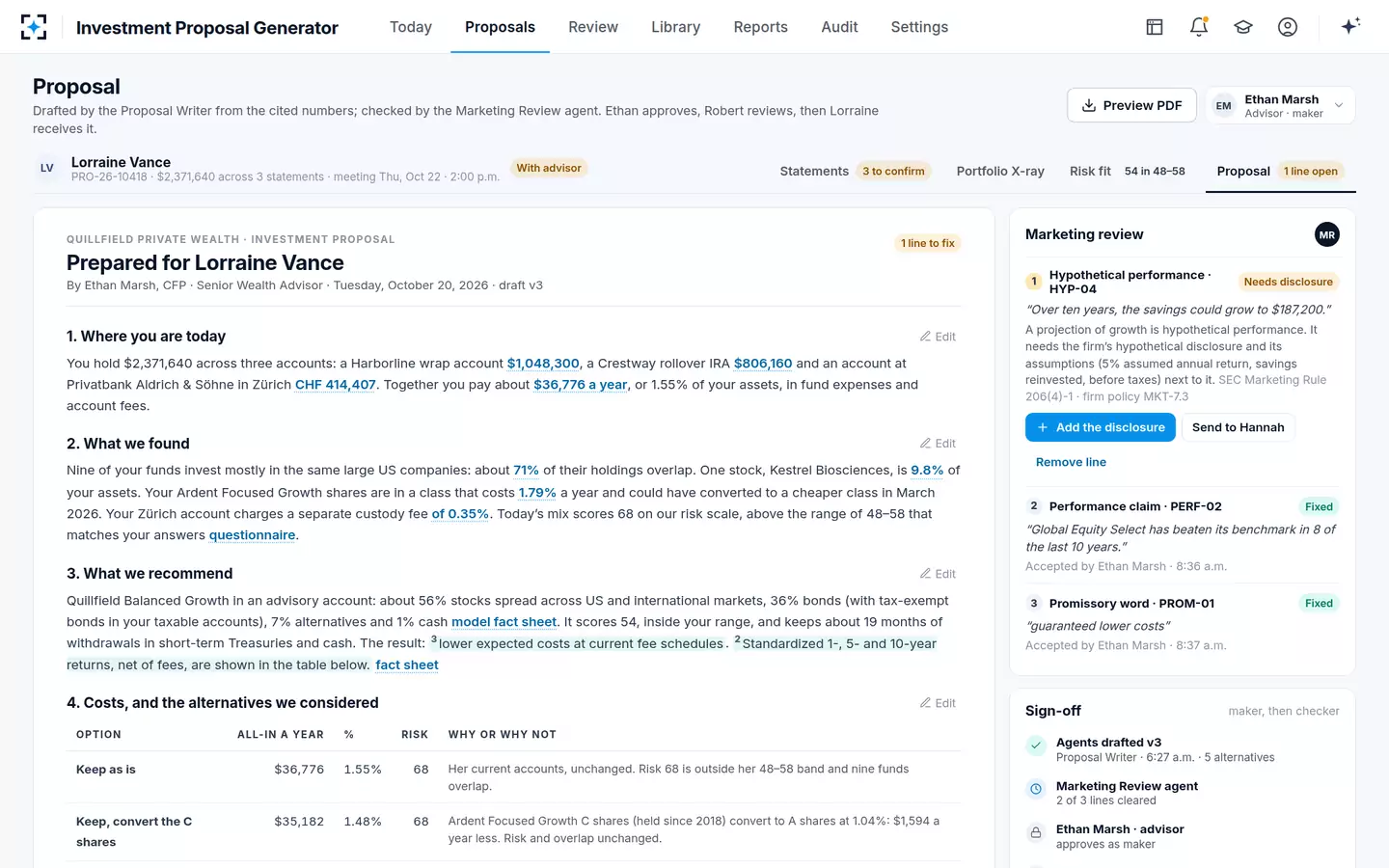
The solution treats this as an alternative in its own right. Even if the prospect never moves her account, converting the C shares to A shares keeps the same fund and saves $1,594 a year; in the sample, the agents add "keep and convert the C shares" as the second of five options compared, at $35,182 a year all-in against $36,776 for keeping everything as it is. A proposal that recommends a new account should still show that option, because it is the cheapest change that requires nothing of the client but a signature.
The missed conversion, in the proposal the prospect reads
Can you convert C shares to A shares early?
Sometimes. Whether a C share can be exchanged into another class of the same fund before its scheduled conversion is set by the fund, and often depends on the account: many funds allow shares held in an advisory or fee-based account to move into a class without distribution fees. The SEC noted this in a 2019 share-class order: "In many cases, mutual funds permit certain advisory clients who hold shares in classes charging 12b-1 fees to convert those shares to Class I shares without cost or tax consequences to the client" (In the Matter of Michigan Advisors, Inc., Advisers Act Release No. 5395, September 30, 2019).
Two checks come before any early exchange. Is a contingent deferred sales charge still running on any lot? And does the fund treat an exchange between its own classes as a non-taxable event for this account type? The order's wording — "in many cases" — is a reason to read the fund's terms rather than assume. The Transition & Tax agent in the solution estimates sales charges and gains but does not give tax advice; where an exchange's tax treatment is not clear from the fund's documents, the item goes to a person.
What regulators found when share classes went wrong
Share-class cases describe failures a proposal can catch. In the SEC's Share Class Selection Disclosure Initiative, advisers that self-reported placing clients in 12b-1 share classes when cheaper classes of the same funds were available settled and repaid clients; the SEC announced in March 2019 that the first group of 79 advisers would return more than $125 million. In the Michigan Advisors order, the adviser undertook to "evaluate whether existing clients should be moved to a lower-cost share class and move clients as necessary."
One firm's C-share purchase limits failed for six years: what FINRA found
$13.4m
in excess sales charges and fees paid by customers
$15.2m
restitution undertaken, with interest; censure, no fine
1.76%
annual expenses on the C shares one customer bought, against 0.96% for the A shares available
2015–21
period of the supervisory failure, corrected in January 2021
The FINRA case shows the logic regulators apply. The firm's system was meant to stop C-share purchases once a customer qualified for A shares at net asset value, and in some funds applied the wrong limit. As FINRA put it, the reason such limits exist is simple:
If a customer qualifies to purchase Class A shares at NAV, there would be no reason for the customer to purchase Class C shares with higher annual expenses and which normally carry a higher CDSC.
FINRA, AWC No. 2020068535401
In its own example, a customer already holding over $500,000 of a fund's C shares bought $200,000 more as C shares at about 1.76% a year when A shares were available at NAV at about 0.96%. On $200,000, that 0.80-point gap is $1,600 a year, our arithmetic. As part of its remediation, the firm worked with fund sponsors to convert certain customers' C shares to A shares. The same aggregation that unlocks A shares at NAV unlocks smaller sales-charge discounts too, which breakpoints in mutual funds covers in detail.
How a proposal should treat a C share
A proposal should treat every C share as a dated question, not a line item: when was it bought, when does it convert under this fund's terms, what would it cost as the other class, and is any deferred sales charge still running. The checklist is what the Cost Lookup agent does on each C share in the solution, and what an associate can do by hand.
Six checks on every C-share position in a prospect's portfolio
- Confirm the class from the statement, not the fund name
If the class is not printed, ask; never infer it.
- Find the purchase date of each lot
From the statement, the cost-basis report or the transfer records.
- Read the conversion clause in the fund's current prospectus
Whether conversion exists, after how long, and for which accounts.
- Price both classes from the same prospectus fee table
Total annual fund operating expenses for the class held and the class it becomes.
- Check for a running deferred sales charge
Lots still inside the CDSC period cost money to sell or exchange.
- Show "keep and convert" as an option
The cheapest change available, whatever else the proposal recommends.
Where Investment Proposal Generator finds the clock
Investment Proposal Generator reads the class and the purchase date from each statement, looks up both classes' fee tables in the fund's own prospectus for the exact share class, and flags a conversion that is due or overdue as a finding with its cost. In the sample, the finding appeared in three places: as a line in the overnight conversation ("Bought March 12, 2018, the shares qualified to convert to A shares at 1.04% in March 2026 and never did"), as the second option in the alternatives table, and in the proposal text the prospect reads, in plain words. The advisor decided what to do with it. How the class costs feed the prospect's all-in cost is in the portfolio cost analysis.
Questions people ask
Do all C shares convert to A shares?
No. Conversion is a feature a fund chooses to offer and describes in its prospectus, along with the holding period. Some funds have no conversion feature, and some apply it only to shares held in certain ways. Read the prospectus for the fund and class held.
Is converting C shares to A shares a taxable event?
Often it is not, but check the fund's terms for the account. The SEC has observed that "in many cases" funds let advisory clients convert 12b-1 classes to institutional classes "without cost or tax consequences". Where the documents are unclear, ask the fund or a tax adviser before treating the exchange as tax-free.
Do C shares have a charge when you sell them?
Often, for a limited period. The SEC's bulletin describes a contingent deferred sales load that applies "for some period of time (often a year)". After that period, selling C shares usually carries no sales charge, but check the prospectus for the class held.
Are C shares ever the better choice?
Yes, for short holding periods. Because C shares usually avoid the A share's up-front charge, they can cost less over a few years; the higher annual fee wins over long holding periods. The SEC's own advice is that the class with the lowest initial fees "may not be the share class with the lowest fees over time."
What is the difference between A, C and I shares?
They are classes of the same fund holding the same portfolio with different fees. A shares usually charge up front and a lower 12b-1 fee; C shares usually charge no up-front fee but a higher 12b-1 fee; institutional (I) shares often have the lowest ongoing expenses but higher minimums, sometimes waived in advisory accounts.
Does a missed conversion get refunded?
There is no automatic refund. In enforcement cases regulators have required firms to repay excess fees and move clients to cheaper classes, as in the FINRA and SEC matters above. For a prospect, the practical remedy is to convert now and document the finding in the proposal.