Breakpoints in mutual funds are the purchase amounts at which a fund's front-end sales charge drops: a fund might charge its maximum load on a small purchase and progressively less as the investment crosses each threshold, down to no sales charge at all on a large one. What makes breakpoints easy to miss is that the amount that counts is rarely just today's cheque. Through rights of accumulation, many funds add the shares an investor and their family already hold in the fund family — sometimes in accounts at other firms — to the new purchase; through a letter of intent, they count purchases the investor commits to make over the coming months. A proposal that sees only one account can quote the wrong sales charge on a discount the prospect has already earned. Botminds' Investment Proposal Generator reads every statement the household brings, and this guide explains how breakpoints work, what regulators found when firms missed them, and what to collect so they are not missed again.
An illustrative breakpoint schedule, and where one household lands
What are breakpoints in mutual funds?
Breakpoints are the investment amounts, set by each fund in its prospectus, at which the front-end sales charge on its load-bearing share classes — typically A shares — steps down. The SEC's investor bulletin describes the idea in plain terms: Class A shares "might have a front-end sales load paid as a percentage of the purchase price, which may be discounted if certain criteria are met (e.g., a minimum amount is invested)" (SEC, Mutual Fund Classes).
The SEC requires funds to publish the schedule. A prospectus must show "any front-end sales load (and each breakpoint in the sales load, if any) as a percentage of both the offering price and the net amount invested", and describe the arrangements that produce breakpoints, "e.g., letters of intent, accumulation plans" (Form N-1A, Item 12(a)). The schedule differs from fund to fund, so a breakpoint is always a fact about one fund family's terms, never a general rule.
How do breakpoints work for mutual funds?
Breakpoints work by comparing the amount that counts toward a discount with the fund's schedule, and charging the rate for the band it falls in. The skill is in the amount that counts. FINRA's 2021 guidance walks through the mechanics: an investor "who had already purchased $20,000 of a mutual fund's shares and purchases an additional $35,000" "would reach the $50,000 breakpoint and, thus, be entitled to 3.75 percent sales charge on this purchase" under that example's schedule (FINRA Regulatory Notice 21-07).
Three routes can raise the amount that counts, and each depends on the fund family's own rules. The table sets them side by side.
Three ways a purchase reaches a lower sales charge
| Route | How it works | What it needs from the investor |
|---|---|---|
| Rights of accumulation | New purchases are added to shares already held — often across the fund family — to reach a breakpoint. The lower rate applies to the new purchase only. | Statements showing current holdings, possibly at other firms. |
| Letter of intent | The investor commits to buy a stated amount, typically over 13 months, and pays the lower rate on each purchase along the way. | A signed letter, and purchases on the terms the fund sets out. |
| Household aggregation | Some families count accounts of close family members, such as a spouse or child, and accounts at other firms. | Information about related accounts the firm cannot see by itself. |
What are rights of accumulation?
Rights of accumulation let an investor count shares they already own toward a breakpoint on a new purchase. FINRA describes them as discounts that work "by aggregating new purchases of shares with the customers' existing holdings to reach a volume discount threshold", and stresses a limit: "The ROA reduces the sales charge to incremental new purchases, but not any prior transactions" (FINRA Regulatory Notice 21-07). Earlier purchases at a higher rate are not refunded; only the new money benefits.
The SEC's bulletin adds the detail that matters for a proposal: a rights-of-accumulation breakpoint is reached when "the dollar amount of mutual fund shares purchased plus the amount already held, often including mutual funds of the same fund family, equals a pre-determined threshold" (SEC, Mutual Fund Classes). The amount already held may sit in accounts the advisor has never seen, which is why a proposal built from every statement the household brings can find a discount a single-account view cannot.
What is a letter of intent?
A letter of intent is a commitment to invest a stated amount in a fund family over a set period, in exchange for the breakpoint rate on each purchase from the start. FINRA describes it as providing discounts "when a customer commits to purchase a specific dollar volume of shares", "typically over a 13-month period", and gives the example of a customer who agrees to buy $130,000 spread equally over 13 months and pays "a 3.25 percent sales charge for each incremental $10,000 purchase" under that schedule (FINRA Regulatory Notice 21-07).
A letter of intent matters to a proposal that phases a transition. If the recommendation moves money into a load-bearing fund family in stages, a letter of intent can secure the lower rate on every stage; without one, the early purchases pay more. The SEC examiners' 2003 report counted "customers not receiving the retroactive benefit of a letter of intent" among the failures it found.
Do held-away accounts count toward breakpoints?
Often, if the fund family's terms allow it and the investor tells the firm about them. Some fund families count holdings at other firms and those of close family members, and the SEC requires funds to say so: a prospectus must state that "in order to obtain a breakpoint discount, it may be necessary at the time of purchase for a shareholder to inform the Fund or his or her financial intermediary of the existence of other accounts", including holdings "in any account of the shareholder at another financial intermediary" and "by related parties of the shareholder, such as members of the same family or household" (Form N-1A, Item 12(a)(4)).
FINRA gives a household example: "If the spouse of a customer owns $110,000 of a mutual fund, the customer may be able to purchase an additional $45,000" "with a 3.25 percent, rather than a 4.25 percent, front-end sales charge" "because the value of their accounts exceeds the $100,000 breakpoint" (FINRA Regulatory Notice 21-07). That is exactly the information a prospect's held-away statements contain. The burden of telling the fund falls on the investor, which in practice means on the advisor who has seen the statements.
What to collect so a breakpoint is not missed
- Statements for every account at this firm that holds the fund family
Including retirement accounts, as Form N-1A Item 12(a)(4)(A) lists.
- Statements for accounts at other firms
Held-away holdings can count if the fund family aggregates them; Item 12(a)(4)(B).
- Holdings of family and household members
Spouse, children, family trusts — whoever the fund family's rules include; Item 12(a)(4)(C).
- Historical cost records, where the fund values accounts at cost
The fund, its transfer agent and intermediaries may not keep them; Item 12(a)(4)(ii).
- Planned purchases over the next 13 months
They may justify a letter of intent.
- The fund family's own schedule and aggregation rules
From the prospectus and statement of additional information, current edition.
What regulators found when firms missed breakpoints
When the SEC, NASD and NYSE examined how often investors received the breakpoints they were due, the answer was: often not. Their joint examination sweep of 43 broker-dealers sampled more than 9,000 transactions, deliberately choosing those most likely to qualify — so the results are not a random sample — and found that in 1,757 of 5,515 transactions that appeared eligible, the investor did not receive a breakpoint discount or appeared to pay other unnecessary sales charges.
The 2003 breakpoint examinations: one in three eligible purchases missed the discount
32%
of apparently eligible transactions missed the discount or paid other unnecessary sales charges
1,757
transactions without the discount, of 5,515 that appeared eligible
$364
average discount not provided, per transaction
43
broker-dealers examined; three failed to give the discount in every eligible sampled trade
The causes are the ones a proposal can prevent. "The most frequent causes for not providing a breakpoint discount were not linking a customer's ownership of different funds in the same mutual fund family, not linking shares owned in a fund or fund family in all of a customer's accounts at the firm, and not linking shares owned in the same fund or fund family by persons related to the customer (e.g., spouse, children)" (joint report). Every one of them is a failure to put information the firm could obtain next to the purchase. The report's consequence was direct: "Firms will be required to refund to customers any amounts that are found to have been overcharged."
Two decades later, FINRA's guidance found the same weaknesses in a different form. Firms "failed to establish or maintain systems, controls and WSPs reasonably designed to identify customers" eligible for discounts; firms "relied on their associated persons to identify and apply available sales charge discounts and waivers"; and firms "used a single threshold in their surveillance systems without considering variability among funds or fund families" (FINRA Regulatory Notice 21-07). The notice puts the question every firm should be able to answer: "How does your firm apply householding parameters when identifying accounts and transactions eligible for discounts?"
Breakpoint sales: selling just below the line
A breakpoint sale is the opposite failure, and FINRA prohibits it outright. Rule 2342 reads:
No member shall sell investment company shares in dollar amounts just below the point at which the sales charge is reduced on quantity transactions so as to share in the higher sales charges applicable on sales below the breakpoint.
FINRA Rule 2342(a)
FINRA weighs the facts and circumstances, including whether the sale followed a genuine asset allocation program and whether customers were told they might not qualify for otherwise available breakpoint reductions. For a proposal that splits money across several funds in one family, the practical test is simple: if a different split would cross a breakpoint, show it, and say why the recommended split is better anyway.
Advisory fees have breakpoints too
The same idea appears in advisory fee schedules, and the same failure follows. When the SEC's examinations office listed the most frequent advisory fee deficiencies in 2018, it named advisers that failed to add up household members' accounts when billing, so clients missed the lower fee tier they had earned, and that "Did not reduce a client's fee rate when the value of that client's account reached a prearranged breakpoint level" (SEC risk alert, April 12, 2018). A proposal that prices the recommended account should apply the firm's own fee breakpoints to the household's total, as the agreement will; how that feeds the all-in cost is in a portfolio cost analysis of the prospect's held-away accounts.
Who checks breakpoints, and how Investment Proposal Generator finds them
Responsibility sits with the firm selling the shares: FINRA expects member firms to have systems and supervisory procedures to identify customers eligible for discounts, rather than relying on individual representatives. In practice, the first person with the information is whoever reads the prospect's statements, which makes the proposal the natural place to catch a missed breakpoint before the next purchase.
Investment Proposal Generator: every holding with its share class and cost, across the household's statements
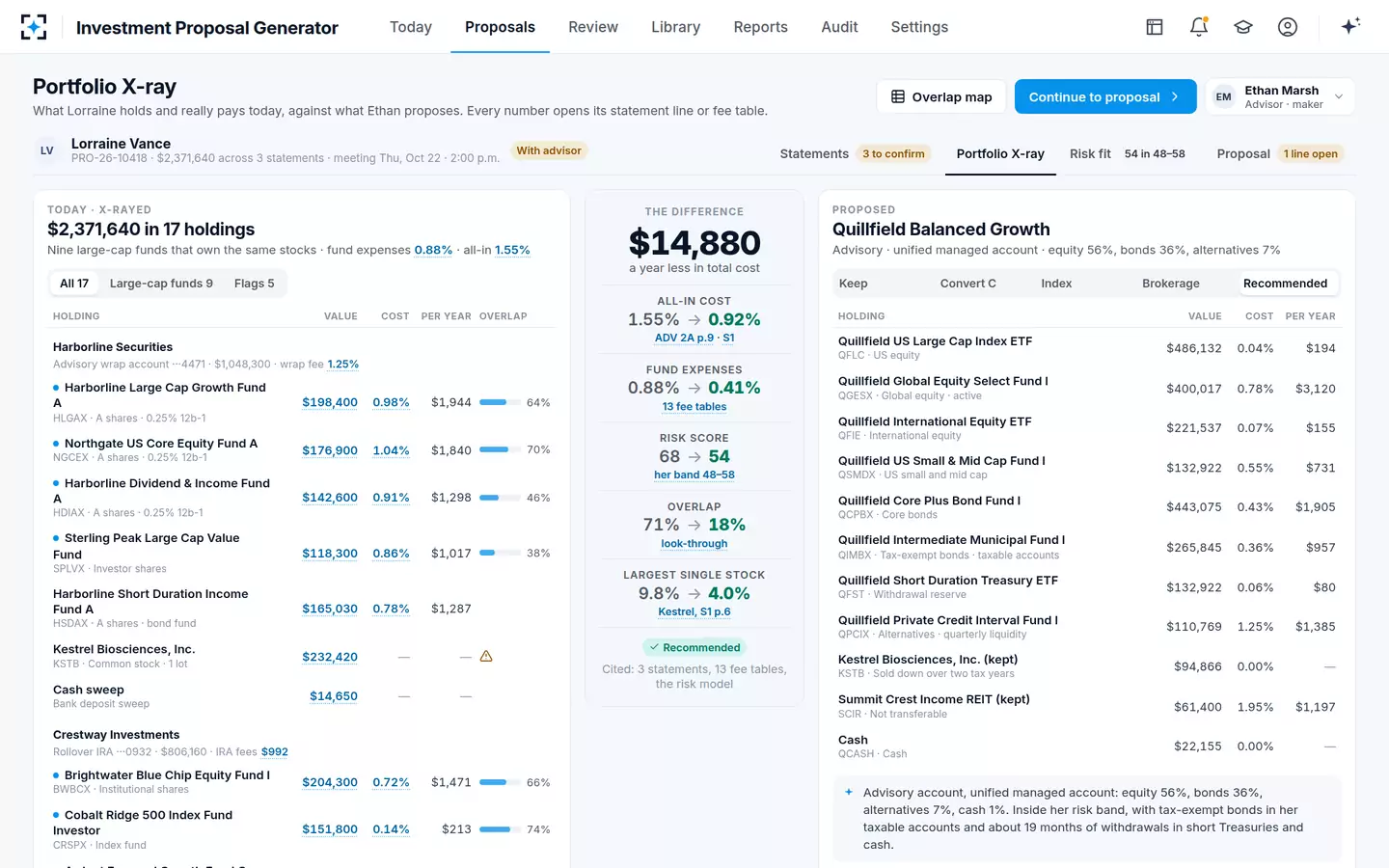
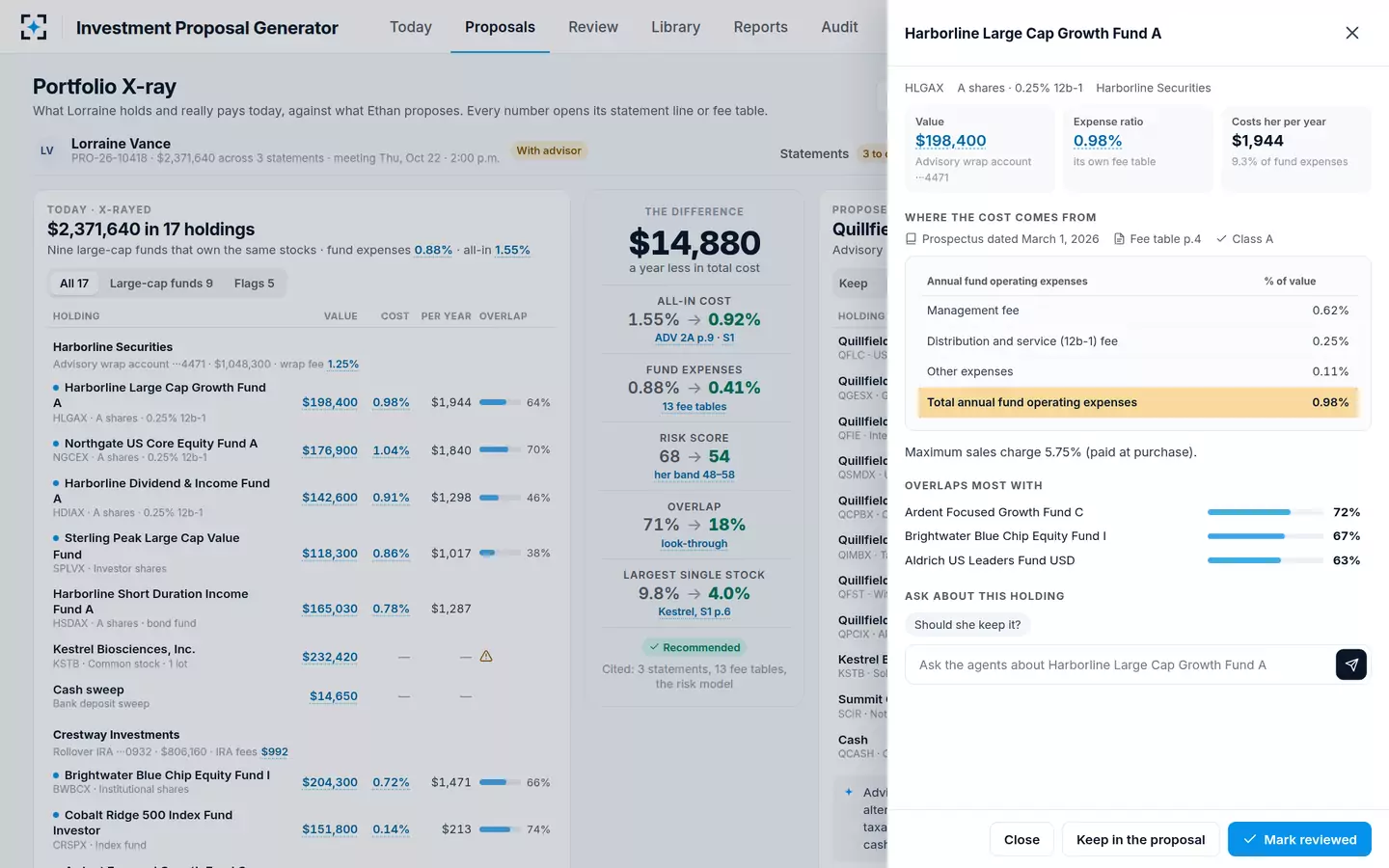
Investment Proposal Generator reads every statement the household provides, records each holding's fund family and share class, and looks up each fund's own prospectus, where the sales-charge schedule and aggregation rules are published. In the sample, one A-share fund's fee table showed a maximum sales charge of 5.75%, paid at purchase; whether a prospect pays that or less on a new purchase depends on exactly the holdings the statements reveal. The agents do not decide eligibility, which is the fund's call under its own terms; they put the household's holdings and the fund's rules side by side, so the advisor can claim the discount before the purchase is placed.
The fund's own fee table, with its maximum sales charge, for the class held
Breakpoints have a close cousin in share-class purchase limits, where reaching a threshold makes a cheaper class available altogether; that case, and what it cost when one firm's limits failed, is in when C shares convert to A shares.
Questions people ask
What is a breakpoint discount?
A lower front-end sales charge a fund gives when the amount invested, or the amount that counts toward it, reaches a level set in its prospectus. The schedule and what counts toward it differ by fund family. Funds must publish each breakpoint as a percentage of both the offering price and the net amount invested.
Do breakpoints apply to C shares?
Breakpoints apply to front-end sales charges, which C shares usually do not have. Large holdings can still matter for C shares, because many fund families limit C-share purchases above a threshold and offer A shares at a reduced or no sales charge instead.
Can I get a refund if I missed a breakpoint?
Rights of accumulation apply only to new purchases, not earlier ones. Where a firm failed to apply a discount a customer was entitled to, regulators have required refunds; the 2003 joint report said firms "will be required to refund to customers any amounts that are found to have been overcharged."
Does a 529 plan have breakpoints?
Some 529 plans sold through brokers have front-end sales charges with volume discounts; FINRA's 2021 guidance on sales charge discounts covers both mutual funds and 529 plans. Check the plan's program description for its schedule and aggregation rules.
Who is responsible for applying breakpoints?
The firm selling the shares must have systems to identify eligible customers, and the fund's prospectus tells shareholders they may need to inform the firm of other accounts. In practice both sides need the household's statements, which is why a proposal is a good place to check.
Do breakpoints count reinvested dividends?
It depends on the fund family's valuation method, which the prospectus must describe — for example historical cost, net amount invested or offering price. Read the method before adding up holdings, because it changes which figure counts.