A portfolio proposal is the document an advisor gives a prospect that sets today's portfolio, with its full cost and risk, beside a recommended portfolio and the alternatives that were considered. Whether it is built by hand in a spreadsheet or drafted by a portfolio proposal tool, its quality is fixed before the first sentence is written, by the inputs: every page of every statement the prospect brings, each fund's fee table for the exact share class held, the firm's own shelf of products and account types, its models and fee schedule, and the prospect's answers about goals, time horizon and risk. Miss one and the proposal is wrong in a way no amount of writing repairs. Botminds' Investment Proposal Generator reads those inputs with AI agents and drafts from them; this guide is about the inputs themselves — what each one proves, where it comes from, and what a firm has to bring before any tool can use them.
Where the guide shows the inputs at work, it uses the solution's sample data on fictional people: a prospect, Lorraine Vance, with three statements from three custodians, one of them in German.
What one prospect's paper held that a summary page would not
17holdings
across three accounts at three custodians
2languages
one statement written in German, with Swiss number formats
$1,810
a year in custody fees, found on page 5 of the German statement
1gap
a stock with no cost basis on the statement, needed to price its sale
What is a portfolio proposal?
A portfolio proposal is a written recommendation to a prospect or client to change how money is invested, supported by a comparison of today's portfolio with the proposed one on cost, risk and fit. It differs from a financial plan, which projects goals and cash flows, and from a marketing piece, which describes a firm's services in general. A proposal is specific to one person's money and one recommendation.
That specificity is why its inputs matter. The SEC's examiners describe the analysis they expect behind advice in concrete terms. In its 2027 priorities, the Division of Examinations says it will evaluate whether the characteristics of recommended products or strategies are consistent with client profiles, and lists the factors: "Examples of the factors assessed include liquidity, risk profile and potential rewards, volatility, projected performance across diverse market and economic conditions, time horizons, and costs (including exit costs)" (SEC, Fiscal Year 2027 Examination Priorities). Each of those factors has to come from somewhere. Costs come from statements and fee tables; exit costs from cost basis and sales charges; risk from holdings and the questionnaire; liquidity from what the products allow.
The path from paper to proposal
A proposal moves through five stages, and the order is fixed: inputs, checks, draft, review, delivery. Most rework comes from skipping the second stage — drafting from inputs nobody reconciled — so the first job, by hand or with agents, is gathering everything completely before writing a word.
Inputs first: how a portfolio proposal reaches the client in Investment Proposal Generator
A person decides
Client service associateUploads every statement the prospect sends — PDF, scan or photo — and chases missing pages.
Agent
Statement ReaderReads every page in its own language and reconciles each statement to the custodian's printed total.
Never: continues when a total does not reconcile
Agent
Cost Lookup and Portfolio X-rayPrice each holding from its own prospectus for the exact share class; look through the funds for overlap and concentration.
Never: guesses a share class it cannot see
Agent
Risk Fit and Proposal WriterScore both portfolios against the questionnaire band; draft the proposal with every option and its reason.
A person decides
AdvisorReads the draft, confirms what the agents flagged, chooses the recommendation and approves with a reason.
A person decides
Registered principalReviews the evidence behind the recommendation before the client receives it, under the firm's procedures.
What goes into a portfolio proposal? Ten inputs from four places
A complete portfolio proposal draws on ten inputs, and they come from four places: the prospect's own paper, the product issuers, the firm, and the conversation with the prospect. The table lists each, where it comes from, and what it proves in the finished proposal.
Ten inputs to a portfolio proposal, and what each one proves
| Input | Where it comes from | What it proves in the proposal |
|---|---|---|
| Every page of every current statement | The prospect, from each custodian | What is held, in what units and share classes, with which account-level fees; the total the extraction must reconcile to. |
| Current account agreements and fee schedules | The prospect, or the other firm's brochure | Wrap, advisory and custody fees that never appear in a fund's expense ratio. |
| Cost basis and tax lots | Statements, gain-loss reports, the prospect | What a sale would realise in gains, and which positions to phase. |
| Each fund's fee table, by share class | The fund's own prospectus | Sales charges, 12b-1 fees and total annual operating expenses for the class actually held. |
| Sales-charge discount terms | Prospectus and statement of additional information | Breakpoints and conversion features the prospect may already be entitled to. |
| Fund holdings | Funds' periodic holdings reports | Overlap and concentration across funds, dated. |
| The investment profile | Questionnaire and conversation | Goals, time horizon, liquidity needs, tax status and risk tolerance the recommendation must fit. |
| The firm's shelf and account types | The firm | The reasonably available alternatives the recommendation was compared against. |
| Models and the fee schedule | The firm's investment committee and Form ADV | The proposed portfolio and what it will cost, in the same units as today's. |
| Approved disclosures and marketing rules | Marketing compliance | The wording any projection, stress test or performance figure must carry. |
The investment profile has a regulatory definition worth keeping beside the questionnaire. Regulation Best Interest lists what a retail customer's investment profile includes — among other things age, other investments, financial situation and needs, tax status, investment objectives, experience, time horizon, liquidity needs and risk tolerance (17 CFR 240.15l-1(b)(2)). "Other investments" is the clause that makes held-away statements an input rather than a courtesy: a proposal for one account that ignores the rest of the household's money has not considered the profile.
What documents does an advisor need from a prospect?
An advisor needs the most recent full statement for every account the prospect wants reviewed — every page, not the summary — plus the agreements that set any fees charged outside the funds, cost basis for taxable positions, and the prospect's own answers about goals and risk. The checklist is what an associate can send on the day the meeting is booked.
What to ask a prospect for before the proposal meeting
- The latest complete statement for each account, every page
Fees and holdings detail can sit on the back pages; a summary page alone can hide both.
- Statements for accounts held elsewhere in the household
Spouse's and family accounts can count toward sales-charge discounts and change the concentration picture.
- The advisory or wrap agreement and fee schedule for current accounts
The fee charged outside the funds never appears in a fund expense ratio.
- Cost basis or a gain-loss report for taxable accounts
Without it, the cost of moving cannot be estimated, only guessed.
- Retirement plan fee disclosures, if a rollover is in scope
Plan costs are needed to compare staying with moving.
- Statements in their original language
A translation summary can drop the fee page; read the original.
- The completed risk questionnaire
Scored before the meeting, so a conflicting answer can be raised in it.
- Anything illiquid or unusual
Non-traded REITs, interval funds, private placements and foreign funds need separate handling.
The prospect's paper: every page, not the summary
The costs that change a proposal most are usually on the pages nobody retypes. Fund expense ratios are in the prospectus; the fees charged by the account itself — a wrap fee, a custody fee, an IRA maintenance fee — sit on the statement and the agreement. A proposal built from the summary page compares the new portfolio's all-in cost with today's fund costs only, and flatters the recommendation or hides a cheaper alternative, depending on which way the error runs.
A German statement read beside the English, and its custody fee found on page 5
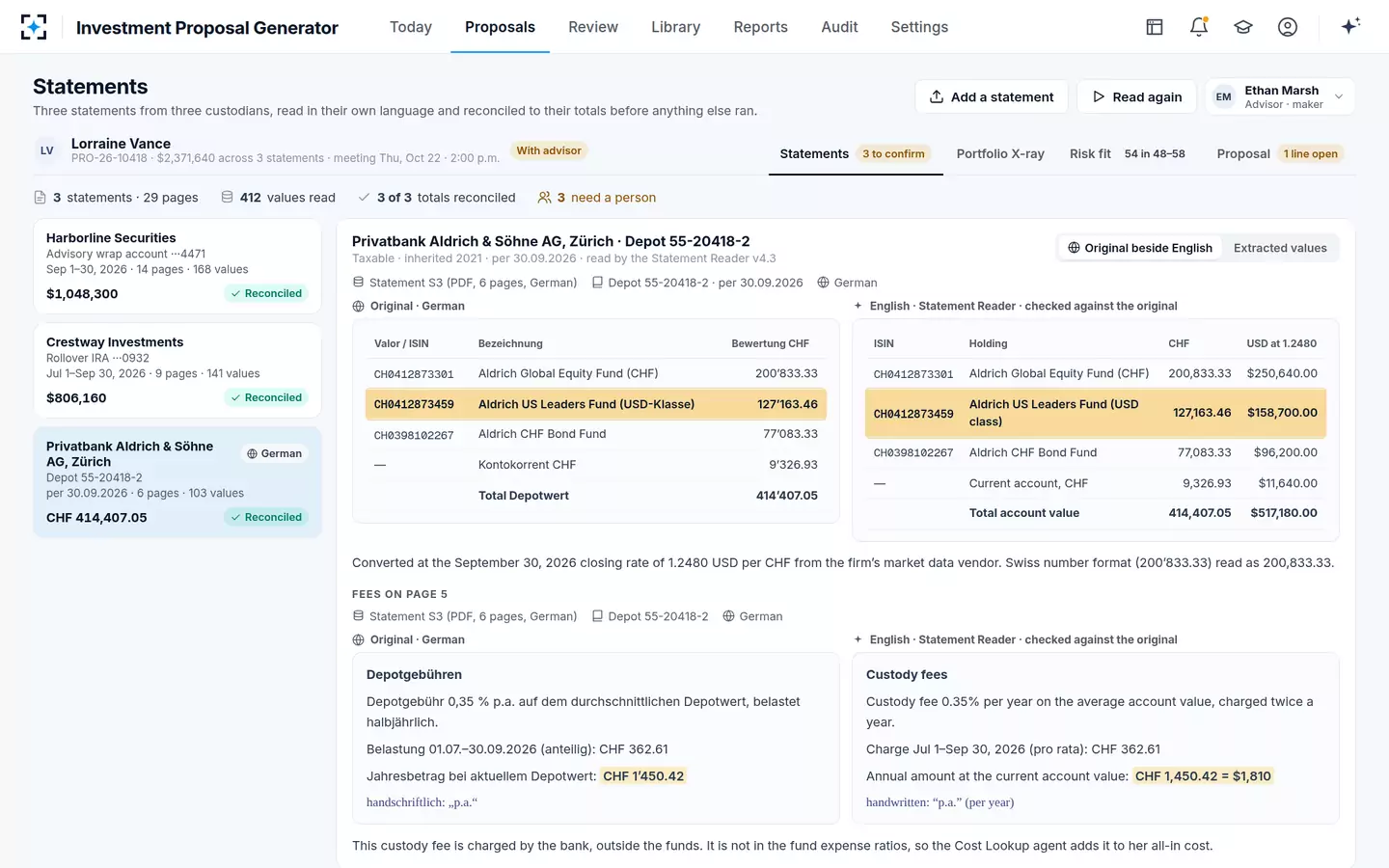
Foreign statements raise the stakes. In the sample, the German statement's fee page said the custody fee was charged "p.a." — per year — in a handwritten note, and the reader stopped to ask a person rather than guess, because the alternative reading doubles the fee. The same statement held two Swiss equity funds, which for a US person are likely to be passive foreign investment companies with their own tax reporting; the solution sends those to a tax desk rather than planning their sale. An input you cannot read in its own language is an input you have not gathered.
The fund side: the fee table for the share class actually held
Every fund fee in a proposal should come from the fund's own prospectus fee table for the share class the prospect holds, dated, with the page. Mutual fund prospectuses carry a standard fee table — shareholder fees such as sales charges, then annual fund operating expenses: management fees, distribution (12b-1) fees, other expenses and the total — under Item 3 of the SEC's Form N-1A (Form N-1A). The same fund can carry very different totals across classes, so a fee "for the fund" is not an input; a fee for the class is.
The sample makes the point twice. One growth fund held as an A share showed a 0.98% total — 0.62% management, 0.25% 12b-1 and 0.11% other expenses — from its prospectus dated March 1, 2026, page 4. Another, held as a C share at 1.79%, had become eligible to convert to the fund's A share at 1.04% and never did; that single fact was worth $1,594 a year to the prospect. How share-class conversion works, and why it goes missing, is the subject of when C shares convert to A shares, and the whole fee arithmetic of a portfolio cost analysis for a prospect's held-away accounts.
The firm's own inputs: shelf, models, fee schedule and bands
A firm brings four inputs no prospect can supply: the shelf of products and account types its advisors may recommend, the model portfolios, the fee schedule, and the risk bands its questionnaire maps to. Without them a tool can describe a prospect's portfolio but cannot compare it with anything the firm offers.
The shelf is easy to leave out of a proposal tool, because the tool can still produce a proposal without it; it is also the input examiners read. SEC staff expect the recommendation to be compared with the alternatives reasonably available through the firm, starting early rather than as an afterthought, and say that comparing classes of a single fund is not enough (SEC staff bulletin on care obligations). The SEC's examiners put the account-type point plainly in a 2021 risk alert on wrap fee programs: "In providing advice about account type, an adviser should consider all types of accounts offered by the adviser and acknowledge to a client when the account types the adviser offers are not in the client's best interest" (SEC Division of Examinations, July 21, 2021). How the shelf is defined for Reg BI purposes is covered in Reg BI reasonably available alternatives; for the proposal, what matters is that the shelf exists as data the tool can compare against.
The fee schedule matters for the same reason in the other direction. A proposal compares today's all-in cost with the proposed all-in cost, and the proposed side includes the firm's own advisory fee from its Form ADV schedule, not only the model's fund expenses. In the sample, the recommended account's cost was $21,896 a year, of which fund expenses were 0.41% and the rest advisory and account fees — against $36,776 today.
How long does a portfolio proposal take?
No regulator or independent study publishes how long a portfolio proposal takes to build, and the surveys that circulate are vendors' own. The useful number is your firm's, and it is easy to measure. For the next ten proposals, have whoever builds them log start and stop times against five steps: gathering and chasing paper, entering or checking positions, looking up fees, building the comparison, and writing and review. Note how many statements each prospect brought and whether any were scans or foreign.
Then look at two things in the log. First, whether time tracks statement pages and custodians rather than assets: if a prospect with five scanned accounts costs more hours than one with a single clean PDF and three times the money, the bottleneck is reading, not analysis. Second, how often the review step sent a proposal back, and why: a principal who has to ask where a fee came from is reporting a missing input. Those two measurements tell you which inputs to fix first, with or without software.
What a firm brings to go live with a portfolio proposal tool
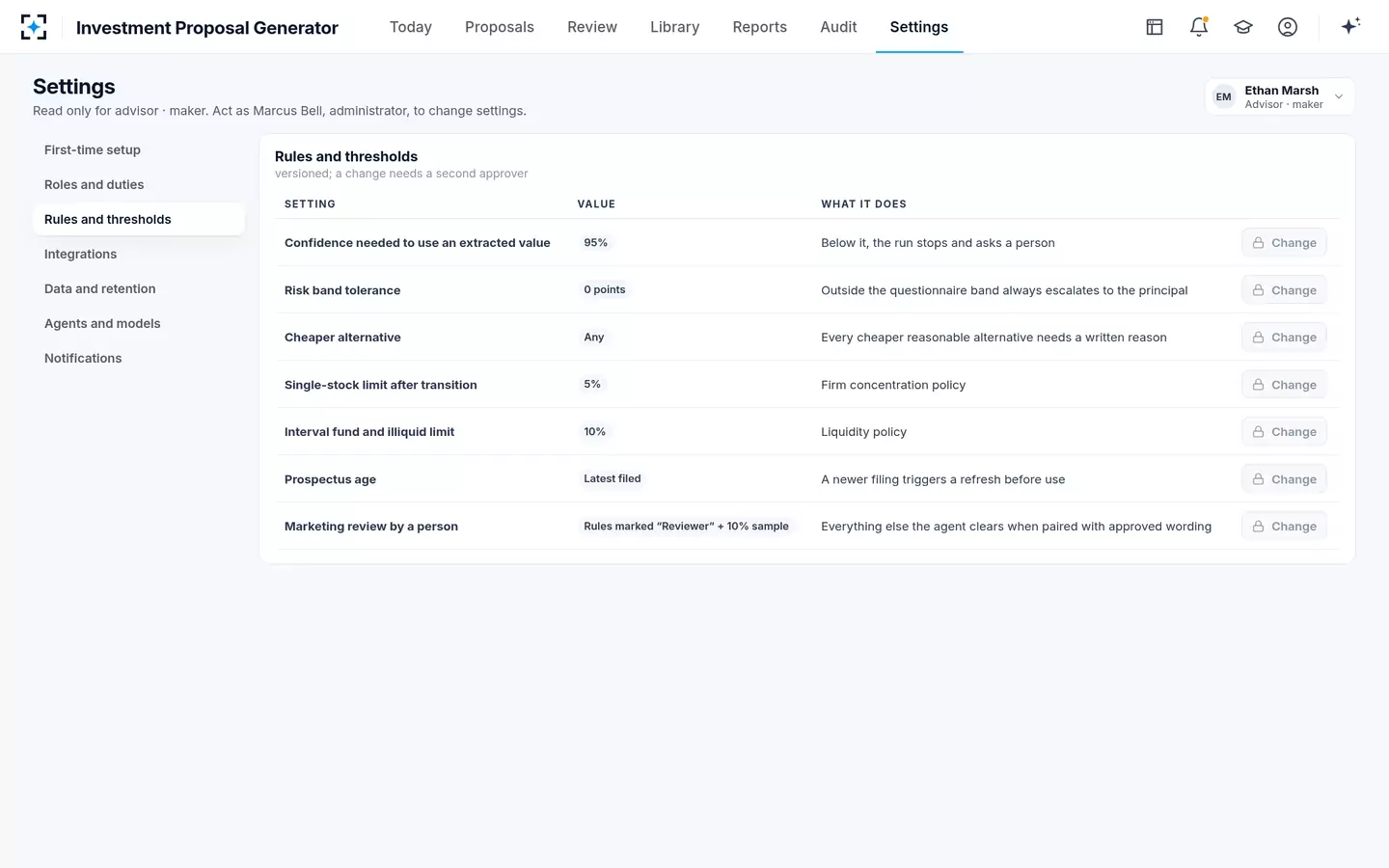
To go live with a portfolio proposal tool, a firm brings its own rules as data: the fee schedule and models, the shelf, the questionnaire and its bands, approved disclosures, the marketing rules its reviewers apply, and a sample of past prospect statements to test on. In Investment Proposal Generator the thresholds that apply those rules are settings, versioned, and changed only when a second approver agrees.
Investment Proposal Generator settings: your firm's policy as thresholds every proposal is checked against
What to bring before the first proposal is drafted
- The fee schedule from Form ADV Part 2A, and any negotiated exceptions
So the proposed side of every comparison is priced the way clients will be billed.
- Model portfolios with their holdings and share classes
Models priced from the same prospectus fee tables as the prospect's funds.
- The shelf: products and account types advisors may recommend
The source of every reasonably available alternative in the comparison.
- The risk questionnaire, its scoring and its bands
So today's and the proposed portfolios are scored on the firm's scale, not the tool's.
- Approved disclosures, by type
Hypothetical performance, stress tests, projections: each with the assumptions it must state.
- The marketing rules your reviewers apply, marked by who may clear them
What a tool may clear with approved wording, and what always goes to a person.
- Roles: who approves as maker, who reviews as principal
And the review clock the firm commits to.
- Twenty past prospects' statements, including the worst
Scans, photos, foreign statements and missing pages: the test set for the first month.
The past statements are the most valuable item on the list. Running the tool on twenty prospects the firm has already proposed to gives a fair comparison: the positions, fees and alternatives in each new draft can be checked against what the advisor actually sent, and any difference is either a finding or an error. A firm that starts with clean PDFs learns little; one that starts with its worst scans learns where the inputs break. What a finished proposal built from these inputs looks like, page by page, is in the annotated investment proposal example.
Questions people ask
What is the difference between a portfolio proposal and an investment proposal?
In wealth management the two terms are used for the same document: a recommendation to change how a prospect's money is invested, compared with what they hold today. "Portfolio proposal" stresses the holdings and their mix; "investment proposal" is also used for business funding pitches, which are a different thing entirely.
Should a portfolio proposal include accounts the prospect is not moving?
It should consider them. Reg BI's investment profile includes the customer's other investments, and accounts held elsewhere can change concentration, overlap and even sales-charge discounts. The proposal can recommend changes to only some accounts while showing the household picture.
What is a portfolio proposal tool?
Software that turns a prospect's holdings into a proposal: today's portfolio and cost, a recommended portfolio, and the comparison. Tools differ most in what they read. Some need positions typed in or imported from a data feed; others, like Investment Proposal Generator, read the statements themselves and price each holding from its own prospectus.
Can a proposal be built from a summary page or a screenshot?
It can be started, but not finished. Account-level fees, share classes and cost basis are usually on the detail pages, and a summary cannot be reconciled to the custodian's total. Ask for every page.
What should a firm test first when it adopts proposal software?
Its own worst paper. Run twenty past prospects, including scans, photos and a foreign statement, and compare each draft's positions, fees and alternatives with what was actually sent. Count totals reconciled and values flagged, not just pages read.
Who should own the inputs a proposal tool relies on?
The fee schedule and models belong to the investment and finance teams, the shelf to product governance, the questionnaire bands to whoever owns suitability, and the disclosure library to marketing compliance. Each should change only with a second approver, because every proposal inherits it.