A financial advisor proposal template is the fixed structure an advisor fills in for each prospect: where the prospect stands today, what the advisor found, what is recommended and why, what it costs against the alternatives, the risk fit, the cost of moving, and the disclosures. At a large firm, other people check each section — an associate reconciles the statements, marketing compliance reviews the projections, a principal signs. In a one-person practice the advisor is all of those people, and the rules do not get lighter: a registered investment adviser of any size must run a compliance program with a named compliance officer, and a proposal that shows projected returns is subject to the SEC Marketing Rule even when it goes to one prospect. So the template for a solo advisor has to carry its checks inside it. Botminds' Investment Proposal Generator is built for firms with a second reviewer; this guide gives the template a single advisor can use, by hand or with software, and says honestly where the solution fits a practice of one.
The solo advisor's context, in the regulators' and statisticians' numbers
299,400
jobs held by personal financial advisors in the US in 2025
16,300+
investment advisers registered with and overseen by the SEC
~13%
of investment advisers examined during fiscal 2025
What should a financial advisor proposal template include?
A financial advisor proposal template should include nine sections, and each should name the check that proves it before the proposal is sent. The structure follows what a reviewer, an examiner or a sceptical prospect will ask of any recommendation: what you hold, what it costs, what you should do instead, what else you could do, and what it costs to change.
The solo advisor's proposal template, with the check built into each section
| Section | What goes in | The built-in check before sending |
|---|---|---|
| 1. Scope | Who the proposal is for, which accounts it covers, the date of the statements used, and whether you act as adviser, broker or both. | The relationship summary was delivered, and the capacity is stated. |
| 2. Where you are today | Every holding and account, with value and annual cost. | Each statement's positions add up to the custodian's total. |
| 3. What we found | Fees outside the funds, share classes, overlap, single-stock concentration, gaps such as a missing cost basis. | Every finding names the page it came from. |
| 4. What we recommend, and why | The recommended portfolio and account type, in the prospect's own terms. | The reason refers to the prospect's goals, horizon, liquidity and risk answers, not to the product. |
| 5. Costs and alternatives | All-in cost today and proposed, and every option considered, including keeping things as they are. | Every cheaper option has a written reason it was not chosen. |
| 6. Risk fit | Risk score today and proposed against the questionnaire band; stress tests. | Stress tests are labelled hypothetical, with their assumptions. |
| 7. Moving | Sales charges, surrender charges and estimated gains of the transition; what stays where it is. | Anything you cannot assess — foreign funds, illiquid products — is referred, not planned. |
| 8. Disclosures | Your fee schedule, conflicts, and the assumptions behind any projection. | Each projection or hypothetical line has its disclosure attached. |
| 9. Sign-off | Who prepared it, who reviewed it, when it was sent, and where the file is kept. | A self-review checklist completed, or a second reviewer's name. |
A template that stops at holdings, recommendation and disclosures leaves out the sections that matter most. Those sections — the findings with their pages, the alternatives with their reasons, the cost of moving — are the ones that make a proposal defensible, and the ones easiest to skip late in the evening. Seeing the full template filled in for one sample prospect, page by page, is the subject of the annotated investment proposal example.
Who reviews a solo advisor's proposals?
In a one-person registered investment adviser, the advisor reviews the proposals, as the firm's own chief compliance officer, under written procedures the advisor wrote. The SEC's compliance rule requires every registered adviser to name a supervised person to run its policies and procedures, and to review those procedures "no less frequently than annually" (17 CFR 275.206(4)-7). Nothing stops that individual being the principal of a one-person firm.
The SEC said so when it adopted the rule. "The rules that we are adopting do not require funds or investment advisers to hire a separate chief compliance officer, and we expect that many small investment advisers will designate a principal or employee of the firm to serve as chief compliance officer." It declined to exempt small firms, reasoning that "the flexibility of the rules obviates the need for this exception", and expected smaller firms without conflicting business interests "to require much simpler policies and procedures than larger firms" (SEC, Compliance Programs of Investment Companies and Investment Advisers, December 2003).
Simpler is not absent. For proposals, the practical form of a solo advisor's procedure is the template's built-in checks: a fixed set of checks, applied every time, with the completed checklist kept with the proposal. A solo advisor can also ask an outside compliance consultant to review a sample each quarter; the rule does not require it, but it supplies the second pair of eyes a one-person firm otherwise lacks.
One advisor, four seats: who does each check in a practice of one
Today
Meets the prospect, chooses the recommendation and writes why it fits.
With agents
Reads a draft whose figures are already cited, and spends the evening on the recommendation and the meeting.
Still theirs: The recommendation and its reason
Today
Retypes positions from every statement page and chases missing ones.
With agents
Confirms only the values a reader flagged, and checks that each statement reconciles.
Still theirs: The prospect's paper
Today
Reviews his own proposal, often the same night it is written.
With agents
Works through the template's checks with the sources one click away.
Still theirs: The written procedures and the annual review
Today
Decides alone whether a projection needs a disclosure.
With agents
Applies a short written rule: no projection without its assumptions attached.
Still theirs: The disclosure wording
Does a solo RIA need a marketing review?
Yes, in substance: an SEC-registered adviser of any size is subject to the Marketing Rule, and a one-to-one proposal that includes hypothetical performance — a projected return, a model's backtest, what savings could grow to — is treated as an advertisement. The rule then allows hypothetical performance only if the adviser "Adopts and implements policies and procedures reasonably designed" to make the hypothetical performance relevant to the finances and goals of the person who will read it, and gives the reader enough to understand "the criteria used and assumptions made" and "the risks and limitations of using such hypothetical performance in making investment decisions" (17 CFR 275.206(4)-1(d)(6)).
For a solo advisor, those conditions translate into three habits. Keep a short written policy on when projections may be used. Keep a small library of approved disclosure wording, one per type of projection. And never let a projected figure leave the office without its assumptions next to it. The definition that pulls a one-person proposal into the rule, and the 2026 change to FINRA's rule that will let broker-dealers project performance under conditions once it takes effect, are covered in the guide to the seven agents and their limits.
The rule applies to advisers "registered or required to be registered" with the SEC. A solo adviser registered only with a state is governed by that state's advertising rules instead, which differ; check your state securities regulator's rules rather than assuming either way.
What should the recommendation section say?
The recommendation section should say why this portfolio and this account fit this prospect, in terms of what the prospect told you, and it should be the one section an advisor never delegates. For an investment adviser, the standard comes from the fiduciary duty of care as the SEC interpreted it in 2019: "In order to develop a reasonable understanding of a retail client's objectives, an adviser should, at a minimum, make a reasonable inquiry into the client's financial situation, level of financial sophistication, investment experience, and financial goals" (SEC, Commission Interpretation Regarding Standard of Conduct for Investment Advisers, Release IA-5248). The same interpretation treats advice about account type, including a rollover, as investment advice covered by the duty.
In practice the section works best in three short paragraphs: what the prospect wants the money to do and when, what in today's portfolio does not serve that, and how the recommended portfolio and account change it. Each sentence should point back to something the prospect said or signed — a questionnaire answer, a stated withdrawal plan — rather than to the product's features. In the sample used across this series, the reason for a moderately priced managed account over a cheaper index model was the prospect's own answers asking for tax-exempt bonds in her taxable accounts and for active management of losses; that reason, not the fee, is what a reviewer reads first.
The proposal evening: where a solo advisor's hours go
No regulator or independent study publishes how long a proposal takes a solo advisor, so the useful number is your own. Botminds' own estimate, for one prospect bringing three statements, puts the work at about four and a half hours by hand, most of it reading and retyping rather than thinking. It is an estimate, not a measurement; the timeline shows it so you can compare your own log against it.
One prospect, three statements: an estimate of the proposal evening, by hand and with agents
- Retyping positions1¼ h
- Looking up fees¾ h
- Overlap½ h
- Risk fit½ h
- Writing, with alternatives1 h
- Review½ h
- Check0.3 h
- Write¼ h
- Review¼ h
To measure your own, log start and stop times for your next ten proposals against the six steps in the top lane, and note the number of statements, custodians and scanned pages each prospect brought. The pattern to look for is whether the reading steps grow with paper rather than with assets; if they do, the evening is a data-entry problem, and the fix is in how statements are read, not in how the proposal is written.
The five checks nobody else will run
In a practice of one, five checks are easy to skip and are the ones a reviewer will ask about later. Each takes minutes; each is one of the template's built-in checks.
Five checks a solo advisor runs on every proposal before it is sent
- Reconcile every statement to its total
If the positions you entered do not add up to the custodian's total, a page or a unit count is wrong, and every cost after it is too.
- Price every fund from its own fee table, for the class held
Note the prospectus date and page. A C share priced as an A share understates today's cost and inflates your savings.
- Find the fees outside the funds
Wrap, custody, IRA and account fees are on the statement and the agreement, not in expense ratios.
- Write the reason for every cheaper option you did not choose
Including keeping everything as it is. A one-line reason, in the client's terms, is enough.
- Attach the assumptions to every projection
Return assumed, period, reinvestment, before or after tax, and the risks. No projection leaves without them.
How often will an examiner read your proposals?
Not often, but the file has to be ready whenever it happens. The SEC's own performance measure shows that the share of investment advisers examined in a year — by the SEC or a self-regulatory organisation — was about 13% in fiscal 2025, with lower estimates for 2026 and 2027, across more than 16,300 SEC-registered advisers (SEC, FY2027 Congressional Budget Justification). That is a reason to keep each proposal's checks with it, not a reason to relax them: an examination looks back across years of files at once.
The records rule sets how long those files live. Advisers must keep written communications relating to any recommendation made or proposed, generally for at least five years (17 CFR 275.204-2). For a solo advisor that means the proposal as sent, the statements it was built from, the fee tables cited, and the completed checklist, kept together where you can find them.
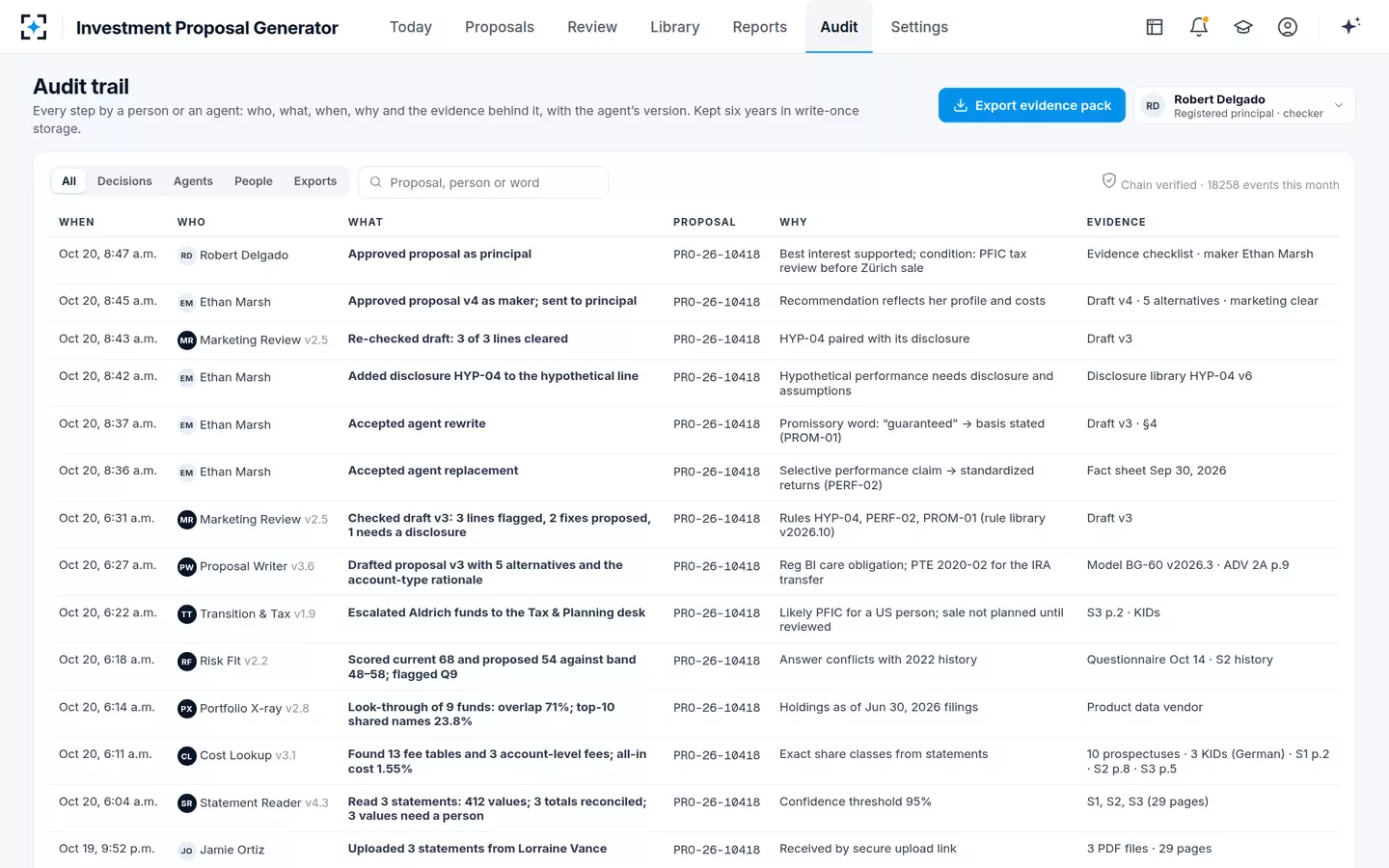
Investment Proposal Generator's audit trail: every step, its reason and its evidence
A template in Word, or a proposal generator?
A template in Word is enough when prospects bring one or two clean statements and the advisor has time to read every page. A generator earns its place when the reading is the bottleneck: many custodians, scanned or photographed pages, foreign statements, dozens of funds to price by share class. The template's checks stay the same either way; what changes is who does the reading.
Investment Proposal Generator: a drafted proposal with its marketing review beside it
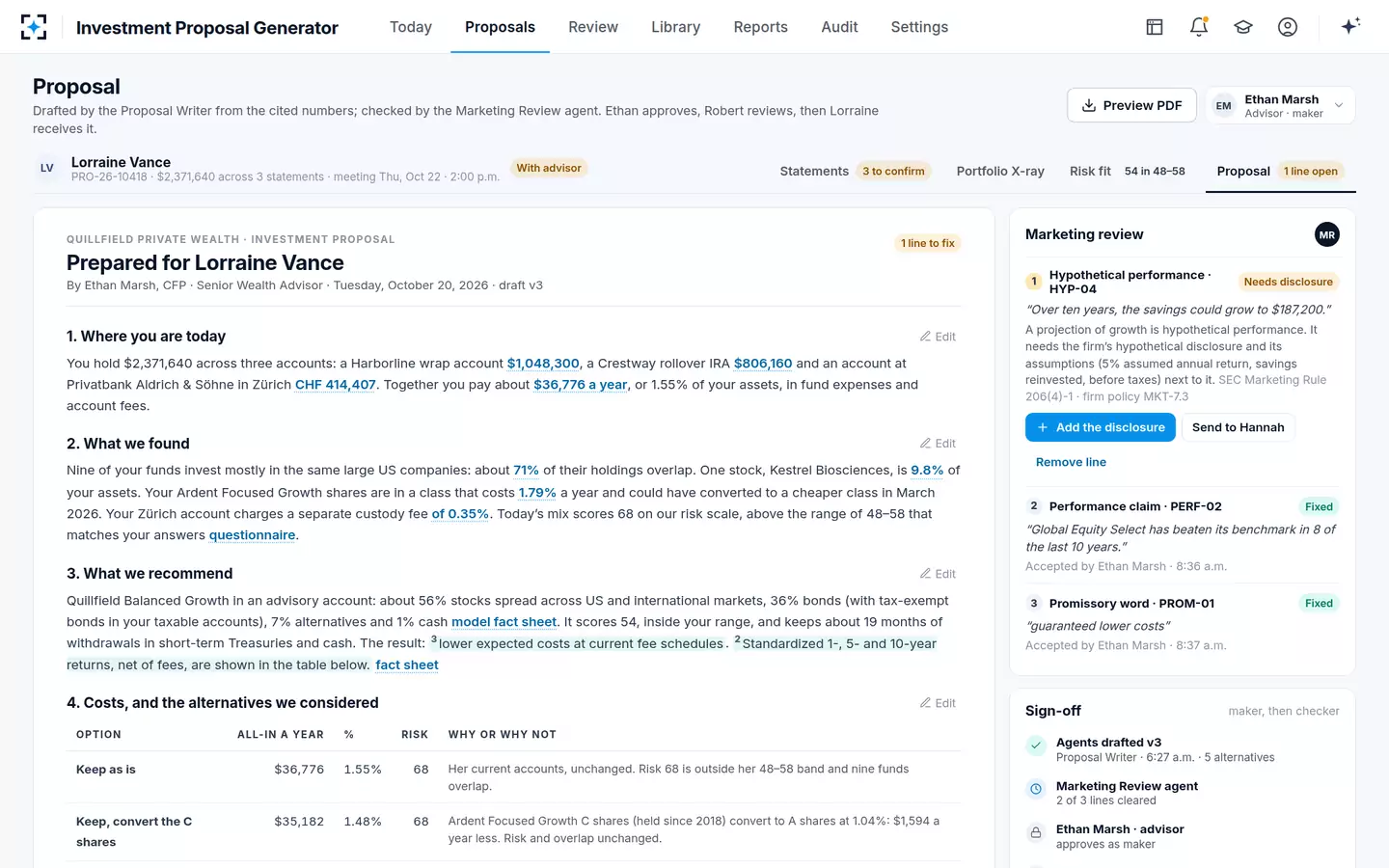
Be clear about one limit before choosing Investment Proposal Generator for a practice of one. The solution enforces maker and checker as two different people: the advisor approves as maker, a registered principal reviews as checker, and the advisor cannot act as principal on the same proposal even with both roles. A one-person firm can use the reading, pricing and drafting, but needs an outside reviewer — a compliance consultant or a partner firm's principal — to use the second signature at all. For most solo advisors the template above, applied consistently, is the right place to start.
Questions people ask
Can a solo advisor be their own chief compliance officer?
Yes. The SEC's compliance rule requires a designated chief compliance officer who is a supervised person, and when it adopted the rule the SEC said it expected many small advisers to designate a principal or employee of the firm. The officer must also review the firm's procedures at least annually.
Is there an investment proposal template in Word I can use?
Any word processor will do; the structure matters more than the file. Use the nine sections above and keep the built-in checks as a separate checklist filed with each proposal. A template without the alternatives section and the cost-of-moving section is a sales document, not a proposal.
Does the SEC Marketing Rule apply to state-registered advisers?
The rule applies to advisers registered or required to be registered with the SEC. State-registered advisers are governed by their state's rules on advertising and communications, which vary, so check the state securities regulator's rules.
What records should a solo advisor keep of a proposal?
The proposal as sent, the statements and fee tables it relied on, any disclosure attached, and evidence of the review. Advisers generally keep written communications relating to recommendations for at least five years under the SEC's books-and-records rule.
Should a solo advisor show projected returns in a proposal?
Only with a written policy and the disclosures the Marketing Rule requires: a projection is hypothetical performance, which must be relevant to the prospect's situation and objectives and come with its criteria, assumptions, risks and limitations. If in doubt, show costs in dollars, which need no projection.