Account aggregation service providers are companies that connect to a client's accounts at other banks, brokers and retirement plans, with the client's permission, and deliver balances, holdings and transactions into an advisor's planning, CRM or reporting systems. For linked accounts they are fast and current. They are also partial: they see only the accounts the client agrees to link and the provider supports, connections break, and many of the documents a financial plan depends on, insurance policy statements, equity award summaries, foreign contracts, tax returns, are not account feeds at all. Reading the client's statements fills those gaps, with a printed date and a page to cite. A planning file needs both, each line labelled with its source and date, which is how Botminds' Financial Planning Data Gathering treats them: aggregation is one source in the firm's precedence rule, and the agents read every document the feeds do not cover.
The comparison below is written for the operations and technology leads who choose and run these services; the examples come from the solution's fictional sample household and firm.
Aggregation feed and statement reading, row by row
Account aggregation: Accounts the client links and the provider supports. Anything the client will not link is outside it.
Reading the statements: Anything the client receives a document for: plans, policies, award summaries, tax forms, foreign contracts.
Account aggregation: As current as the last successful refresh; a broken connection silently ages.
Reading the statements: As current as the statement date, which is printed on the page and can be tested against a rule.
Account aggregation: A data record from the provider; history depends on what it keeps.
Reading the statements: The page itself: value, date, owner, often beneficiary and contribution rate.
Account aggregation: Link once per account, then re-link when a connection breaks.
Reading the statements: Upload or forward statements, each time a newer one is needed.
Account aggregation: An interface, or screen scraping with the client’s login credentials.
Reading the statements: None: the client sends the document.
Account aggregation: Holdings and transactions, where the source exposes them.
Reading the statements: Whatever the page shows, including cash value versus death benefit, loan principal versus payoff, vesting dates.
Account aggregation: Keeping linked accounts current between reviews.
Reading the statements: Completing the household and proving each number.
What is account aggregation?
Account aggregation is the collection of a person's financial account data from several institutions into one place, with their permission. FINRA's investor guidance puts it in a sentence: “At its most basic level, financial data aggregation puts information about your financial holdings under one roof” (FINRA, January 12, 2024). For an advisory firm it is the main way to see held-away accounts between meetings without asking the client for a new statement each time.
The US data-access rule uses its own vocabulary. In the CFPB's 2024 personal financial data rights rule, a data aggregator “means a person that is retained by and provides services to the authorized third party to enable access to covered data” (CFPB, 89 FR 90838, November 18, 2024). In an advisory setting the authorized third party can be the advisor's planning or reporting platform, and the aggregator is the provider behind it.
What do account aggregation service providers do for advisors?
They maintain the connections. A provider builds and keeps up links to thousands of institutions, through an application programming interface where the institution offers one or, otherwise, by screen scraping. FINRA describes the first as an interface “which offers a prearranged agreement to transfer data” and the second as one “in which you provide your login credentials for each financial account” (FINRA). The provider normalises what comes back, balances, positions, transactions, into a common format for the advisor's systems.
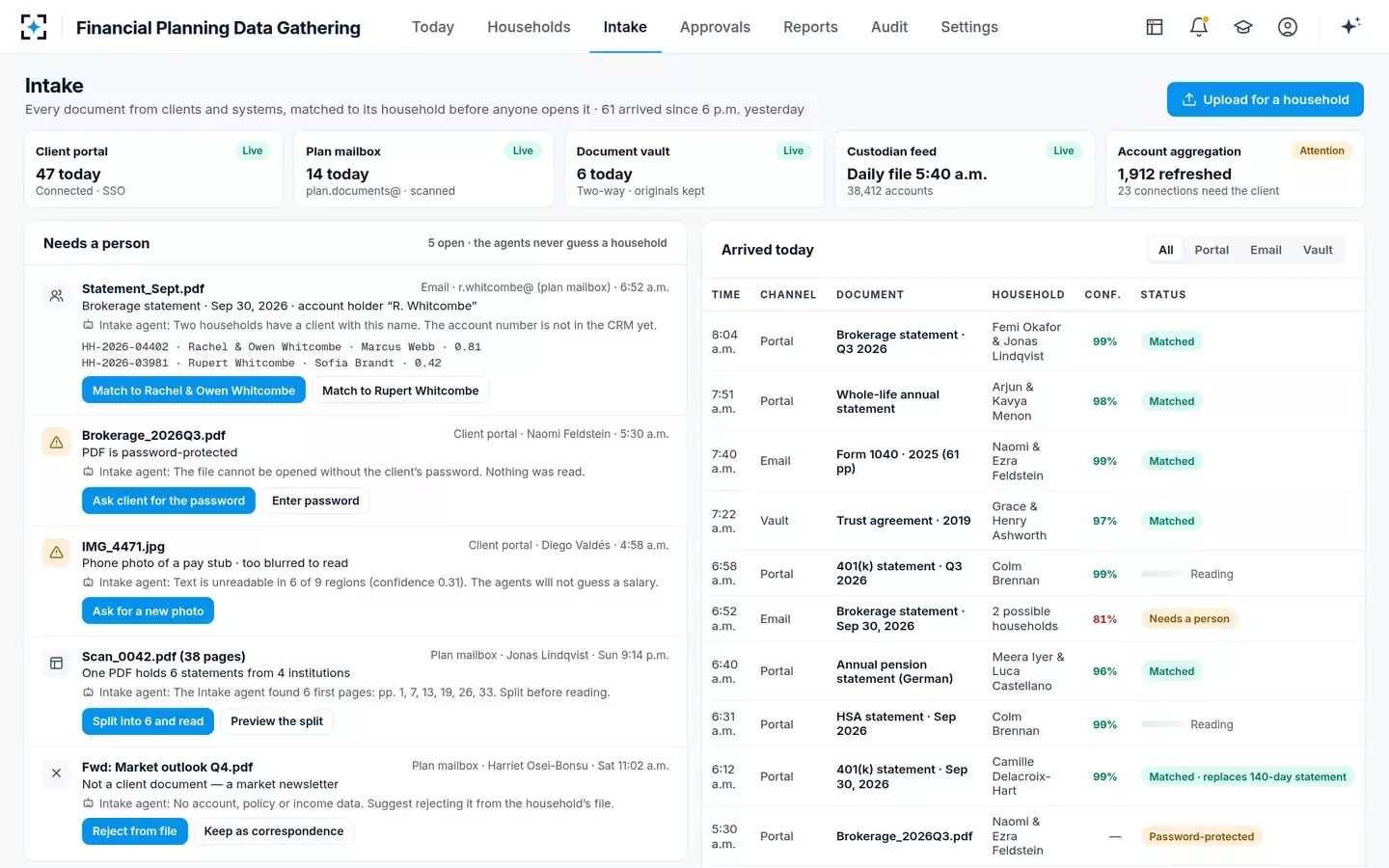
The value to a planning firm is currency between reviews. A linked 401(k) can show this week's balance rather than last quarter's, and a linked bank account can show cash that a plan meeting would otherwise miss. In the sample firm's intake screen, the aggregation channel had refreshed 1,912 connections that morning, while 23 were flagged because they needed the client to act.
Aggregation as one channel among five: refreshed connections, and the ones that need the client
What does account aggregation miss?
Whatever the client does not link, whatever the provider cannot reach, and whatever is not an account. The first is a consent problem: a client may link a bank account and not an old employer plan, or not link at all. The second varies by provider and changes over time, so the only reliable answer is a test on the firm's own households. The third is structural: an insurance policy's annual statement, an equity award summary, a will, a tax return and a foreign contract's yearly valuation are documents, not feeds.
The US data-access rule sharpens the point. The CFPB's 2024 rule applies to a “covered consumer financial product or service”, defined as a Regulation E account, a Regulation Z credit card, or facilitating payments from either (12 CFR 1033.111(b), as adopted in 2024). That is checking, savings and card data. Brokerage accounts, retirement plans, insurance contracts and equity award accounts are outside its definition, so a right to that data, where it exists, comes from the institution's own terms rather than the rule.
About a tenth of the sample household's held-away money sat in the deposit accounts the 2024 rule covers
Where the US data-access rule stands
The rule is in reconsideration, which is another reason not to plan a data strategy around it. The CFPB proposed it in October 2023, adopted it in November 2024, and on August 22, 2025 published an advance notice seeking comment on four issues, among them who may act as a consumer's representative, fees, data security and data privacy (CFPB, Federal Register, August 22, 2025). The most recent Federal Register action on the rule is that advance notice.
The CFPB's personal financial data rights rule, dated
| Date | Action | What it means for advisors |
|---|---|---|
| October 31, 2023 | Proposed rule published | A first draft of a US right to account data |
| November 18, 2024 | Final rule published (89 FR 90838) | Covers Regulation E accounts, Regulation Z credit cards and payment facilitation; investment and insurance accounts are outside the definition |
| August 22, 2025 | Advance notice of proposed rulemaking: reconsideration | Representatives, fees, data security and privacy reopened for comment; terms may change |
How current is aggregated data?
As current as the last successful refresh, which is the strength and the trap. A working connection can be more current than any statement; a broken one keeps showing its last balance without saying how old it is unless the system surfaces the date. The rule of thumb is the same as for documents: every line carries its as-of date, and a firm's staleness rule applies to feeds as well as statements.
Statements have the opposite profile. Their date is printed on the page and never drifts; where an adviser has custody, the rule requires a reasonable basis to believe the qualified custodian sends each client a statement “at least quarterly” (17 CFR 275.206(4)-2(a)(3)), and retirement plans and insurers send theirs on fixed cycles. In the sample household, two statements failed the firm's rules, a 403(b) at 111 days against a 90-day limit and a French contract at 292 days, and both went on the client request rather than into the plan unflagged.
Aggregation or statement reading: which does a planning file need?
Both, ranked. Aggregation keeps linked accounts current between reviews; statements complete the household and prove the figures. The decision that matters is which source wins when they disagree, and that should be a written rule, not a paraplanner's habit.
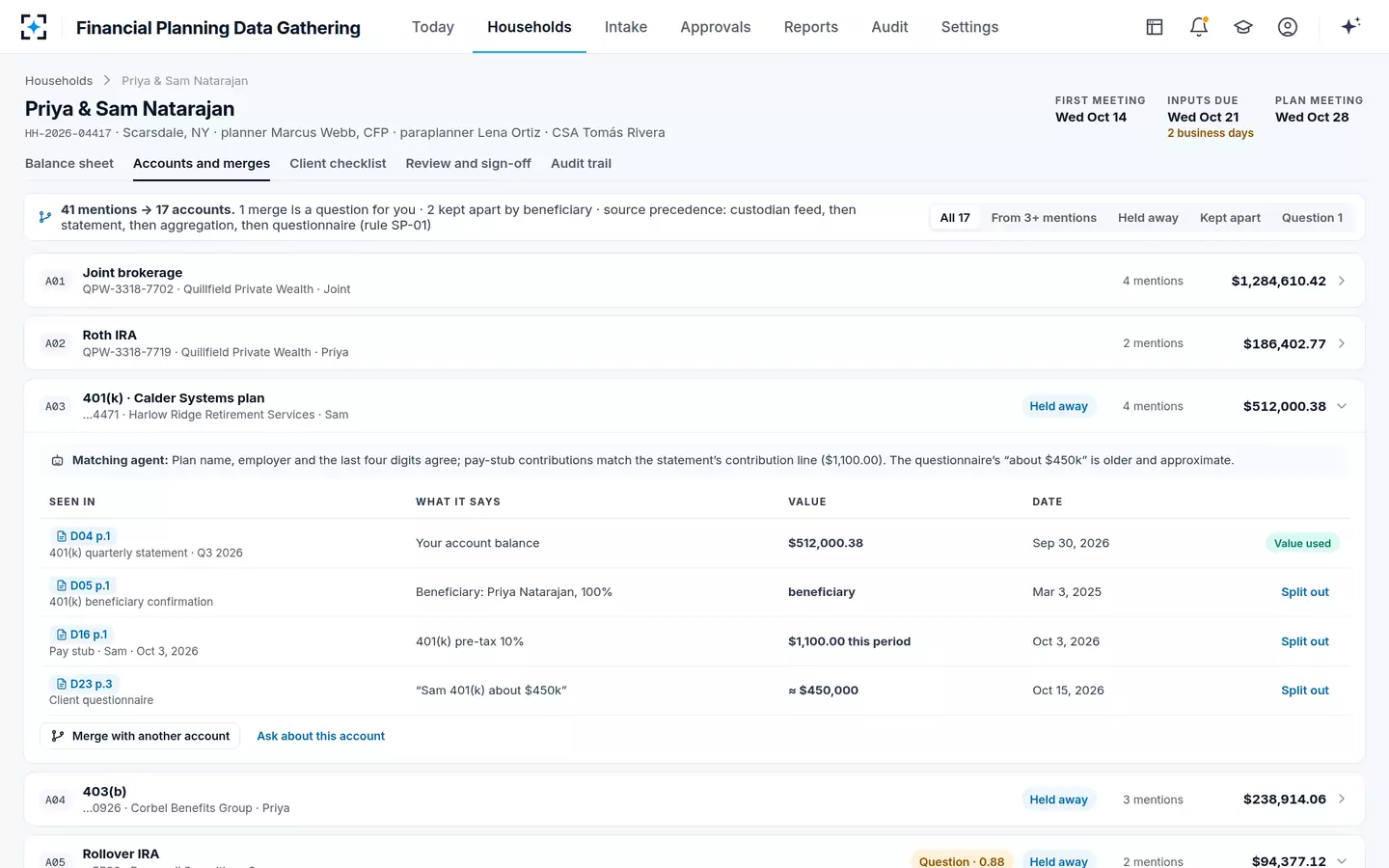
The sample firm's rule ranks the custodian feed first, then the statement, then aggregation, then the questionnaire. It is one reasonable choice, favouring the document with a printed date over a feed whose refresh may have failed; a firm that trusts its aggregation provider's history might rank them the other way for linked accounts. Either way, the rule is a setting with a version and a second approver, and every line on the balance sheet shows which source won. The held away assets guide covers the other routes to held-away data, and the financial planning balance sheet guide shows the sheet the rule produces.
The precedence rule at work: one account, several sources, one value used
Questions to ask account aggregation service providers
FINRA's investor guidance gives a list that works as well for a firm as for an individual, and a planning firm should add a few of its own. Ask them in writing, and test the answers on a sample of the firm's own households.
Ten questions for any account aggregation service provider
- Interface or screen scraping, institution by institution?
FINRA asks investors to understand whether connections “come from screen scraping, API or both.” An interface lets access be authorised without handing over credentials; scraping needs them.
- Do you store clients’ credentials, and where?
FINRA: if the aggregator scrapes, “does it store your credentials?” A store of passwords is a target; ask how it is protected.
- Will you access only the data needed for the service?
FINRA asks whether the aggregator will “access only the information it needs to provide the desired service.”
- Can you sell or share the data?
In FINRA’s words: “Can the aggregator sell your data to a third-party entity?”
- What liability do you bear for a loss?
FINRA asks what liability, if any, the aggregator bears and whether it can compensate consumers.
- How does a client revoke access?
FINRA notes that stopping access may involve more than deleting the app.
- Which of our households’ accounts can you actually reach?
Run your own sample: plans, IRAs, banks, insurance, award accounts, foreign accounts.
- How do we see a broken connection and its last good date?
Every balance should carry its as-of date, so staleness rules can apply to feeds.
- How much history do you keep, and can we export it?
Your records obligations do not stop when a connection does.
- Will your terms meet our Regulation S-P service-provider requirements?
Including notice to the firm within 72 hours of a breach of a customer information system you maintain.
Credentials, consent and data security
A firm that uses aggregation takes on a service provider that holds some of its clients' most sensitive data, and the rules treat it accordingly. FINRA warns that “Many data aggregators might operate under limited regulatory oversight” (FINRA). Under the SEC's amended Regulation S-P, a covered firm's policies must oversee service providers and require them to notify the firm no later than 72 hours after becoming aware of a breach affecting a customer information system they maintain (17 CFR 248.30), and the SEC's examiners have said they will look at how firms oversee their service providers when they review response programs (SEC, fiscal 2027 priorities).
Statement reading carries its own duties, since the documents are customer information too, but it does not require anyone to hold a client's passwords. That is one reason the sample firm treats documents as the base of the household file and aggregation as a way to keep linked accounts current.
Where Financial Planning Data Gathering fits
It does not replace an aggregation provider; it uses one. Account aggregation is one of the systems the solution works with, supplying linked held-away accounts and the list of connections that need the client. The agents read everything else from documents, match aggregated accounts to the same accounts seen in statements and pay stubs, apply the firm's precedence and staleness rules, and put the result on a household balance sheet where every line shows its source, date and page. For the sample household that was eleven held-away lines, $1,609,813.51, ranging from a 401(k) to a French insurance savings contract no feed would carry.
People still decide: the paraplanner settles open lines and signs, and a different person approves the push to the planning software, where every field is read back. The overview of Financial Planning Data Gathering follows the household through it.
Questions people ask
What is an account aggregation service?
A service that, with the account holder's permission, collects balances, holdings and transactions from accounts at several institutions into one place. FINRA describes it as putting information about your financial holdings under one roof, through either an interface or screen scraping with your login credentials.
Is account aggregation safe?
It depends on the provider and the method. Interfaces avoid sharing credentials; screen scraping requires them and concentrates risk. FINRA notes that many aggregators operate under limited regulatory oversight, and an SEC-registered firm that uses one must oversee it as a service provider under Regulation S-P, including 72-hour breach notice to the firm.
Can account aggregation see life insurance policies?
Do not assume so. Coverage varies by provider and institution, and the CFPB's 2024 data-access rule covers deposit accounts and credit cards, not insurance contracts. For planning, the annual policy statement remains the reliable source for cash value, loans and the death benefit.
Does the CFPB's open banking rule cover brokerage and retirement accounts?
No. The 2024 rule defines covered products as Regulation E accounts, Regulation Z credit cards and payment facilitation, and the CFPB reopened the rule for reconsideration with an advance notice on August 22, 2025. Brokerage, retirement and insurance data access depends on institutions' own arrangements.
Do advisors still need statements if they use aggregation?
Yes, for every account the client does not link or the provider cannot reach, and as evidence with a printed date. Retirement accounts alone were held by 54.3% of US families in 2022, in the Federal Reserve's survey, and many sit in employer plans a client may never link.