A financial planning fact finder is the form a planner uses at the start of an engagement to collect the facts a financial plan rests on: who is in the household, what they earn, every account they hold, their insurance, debts, property and estate documents, and their goals and tolerance for risk. The hard part is not the form. It is that most answers arrive from memory, months out of date or rounded, and someone then has to re-key the real figures from a shoebox of statements. Botminds' Financial Planning Data Gathering exists for that second step: its agents read the household's statements, pay stubs, policies and tax return into the planning inputs, each value cited to its page, so the fact finder can ask the client for documents instead of numbers.
The pages below annotate a fact finder the way a paraplanner would use it: section by section, with the document that confirms each answer and the rule that makes the answer matter. The worked examples come from the solution's sample household, Priya and Sam Natarajan, a fictional couple whose 23 documents run through it; the rules are quoted from the SEC, FINRA, the IRS and the Federal Reserve.
What a fact finder has to reach, by rule and by household
9
named factors in the Reg BI investment profile, “other investments” among them
36months
longest interval at which a broker-dealer re-sends the customer account record
54.3%
of US families held a retirement account in 2022
16.1%
held cash value life insurance, a line many forms skip
What is a financial planning fact finder?
A fact finder is the structured list of questions, and usually the document request that goes with it, that turns a first meeting into the inputs of a financial plan. Firms call it a fact find, a data gathering form, a client intake form or a financial planning questionnaire; the content is the same family of questions. What differs is whether each question is answered by the client's recollection or by a document the firm can cite later.
For a broker-dealer the profile it builds has a regulatory shape. Regulation Best Interest lists nine factors the retail customer investment profile must at least include: the customer's age, holdings elsewhere (“other investments”), financial situation and needs, tax status, objectives, experience, time horizon, liquidity needs and risk tolerance, plus anything else the customer discloses (17 CFR 240.15l-1(b)(2)). FINRA's know-your-customer rule asks members to use reasonable diligence to know and keep the essential facts about every customer, at opening and for as long as the account is maintained (FINRA Rule 2090). An investment adviser writing a plan works under its fiduciary duty rather than Reg BI, but the facts it needs to give suitable advice are the same list.
The account record rule adds a clock. A broker-dealer's record for each natural-person account holds name, tax identification number, date of birth, employment status, “annual income, net worth (excluding value of primary residence), and the account's investment objectives,” and the firm sends the customer a copy within thirty days of opening and again at least every thirty-six months (17 CFR 240.17a-3(a)(17)). A fact finder is therefore not a one-off form: it is the first version of a profile that has to stay current.
What does a fact finder include? Fourteen sections, and the document that confirms each
A complete financial planning fact finder covers fourteen areas, and thirteen of them have a document that can stand in for the client's answer. The fourteenth, goals and attitude to risk, is the only part that genuinely has to come from conversation, which is a good reason to spend the meeting there.
Fourteen sections of a fact finder, each with the paper that replaces the answer
- People and key dates
Names, dates of birth, dependants, marital status, residency. Confirm from account titles and the tax return’s filing status and dependants; dates of birth drive retirement-account and benefit ages.
- Employment and income
Employer, salary, bonus, other income. Confirm from the two latest pay stubs and the W-2; the Form 1040 shows every income type in one place.
- Cash and bank accounts
Checking, savings, money market, CDs. Confirm from bank statements; Schedule B names each payer when taxable interest and dividends exceed $1,500.
- Taxable investment accounts
Brokerage and advisory accounts. Confirm from the latest statement; where an adviser has custody, the rule expects the qualified custodian to send one at least quarterly.
- Employer retirement plans
401(k), 403(b), 457(b), pensions. Confirm from the plan’s quarterly statement; W-2 box 12 codes D, E and AA show the deferrals that prove the plan exists.
- IRAs
Traditional, Roth, rollover, inherited. Confirm from the IRA statement; Form 5498 reports each IRA’s value at December 31.
- Education and health accounts
529 plans and HSAs. Confirm owner and beneficiary from the plan statement; W-2 code W shows employer HSA contributions.
- Equity compensation
RSUs, options, ESPP. Confirm vested and unvested units, grant and vesting dates from the award summary, never from the pay stub alone.
- Insurance
Life, disability, long-term care, umbrella. Confirm face amount, cash value, loans and owner from the annual policy statement; term policies from the policy schedule.
- Debts
Mortgage, home equity, auto, student, cards. Confirm rate, term and principal from the statement and note; a payoff figure includes interest and is a different number.
- Real estate and other assets
Home, rental, business interests. Confirm from a property tax bill, appraisal or valuation; a client estimate stays marked as one.
- Estate documents
Wills, trusts, powers of attorney, beneficiary designations. Confirm by collecting the documents and the beneficiary confirmations on each account.
- Foreign assets
Accounts, pensions and insurance contracts abroad. Confirm from the statement in its own language, with the exchange rate and its date; Schedule B Part III asks about foreign accounts.
- Goals, horizon and risk tolerance
The one section with no document. Ask factual, specific questions and record the answers as the client’s.
Read down the right-hand column and a pattern appears: the fact finder's job is less to collect numbers than to collect the right documents and say which one wins when two disagree. A balance typed from memory is a lead, not an input. The Federal Reserve's Survey of Consumer Finances makes the breadth concrete. In 2022, 98.6% of families held a transaction account, 54.3% a retirement account, 21% stocks held directly, and 16.1% cash value life insurance (Federal Reserve, October 2023). A planning household at the upper end of those ranges brings most of the categories at once.
Why does the tax return belong at the top of the request list?
Because the return is the one document that points to the others. A paraplanner who reads the Form 1040 and its schedules before the first meeting arrives with a map of the household's accounts and income, and can test every answer on the fact finder against it.
Schedule B is the clearest example. A filer must complete it if they “had over $1,500 of taxable interest or ordinary dividends” (IRS, 2025 Schedule B instructions), and it lists each payer by name, so a bank or brokerage account missing from the fact finder often shows up as a line of interest. Part III asks whether, at any time in the year, the filer had “a financial interest in or signature authority over a financial account located in a foreign country”. A “Yes” there is a foreign account the household may have forgotten to mention.
The W-2 does the same for workplace plans. Box 12 carries code D, “Elective deferrals under a section 401(k) cash or deferred arrangement (plan)”; code E for 403(b) salary reduction deferrals; code AA for designated Roth 401(k) contributions; and code W, “Employer contributions to a health savings account (HSA)” (IRS, 2026 W-2 and W-3 instructions). A deferral code with no matching plan statement in the shoebox is a held-away account still to be requested. For IRAs, the custodian files Form 5498 to report each account's fair market value at December 31, by May 31 of the following year (IRS, 2026 instructions for Forms 1099-R and 5498), which gives a dated year-end value to reconcile against.
What the tax documents tell a fact finder before the client answers
| Tax document | What it reveals | Section it confirms or challenges |
|---|---|---|
| Form 1040, Schedule B Part I and II | Each payer of interest and ordinary dividends, when the total exceeds $1,500 | Cash, bank and taxable accounts |
| Schedule B Part III | Whether the filer had a financial interest in, or signature authority over, a foreign account | Foreign assets |
| W-2 box 12, codes D, E, AA | Pre-tax and Roth deferrals into a 401(k) or 403(b) | Employer retirement plans |
| W-2 box 12, code W | Employer contributions to an HSA | Health accounts |
| Form 5498 | Each IRA’s fair market value at December 31, and contributions and rollovers | IRAs |
| Form 1099-R | Distributions from plans, IRAs and insurance contracts in the year | Retirement plans, IRAs, insurance |
Financial planning data gathering form, intake form, fact finder: is there a difference?
In practice the three names describe one tool at different stages. An intake form is usually the short first contact: names, contact details, the reason for the meeting and the firm's disclosures. A financial planning data gathering form or fact finder is the long version that feeds the plan. A financial planning questionnaire, in the narrow sense, is the part that asks about goals, values and risk.
What matters more than the label is how each section is answered. A form that asks “What is your 401(k) balance?” invites a rounded guess. A form that asks for “your latest quarterly 401(k) statement” gets the balance, the date, the contribution rate, the investment options and often the beneficiary in one upload. The financial planning questionnaire guide shows why even a completed questionnaire should be treated as the client's view rather than the final figure, and what European supervisors say about leaning on self-assessment.
Two ways to write the same fact-finder question
Asks for a number: “Approximate 401(k) balance?” The answer is rounded and of unknown date.
Asks for the document: “Upload your latest quarterly plan statement.” Balance, as-of date, contribution rate and plan name in one page.
Asks for a number: “How much life insurance do you have?” Most clients give the death benefit.
Asks for the document: “Your most recent annual policy statement.” Death benefit, cash value, loans and owner, each on its own line.
Asks for a number: “Mortgage balance and rate?”
Asks for the document: “Latest mortgage statement and the note.” Principal, rate, payment, maturity and any escrow.
Asks for a number: “Value of company stock?”
Asks for the document: “Your award summary from the plan administrator.” Vested and unvested units, with dates.
Asks for a number: “Any accounts abroad?” Often answered “no” by people who hold one.
Asks for the document: “Statements for any account or insurance contract outside the US, in the original language.”
What to bring to a financial planner: the list from the client's side
Clients search for this list as often as planners do, and the answer is shorter than most checklists: bring the latest statement for every account, the last tax return, recent pay stubs, every insurance policy's annual statement, loan statements, and any wills or trusts. Everything else follows from those.
A useful list for clients says three things a generic one does not. First, the latest statement, not any statement: a plan built in October on a June balance is four months stale before it starts. Second, all pages: the beneficiary, the policy loan or the contribution rate is often on page two or three. Third, accounts held elsewhere, including old employer plans and anything abroad, because those are the ones the planner's own systems cannot see, the subject of the guide to held away assets.
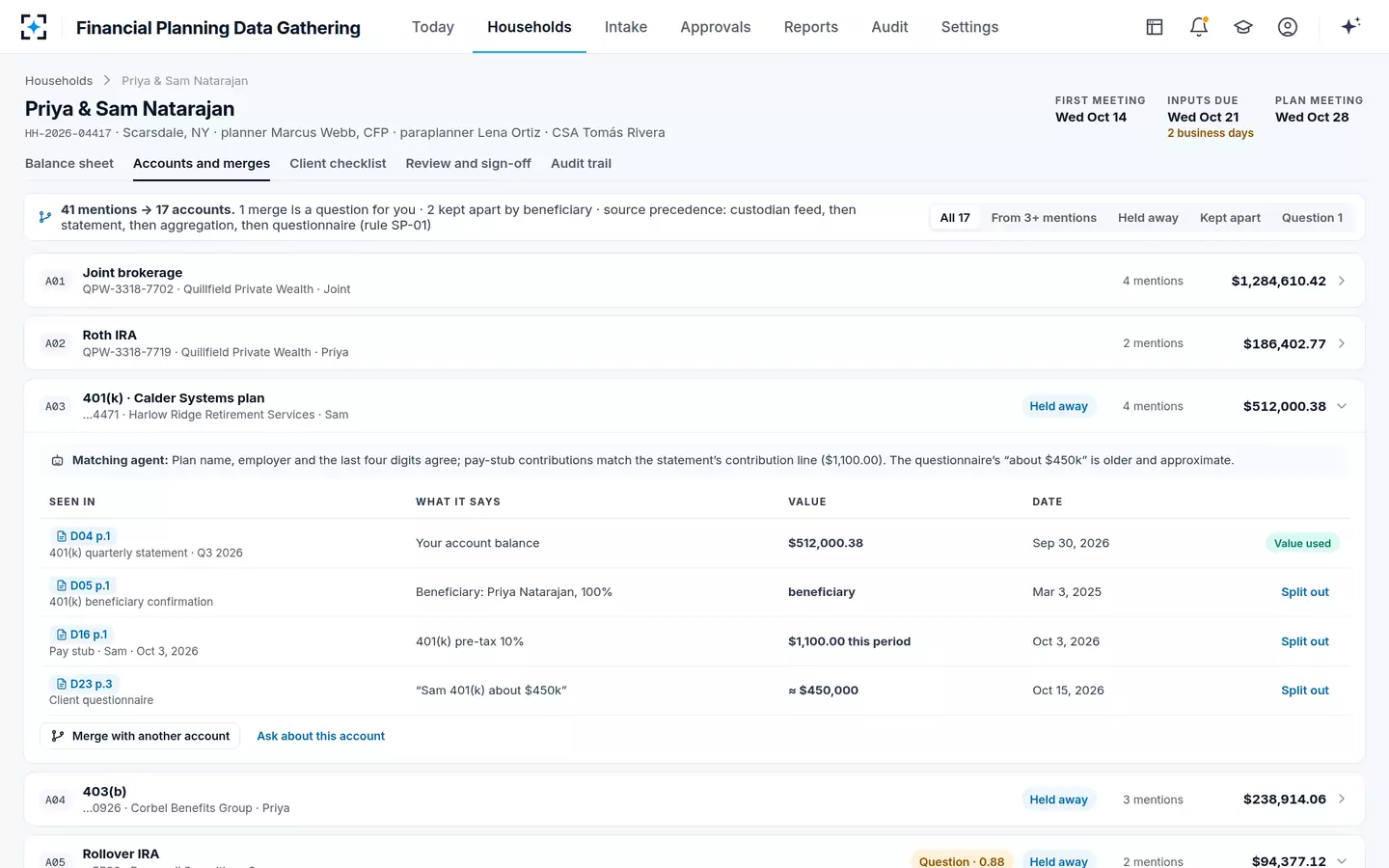
The sample household shows why. Priya and Sam Natarajan sent 23 documents over four days, 19 through the client portal and 4 by email, one of them a French insurance savings statement. Among them were an older copy of the joint brokerage statement, a 401(k) beneficiary confirmation from 2025, and a client questionnaire that said “about $450K” for an account whose statement showed $512,000.38. Nothing was missing in the sense of a blank field. Several things were simply older or rougher than the documents that replaced them.
One 401(k), four mentions: the statement wins and the questionnaire is kept as a note
How current does each document have to be?
Each firm sets its own staleness rules, and it should write them down, because “latest statement” means different things for different documents. Investment statements are issued at least quarterly where an adviser has custody (17 CFR 275.206(4)-2(a)(3)), so a statement more than about three months old has usually been replaced. Insurance carriers report once a policy year, so an annual statement can be current at eleven months. Tax documents are annual by design.
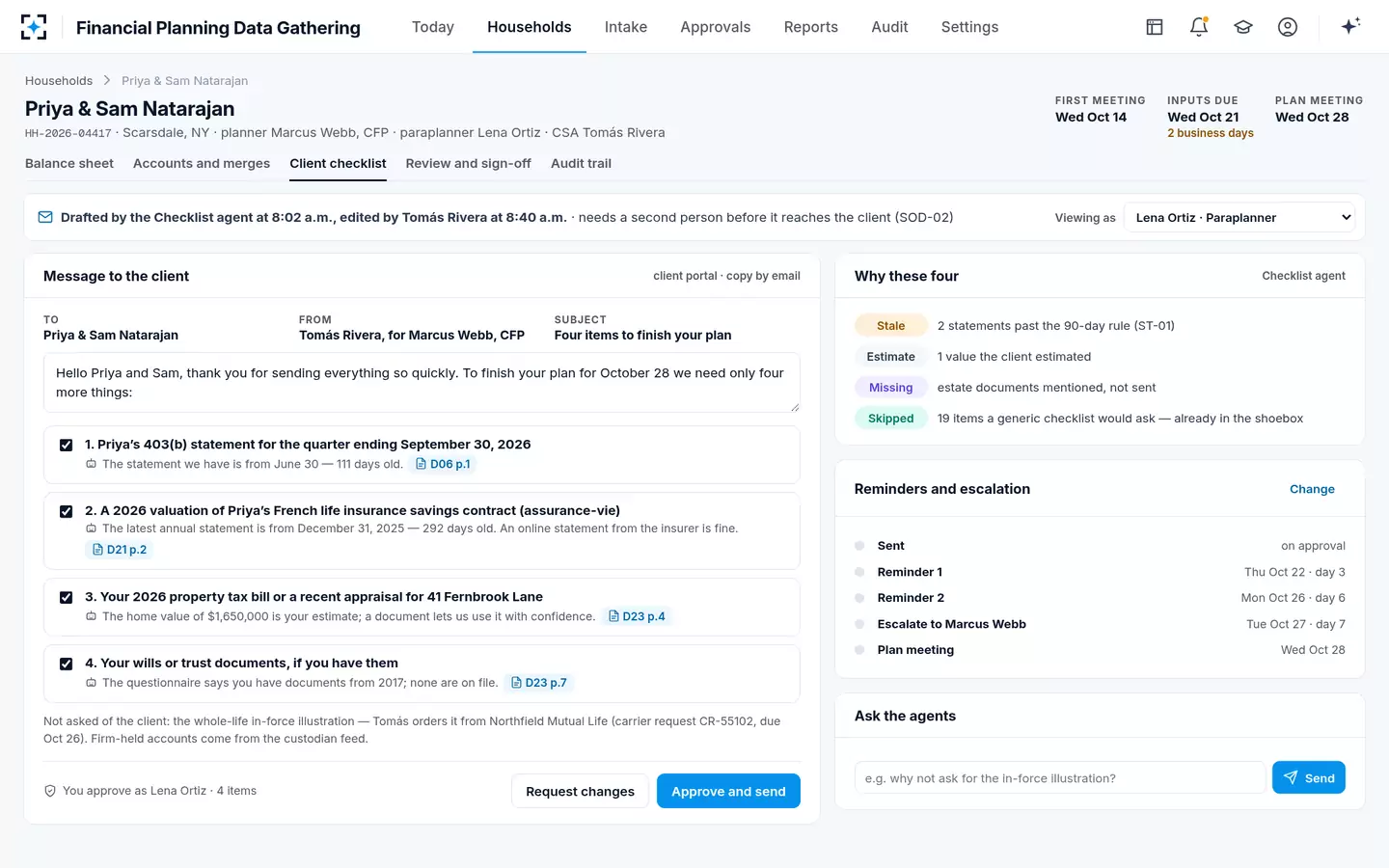
The sample firm in Financial Planning Data Gathering treats investment statements as stale after 90 days and insurance annual statements after 13 months, raised from 12 because carrier anniversary statements can arrive late. On those settings, two of the Natarajans' documents failed: a 403(b) statement dated June 30, 111 days old on the Monday it was read, and the French insurance savings statement, 292 days old. Both went on the client request; the whole-life statement, 99 days old, passed. These are a firm's choices, not a regulatory standard, and the point is that they are explicit and versioned, so the next reviewer applies the same test.
A staleness rule for each document type, written down
| Document | Issued | A reasonable test at the plan date | If it fails |
|---|---|---|---|
| Brokerage, advisory, IRA statement | Monthly or quarterly | Within one statement cycle; the sample firm uses 90 days | Ask for the latest, or use the custodian feed where the firm holds the account |
| Employer plan statement | Quarterly, through the plan’s website | Within 90 days | Ask the client to download the current quarter |
| Life insurance annual statement | Once a policy year | Within the last policy year; the sample firm uses 13 months | Ask the carrier for a current statement or an in-force illustration |
| Pay stubs | Each pay period | The latest two | Use the W-2 for annual pay; ask for a current stub |
| Tax return | Annually | The last filed year | Use the prior year and note the gap |
| Property value | Tax bill yearly; appraisal ad hoc | Mark the source and date | Keep the client’s estimate, labelled as an estimate |
Where does each fact-finder answer go in the plan?
Every section feeds a specific part of the planning software, and knowing which part tells a paraplanner how precise the answer has to be. A rounded salary is harmless in a long-range retirement projection and wrong in a tax projection. A missing beneficiary does not change net worth and does change the estate analysis. The overlap with a broker-dealer's own account record, which carries some of the same fields under FINRA and SEC rules, is mapped in FINRA Rule 4512 customer account information.
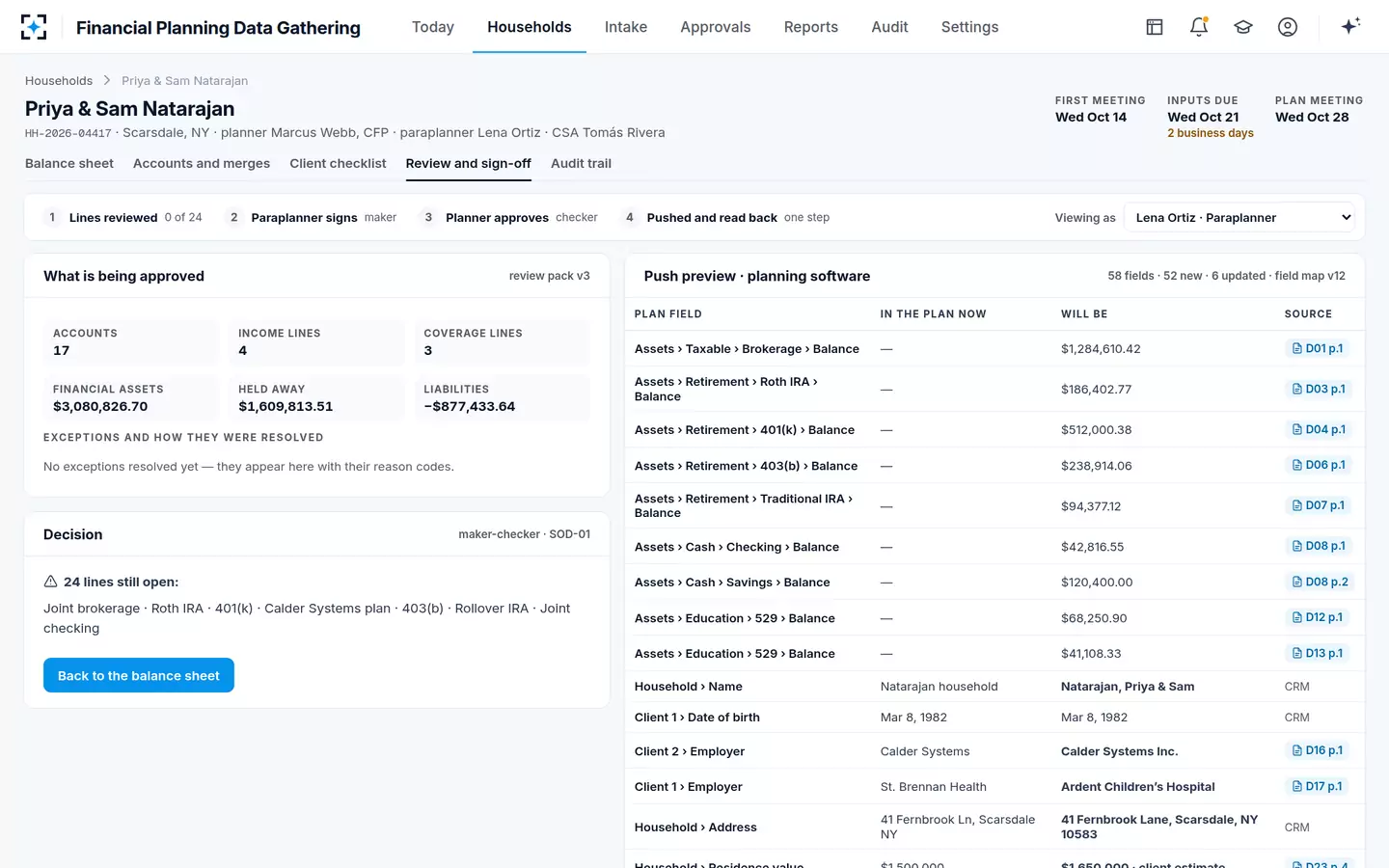
The sample household's plan inputs show the shape. Once the paraplanner signed and the planner approved, 58 fields went to the planning software: 52 new, 6 updated. The six updates are the instructive ones: an employer name that had changed since the CRM was last touched, a residence value the clients estimated at $1,650,000 against $1,500,000 on file, and similar drift. None would have been caught by a fact finder that asked only for what was missing, because none of the old values were blank. They were simply no longer true, which is the case the financial planning balance sheet guide works through line by line.
The push preview: each field, its value now, its new value and its source page
How Financial Planning Data Gathering uses the fact finder instead of replacing it
The solution keeps the firm's fact finder and questionnaire as one source among many and moves the re-keying to agents. An Intake agent sorts each upload to its household and splits combined PDFs; an Extraction agent reads every balance, contribution, policy value and loan term with its page; a Matching agent merges the same account seen on several documents and says why; a Checker agent re-reads independently and applies the staleness rules. For the Natarajans that was 112 values read and 41 account mentions merged into 17 accounts.
The fact finder's last job, asking the client for what is still missing, also changes. Instead of a generic list, a Checklist agent drafts a request for only what is missing, stale or estimated. For the sample household it asked for four things and skipped nineteen a generic list would have asked for, because they were already in the shoebox. A person approves every client message before it goes, and the household is re-run when the client uploads.
Four items, not thirty: the request that replaces the generic checklist
What stays with people is everything that is a judgement: which of two conflicting values is right, whether a client's estimate is good enough for this plan, and whether the inputs are ready. The Financial Planning Data Gathering overview shows the full sequence for one household, from the shoebox to the read-back.
Questions people ask
What is a fact finder in financial planning?
It is the form, or set of forms, a planner uses to collect a household's personal details, income, assets, debts, insurance, estate documents, goals and risk tolerance before building a plan. Under Reg BI the resulting investment profile includes at least nine named factors, from age and other investments to liquidity needs and risk tolerance. The most useful versions ask for the document behind each answer.
Should the home go on the fact finder?
Yes, as a planning asset with its source and date, but keep it apart from the investable picture. The SEC's account record rule asks broker-dealers for net worth “excluding value of primary residence”, so a fact finder that records the home separately can produce both numbers without re-asking the client. A client's estimate of the home's value should stay labelled as an estimate until a tax bill or appraisal arrives.
What documents do financial planners need?
The latest statement for every bank, brokerage, retirement, 529 and HSA account; the last filed tax return with schedules; two recent pay stubs; the annual statement for each life policy and the schedule for term cover; mortgage and loan statements; equity award summaries; and wills, trusts and beneficiary designations. Statements for accounts and insurance held abroad belong on the list too, since Schedule B asks every filer about foreign accounts.
How long should a fact finder take to complete?
No regulator or independent study publishes a standard time, and it depends on how many accounts a household holds. A firm can measure its own: log when the request goes out, when each document arrives and when the last value is confirmed. In the sample firm's own estimate, more than a third of its 16-day baseline was waiting on the client after the request list went out.
How often should a fact finder be updated?
At every material life change and at least on a fixed cycle the firm sets. For broker-dealer accounts, the SEC's account record rule requires the firm to send the customer a copy of the account record at intervals of no more than 36 months, which is a sensible outer limit for a full refresh.
Can a fact finder be filled in automatically from statements?
Most of it can be, because thirteen of the fourteen sections have a confirming document. Financial Planning Data Gathering reads those documents into the inputs with each value cited to its page; goals and risk tolerance still come from the conversation, and a paraplanner and a planner approve before anything reaches the planning software.