Consultant relations in asset management comes down to two duties: keep the firm known, accurate and trusted at the investment consultants who advise pension plans and other institutions on which managers to hire, and learn about their manager searches before competitors do. The seat sits between institutional sales, the RFP team, product specialists and sales compliance. What makes it hard is timing: a search is usually set in motion in a pension board's public minutes months before any RFP appears, and contact with a government plan is regulated from the first call. Botminds' RFP Tracking was built for that gap. Its agents read the board documents of the plans a team covers, forecast each coming manager search with the page it came from, and leave every pursuit decision and every contact with a government plan to people.
The examples below come from the solution running on fictional sample data: Quillfield Capital, a fictional manager, and the plan sponsors, consultants and people around it.
The seats are small; the money they move is not
1,518
SEC-registered advisers reporting direct state or municipal government clients on Form ADV
4,372
US state and local defined benefit public pension systems counted by the Census Bureau in 2025
What does consultant relations do in asset management?
Consultant relations manages an asset manager's standing with investment consultants, the firms that pension plans, endowments, foundations and insurers hire to set an asset allocation and recommend managers. When a consultant's research team rates a strategy, puts it on a shortlist or leaves it off, the consultant relations team is the firm's voice in that room. It schedules the research meetings and on-site due diligence visits, answers follow-up questions, makes sure the consultant's database holds current figures, and tells the firm's sales and product people what each consultant is looking for.
The SEC described the other side of that relationship in a 2005 staff examination of pension consultants. Consultants advise plans on matters including "selecting money managers to manage plan assets in ways designed to achieve objectives" and "monitoring performance of money managers and mutual funds and making recommendations for changes", and "Many pension plans rely heavily on the expertise and guidance of their pension consultant in helping them to manage pension plan assets" (SEC staff report, May 16, 2005). The same report counted about 1,742 SEC-registered advisers that said they provided pension consulting services, as of November 2004. A manager that sells to institutions therefore sells, much of the time, through a gatekeeper it does not pay and cannot instruct.
That is why the role is distinct from institutional sales. A sales director owns named plan relationships and closes mandates. Consultant relations owns the consultants who influence many plans at once, and its success shows up as searches the firm was invited into, and finals it reached, rather than as one client won.
Consultant relations duties, one by one
Most consultant relations roles carry six duties, whatever the title. The table sets each one against the seat it hands work to and what changes once agents read the public documents first; the descriptions are ours, written from the work rather than from any one firm's posting.
Six consultant relations duties, and where each one hands off
| Duty | What it involves | Hands work to | What agents change |
|---|---|---|---|
| Consultant coverage | Research meetings, due diligence visits, follow-up questions, the firm's story told consistently to each consultant. | Portfolio managers and product specialists | Nothing in the room. Preparation starts from what each consultant's plans have voted on lately. |
| Database accuracy | Quarterly profiles and questionnaires on consultant databases, every figure from an approved source. | The RFP and database team | A separate solution covers the profiles; this seat checks that the right strategies are listed. |
| Search intelligence | Knowing which plans are reviewing which asset classes, which managers are on watch, which searches are coming. | Distribution intelligence | The board documents of every watched plan are read overnight, each signal cited to its page. |
| Pursuit decisions | Choosing which searches to chase with which strategy, and which to pass on. | The RFP coordinator and sales directors | A proposal arrives with the motion, the size, the fit and a probability; a person approves with a reason. |
| Contact discipline | Knowing when a plan is in a quiet period and whether a contribution by anyone on the team blocks a call. | Sales compliance | Every planned contact is checked first; anything doubtful is held for compliance. |
| Reporting | Pipeline, lead time, searches missed and products the plans asked for that the firm lacks. | The head of distribution | Figures come only from approved pursuits, so the report can be defended. |
Two of these duties are where most of the friction sits, and neither is about relationships. Search intelligence is a reading problem: the signals are public, but scattered across thousands of board packets. Contact discipline is a timing problem: the rules that govern a call to a public plan depend on where that plan's search is, and on contributions anyone on the team may have made in the past two years. The rest of this page follows one search through the five seats that carry it.
Consultant relations team: the five seats around one manager search
A consultant relations team, in the broad sense, is the five people who touch a search between the first board signal and the RFP: the head of consultant relations, an RFP coordinator, a distribution intelligence analyst, someone in sales compliance and the head of distribution. Titles vary from firm to firm; the functions recur. Here they are as the solution's sample firm staffs them, on one emerging-markets debt search at a fictional $18.4 billion county plan.
Five seats around one manager search, before and after agents read the board documents
Today
Decides which searches to chase from alert emails and a pipeline with no source behind it, often after the RFP is out.
With agents
Starts the day on the decisions waiting, each with one next step, and approves or rejects with a reason code and the source page one click away.
Still theirs: The checker's signature on every pursuit, and the consultant relationship itself.
Today
Hears of a search when the RFP lands and builds the whole response inside its deadline.
With agents
Proposes a pursuit months earlier, with an owner, a date for the response materials and a consultant meeting request.
Still theirs: The proposal, and the response once the RFP is issued.
Today
Skims what a small team can of the plans' postings, in the languages the team happens to read.
With agents
Receives only the signals the checking agent was unsure of, with the original page beside the English and the reason it stopped.
Still theirs: The call on every low-confidence signal; nothing proceeds until it is made.
Today
Learns of a trustee dinner or a consultant meeting after it is booked, sometimes after it happened.
With agents
Sees every planned contact with a government plan checked against its quiet period and the contribution pre-clearance list, with the rule cited.
Still theirs: Clearing or declining every contact that was held.
Today
Reviews a pipeline that cannot be traced, with no view of the searches the shelf could not enter.
With agents
Reads lead time, forecast accuracy and product gaps built from approved pursuits only.
Still theirs: The second approval on any pursuit of $1 billion or more, and the product decisions the gaps argue for.
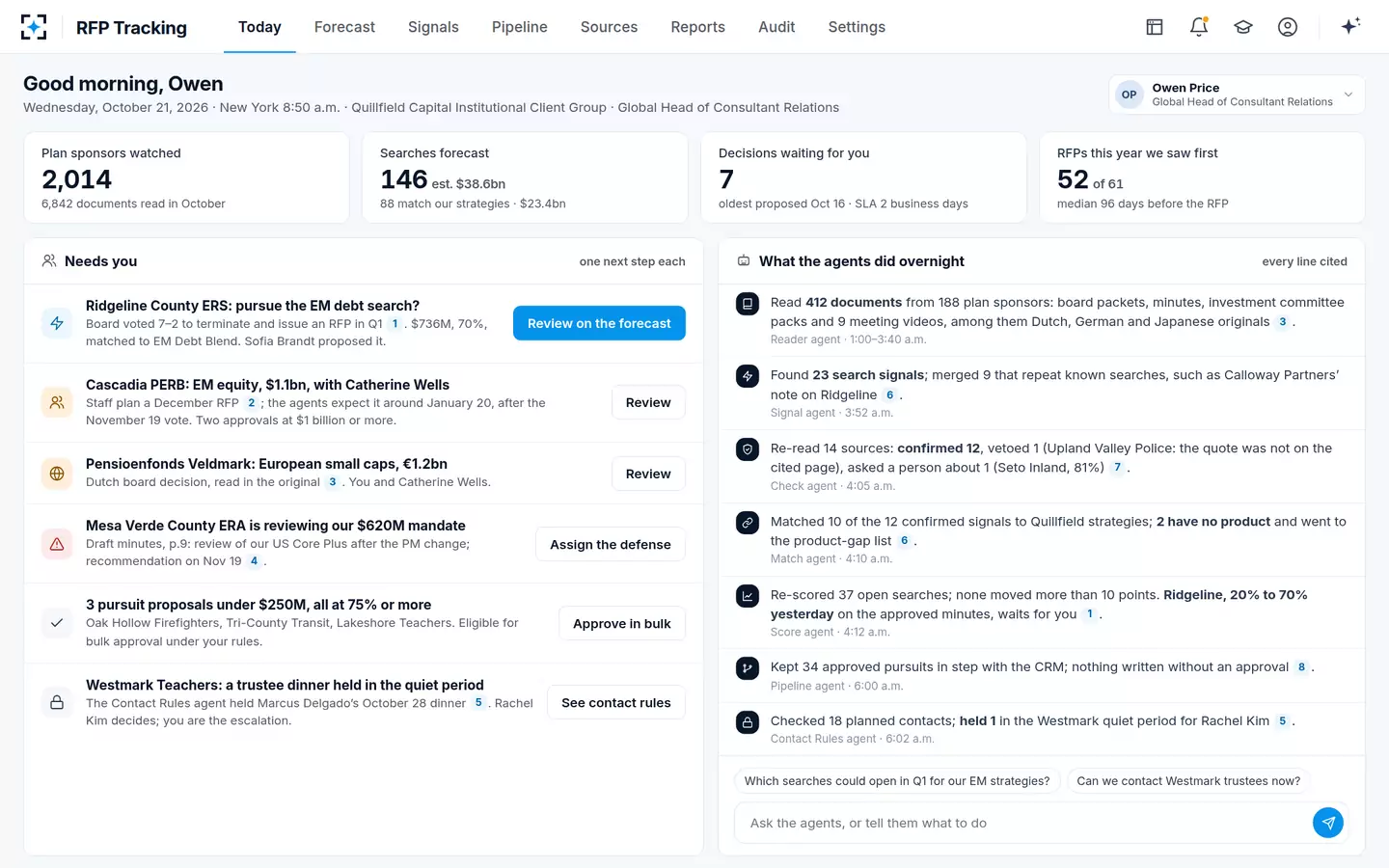
The figure shows what moves and what does not. Every seat that decides still decides: the head of consultant relations approves, compliance clears, the analyst confirms. What moves is the reading. The coordinator stops learning about searches from the RFP, and the analyst stops skimming everything to find the few pages that matter.
The head of consultant relations' morning: decisions first, the overnight reading beside them
Consultant relations analyst, manager and director: how the seats differ
The three titles usually mark scope, not a different job. A consultant relations analyst prepares: meeting notes, consultant questionnaires, competitor and search research, the pipeline report. What those questionnaires and profiles ask is set out in the guide to investment consultant databases. A consultant relations manager covers a set of consultants or a region and is the person a consultant's researcher calls. A director or global head owns the strategy across consultants, sits on pursuit decisions and answers to the head of distribution for which searches the firm entered.
In many firms a fourth seat does the analyst's search research under another name: distribution intelligence, market intelligence or sales analytics. The work is the same, and so is its limit. A two-person team that reads German but not Japanese cannot cover the board documents of two thousand plans, so it covers the largest plans and the consultants' announcements, and learns about the rest when the RFP is public.
One difference between the seats is regulatory. Whoever solicits a government plan, and whoever supervises that person, can bring the firm inside the SEC's pay-to-play rule, so the seat a person holds decides whether their political contributions are checked. That is the next section.
Is a consultant relations employee a covered associate?
Under the SEC's pay-to-play rule, often yes. A covered associate includes "Any employee who solicits a government entity for the investment adviser and any person who supervises, directly or indirectly, such employee", alongside executive officers and any political action committee the firm controls (17 CFR 275.206(4)-5(f)(2)). To solicit, in the rule's words, is "to communicate, directly or indirectly, for the purpose of obtaining or retaining a client for, or referring a client to, an investment adviser". A consultant relations manager who pitches a strategy for a public plan's search, and the head who supervises that manager, are squarely the people the definition describes; whether a given meeting with a consultant counts is a question for the firm's compliance team, and it is better asked before the meeting than after.
The consequence reaches hiring and promotion. As the SEC put it in its September 2026 proposal, "if an existing employee is promoted or transferred into a covered associate role, under the rule the firm must review the employee's political contributions from the previous six months or two years, as applicable" (91 FR 57698). The two-year look-back applies to people who will solicit; the six-month one to those who will not. A new consultant relations manager's contribution history is therefore part of onboarding, not an afterthought.
That proposal would rescind the rule, but it is a proposal: comments close on 9 November 2026 and the rule stays in force until a final rule is adopted. What the SEC proposed, and what applies in the meantime, is set out in its own guide.
Who knows first: why reading the minutes decides the calendar
The seat that reads first sets everyone else's calendar. A search usually starts with a board putting a manager on watch, a consultant presenting an asset-class review, or a vote to terminate or to fund a new allocation, and each of these is written into a public agenda, packet or set of minutes. The Census Bureau counted 311 state-administered funds and 4,061 locally administered systems in 2025 (Annual Survey of Public Pensions 2025). Their boards meet under state open-meetings laws; Virginia's, for one, says "Minutes shall be taken at all open meetings" and that they must include "a record of any votes taken" (Va. Code § 2.2-3707).
One search through the five seats, from board vote to an approved pursuit
Agent
Read and findReads the plan's posted minutes overnight, finds the motion to terminate and extracts body, date, vote, asset class and size, each with its page.
Never: logs in where a login is required, or contacts anyone.
Agent
Re-readA second agent opens the posted page itself and confirms the quote, the vote and that the minutes are approved, not draft.
Never: lets a forecast exist when the quote is not on the cited page.
A person decides
Distribution intelligence analystDecides any signal the checker scored below its confidence line, with the original language beside the English.
A person decides
RFP coordinatorProposes the pursuit: owner, strategy, consultant meeting, date for the response materials.
A person decides
Sales complianceClears or holds each planned contact against the plan's quiet period and the contribution pre-clearance list.
A person decides
Head of consultant relationsApproves or rejects with a reason code; a second approver joins at the firm's top size tier.
Agent
Write the pipelineOnly after approval, creates the opportunity in the CRM with the approval as its reference and sets a watch for the RFP.
Never: sends a meeting request; it drafts one for compliance to clear.
On the sample firm's books, the agents read 412 documents from 188 plan sponsors between 1:00 and 3:40 one October morning, and this year saw 52 of 61 relevant RFPs before they landed, a median 96 days earlier. Those are results on fictional data, not a customer's measurement; the way to test such claims on your own plans is in a back-test of RFP tracking tools on searches you already know. For the consultant relations seat, three months is the difference between a consultant meeting while the consultant is still drafting the RFP and a response written in the weeks after it is issued.
What agents change in each seat, and what they never do
Agents change where the hours go, not who signs. The solution's designers estimate that one public pension search takes a sales team about twelve working days by hand, from the first board signal to an approved pursuit in the CRM, and about two and a half with the agents reading first. That is an estimate, not a measurement, and the useful part is where the days go.
Where twelve working days go on one manager search, by hand
By hand: about 12 working days
- Finding the search, 5 d · 42%
- Reading and sizing, 2 d · 17%
- Picking the strategy, 2 d · 17%
- Contact checks, 1 d · 8%
- Approval and CRM, 2 d · 16%
With agents reading first: about 2.5 days
- Each step about half a day · 100%
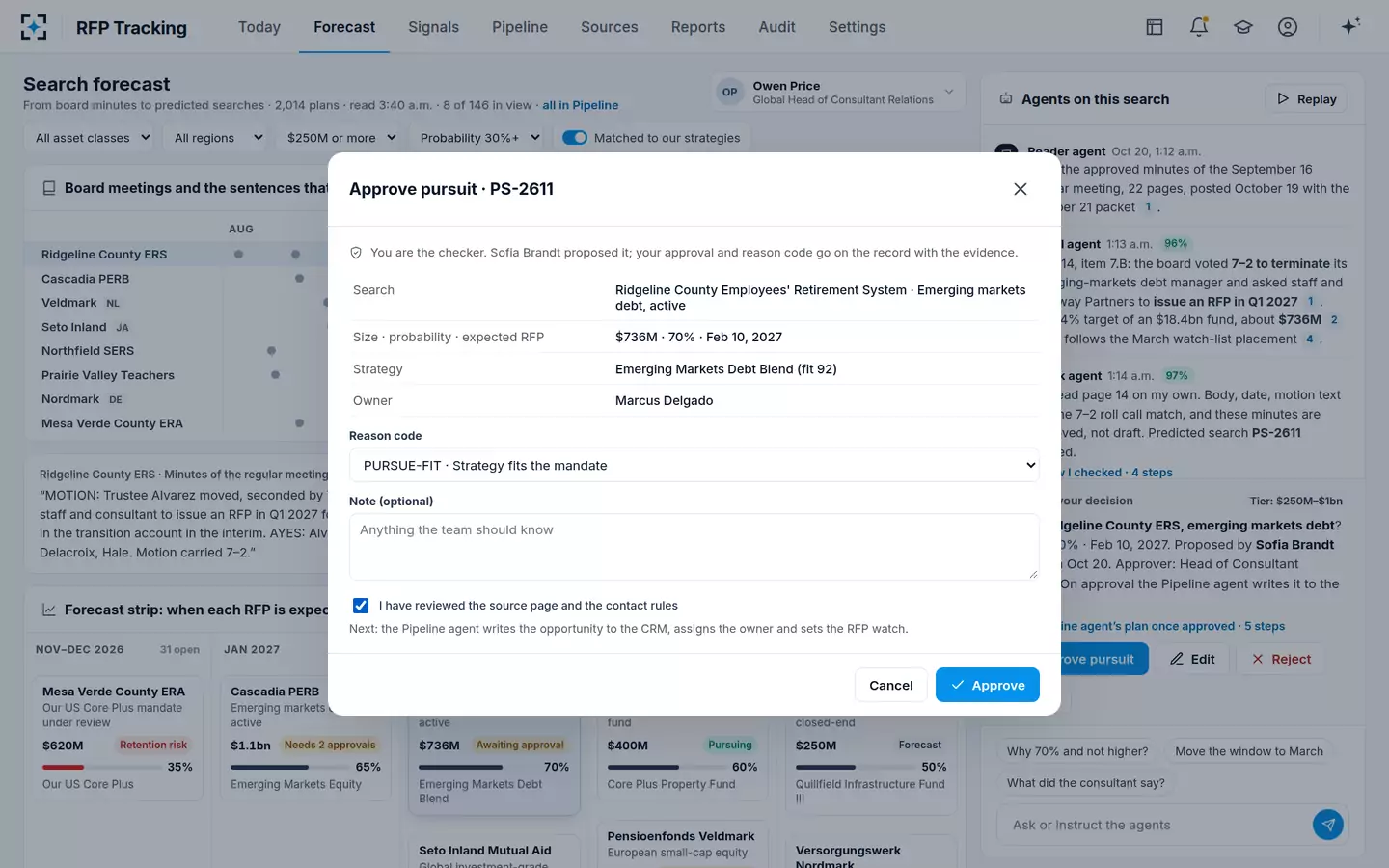
Finding the search is the largest block because it is the least visible: alert emails, trade lists and board packets, read in no particular order. The agents take that block almost entirely. The decisions do not shrink as much, and should not: contact checks still end with a person in compliance, and approval still ends with a named checker who ticks that the source page and the contact rules were reviewed.
The limits are written into each agent. The reading agent uses public sources only and never logs in. The checking agent can veto a signal but never approve a pursuit. The contact agent never clears a contact and never sends anything. The pipeline agent writes nothing to the CRM before approval and drafts, rather than sends, the consultant meeting request.
The checker approves: one pursuit, one reason code, one confirmation box
How to tell a strong consultant relations function from a busy one
A busy function counts meetings; a strong one can show when it learned of each search and why it chose to pursue or pass. Five questions separate the two, and each can be answered from a team's own files, with or without agents.
Five questions for a head of distribution reviewing consultant relations
- How many days before each RFP did we know?
Count from the first board signal you can date, not from the alert. Our guide to RFP win rate sets out why this beats win rate as a first measure.
- What share of relevant RFPs did we see before they were issued?
Only the RFPs your shelf could enter count; list the ones you missed and why.
- Was every contact with a government plan checked before it happened?
Quiet period and two-year contribution look-back, with the clearance on file.
- Does every pursue-or-pass decision carry a reason?
Without reasons, a pipeline cannot be audited and lost searches teach nothing.
- Which searches could the shelf not enter?
No product, no capacity, a fee floor: the product team needs the list, sized.
The first two questions are the economics of the seat, and they are worked through in why average RFP win rate is the wrong first KPI. The others are controls. To see the five seats working on one search, start from RFP Tracking.
Questions people ask
What does a consultant relations manager do?
A consultant relations manager covers a set of investment consulting firms for an asset manager: arranging research meetings and due diligence visits, answering their questions, keeping their view of the firm's strategies current and hearing about the searches their plan clients plan to run. Pension plans lean heavily on these consultants; the SEC's 2005 staff report said many plans "rely heavily on the expertise and guidance of their pension consultant".
What is the difference between consultant relations and institutional sales?
Institutional sales owns named client relationships and closes mandates. Consultant relations owns the consultants who influence many plans' choices at once. The two work the same searches from different ends: sales with the plan, consultant relations with the consultant who will write or shape the RFP.
How early can consultant relations hear about a search?
Often months before the RFP, because a public plan's search usually starts in its board's public minutes. In the fictional sample firm the agents saw 52 of 61 relevant RFPs before they were issued, a median 96 days earlier; that is a result on sample data, and a back-test on searches the firm already knows is the way to check it.
Does the pay-to-play rule apply to consultant relations staff?
It can. The rule's covered associates include any employee who solicits a government entity for the adviser and anyone who supervises that employee, so a consultant relations manager working a public plan's search and the head above them are typically inside it. The SEC proposed rescinding the rule in September 2026, but it remains in force until a final rule.
What should a firm expect of its consultant relations analysts?
The core skills are reading and judgment: finding a search in a board packet, sizing it from a target allocation, matching it to the right strategy and knowing when a signal is too weak to act on. Languages help, since many plans outside the US publish board decisions in their own language. The rest is writing for consultants who read many managers' answers to the same questions.