An RFP blackout period, also called a quiet period, silent period or restricted period, is the part of a public procurement during which bidders may contact only the people the issuer names, usually a procurement officer, and may not lobby trustees, staff or officials about the search. Its start and end are set by the plan's own procurement rules or by state law, and they differ. Florida's state procurement statute runs it from the release of the solicitation to 72 hours, excluding weekends and holidays, after the agency posts its notice of intended award. New York's procurement lobbying law starts it at the earliest posted notice of the solicitation and ends it at final contract award and approval. For an asset manager, the blackout is one of two clocks to check before every call, meeting or dinner with a government plan; the other is the SEC pay-to-play rule's two-year look-back on contributions. Botminds' RFP Tracking checks both for every planned contact and holds anything doubtful for sales compliance.
A contact check before every call, meeting or dinner with a government plan
A person decides
Request the contactThe salesperson or consultant relations manager logs who, which plan, when, and what about.
Agent
Find the plan's windowLooks up any open solicitation at the plan and the section of its RFP or policy that restricts contact, with its start and end.
Never: assumes a quiet period starts at the RFP; the plan's rule says when.
Agent
Check the personReads the firm's contribution pre-clearance list for the two-year look-back to officials of that government entity.
Agent
Check the channelIs the contact with a named procurement contact, in writing, or at a public event the solicitation allows?
Agent
Clear or holdMarks the contact clear, clear with conditions, or held with the rule and section cited.
Never: clears a held contact or sends anything.
A person decides
Sales compliance decidesDeclines, conditions or allows each held contact, with a reason, before the date.
What is an RFP blackout period?
An RFP blackout period is a rule of the procurement, not of the securities laws: it protects the fairness of a competitive selection by routing every bidder's questions through the same channel. Under it, a manager that has responded, or intends to, may not call a trustee, meet the chief investment officer or take a staff member to dinner to talk about the search. It may still submit its proposal, ask questions in writing and attend events the solicitation itself sets up.
The names vary with the issuer. Plans and their consultants say quiet period or silent period; Florida's statute does not name it at all but writes it into every solicitation; New York calls it the "restricted period". In practice the effect is the same: one door open, every other door closed, for a defined time.
The term means something else in other settings, and searchers often land in the wrong one. For a 401(k) or other individual account plan, a "blackout period" under federal pension law is a stretch of more than three consecutive business days in which participants cannot direct investments, take loans or take distributions, and the plan must give notice "at least 30 days, but not more than 60 days" in advance (29 CFR 2520.101-3). In listed companies, a trading blackout usually means a window in which insiders may not deal in the shares. Neither has anything to do with who may call a pension board during a manager search.
When does an RFP quiet period start and end?
It starts and ends when the plan's rules say, and the rules differ widely. Some quiet periods start with the RFP's release; some start earlier, with the first public notice that a solicitation is coming; and they end at the award, at the contract's approval or a set time after the notice of award. The table compares two state statutes with a plan's own RFP clause from the solution's sample.
Three blackout windows: when each starts, when it ends, and who may be contacted
| Florida state procurement | New York procurement lobbying law | A plan's own RFP (sample) | |
|---|---|---|---|
| Starts | At the release of the solicitation | At the earliest posting of the notice, advertisement or solicitation | When the RFP is issued: 2 October in the sample |
| Ends | 72 hours after the notice of intended award is posted, excluding weekends and state holidays | At final contract award and approval, and where applicable the state comptroller's | At award, under the RFP's section 2.6 |
| Who may be contacted | The procurement officer, in writing, or as the solicitation provides | Only the contacts the governmental entity designates, with listed exceptions | Only the named procurement officer |
| Consequence of a breach | May be grounds for rejecting a response | A finding of non-responsibility; a second within four years bars the bidder for four years | "Violation may disqualify" |
The New York definition shows why a team cannot assume the window opens with the RFP. Its restricted period begins "with the earliest posting, on a governmental entity's website, in a newspaper of general circulation, or in the procurement opportunities newsletter" of the notice or solicitation, and ends "with the final contract award and approval by the governmental entity and, where applicable, the state comptroller" (N.Y. State Fin. Law § 139-j(1)(f)). A notice of intent can precede the RFP itself, and an award can precede its approval by weeks.
"Respondents to this solicitation or persons acting on their behalf may not contact, between the release of the solicitation and the end of the 72-hour period following the agency posting the notice of intended award, excluding Saturdays, Sundays, and state holidays, any employee or officer of the executive or legislative branch concerning any aspect of this solicitation, except in writing to the procurement officer or as provided in the solicitation documents."
Fla. Stat. § 287.057(25), the provision every Florida state solicitation must include
Who may a manager contact during an RFP?
Only the people the solicitation names, through the channels it allows. Under New York's law, an offerer "shall contact only the person or persons who may be contacted by offerers as designated by the governmental entity" (§ 139-j(3)(a)), and the statute lists the exceptions: written proposals, written questions answered for all bidders, open conferences, negotiations after a tentative award, protests and responsibility reviews. Florida's version allows contact "in writing to the procurement officer or as provided in the solicitation documents".
During a quiet period: the channels that stay open, and the ones that close
Stays open under New York's list: Written questions to the designated contact, answered for all bidders.
Closes: A call to a staff member or trustee to "clarify" the scope.
Stays open under New York's list: Open bidders' conferences the solicitation sets up.
Closes: A one-to-one meeting or meal with anyone involved in the selection.
Stays open under New York's list: The written proposal, and negotiation after a tentative award.
Closes: Lobbying a board member before the award.
Stays open under New York's list: Protests and complaints to the oversight body.
Closes: Raising the outcome privately with an official.
The consultant is a separate question. Where a plan's investment consultant runs the search, the solicitation should name who handles bidder questions, and the consultant's own staff may or may not be inside the restriction; the RFP's contact section is the only reliable answer. In the solution's sample, the Contact Rules agent reads that section for every open search and cites it.
Can a manager meet a trustee during an RFP?
Not about the search, and usually not one-to-one at all while the quiet period runs. A manager already running money for the plan has a business-as-usual relationship with its staff, and a plan's rules may allow routine contact on an existing mandate; that contact has to stay off the search, and the plan's rule is what permits it, not the relationship.
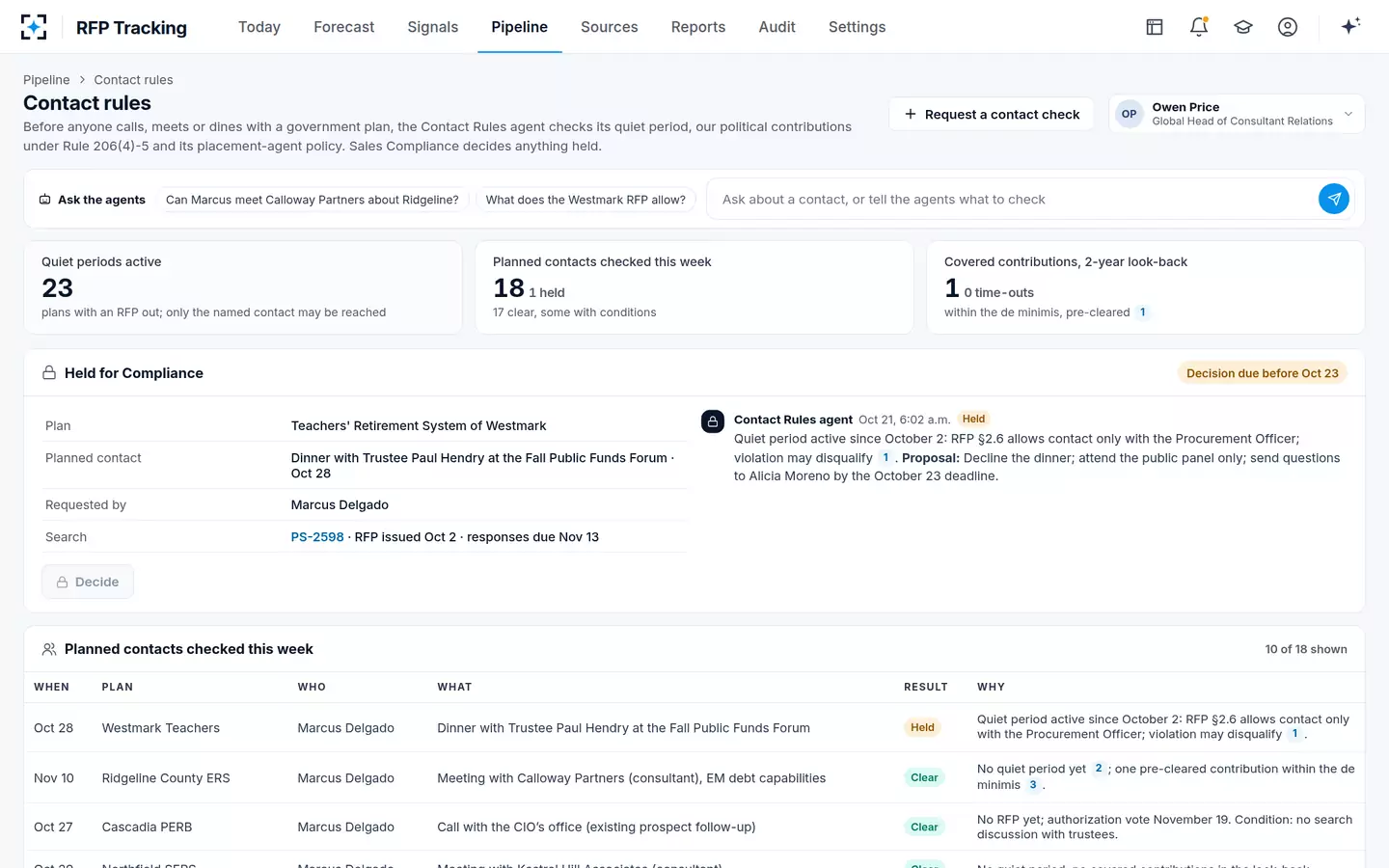
The sample shows the common case. A salesperson at the fictional manager planned a dinner on 28 October with a trustee of a fictional teachers' plan at a public funds forum. The plan had issued a direct-lending RFP on 2 October, with responses due on 13 November, and its section 2.6 allows contact only with the procurement officer. The Contact Rules agent held the dinner and proposed an alternative: decline the dinner, attend the forum's public panel only and send any questions to the procurement officer by her 23 October deadline.
One trustee dinner held for compliance, with the RFP section that bars it
Who clears a dinner with a pension trustee?
Sales compliance, before the date, on two checks. The first is the plan's window: is there an open solicitation, and does its contact clause allow this contact? The second is the person: has the salesperson, or anyone else at the firm who counts as a covered associate, contributed to an official of that government entity in the past two years above the SEC's de minimis limits? A dinner can pass the first check and fail the second, or the reverse.
Gifts and entertainment add a third layer that this page does not cover: state ethics laws may limit what a public official or trustee may accept, and a firm's code of ethics sets its own limits. The point for the quiet period is that a contact check should run before the invitation goes out, not after the dinner is in the expense system.
The two clocks: the quiet period ahead, the look-back behind
A contact with a government plan sits between two clocks that run in opposite directions. The quiet period runs forward from the plan's first notice or the RFP to the award. The pay-to-play look-back runs backward two years from the contact: under Rule 206(4)-5 an adviser may not be paid by a government entity for two years after the adviser or one of its covered associates contributes to an official of that entity (17 CFR 275.206(4)-5(a)(1)). The SEC proposed rescinding that rule on 3 September 2026, but it remains in force until a final rule; what the proposal would change is covered separately.
Both clocks exist for the same reason: the people who choose managers for public plans are exposed to influence. Research on public pension funds found that board representation by state officials "is negatively related to the performance of private equity investments made by the pension fund", and that their underperformance "is also positively related to political contributions from the finance industry" (Andonov, Hochberg and Rauh, Journal of Finance, 2018). Quiet periods and contribution limits are the procurement and securities-law answers to that risk, and a manager's controls are judged against both.
What breaking a quiet period can cost
The plan's rule sets the price, and it can be the bid. Florida's clause says a violation "may be grounds for rejecting a response". New York's law goes further: "A finding that an offerer has knowingly and willfully violated the provisions of subdivision three of this section shall result in a determination of non-responsibility for such offerer", and a second such finding within four years makes the offerer ineligible for procurement contracts for four years. Plans' own RFPs often state their sanction directly; the sample's says "violation may disqualify".
The cost is also reputational with the consultant, who has to explain to the board why a finalist went around the process. And a pay-to-play breach is separate: a contribution that triggers the SEC's two-year time-out bars compensation from that government entity whatever happened in the search.
Procurement blackout period vs company blackout period
A procurement blackout period governs contact between bidders and a buyer during a solicitation. A company blackout period, in the sense most people search for, stops insiders from trading the company's shares around earnings or other events. A pension plan blackout period, under 29 CFR 2520.101-3, suspends participants' rights to direct investments, take loans or take distributions in an individual account plan for more than three consecutive business days. An RFP tracker cares only about the first; the other two share the word and nothing else.
A contact check before every meeting
The control that works is boring and absolute: no contact with a government plan's trustees, staff or officials is booked until it has been checked against both clocks. Six questions make the check.
Six questions before any call, meeting or meal with a government plan
- Does the plan have an open or announced solicitation in any asset class?
Some windows open at the first notice, not the RFP; read the plan's rule.
- What does its contact clause allow, and with whom?
Named contact, in writing, or a public event the solicitation sets up.
- Is the contact about the search, or business as usual on an existing mandate?
Only the plan's rule can permit the second during a quiet period.
- Has anyone attending contributed to an official of that government entity in two years?
Above $350 per election if they could vote for the official, $150 if not.
- Is anyone being paid to arrange the meeting?
A third-party solicitor must be a regulated person; some jurisdictions and plans ban placement agents outright.
- Who in compliance cleared it, and when?
A name and a date on file before the invitation goes out.
In the solution's sample week, the agent checked 18 planned contacts: 17 cleared, some with conditions, and one held. It also tracks quiet periods that have not started: for one fictional county plan with no RFP yet, it cleared a meeting with the plan's consultant because no quiet period had started under the plan's rules and the one contribution in the look-back had already been pre-cleared by compliance. To see the checks beside the forecast that prompted them, start from RFP Tracking, or read how one board motion becomes a pursuit in pension board meeting minutes, traced.
Questions people ask
What is an RFP quiet period?
The time during a public solicitation when bidders may communicate only with the contacts the issuer designates, usually a procurement officer, and only through permitted channels such as written questions. It is set by the plan's procurement rules or state law, so its start and end vary by issuer.
Is a silent period the same as a blackout period?
For RFPs, yes: quiet period, silent period, blackout period and restricted period describe the same restriction on contact during a solicitation. New York's statute uses "restricted period"; many plans' RFPs say quiet period.
Does an RFP blackout period apply to existing managers?
It applies to anyone responding to the solicitation, including incumbents. A plan may allow routine contact on an existing mandate during a quiet period, but only its rule can say so, and that contact must stay off the search.
How long does an RFP blackout period last?
From its start to its end under the plan's rule: for Florida state solicitations, from release to 72 hours, excluding weekends and holidays, after the notice of intended award; for New York procurements, from the earliest posted notice to final award and approval. A plan's own RFP states its window, typically in the section that governs communications.
What happens if a bidder violates the quiet period?
The plan may reject its response. Under New York's procurement lobbying law, a knowing and wilful violation leads to a finding of non-responsibility, and a second within four years bars the bidder from procurement contracts for four years.
Can a manager attend a conference where trustees are speaking?
Often, for the public parts, if the solicitation's contact clause allows it and the manager does not use the event to discuss the search with anyone involved in the selection. In the solution's sample, the agent proposed attending the forum's public panel only and sending questions to the procurement officer in writing.