A CRM for asset managers works best as the system of record for decisions already taken: the plans and consultants the firm covers, the people it deals with, the activities its team logs and the opportunities someone has decided to pursue. It works badly as the place where search intelligence starts, because a rumour typed into an opportunity carries the same weight in the pipeline as a board vote, and nobody can later show where either came from. The better pattern keeps the CRM and puts the reading outside it: board papers, procurement portals and consultant announcements are read and checked elsewhere, a person approves each pursuit, and only then is an opportunity written, with the approval and the evidence page attached. Botminds' RFP Tracking is built that way. Its agents read the plans' documents, forecast each search and check the contact rules; its Pipeline agent writes to the CRM only after a person approves, and logs every write with the approval it rests on.
The integration map: what is read outside the CRM, who decides, and what is written after approval
1Read, outside the CRM
- Board agendas, packets and minutes
- Meeting video transcripts
- Procurement portal notices
- Consultant announcements
- Approved strategy data
- Contribution pre-clearance list
2Decide, by people
- Analyst confirms low-confidence signals
- Coordinator proposes the pursuit
- Compliance clears each contact
- Head of consultant relations approves
- Head of distribution co-approves the top tier
3Write, to the CRM, after approval
- Opportunity, with the approval as its reference
- Owner and RFP coordinator
- Tasks and dates
- RFP watch on the plan's portal
- Decision, reason code and evidence page
What should a CRM for asset managers hold?
A CRM for an institutional asset manager should hold five things well: accounts (plans, sponsors and their consultants, with the relationships between them), contacts (named people at each, with roles), activities (meetings, calls and research visits, with who attended), opportunities (searches the firm has decided to pursue) and mandates won, with the strategy and size. Most CRMs sold to financial firms can model these; what differs between firms is the discipline about what goes in.
Three things should not live in the CRM, or not only there. Raw search intelligence, a line in a consultant's note or a sentence in a board packet, belongs with its source, where it can be checked. Contribution pre-clearance belongs in the compliance system that owns it; under the SEC's pay-to-play rule an adviser with government clients must keep lists of its covered associates and their contributions to officials (17 CFR 275.206(4)-5; records under 17 CFR 275.204-2(a)(18)), and the CRM should read that list, not copy it. And trustee names should come only from public sources such as the plan's own minutes, which is the rule RFP Tracking applies.
Why the CRM is the wrong place for search intelligence
Because the CRM is built to record decisions, not evidence. A salesperson who hears that a plan "is looking at EM debt" creates an opportunity; the CRM gives it a stage and a stage probability; and from then on it sits in the pipeline beside searches backed by a board vote. Six months later nobody can say why it was there, whether the plan ever voted, or why the firm spent a finals slot on it. Multiply by a few hundred opportunities and the pipeline a head of distribution presents is partly rumour.
Stage probabilities make it worse. CRMs commonly assign a default percentage to each stage, so a rumour at "qualified" and a board-approved RFP authorisation at "qualified" carry the same number. A search forecast should instead carry its own probability with its reasons, tested against outcomes; how calibration replaces stage percentages is set out with the other pipeline KPIs.
Should agents write directly to the CRM?
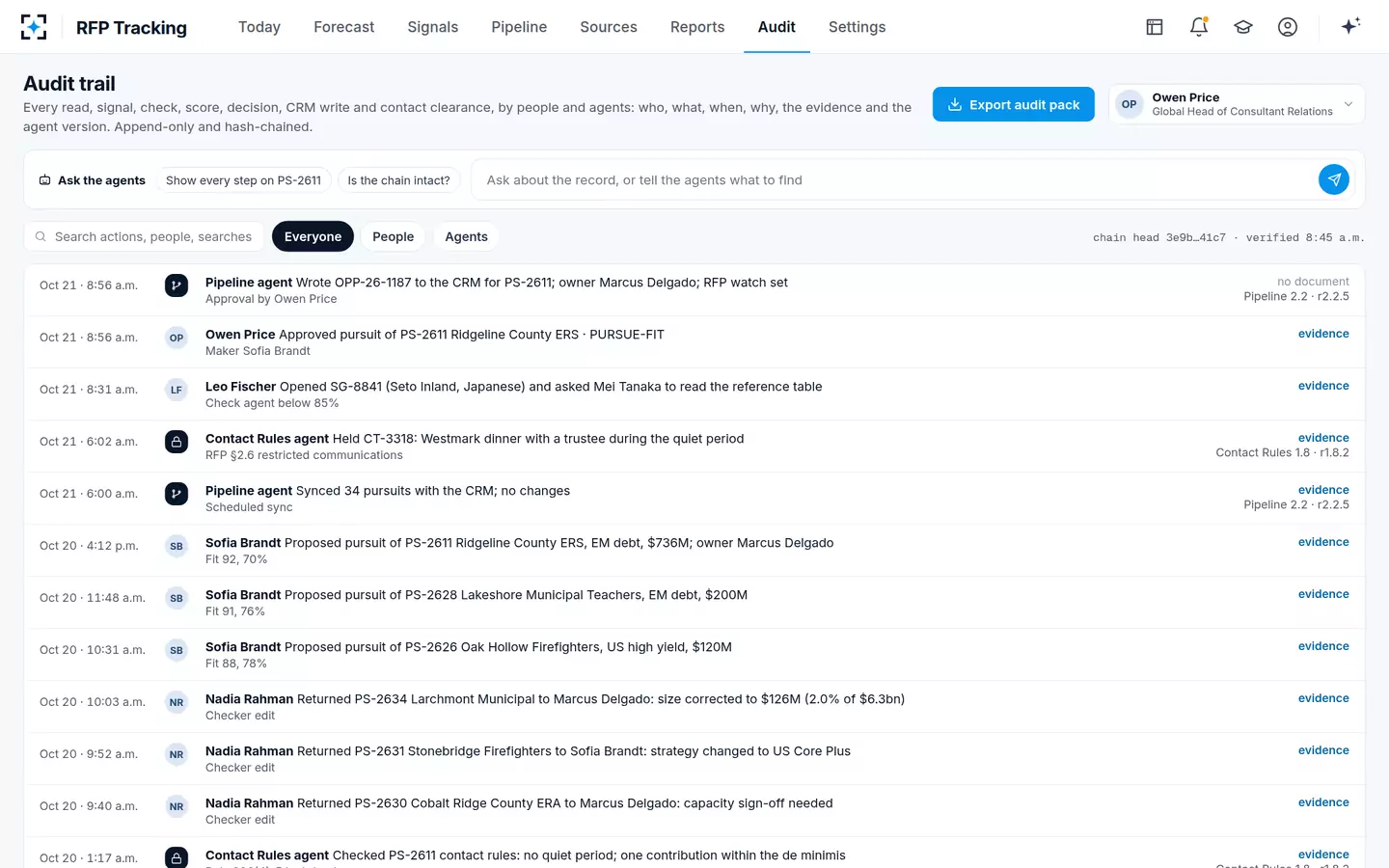
Not before a person approves. An agent that writes forecasts straight into the CRM turns the pipeline into the agent's opinion, however good it is, and makes every downstream report depend on a step nobody reviewed. The safer rule, and the one RFP Tracking enforces, is that agents prepare everything a pursuit needs and write nothing until a named checker approves it: "Writes nothing before approval", "Every write logged with the approval it rests on" and "Drafts only — a person sends" are the Pipeline agent's three written limits.
From approved pursuit to CRM opportunity: one approval, five logged steps
A person decides
Checker approvesThe head of consultant relations approves the Ridgeline pursuit with reason code PURSUE-FIT, after ticking that the source page and contact rules were reviewed.
Agent
Create the opportunityOPP-26-1187 in the CRM: $736M, Emerging Markets Debt Blend, expected 10 February 2027, with the approval as its reference.
Never: creates an opportunity without an approval reference.
Agent
Assign owners and tasksThe institutional sales director as owner, the RFP coordinator for the response materials due 15 December, a consultant meeting request.
Agent
Set the RFP watchWatches the plan's procurement portal and the consultant's announcements for the RFP's release.
Agent
Draft the meeting requestDrafts the request to the consultant and holds it for sales compliance to clear.
Never: sends it; a person does, after clearance.
Agent
Log the decisionWrites the decision, the reason code and the evidence page, page 14 of 22, to the trail.
Only now is the CRM written: the Pipeline agent's five steps after approval
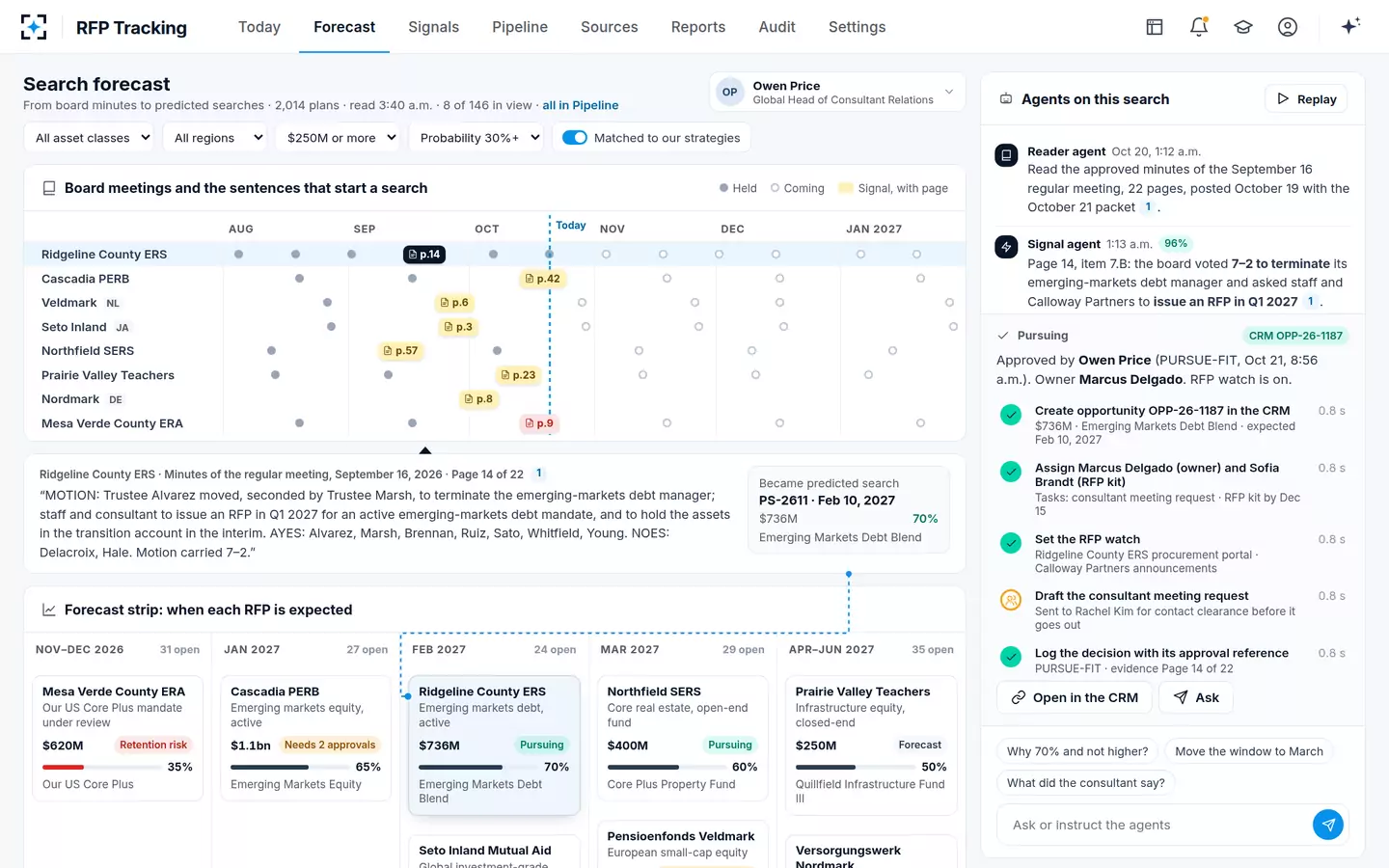
What gets written to the CRM, field by field
An approved pursuit should arrive in the CRM complete enough to act on and traceable back to its evidence. These are the fields RFP Tracking writes, and the reason for each.
The opportunity record an approved pursuit should create
| Field | Example from the sample | Why it is there |
|---|---|---|
| Account and consultant | Ridgeline County ERS; Calloway Partners | Joins the search to the plan and the gatekeeper already in the CRM |
| Search ID and approval reference | PS-2611; approval by the head of consultant relations | Every opportunity traces to a decision by a named person |
| Asset class, vehicle, size | EM debt, active, separate account; $736M from 4% × $18.4bn | The arithmetic travels with the number |
| Strategy and fit | Emerging Markets Debt Blend, fit 92 | Which strategy the firm chose, and that alternatives were considered |
| Probability and window | 70%; 15 January to 31 March 2027, most likely 10 February | A forecast with its date, testable later |
| Owner and coordinator | Institutional sales director; RFP coordinator | Who acts when the RFP lands |
| Reason code | PURSUE-FIT · strategy fits the mandate | Pursue and pass decisions can be counted and compared |
| Evidence link | Minutes of 16 September, page 14 of 22, stored copy | Anyone can open the page the pursuit rests on |
| Contact status | No quiet period yet; consultant meeting request held for compliance | The next contact is cleared before it happens |
The CRM does not need the whole evidence file, and should not get it: the signals, the second reader's check, the probability drivers and the stored documents stay in RFP Tracking, linked from the opportunity. A scheduled sync keeps the two in step afterwards; on the sample morning the Pipeline agent checked 34 approved pursuits against the CRM and found nothing to change.
Books and records: what an adviser keeps anyway
Some of what a sales team writes is already subject to the SEC's books-and-records rule, which is a reason to keep the pipeline clean. An adviser must keep the written communications it sends and receives about any recommendation or advice, given or only proposed, along with its written agreements, and most such books and records are kept for at least five years after the end of the fiscal year in which the last entry was made (17 CFR 275.204-2(a)(7), (a)(10) and (e)(1)). Which CRM content falls inside those categories is a question for each firm's compliance team; a pipeline that holds unsourced rumours is harder to defend whichever way it is answered.
The pay-to-play records are the other link. The SEC proposed on 3 September 2026 to remove the rule's records from 204-2 along with the rule itself, but asked whether some should be kept, and both remain in force until a final rule (91 FR 57698). A contact check should read the current list, wherever it lives; what the rescission proposal would change is covered separately.
The audit trail behind the CRM: every write with the approval it rests on
Best CRM for asset managers? The question to ask instead
Most firms already have a CRM, and the expensive decision is not which one to buy but what to connect to it and on what terms. Whichever CRM a firm runs, the questions below decide whether search intelligence will make its pipeline better or worse.
Seven questions for an asset management CRM and anything that writes to it
- Does the data model hold plans, sponsors and consultants as separate, linked accounts?
A search involves at least the plan and its consultant; the CRM must show both.
- Can an opportunity carry an external approval reference and an evidence link?
So every opportunity traces to a decision and a page.
- Does the write interface log who or what wrote each field, and when?
Agent writes and human edits should be distinguishable on the record's history.
- Can permissions stop an integration from creating opportunities on its own?
Write access tied to an approval, not to the integration's account.
- Will stage probabilities give way to a forecast probability where one exists?
Otherwise the pipeline averages rumours and votes.
- Can contact activity be checked against compliance before it is logged?
A meeting with a government plan should not be booked before it is cleared.
- Can the firm export the full history for a back-test?
Last year's pursuits and passes are the test set for any tracking tool.
Where RFP Tracking sits beside the CRM, and what it leaves alone
RFP Tracking sits beside the CRM, not in place of it. It reads public board documents, procurement notices and consultant announcements for the plans a team watches; forecasts searches with cited evidence and calibrated probabilities; matches each to a strategy from approved product data; checks contacts against quiet periods and contribution records; and writes approved pursuits to the CRM. It works with the systems around it: the CRM, document management for the stored copies, procurement portals, meeting video, a plan-assets data source, the contribution pre-clearance system and the RFP response library, where landed RFPs are handed to the RFP team.
It does not replace what the CRM does for client service, relationship history or mandate administration, and it is not a consultant database tool, a pitch book builder or a response writer; other Botminds solutions cover those. It reads public sources only, never logs in where a login is required and never contacts anyone. A firm whose searches mostly come from relationships with no public trail, such as corporate plans that do not meet in public, will get less from it than one covering public plans, and a back-test on last year's searches will show which kind of firm it is; how to run that back-test is set out separately.
Asset management CRM software: integrating in the right order
Integrate in three steps, and do not skip the first. Start read-only: let the tracking tool read the CRM's accounts, consultants and relationships, so its matches know which plans are clients and which consultants cover them, and change nothing in the CRM. Then write approved pursuits for one team, with the approval reference and evidence link, and check every opportunity against what the team expected. Only then turn on the scheduled sync for all teams, with the rule that nothing is written before approval made a setting that an approver, not an integration, controls.
Backfill last. Past opportunities can be linked to their evidence where it exists, and the rest marked as unsourced, which is itself useful: it shows how much of the old pipeline rested on nothing a reviewer could open. To see the approval, the write and the trail together, start from RFP Tracking.
Questions people ask
What is the best CRM for asset managers?
The one a firm's teams will keep accurate, with a data model for plans, sponsors and consultants as linked accounts, an auditable write interface and permissions that stop integrations from creating opportunities on their own. For search tracking, how the CRM is fed matters more than which CRM it is.
What is the difference between a CRM and an RFP tracker?
A CRM records relationships, activities and the opportunities a firm has decided to pursue. An RFP tracker follows searches from the first public signal, with evidence, dates and probabilities, to a pursue-or-pass decision. The tracker's approved output is what the CRM should receive.
Should trustee names go into the CRM?
Only from public sources, such as the plan's own minutes and website, and only where the firm needs them for coverage or contact checks. RFP Tracking takes trustee names from public minutes only, and every planned contact with a trustee is checked against the plan's quiet period first.
Can agents update CRM opportunities automatically?
After approval, yes, within limits. In RFP Tracking the Pipeline agent creates the opportunity, assigns owners and tasks and keeps approved pursuits in step through a scheduled sync, logging each write with its approval; it never creates an opportunity on its own and never sends anything.
How long must an investment adviser keep CRM records?
Records the SEC's books-and-records rule requires, such as written communications relating to advice and written agreements, must generally be kept for at least five years from the end of the fiscal year of the last entry, the first two in an appropriate office. Whether a CRM entry is such a record depends on its content.
Does a CRM help with pay-to-play compliance?
Only if it is connected to the contribution pre-clearance records and checks contacts before they are booked. The SEC's rule bars compensation from a government entity for two years after a covered contribution; the check has to happen before the call, not when the activity is logged.