The SEC's pay-to-play rule rescission is a proposal, not a change in the law: in a release dated 3 September 2026 the Commission proposed rescinding Rule 206(4)-5, the political contribution rule for investment advisers, together with the related records in Rule 204-2, and published the proposal on 10 September with comments due by 9 November 2026. Until the SEC adopts a final rule, an adviser that receives compensation from a government client within two years of a covered contribution is still in breach, the $350 and $150 de minimis limits still set what an individual may give without triggering it, and the records must still be kept. And whatever the SEC decides, state pay-to-play laws, placement-agent bans and each plan's own procurement rules stay in force. For the teams who call on public plans, that means two checks before every contact, which is what the Contact Rules agent in Botminds' RFP Tracking does: the plan's quiet period, and the firm's contributions in the two-year look-back, with anything doubtful held for sales compliance.
What the proposal touches, in the SEC's own numbers
1,518
registered advisers with state or municipal government clients on Form ADV
2,091
advisers the SEC estimates are subject to the rule, counting pools with government investors
$150
the SEC: the two-year ban "can be triggered by contributions of as little as $150"
9 Nov2026
last day for comments; the rule stays in force until a final rule
What did the SEC propose?
The SEC proposed to rescind the pay-to-play rule entirely, not to amend it. In its words, "We propose to rescind the political contribution rule in its entirety based on our experience administering the rule since its adoption", and the rule text it would adopt simply removes and reserves 17 CFR 275.206(4)-5 and the pay-to-play records in 275.204-2(a)(18) (91 FR 57698). The release is dated 3 September 2026, appeared in the Federal Register on 10 September, and asks for comments "on or before November 9, 2026".
The Commission gave four reasons. The rule, it said, "Has led to significant unintended consequences, including prohibitions by some investment advisers on any and all political contributions made by the investment adviser and its employees at the State and local level"; it "Is operationally challenging for investment advisers to implement"; it "May impose significant burdens that may not be justified by its benefits"; and it "Lacks clarity and creates a de facto strict liability standard, which can lead to situations where small donations or ‘foot faults’ potentially trigger substantial prohibitions." It proposes to rely instead on "prohibitions on fraud, fiduciary duty requirements" and the compliance and code of ethics rules, which it considers "likely sufficient to address pay-to-play practices".
The SEC also asked whether to keep part of the records. Question 15 asks: "should we retain certain recordkeeping requirements within rule 204-2(a)(18)? If so, which requirements and why?" A final rule could therefore differ from the proposal, and a firm should not dismantle its contribution tracking on the strength of the proposal alone.
Is the pay-to-play rule still in effect?
Yes. A proposed rescission changes nothing until the SEC votes on a final rule and that rule takes effect. Today, Rule 206(4)-5 makes it unlawful for a covered adviser "to provide investment advisory services for compensation to a government entity within two years after a contribution to an official of the government entity is made by the investment adviser or any covered associate of the investment adviser (including a person who becomes a covered associate within two years after the contribution is made)" (17 CFR 275.206(4)-5(a)(1)).
The rule has been enforced. In January 2017 the SEC announced that "10 investment advisory firms have agreed to pay penalties ranging from $35,000 to $100,000 to settle charges that they violated the SEC's investment adviser pay-to-play rule by receiving compensation from public pension funds within two years after campaign contributions made by the firms' associates" (SEC press release 2017-15). A contribution made this month starts a two-year clock that runs into late 2028, whatever the timing of a final rule, and a firm cannot know today how a final rule would treat contributions made before it.
What the rule requires today: the time-out, the solicitation ban and the records
The rule has four working parts, and each one reaches the people who sell to public plans. The SEC's own description in the proposal covers the ban on compensation with its two-year look-back, the ban on paying solicitors who are not regulated persons, the ban on soliciting or coordinating contributions, and the treatment of pooled funds with government investors as if the government were the client.
Rule 206(4)-5 as it applies today, part by part
| Part | What it says | Where it bites in a search |
|---|---|---|
| Two-year time-out | No compensation from a government entity for two years after the adviser or a covered associate contributes to an official who can influence the hiring. | One contribution by a salesperson to a trustee who holds elected office can bar the firm from being paid on the mandate. |
| Ban on paying solicitors | An adviser may pay only regulated persons, or its own executives and employees, to solicit a government entity. | Placement agents and finders must be registered advisers, broker-dealers or municipal advisors subject to pay-to-play rules. |
| Ban on soliciting or coordinating contributions | The adviser and its covered associates may not solicit or coordinate contributions to officials or payments to parties where it seeks business. | Fundraising for a candidate with influence over a plan is caught even if nobody at the firm gives. |
| Pooled funds | An adviser to a covered investment pool with a government investor is treated as if it advised the government directly. | Private funds and registered funds offered to public plans are inside the rule. |
| Records | Lists of covered associates, government clients and investors, contributions and payments, and regulated persons paid to solicit. | The pre-clearance list a contact check reads is also a record the SEC can ask for. |
The solicitation ban is often the part that surprises a distribution team. How it applies to placement agents in private equity, and who bears their fees, is covered in a guide to placement agent fees; for a public plan's search, the practical rule is that anyone paid to open a door must be a regulated person.
Pay-to-play rule de minimis: $350 and $150, per election
The de minimis exception lets an individual covered associate give small amounts without triggering the time-out: up to $350 per election to an official the person is entitled to vote for, and up to $150 per election to one they are not. The rule's text says it does not apply to contributions "to officials for whom the covered associate was entitled to vote at the time of the contributions and which in the aggregate do not exceed $350 to any one official, per election, or to officials for whom the covered associate was not entitled to vote at the time of the contributions and which in the aggregate do not exceed $150 to any one official, per election" (§ 275.206(4)-5(b)(1)).
Three details catch firms out. The limit is per official and per election, added up across everything the person gives that official for that election. The vote test turns on where the contributor can vote, which a pre-clearance check has to know. And the exception is for natural persons only; as the SEC's proposal notes, it "is available only for contributions by individual covered associates, not the investment adviser itself."
There is also a narrow cure. If a contribution of no more than $350 to an official the person could not vote for is discovered within four months, and returned within 60 days of discovery, the time-out does not apply; a firm reporting more than 50 employees may use this exception three times a calendar year, a smaller firm twice, and never twice for the same person.
Who is a covered associate under the SEC pay-to-play rule?
A covered associate is any general partner, managing member or executive officer of the adviser, any employee who solicits a government entity for it and anyone who supervises such an employee, and any political action committee the adviser or those people control (§ 275.206(4)-5(f)(2)). For a distribution team, that typically means the head of distribution, the head of consultant relations, the institutional sales directors who cover public plans and their managers.
The look-back follows people into the role. A person who becomes a covered associate brings their contributions of the previous two years with them if they will solicit, and of the previous six months if they will not. The SEC's proposal describes the effect: an adviser "may be prevented from hiring or promoting qualified individuals into roles where they would be considered a ‘covered associate’ for either six months or two years following an individual's contribution". Until a final rule, a new hire into consultant relations needs a contribution check before their first call on a public plan; the consultant relations seats are set out with that in mind.
What would still apply if the rule is rescinded?
Rescission would remove the SEC's prescriptive rule, not the law against pay-to-play. The proposal is explicit that "the Commission's ability to bring cases against investment advisers for fraudulent practices and violations of fiduciary duty for engaging in pay-to-play practices would remain unchanged", and that "Investment advisers' fiduciary duty obligations and the broad anti-fraud provisions under the Federal securities laws would continue to apply following the proposed rescission".
Pay-to-play controls today, and if the SEC rescinds Rule 206(4)-5 as proposed
Today, with the rule in force: A two-year time-out from compensation, triggered automatically by a covered contribution above the de minimis.
If rescinded as proposed: No automatic time-out. Pay-to-play remains fraud and a breach of fiduciary duty; the firm's own policies and code of ethics set the limits.
Today, with the rule in force: $350 or $150 per official, per election, set by the SEC.
If rescinded as proposed: No SEC thresholds. A firm may set its own; state laws keep theirs.
Today, with the rule in force: Only regulated persons, or the adviser's own staff.
If rescinded as proposed: The SEC ban goes, but MSRB, FINRA and state placement-agent rules still apply where relevant.
Today, with the rule in force: Six-month or two-year look-back on a person's past contributions.
If rescinded as proposed: No SEC look-back; any check is the firm's policy.
Today, with the rule in force: Covered associates, government clients, contributions and solicitors under 204-2(a)(18).
If rescinded as proposed: Proposed for removal, though the SEC asked whether to keep some. Written agreements with solicitors are still kept under 204-2(a)(10).
Today, with the rule in force: Apply alongside the SEC rule.
If rescinded as proposed: Unchanged. The SEC says they "exist independently" of its rule.
Other federal and self-regulatory rules stay too. The proposal notes that advisers "may still face restrictions on using certain persons for purposes of soliciting government entities to the extent that other rules and regulations that govern the use of solicitors, including the MSRB Political Contribution Rule, FINRA Rule 2030, and Exchange Act rule 15Fh-6" apply, for example to dual registrants. MSRB Rule G-37 is the municipal-dealer rule on which the adviser rule was "closely modeled", with its own two-year prohibition.
The SEC also sketched what a principles-based program would look at: governmental relationships, which personnel are giving (it notes that "contributions by personnel in positions involving client solicitation may carry heightened pay-to-play risks"), pre-clearance, risk mitigators such as contribution windows and thresholds, third-party solicitors and periodic monitoring. It observes that "a large adviser with multiple advisory contracts with several public pension plans could determine that it is appropriate to have an electronic pre-clearance system for contributions similar to what typically is used for pre-clearing personal securities transactions." In other words, the checks a firm runs today are likely to survive as policy even if the rule does not.
State pay-to-play laws do not change
State and local pay-to-play laws are untouched by the SEC's proposal, and they vary widely. The release itself describes the landscape: "Some jurisdictions prohibit principals of investment advisory firms from contributing to campaigns or other organizations related to offices with discretion in the selection or compensation of an investment adviser"; some require public disclosure of contributions by contractors; some bar government entities from contracting with advisers who have contributed; "Some jurisdictions prohibit the use of placement agents"; and "Some jurisdictions have no restrictions resembling those in the political contribution rule."
Its examples show the range. Rhode Island requires a state vendor with a contract of $5,000 or more to file an affidavit if it has given more than $250 in a calendar year to listed officials or candidates within the 24 months before the contract. South Carolina bars certain contributions by persons awarded non-competitively bid contracts. Philadelphia requires contractors on non-competitively bid contracts to disclose contributions to city officeholders and candidates. New York's Retirement and Social Security Law bars the state Common Retirement Fund from investing with a manager that uses a placement agent to obtain its investments. A contact check therefore needs the plan's state, not only the SEC's rule.
What a sales team should do before a final rule
Until a final rule, keep running the program as if the rule will stay, and prepare for the possibility that it will not. Five steps cover both.
Five steps for distribution and compliance while the rescission is pending
- Keep pre-clearing contributions by covered associates
The two-year clock on a contribution made today outlasts the comment period by a wide margin.
- Keep the 204-2(a)(18) lists current
The SEC asked whether to keep some of them; they are also the input to every contact check.
- Map each watched plan's state and local rules
Contribution limits, disclosure duties and placement-agent bans that would survive rescission.
- Check every planned contact against both clocks
The plan's quiet period ahead of the award, and the firm's contributions in the two-year look-back.
- Decide now what the post-rescission policy would be
Which roles pre-clear, at what thresholds, and who reviews: the factors the SEC listed in its proposal.
The fourth step is where pay-to-play meets the sales calendar. In RFP Tracking, the Contact Rules agent checks every planned call, meeting or dinner with a government plan against the plan's quiet period, the firm's contribution pre-clearance records under Rule 206(4)-5 and the plan's placement-agent policy, and holds anything doubtful for sales compliance. It never clears a contact and never sends anything.
Contact rules: quiet periods, the two-year look-back and one dinner held for compliance
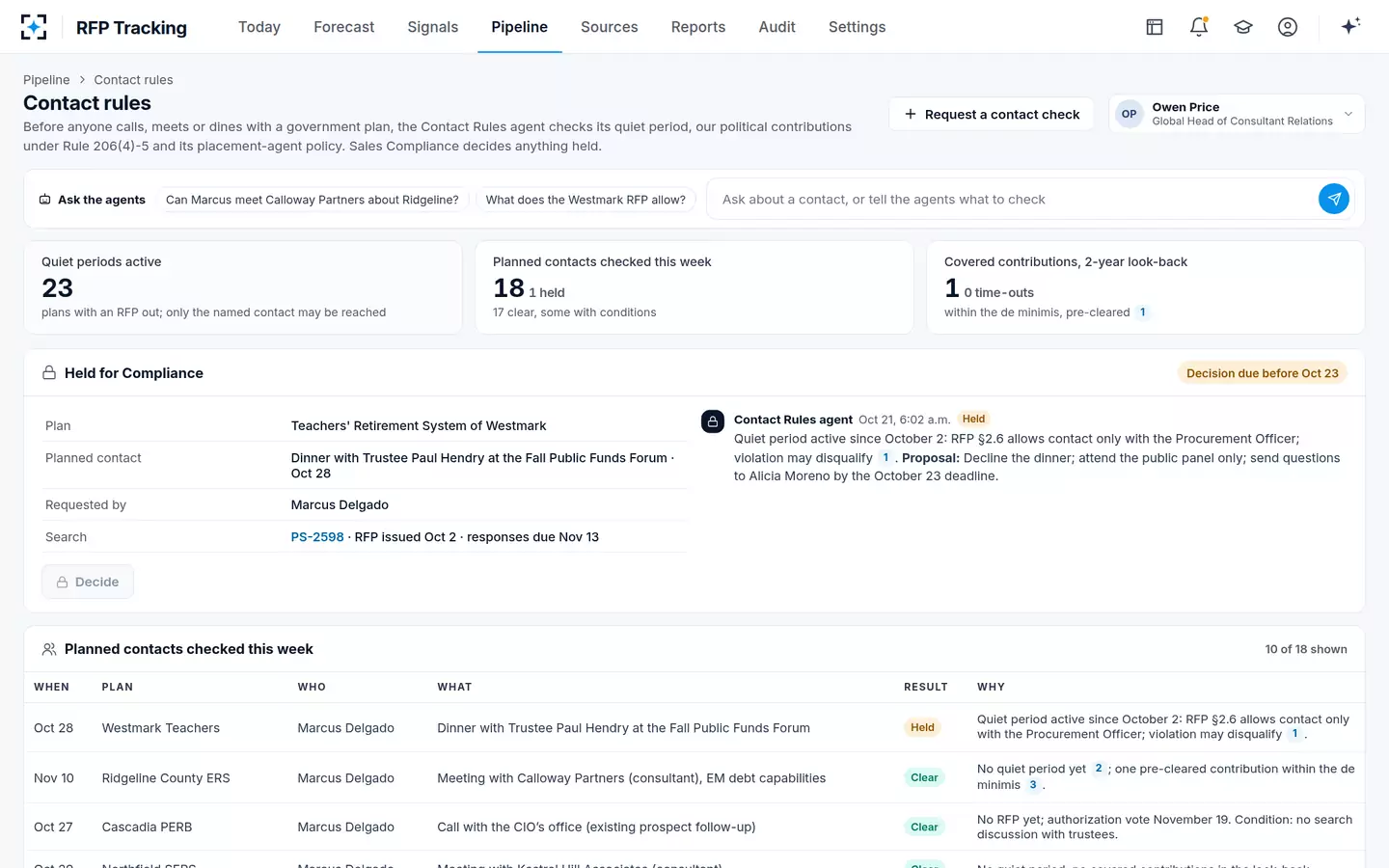
Contribution checks look backward; the plan's quiet period looks forward, and the two have to be read together. When an RFP blackout period starts and ends covers the second clock. To see both checked before a contact is booked, start from RFP Tracking.
Questions people ask
Has the SEC rescinded the pay-to-play rule?
Not as of 28 October 2026. The SEC proposed rescission on 3 September 2026 and published the proposal on 10 September; comments are due by 9 November 2026. Rule 206(4)-5 stays in force until the Commission adopts a final rule and it takes effect.
What is the SEC pay-to-play rule?
Rule 206(4)-5 under the Investment Advisers Act. It bars an adviser from receiving compensation from a government entity for two years after the adviser or a covered associate contributes to an official who can influence the hiring, limits whom an adviser may pay to solicit government business, and bars soliciting or coordinating contributions. The SEC adopted it in 2010.
What is the de minimis amount under the pay-to-play rule?
$350 per election to an official the covered associate can vote for, and $150 per election to one they cannot, in aggregate per official. Only individuals can use it; a contribution by the firm itself has no de minimis.
Does the pay-to-play rule apply to private funds?
Yes, through the covered investment pool provision: an adviser to a pool in which a government entity invests, or is solicited to invest, is treated as if it advised the government entity directly. The rule also applies to exempt reporting advisers and certain foreign private advisers, not only registered ones.
Would state pay-to-play laws still apply after rescission?
Yes. The SEC's proposal says State and local pay-to-play laws exist independently of its rule and would not be limited by rescission. They range from contribution bans on investment firm principals to placement-agent bans and contractor disclosure duties.
What is MSRB Rule G-37?
The Municipal Securities Rulemaking Board's political contribution rule for brokers, dealers, municipal securities dealers and municipal advisors. It imposes a two-year prohibition on municipal securities or municipal advisory business after certain contributions, and the SEC says its adviser rule was closely modeled on G-37 and G-38. The SEC's proposal does not amend it.