A pension board meeting is where a public plan's trustees take the decisions that start a manager search: putting a manager on watch, voting to terminate one, adopting a new asset allocation or authorising an RFP. The minutes of that pension board meeting are where the decision becomes public, with the motion, the vote and often the size, and they usually appear months before the RFP itself. Reading them is therefore the earliest dependable way for an asset manager to see a search coming. It is also slow work, because the signal is one paragraph in a packet of hundreds of pages, posted by one of thousands of boards. Botminds' RFP Tracking exists to do that reading: its agents read the minutes, packets and notices of the plans a team watches, re-check each signal against the posted page, and hand people a cited forecast to approve or reject.
The trace below follows one motion through the solution on fictional sample data: Ridgeline County Employees' Retirement System, an $18.4 billion county plan, and Quillfield Capital, a manager that already runs $410 million for it. Both are invented; the open-meetings rules quoted are real and linked.
From the vote to the expected RFP: 147 days, 112 of them left to prepare
- Vote to approval of the minutes21 d
- Approval to posting12 d
- Read and checked1 d
- Pursuit approved1 d
- Preparing before the RFP112 d
- Unaware of the search147 d
What happens at a pension board meeting, and where is it written down?
A pension board meeting is a public meeting of the plan's trustees, and three documents record it. The agenda, posted in advance, lists what the board will take up. The board packet, often called the board book, holds the staff memos, consultant reports and draft resolutions behind each item. The minutes record what was actually decided: who moved and seconded, how each trustee voted, and the wording of the motion as carried.
State open-meetings and public-records laws are what make these documents public, and the details differ from state to state. Virginia's Freedom of Information Act requires notice "at least three working days prior to the meeting", says "Minutes shall be taken at all open meetings", and requires them to include "a summary of the discussion on matters proposed, deliberated, or decided, and a record of any votes taken" (Va. Code § 2.2-3707). Florida declares board meetings at which official acts are taken "public meetings open to the public at all times" and requires that "The minutes of a meeting of any such board or commission of any such state agency or authority shall be promptly recorded, and such records shall be open to public inspection" (Fla. Stat. § 286.011).
The scale is what makes this hard. The Census Bureau counted 311 state-administered funds and 4,061 locally administered defined benefit systems in 2025 (Annual Survey of Public Pensions 2025). A board may meet monthly, and an investment committee in between. Which plans hold the assets, and how long the tail runs, decides which of those meetings a team can afford to ignore.
How do you read pension board minutes?
Read pension board minutes from the decision outward: find the motions, then read the discussion and the packet behind each one. In a long set of minutes only a few motions matter to a manager; the rest is administration, benefits and approvals of earlier minutes.
Five things are worth extracting from each investment motion. The body that acted, since a full board vote carries more weight than an investment committee's recommendation. The date of the meeting, not the posting date. The text of the motion as carried, because "staff and consultant to issue an RFP" is a different commitment from "staff to review options". The vote, because a 5–4 split may invite a second look and a unanimous vote rarely does. And the status of the minutes: draft, or approved by the board at a later meeting.
Then size it. Minutes rarely state a mandate size, but they often state a target allocation, and the plan's assets are public. In the sample, the packet sets emerging-markets debt at 4% of an $18.4 billion fund, so the search is worth about $736 million; the arithmetic has to be shown, because a search sized without its working cannot be checked by anyone downstream.
Which sentences in board minutes signal a manager search?
Six kinds of sentence account for most early signals, and they differ in strength. A watch-list placement says a board is unhappy; a vote to terminate with an instruction to issue an RFP says a search is coming. The list below runs from the weakest to the strongest, with the probability that RFP Tracking's sample firm gave the Ridgeline search at two of the steps.
Six board sentences that signal a coming manager search, weakest first
- A manager placed on watch
Usually after underperformance or a team change. In the sample, Ridgeline's March watch-list placement scored 20%.
- An asset-class or structure review
The consultant presents the asset class; a change of structure often means a change of manager.
- A new target allocation or asset-liability study
A new target creates mandates that did not exist; the size follows from target × fund assets.
- A pacing plan line
For private markets, the year's planned commitments by strategy, often the clearest forward calendar a plan publishes.
- A vote to terminate
The manager is out; the open question is whether the assets go to an existing manager, a passive option or a search.
- "Staff and consultant to issue an RFP"
The strongest signal short of the RFP itself. Ridgeline's 7–2 vote with this wording moved the sample forecast to 70%.
Two traps recur. The first is the repeated signal: a consultant's quarterly note, the minutes and the next agenda can all describe the same search, and a tracker that counts each one inflates the pipeline. The solution merges repeats and says so; on the sample night it found 23 signals and merged 9 into searches it already knew. The second is the signal that is not one: a board that terminates a manager and moves the assets to an existing one, which in the sample plan's history happened twice in its last eleven terminations.
Draft minutes vs approved minutes: which can you trust?
Approved minutes are the board's own account of what it decided; draft minutes are earlier and can change. Both are usually public. Virginia's statute is explicit that "Minutes, including draft minutes, and all other records of open meetings, including audio or audio/visual records, shall be deemed public records" (Va. Code § 2.2-3707). The question for a manager is not whether it may read the draft but how much weight to put on it.
Three documents from one pension board meeting, and what each is good for
Draft minutes: Days after the meeting, often in the next packet.
Approved minutes: After the board approves them, usually at a later meeting. In the sample, 21 days after the vote.
Draft minutes: What staff recorded. Wording and votes can still be corrected.
Approved minutes: The board's own account of the motion and the vote.
Draft minutes: Treat as an early signal; re-read when the approved text appears.
Approved minutes: Cite it. A forecast should rest on approved text wherever it exists.
Draft minutes: The staff memo shows the options considered, including the ones not chosen.
Approved minutes: Read with the memo: a passive option left open is a reason a search may not happen.
The sample shows both kinds at work. A different fictional plan, Mesa Verde County, appears on the same morning with draft minutes that record a review of one of the manager's own mandates after a portfolio manager change. That signal is a retention risk, not a search, and it goes to the people defending the mandate, flagged as draft, with a recommendation due on 19 November.
When are pension board minutes posted?
There is no single deadline. Notice of the meeting comes first, three working days ahead in Virginia; Florida requires "reasonable notice". Minutes follow when the plan's own process produces them, and where they are approved at the next meeting the approved text can trail the vote by weeks. In the sample, Ridgeline voted on 16 September, approved the minutes on 7 October and posted them on 19 October with the packet for its 21 October meeting: 33 days from vote to public, approved text.
That lag is why the packet and the draft matter, and why a team should know each watched plan's rhythm: which day the board meets, how far ahead the packet is posted and whether a meeting video appears sooner than the minutes. Ridgeline's board, in the sample, meets on the first and third Wednesday; RFP Tracking keeps that calendar for each plan and reads each document when it appears.
One motion, traced: read, extract, re-read, match, score, approve
Here is the Ridgeline motion as it moves through the solution, with what each step produced and who acted. The agents work overnight; the people act in the morning.
"MOTION: Trustee Alvarez moved, seconded by Trustee Marsh, to terminate the emerging-markets debt manager; staff and consultant to issue an RFP in Q1 2027 for an active emerging-markets debt mandate, and to hold the assets in the transition account in the interim. Motion carried 7–2." Fictional sample minutes, page 14 of 22.
The Ridgeline motion through RFP Tracking, step by step
Agent
Reader agent, 20 Oct, 1:12 a.m.Reads the approved minutes of the 16 September meeting, 22 pages, posted with the 21 October packet, and keeps a dated, hashed copy.
Never: logs in where a login is required; it flags the source instead.
Agent
Signal agent, 1:13 a.m., 96%Finds item 7.B on page 14: a 7–2 vote to terminate and an RFP in Q1 2027. Sizes it at 4% of $18.4 billion, about $736 million, with the arithmetic.
Never: estimates a size without its arithmetic and source.
Agent
Check agent, 1:14 a.m., 97%Opens the posted PDF itself, not the Signal agent's text; compares the motion word for word, checks the roll call (7 ayes, 2 noes) and that the minutes were approved on 7 October.
Never: lets a forecast exist if the quote is not on the cited page.
Agent
Match agentCompares three of the firm's strategies on eight criteria. Emerging Markets Debt Blend fits 92, against 71 and 58.
Never: invents a track record; it uses approved product data only.
Agent
Score agentGives 70% that an RFP the firm can enter opens, most likely around 10 February 2027, up from 20% after the March watch list, with its reasons.
A person decides
RFP coordinator, 20 Oct, 4:12 p.m.Proposes the pursuit: owner, a date for the response materials, a meeting request to the plan's consultant in November.
Agent
Contact Rules agentFinds no quiet period yet under the plan's rules, and checks the firm's contribution pre-clearance list for the two-year look-back.
Never: clears a contact; compliance does.
A person decides
Head of consultant relations, 21 Oct, 8:56 a.m.Asks why the score is 70% and not higher, reads the cited answer, and approves with the reason code PURSUE-FIT.
Page 14 of 22, as the board posted it, beside what the agents took from it
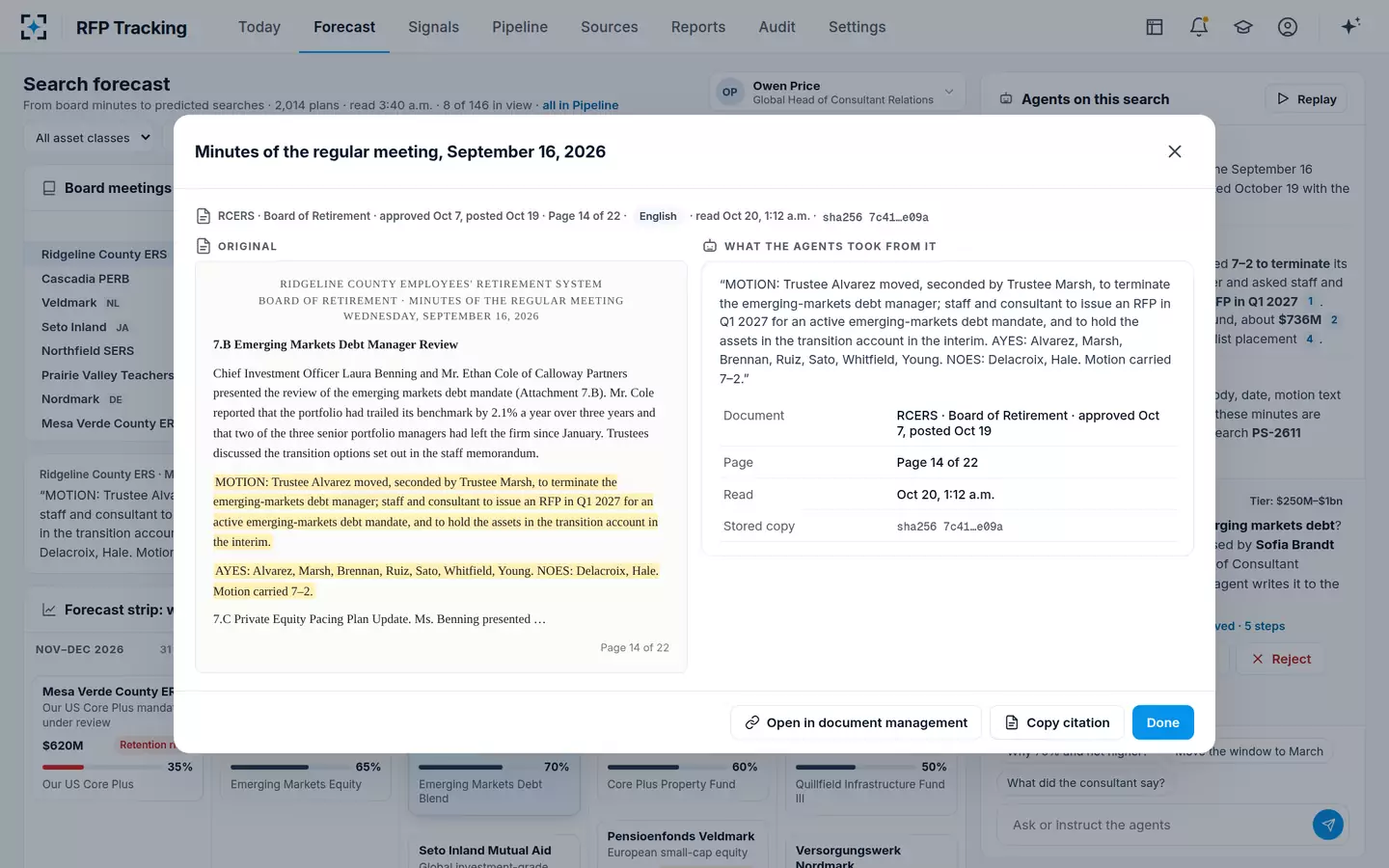
The second reader is the point of the design. The Signal agent works from text it extracted; the Check agent goes back to the posted document and reads the page on its own, so an extraction error cannot pass through two steps unnoticed. That same night it re-read 14 sources, confirmed 12, vetoed one because the quoted sentence was not on the cited page, and sent one to a person because it was only 81% sure, below the sample firm's 85% line.
Sizing and timing a search from the minutes
A search from the minutes gets a size, a probability and a window, and each needs its reasons. Size comes from the target allocation and the plan's assets. Timing comes from the motion's wording and the plan's own history. Probability is a judgment about everything that could still stop the search.
The sample's answer to "why 70% and not higher?" shows what that judgment rests on. The staff memo kept a passive index option open, at 0.28% a year less. Two of the plan's last eleven terminations went to an existing manager rather than an RFP. And the motion says Q1 but gives no date. On the other side, nine of those eleven terminations went to a public RFP within 150 days. If the January agenda carries the RFP release, the agent says it will move to about 85%.
The search forecast: board meetings on a timeline, the motion, and the predicted search it became
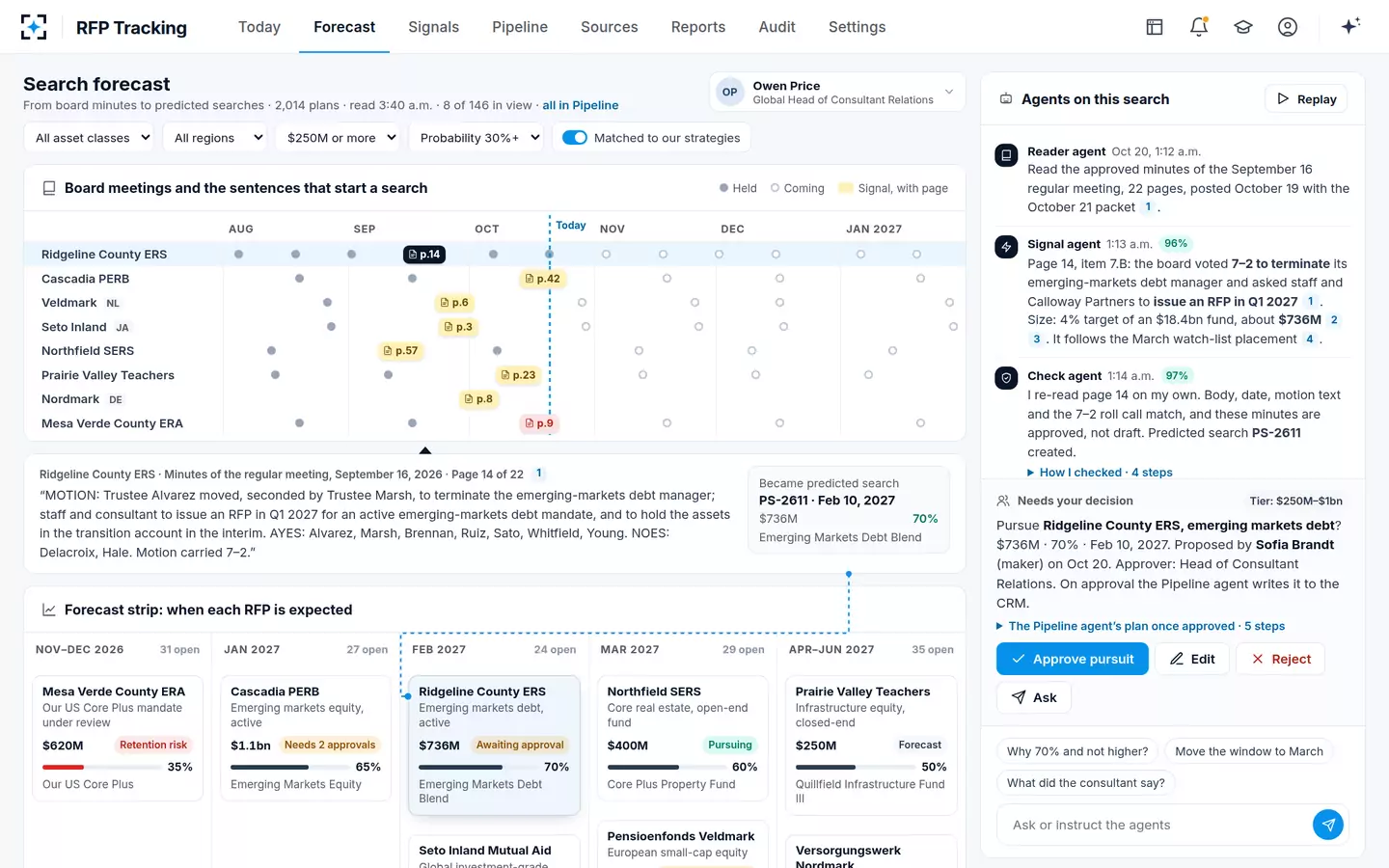
How good such probabilities are is an empirical question, and the answer is to test them on searches whose outcome is already known. How to back-test a tracking tool on last year's board papers sets out the method.
How long does the RFP process take after the board votes?
No regulator or independent study publishes how long public plans take between a board vote and an RFP, so the useful figure is each plan's own history. The sample plan's history, nine of its last eleven terminations sent to a public RFP within 150 days, is the kind of number a team can build for every plan it watches from that plan's past minutes and procurement notices.
Across the sample firm's watched plans, the solution saw 52 of this year's 61 relevant RFPs before they were issued, a median of 96 days earlier, on fictional data. The nine it missed are instructive: five plans were not on the watch list, three searches were run by a consultant with no public minutes, and one plan's portal required a login the agents do not use. Once an RFP is out, the plan's quiet-period rules govern contact, and under some rules they start earlier; who a manager may contact, and when, is a different question.
Why nothing reaches the CRM until a person approves
A forecast is not a pipeline entry, and the solution keeps the two apart. Until the head of consultant relations approves the Ridgeline pursuit, the CRM holds nothing about it; once he does, the Pipeline agent creates the opportunity with the approval as its reference, assigns the owner and the RFP coordinator, sets a watch on the plan's procurement portal and the consultant's announcements, and logs the decision with its reason code and the evidence page. The consultant meeting request is drafted and waits for sales compliance.
That order is what makes the pipeline defensible: every opportunity in it can be traced to a page in a public document and to a named person's decision. Why the CRM should be written only after approval covers the integration in detail. To see the whole trace run, start from RFP Tracking.
Questions people ask
Are pension board meetings open to the public?
For public plans, generally yes, under state open-meetings laws. Virginia's says "All meetings of public bodies shall be open", except for the closed meetings its statute lists elsewhere; Florida's declares board meetings at which official acts are taken open "at all times". Check each plan's state law for what may be taken up in closed session.
Where can I find pension board meeting minutes?
On the plan's own website, usually under the board or governance pages, alongside agendas and board packets; some plans also post meeting video. Approved minutes often appear with the packet for the following meeting, which is why the packet is worth reading too.
What is a pension board?
The board of trustees that governs a public pension plan: it sets the asset allocation, hires and fires managers and consultants, and approves the budget. Its make-up is often set by statute, mixing elected officials, appointees and members elected by plan participants, and research on public plans has found that composition matters for investment results (Andonov, Hochberg and Rauh, Journal of Finance, 2018).
How long after a board vote is an RFP issued?
It depends on the plan, and no regulator publishes a figure. Build it per plan from past minutes and procurement notices; in RFP Tracking's sample, one plan had sent nine of its last eleven terminations to a public RFP within 150 days.
Can board minutes in other languages be read the same way?
Yes, and many plans outside the US publish board decisions only in their own language. In the sample, a Dutch fund's decision to replace its European small-cap manager is read in Dutch and shown beside a checked English translation, with the decision highlighted in both.
What is the difference between minutes and a board packet?
Minutes record what the board decided and how each trustee voted. The packet is the material the board read before deciding: staff memos, consultant reports and draft resolutions. The packet often shows the options the board did not choose, which is how a reader learns that a passive option was on the table.