The largest public pension funds in the US are state systems: the California Public Employees' Retirement System's main fund, the California State Teachers' Retirement System, the Teacher Retirement System of Texas, New York State's employees' system and the Florida Retirement System each held more than $200 billion in the Census Bureau's 2025 survey. But the public pension market is far wider than its top names. The Census Bureau counted 311 state-administered funds and 4,061 locally administered systems in 2025, 4,372 in all, holding $6.49 trillion, each governed by a board that votes on the decisions that start manager searches. For an asset manager, the size of the market is the problem: every manager watches the largest plans, and few can read the boards of the rest. Botminds' RFP Tracking was built to read them, so that searches at a $2 billion county plan are seen as early as searches at the state system next door.
Where $6.49 trillion of public pension assets sat in 2025
Share of all state and local pension assets, by size of system
- 12 systems of $100bn or more · 38%
- 101 systems of $10bn to $100bn · 50%
- The other 4,259 systems · 12%
Which are the largest public pension funds in the US?
Ranked by total cash and investments in the Census Bureau's 2025 survey, the largest public pension funds in the US are led by the California Public Employees' Retirement System, whose main fund the Bureau reports in three parts totalling about $636 billion, and the California State Teachers' Retirement System at about $415 billion. Texas, New York, Florida and Wisconsin follow, and three of the top sixteen are run by local governments rather than states: New York City's teachers' and employees' systems and the Los Angeles County Employees Retirement Association.
The sixteen largest US public pension systems by assets, 2025 survey year
| Rank | System (as the Census Bureau lists it) | State | Assets |
|---|---|---|---|
| 1 | CalPERS Public Employees' Retirement Fund (funds A, B and C combined) | CA | $636.1bn |
| 2 | California State Teachers' Retirement System (CalSTRS) | CA | $415.4bn |
| 3 | Teacher Retirement System of Texas | TX | $244.4bn |
| 4 | New York State and Local Employees' Retirement System | NY | $230.7bn |
| 5 | Florida Retirement System defined benefit pension plan | FL | $212.0bn |
| 6 | Wisconsin Retirement System | WI | $176.1bn |
| 7 | New York State Teachers' Retirement System | NY | $151.5bn |
| 8 | Teachers' Retirement System of the City of New York | NY (city) | $122.3bn |
| 9 | Teachers Retirement System of Georgia | GA | $116.1bn |
| 10 | University of California Retirement Plan | CA | $110.8bn |
| 11 | Ohio Public Employees Retirement System, traditional plan | OH | $104.1bn |
| 12 | State Teachers Retirement System of Ohio, defined benefit plan | OH | $94.1bn |
| 13 | North Carolina Teachers' and State Employees' Retirement System | NC | $93.2bn |
| 14 | New York City Employees' Retirement System | NY (city) | $92.5bn |
| 15 | Oregon Public Employees Retirement System, defined benefit | OR | $89.2bn |
| 16 | Los Angeles County Employees Retirement Association | CA (county) | $84.8bn |
Three cautions apply to any such list. The figures are each system's own fiscal-year totals, so they are not all measured on the same day. Some well-known names are pools rather than plans, or pools of several plans, so a list of "funds" depends on how the counter draws the boundaries; the Census Bureau, for instance, lists New York's police and fire system separately from its employees' system. And size is not the same as search activity: a $90 billion plan with a settled manager line-up can run fewer searches in a year than a $5 billion plan rebuilding its fixed income structure.
How many public pension plans are there?
The Census Bureau counted 4,372 state and local defined benefit public pension systems in 2025: "311 state-administered funds and 4,061 locally administered defined benefit public pension systems" (Annual Survey of Public Pensions 2025). Together they held $6.49 trillion in cash and investments, "up 8.46% from $5.98 trillion in 2024", and more than 37 million people participated in them, counting active, inactive and retired members (Census Bureau release, 14 May 2026).
The US public pension market in four numbers, 2025
4,372
state and local defined benefit systems: 311 state, 4,061 local
$6.49T
cash and investments, up 8.46% from 2024
37M+
members, including inactive members and beneficiaries
$418bn
benefits paid in 2025
The split between state and local is lopsided by assets and the other way round by count. "Of the cash and investments held by public pensions in survey year 2025, 311 state plans held $5.37 trillion and 4,061 local plans held $1.12 trillion," the report concludes (ASPP 2025, PDF). The average state plan therefore held about $17 billion and the average local system about $280 million, our arithmetic, though the averages hide a long tail on both sides.
Largest state pension plans, by state
Add up the systems by state and California dwarfs the rest, with about $1.55 trillion, more than twice New York's $730 billion. Texas, Florida, Illinois and Ohio follow. These totals include local systems in each state, which matters most in New York, where the city's systems are among the largest in the country.
Public pension assets by state, state and local systems combined, 2025
What is a public pension fund?
A public pension fund is a retirement system sponsored by a state or local government for its employees. The Census Bureau's survey covers "pension systems that are sponsored by recognized government units (as defined by the U.S. Census Bureau) whose members are public employees compensated with public funds", and it counts defined benefit systems, which promise a specified benefit in retirement. Besides states, the Bureau recognises five kinds of local government that can sponsor one: county, municipal, township, school district and special district.
Each is governed by a board of trustees, and the board's make-up is often set by statute. That matters to anyone selling to it: research on public pension funds found that boards with more state officials on them made weaker private equity investments, and that the shortfall rose with political contributions from the finance industry (Andonov, Hochberg and Rauh, Journal of Finance, 2018). A board is a political body as well as a fiduciary one, which is why the rules on who may contact it during a search are strict; who a manager may call during an RFP covers those rules.
Where the manager searches are: the giants, and the tail
Every manager watches the largest plans, and that is the problem with them. A search at a $400 billion state system is visible to every competitor and every consultant at once; the warning a manager gains from reading its minutes early is real but shared. The searches where early warning is worth most are further down: the 101 systems between $10 billion and $100 billion held half of all public pension assets in 2025, and the 177 systems between $1 billion and $10 billion held about $566 billion more, by our count from the Census Bureau's unit file.
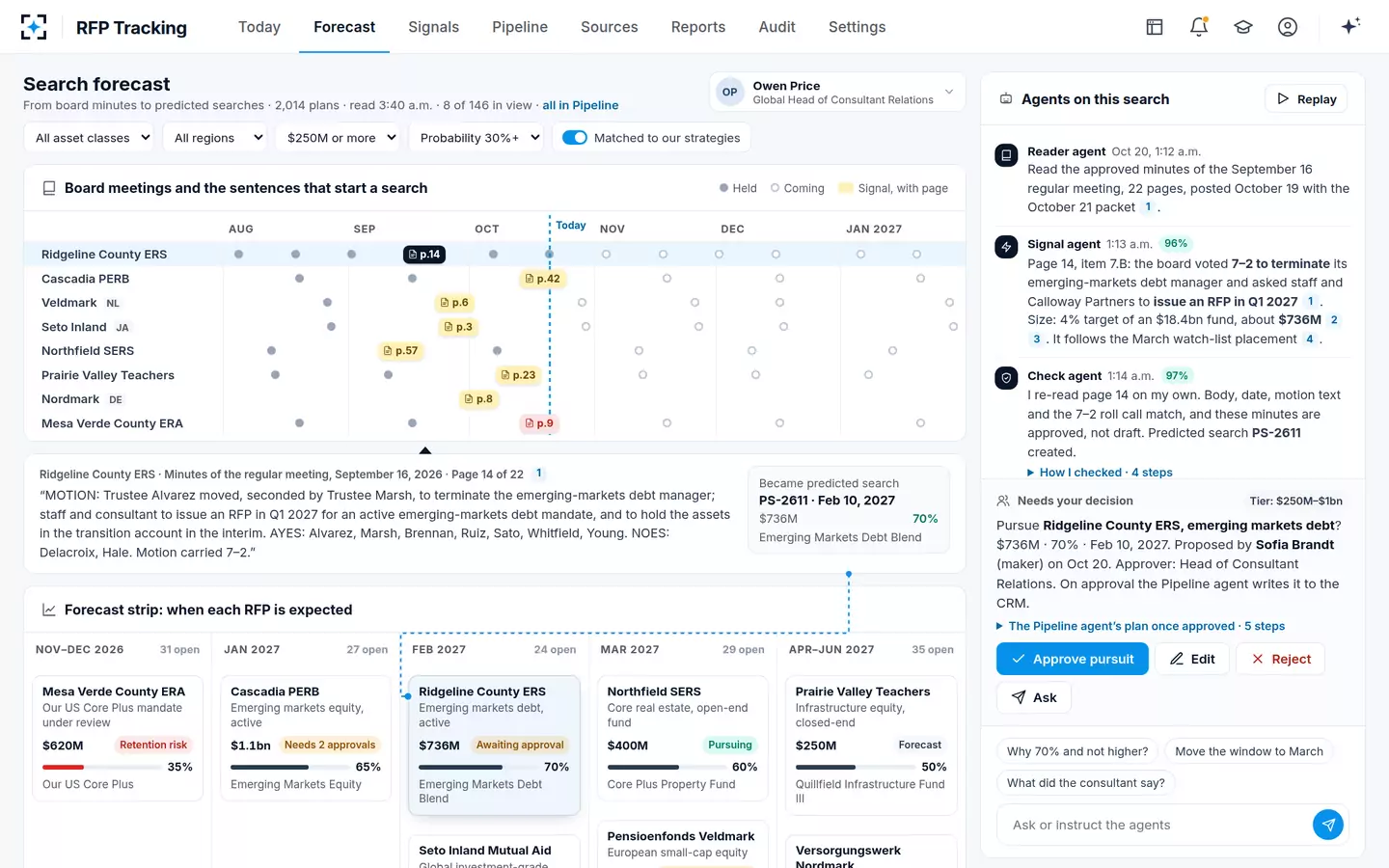
Few teams read that tier. A team with time for forty boards reads the forty largest, and in the Census Bureau's 2025 list the fortieth-largest system held about $39 billion. An $18 billion county plan, like the fictional Ridgeline County ERS in the solution's sample, would rank around 81st, and its board's vote to terminate a manager would be found, by most teams, when the RFP was issued. The solution's sample firm watches 2,014 plan sponsors and read 6,842 of their documents in October, in their own languages.
Board meetings of eight watched plans on one timeline, the signals marked by page
How many managers compete for public plan mandates?
The SEC's figures give the supply side. In its September 2026 proposal on the pay-to-play rule, the Commission reported that "1,518 advisers have clients that are State or municipal government entities, which represents approximately 9.24% of all advisers registered with the Commission (16,434)", based on Form ADV data as of December 2025 (91 FR 57698). It estimated 2,091 advisers in all are subject to the rule once advisers to pools with government investors are counted. Of the 1,518 with direct government clients, 700 were larger firms, 460 medium and 358 smaller.
That is the field a manager competes in for a public mandate, and it shows why the long tail matters. A large manager may win most of its public business from big systems, but there are only 113 systems above $10 billion and more than 1,500 advisers with government clients. The smaller plans' searches are where a manager can be early without being one of a hundred.
Largest public pension funds in the world: what US data can and cannot say
The Census Bureau's survey covers US state and local defined benefit systems only, so it cannot rank the world's largest public pension funds. Comparing across countries also mixes different things: national reserve funds, sovereign funds with pension mandates, occupational funds for public employees and social security reserves are often listed together. For funds outside the US, the reliable source is each fund's own annual report, read for its own definition of assets.
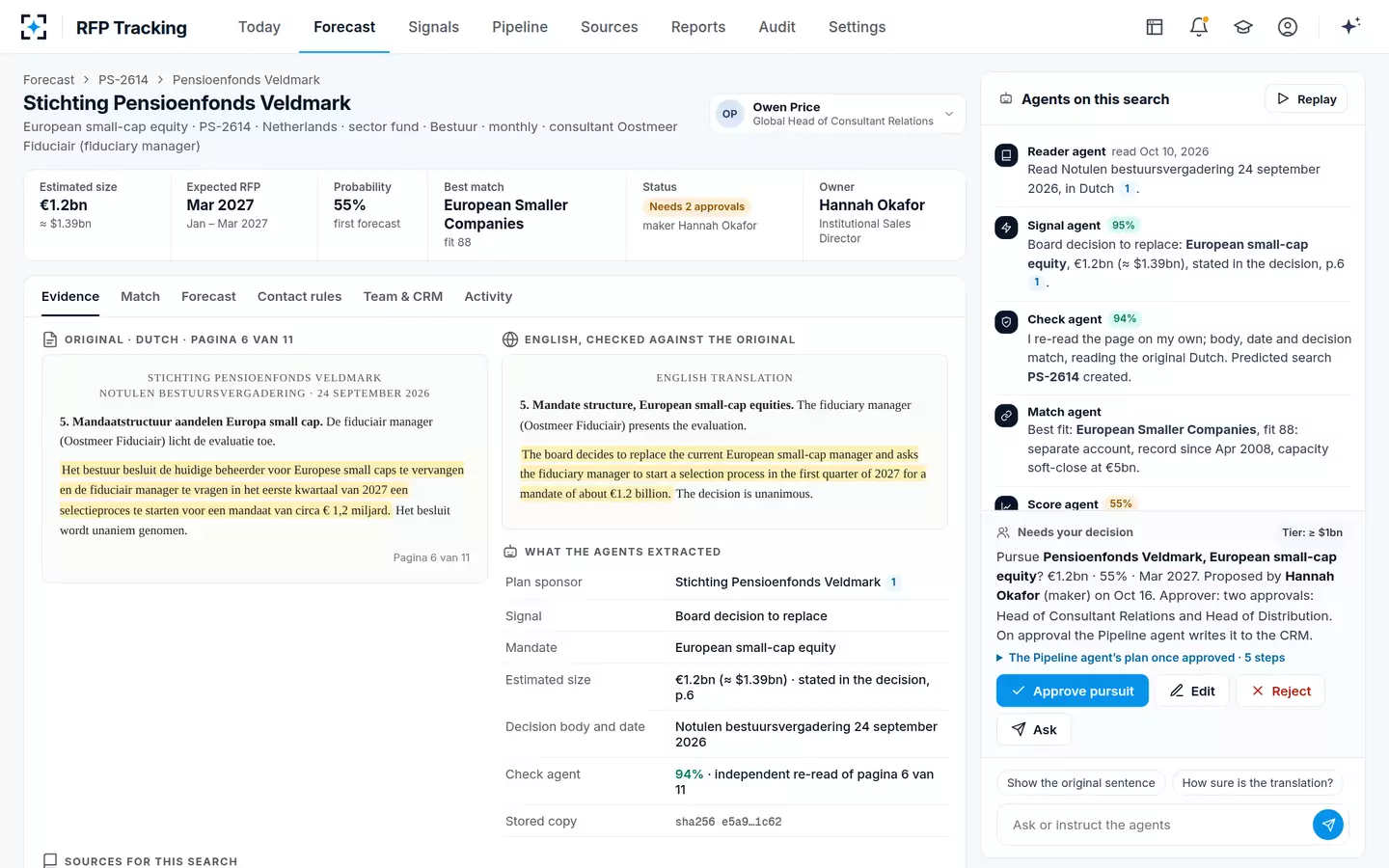
For a manager, the useful point is that many of those funds publish board decisions in their own language. In the solution's sample, a Dutch fund's decision to replace its European small-cap manager with a mandate of about €1.2 billion is read in Dutch and shown beside a checked English translation, and the search needs two approvals at the sample firm because it is over $1 billion.
A Dutch pension board's decision, read in the original with the English beside it
How to use the Census Bureau's pension data yourself
The data behind every number on this page is public. The Census Bureau publishes its Annual Survey of Public Pensions each year with an individual unit file listing each system it surveyed, its state, its type of government and dozens of items: total cash and investments, contributions, benefits paid, membership and, from the actuarial section, discount rates and covered payroll (ASPP 2025 datasets).
Three things to know before using it. Item RZ01 is total cash and investments, the measure ranked here. The survey is a full count only "every 5 years in years ending in '2' and '7'", with a sample in between, so smaller local systems carry sample weights; weight them, as here, to reproduce the published totals. And the file lists 1,949 systems for 2025, not 4,372: the rest are represented by the weights. A manager can join the file to its own CRM by plan name and see, in an afternoon, which systems above any size line it does not watch.
That list is where to start a watch list for RFP Tracking, and the first-time setup re-reads the last twelve months of those plans' board documents against the RFPs that actually landed; how that back-test works is set out separately. To see the watched plans and their searches together, start from RFP Tracking.
Questions people ask
What is the largest public pension fund in the US?
The California Public Employees' Retirement System. In the Census Bureau's 2025 survey its main fund, which the Bureau lists in three parts, held about $636 billion in cash and investments, ahead of the California State Teachers' Retirement System at about $415 billion.
How many public pension funds are there in the US?
The Census Bureau counted 4,372 state and local defined benefit systems in 2025: 311 state-administered and 4,061 locally administered. They held $6.49 trillion between them, with state plans holding $5.37 trillion and local plans $1.12 trillion.
Which states have the largest public pension assets?
California, with about $1.55 trillion across its state and local systems in 2025, then New York with about $730 billion and Texas with about $429 billion, by our arithmetic from the Census Bureau's unit file. Florida and Illinois each held a little over $260 billion.
Are local pension plans small?
Most are, but not all. The average local system held about $280 million in 2025, yet New York City's teachers' system held about $122 billion and the Los Angeles County Employees Retirement Association about $85 billion, larger than most state systems.
How much do US public pensions pay out each year?
$418.25 billion in benefits in 2025, up 3.40% from 2024, against $315.02 billion of contributions, of which governments paid about three-quarters, according to the Census Bureau.
Where can I find a list of US public pension funds?
The Census Bureau's Annual Survey of Public Pensions publishes an individual unit file each year with every surveyed system's name, state, government type and assets. It is the most complete public list, though smaller local systems are sampled in most years and represented by weights.