The investment manager selection process at a pension plan typically runs in six stages: the board sets an asset allocation that creates or changes a mandate; staff and the consultant review the asset class and the current manager; the board votes to search; an RFP or consultant search screens the candidates; finalists present; and the board votes to hire, followed by contracting and funding. Research on how plans actually hire and fire is less tidy than that sequence. Sponsors hire managers after strong past returns that do not persist, consultants' recommendations rest mostly on qualitative judgments and add no measurable value, and the make-up of a public board affects how well it chooses. For a manager, the lesson is that a search is largely shaped in public board papers and consultant research meetings before any RFP is written. Botminds' RFP Tracking reads those board papers for the plans a team watches, so the search before the search is visible while it can still be influenced fairly.
Four bodies of evidence on how plans choose managers, and what each means for a manager
Plan sponsors hiring and firing
3,400 plan sponsors, 1994–2003
Managers were hired after large positive excess returns that did not continue after hiring. Fired managers did about as well afterwards as the managers hired to replace them.
For a manager: A strong recent record gets a manager considered; it does not predict who wins, and a weak one is not the only reason for a termination.
Goyal and Wahal, Journal of Finance, 2008
Investment consultants
Consultants' ratings of US active equity funds
Recommendations were driven mostly by qualitative judgments rather than past returns, moved flows significantly, and showed no evidence of adding value.
For a manager: The consultant's view of the team and process is formed in research meetings, long before the RFP.
Jenkinson, Jones and Martinez, Journal of Finance, 2016
Public pension boards
Public pension funds' private equity investments
Boards with more state officials made weaker private equity choices, worse where the finance industry gave more political money; boards dominated by elected participants also lagged, by less.
For a manager: Who sits on the board shapes how it chooses, and is public in its minutes and statutes.
Andonov, Hochberg and Rauh, Journal of Finance, 2018
Consultants' conflicts
24 pension consultants registered as advisers
13 provided services to both plans and money managers; 14 had broker-dealer affiliations or relationships.
For a manager: The gatekeeper can have business with the managers it rates; plans are told to ask.
SEC staff examination report, 2005
What is the investment manager selection process?
The investment manager selection process is the sequence by which a plan decides it needs a manager, finds candidates, compares them and hires one. At a public plan each stage that commits the plan is a board decision, taken in a public meeting, and the stages in between are staff and consultant work that surfaces in the board packet.
Six stages of a public plan's manager search, and where each one becomes visible
A person decides
Board sets the allocationAn asset-liability study or a new target creates, enlarges or removes a mandate. Visible in the packet and the minutes.
A person decides
Staff and consultant reviewAn asset-class or structure review, a manager put on watch, a recommendation to the board. Visible in the packet.
A person decides
Board votes to searchA motion to terminate, or to issue an RFP. Visible in the minutes; in the solution's sample, months before the RFP.
Agent
RFP Tracking readsFinds the motion overnight, re-reads the page, sizes the search, matches a strategy and forecasts the RFP window with its reasons.
Never: contacts anyone; the plan's contact rules are checked first.
A person decides
RFP or consultant searchCandidates screened on the plan's criteria; a shortlist forms. Quiet-period rules govern contact by now, if not before.
A person decides
Finalists and the hirePresentations to staff or the board, a vote to hire, then contracting and funding.
Investment manager selection criteria: what plans weigh
Investment manager selection criteria fall into a handful of groups, whatever the RFP's wording: the fit of the strategy to the mandate (asset class, benchmark, vehicle, minimum size), the organisation (ownership, team stability, capacity), the investment process and its record, risk management and operations, fees, and the relationship and service the plan can expect. A consultant's research rating usually sits across several of these, which is why it carries so much weight.
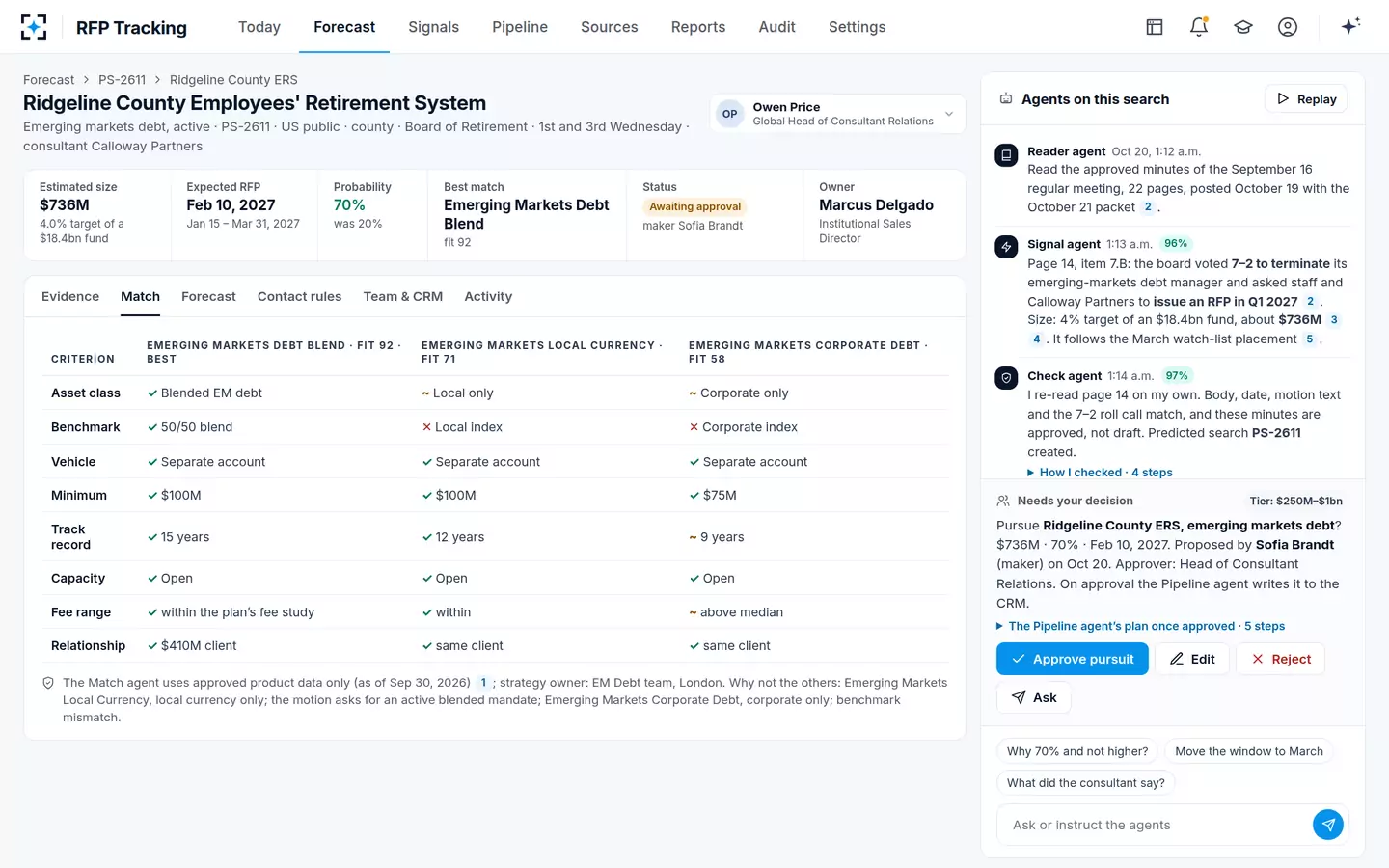
The fit criteria decide which strategy a manager should put forward, and getting that wrong wastes a finals slot; what the finals themselves turn on is covered in the research on the fund manager presentation. RFP Tracking's Match agent compares a firm's strategies on eight criteria, asset class, benchmark, vehicle, minimum, track record, capacity, fee range and relationship, using approved product data only.
Three strategies matched to one search on eight criteria
Do plans pick managers well? What the hiring research found
On the evidence, not especially. A study of how plan sponsors choose managers followed 3,400 sponsors' hiring and firing decisions from 1994 to 2003. Sponsors hired managers after large positive excess returns, and those returns did not continue after the hire; managers were fired for many reasons, not only underperformance; and in matched cases, the fired managers would have delivered about the same excess returns as the managers hired to replace them (Goyal and Wahal, Journal of Finance, 2008). The study's own words are quoted in a guide to evaluating a fund manager, and its use in watch-list design in a guide to watch-list criteria.
For a manager, two consequences follow. A strong recent record is the entry ticket to most searches, and nothing in the research says it should be. And terminations are not only performance events: team departures, organisational change and fees can appear in board papers as reasons, and a manager whose record is fine can still be the one put on watch. Both are written down, in public, before the search.
Do investment consultants add value?
A peer-reviewed study found no evidence that they do, at least in picking active equity managers. Studying consultants' recommendations of US actively managed equity funds, the authors found the recommendations were driven mostly by qualitative judgments rather than past performance, that they shifted fund flows significantly, and that there was no evidence the recommendations added value (Jenkinson, Jones and Martinez, Journal of Finance, 2016). The finding concerns recommendations' value to plans; it does not say consultants are not influential. The flows result says the opposite.
A manager should read that as a map of where the search is decided. If a consultant's view rests largely on judgments about the team, the process and the organisation, those judgments are formed in research meetings and due diligence visits, often well before a given search. By the time an RFP arrives, the consultant has a view, and the consultant relations team's job was to make it an informed one; the seats that carry that work are set out separately.
How board composition shapes manager selection
At a public plan, the board is the final decision-maker, and research shows its make-up matters. A study of public pension funds' private equity investments found weaker results where state officials held more board seats, partly driven by decisions "consistent with political expediency" and related to the finance industry's political contributions, and found a smaller shortfall on boards dominated by members elected from the plan's own participants (Andonov, Hochberg and Rauh, Journal of Finance, 2018).
"Boards dominated by elected rank‐and‐file plan participants also underperform, but to a smaller extent and due to these trustees’ lesser financial experience."
Andonov, Hochberg and Rauh, 'Political Representation and Governance: Evidence from the Investment Decisions of Public Pension Funds', Journal of Finance 73(5), 2018
Two practical points follow for a manager. Board composition is public, in the plan's statute and on its website, and it tells a reader how much a search will lean on staff and the consultant. And the political exposure of public boards is the reason for the contact rules around them: quiet periods during an RFP and the SEC's pay-to-play rule exist because the people who choose managers for public money are exposed to influence.
The consultant conflicts the SEC examined
In 2005 the SEC's examination staff looked at 24 pension consultants registered as investment advisers and found business ties to the managers they rated. More than half, 13, "provided products and services to both pension plan advisory clients and money managers and mutual funds on an ongoing basis"; of 13 that hosted conferences for plan clients, "eight also allow money managers to attend these conferences for a fee"; and "A majority of the pension consultants examined (14, or 58%) have affiliated broker-dealers or relationships with unaffiliated broker-dealers" (SEC staff report, May 16, 2005). The report is a staff report, more than twenty years old, and does not represent the Commission's findings, but its questions are still the ones plans ask.
What the SEC's 2005 examination of 24 pension consultants found
13of 24
served both pension plan clients and money managers on an ongoing basis
8of 13
consultants hosting plan conferences let managers attend for a fee
14of 24
had affiliated broker-dealers or relationships with unaffiliated ones
$70,000
a year, the top cost of performance software some consultants sold to managers
The Labor Department and the SEC turned the findings into questions for plan fiduciaries the same month. The first asks the consultant, "Are you registered with the SEC or a state securities regulator as an investment adviser?"; others ask whether the consultant or a related company has relationships with or receives payments from the managers it recommends, and whether it will "acknowledge in writing that you have a fiduciary obligation as an investment adviser to the plan" (DOL EBSA, Selecting and Monitoring Pension Consultants, May 2005).
Investment manager selection checklist for trustees
A trustee's checklist can be short if it is built on the evidence above: it guards against chasing recent returns, tests the consultant's independence and keeps the reasons for each decision on file.
Eight checks for a board hiring an investment manager
- Is the reason for the search written down?
A new allocation, a structure change or a termination, with the evidence for it in the packet.
- Has a passive or existing-manager option been priced?
The research finds new hires do no better on average than the managers they replace.
- Is recent performance the main screen?
Strong past excess returns did not persist after hiring in a study of 3,400 plan sponsors.
- What evidence does the consultant's rating rest on?
Ask for the research behind it, not only the rating.
- Has the consultant disclosed its business with the candidates?
The 2005 DOL and SEC questions, starting with payments from managers it recommends.
- Does the strategy fit the mandate on benchmark, vehicle, minimum and capacity?
A good manager in the wrong strategy is a poor hire.
- Are fees compared with the plan's own fee study?
And with the cost of the passive option.
- Are contact rules being applied to every candidate?
Quiet period and contribution checks, the same for all.
How to choose an investment manager: the plan's side of the same evidence
For an individual choosing an adviser, the questions differ, but the evidence on past performance still holds: a strong recent record is weak evidence of future skill. For an institution, the process above, an explicit reason for the search, a priced alternative, a fit test on the mandate and a disclosed consultant, is the practical answer to how to pick an investment manager. It is also what a well-run board's papers show, which is why those papers are so useful to the managers who read them.
What this means for a manager: the search before the search
Put the studies together and a search has two halves. The public half, the RFP, the finalist meeting and the vote, is where the process is visible to every competitor. The earlier half, the allocation change, the watch list, the consultant's review and the vote to search, is also public, but it is spread across thousands of board packets and is read by few. That earlier half is where a manager can do the legitimate work that matters: make sure the consultant's research on its team is current, decide which strategy fits, clear its contact plan with compliance and prepare its response before the clock starts.
RFP Tracking is built for that earlier half. On its fictional sample firm's year, it saw 52 of 61 relevant RFPs before they were issued, a median of 96 days earlier, each one cited to the board page that started it. How one board motion is traced to an approved pursuit shows the steps. To see the reading, matching and contact checks together, start from RFP Tracking.
Questions people ask
What are the steps in the investment manager selection process?
For a public plan, typically six: set the allocation and mandate, review the asset class and current manager, vote to search, screen candidates through an RFP or consultant search, hear finalists, and vote to hire before contracting and funding. Each board decision appears in public minutes.
What criteria do pension plans use to select investment managers?
Strategy fit (asset class, benchmark, vehicle, minimum, capacity), organisation and team, investment process and record, risk and operations, fees and service. In practice a consultant's research rating, which research finds rests mostly on qualitative judgments, carries much of the weight.
Do investment consultants add value when picking managers?
A study of consultants' recommendations of US active equity funds found no evidence that the recommendations added value, although they moved flows significantly (Jenkinson, Jones and Martinez, Journal of Finance, 2016). Consultants may add value in other ways, such as asset allocation and governance, which that study did not measure.
Why do pension plans fire investment managers?
For many reasons besides underperformance: team departures, organisational changes, fees, a change of structure or a new asset allocation. A study of 3,400 plan sponsors found terminations happened for a variety of reasons, and that fired managers did about as well afterwards as their replacements.
How long does an investment manager search take?
No regulator publishes a figure; it varies by plan. From the first board signal, the solution's sample firm saw RFPs a median of 96 days later on fictional data, and finalist meetings, the vote and contracting follow the RFP. A plan's own past minutes are the best guide to its pace.