A fund manager presentation is the meeting, and the deck behind it, in which a portfolio manager and a sales lead make the case for their strategy to a prospective client: at the finals of an institutional search, in front of a pension plan's investment committee, an endowment's trustees or a fund selector, usually with the client's investment consultant in the room. Peer-reviewed research on how those decisions are made gives a clear and slightly uncomfortable answer about what the presentation is for. Plan sponsors tend to hire managers after strong past returns, and those returns do not, on average, continue; consultants' recommendations rest mainly on qualitative judgments about people, process and organisation; and selected performance persuades even professionals unless the selection is plain. The deck that follows from that research leads with evidence of process and team, answers the consultant's own questions in their order, and shows performance complete and current. Botminds' Pitch Book Creation is built to make the last two parts dependable, so the portfolio manager's time goes to the first.
How one finals deck spends its 26 slides: as much on process and fit as on the record
What is a fund manager presentation, and who is it really for?
A fund manager presentation at the finals of an institutional search is for two audiences at once. The committee decides, and its members may be trustees, officials or elected plan participants rather than investment professionals; they are judging whether they would trust these people with the plan's money. The consultant advises; they know the strategy's record from their own database, have read the manager's RFP answers, and are testing whether what is said in the room matches what they already hold. A deck that impresses the first audience and contradicts the second has failed.
That is why a finals deck is not a longer factsheet. It is a structured answer to the questions the consultant set in the finals letter, in their order, with evidence the consultant can check and a story the committee can follow. In the sample, the consultant's letter asked twelve questions, from net and gross performance over 1, 3, 5 and 10 years to how the strategy would apply the endowment's fossil-fuel exclusion and what a $300 million account would cost. The research below explains why most of those questions are not about returns.
Do past returns win mandates?
Past returns win shortlists, and the evidence says they are a poor guide to what follows. In the largest study of the question, covering the hiring and firing decisions of 3,400 plan sponsors from 1994 to 2003, sponsors hired managers after large positive excess returns, but that record did not carry on after the hire; managers were fired for a range of reasons, not only underperformance, and in round trips of firing and hiring the fired managers would have delivered returns no different from their replacements (Goyal and Wahal, Journal of Finance, 2008).
For a presenter that cuts both ways. A strategy that reached the finals almost certainly has a strong recent record; every finalist does, so the record alone does not separate them. And a deck that leans on the last three years invites exactly the question the research raises: why should this continue? A presentation that explains where the returns came from, and what in the process would repeat them, answers it. On the sample deck the consultant's second question was precisely that: sources of excess return over the last twelve months.
Five findings about how managers are chosen, and what each means for the deck
Goyal and Wahal, Journal of Finance, 2008
Studied
3,400 plan sponsors’ hiring and firing decisions, 1994–2003.
Found
Sponsors hired managers after large positive excess returns, and those returns did not continue after hiring. Fired managers, had they been kept, would have done about as well as their replacements.
The record wins the shortlist; it is a weak argument for what happens next.
Jenkinson, Jones and Martinez, Journal of Finance, 2016
Studied
Investment consultants’ ratings of US actively managed equity funds.
Found
Recommendations rested mainly on qualitative judgments rather than past returns, moved money significantly, and showed no evidence of adding value.
The consultant in the room is weighing people, process and organisation.
Koehler and Mercer, Management Science, 2009
Studied
Fund advertisements, and two experiments with investors and professionals.
Found
Firms advertised their best funds; both novices and professionals read selected figures as typical unless the selection was made plain.
Show the record in full and say how it was chosen; it is fairer and more credible.
Sirri and Tufano, Journal of Finance, 1998
Studied
Flows into and out of US equity mutual funds.
Found
Investors bought on prior performance, disproportionately the top performers, and search costs shaped where money went.
Being easy to evaluate is an advantage in itself.
Gennaioli, Shleifer and Vishny, Journal of Finance, 2015
Studied
A model of investors delegating money to professional managers.
Found
Trust lowers how risky investors perceive an investment to be, and lets managers charge fees above cost.
A finals deck is an exercise in earning trust, which a single wrong number can spend.
What do consultants weigh besides performance?
Consultants weigh mainly qualitative factors: the people, the process, the organisation and its stability. A study of investment consultants' recommendations of US actively managed equity funds found that the ratings were driven largely by such soft factors rather than by past performance, that they moved significant flows, and that there was no evidence the recommended funds did better (Jenkinson, Jones and Martinez, Journal of Finance, 2016). Whatever one makes of the last finding, the first tells a manager where the consultant's attention goes.
A finals deck should therefore make the qualitative case checkable. Team stability is a slide with names, roles, tenure and the succession plan, dated; the sample consultant asked about team changes in the last three years. Process is a slide that shows how an idea becomes a position and what happens when it goes wrong. Capacity is a figure with a definition: the sample deck shows strategy assets of $17.6 billion against capacity of $30 billion. Each is a claim the consultant can test against what they already know, and the rule bars any material statement of fact the firm could not substantiate if asked (Rule 206(4)-1(a)(2)).
The search behind the finals, how plans and consultants build the long list and the short list, is a subject of its own, covered in the investment manager selection process guide. By the time a manager is presenting, that work is done; what remains is whether the room believes the process is real.
Why selected performance persuades, and how to present it so it does not mislead
Selected performance persuades because readers, including professionals, do not discount for the selection. In an archival study, fund companies advertised their better performers: the median advertised fund ranked between the 79th and 100th percentile. In experiments, novice investors and financial professionals alike treated advertised figures as representative unless the advertisement made the selection visible; a simple cue about the full set of funds reduced the effect (Koehler and Mercer, Management Science, 2009).
The Marketing Rule's performance conditions read like a regulatory version of that cue. Outside private funds a deck must show one-, five- and ten-year returns to a date no earlier than the latest calendar year-end, with equal prominence, and net beside every gross; it may not include or exclude results, or choose periods, in a way that is not fair and balanced (Rule 206(4)-1(a)(6), (d)(1) and (d)(2)). A presenter who shows the full record, including the weak year, and explains it, is doing what the research says builds credibility with sophisticated readers.
Flows research points the same way from the investor side. Fund buyers base purchases on prior performance, but asymmetrically, putting disproportionately more money into the very best recent performers, and lower search costs, such as a larger fund family or more media attention, bring more flows (Sirri and Tufano, Journal of Finance, 1998). For an institutional finalist the lesson is about ease of evaluation: a deck whose figures tie to the consultant's database without translation lowers the cost of saying yes.
Trust is the product: what the presentation is really selling
What a finals presentation sells is trust in the people who will manage the money, and economic theory treats that trust as what lets managers charge fees at all. In a model of investors delegating to professional managers, trust lowers an investor's perception of risk and lets managers charge fees that do not fall to cost (Gennaioli, Shleifer and Vishny, Journal of Finance, 2015). The same paper has a warning for anyone tempted to tell a room what it wants to hear.
When investors hold biased expectations, trust causes managers to pander to investor beliefs.
Gennaioli, Shleifer and Vishny, 'Money Doctors', Journal of Finance, 2015
Pandering in a finals deck looks familiar: a backtest that shows how the strategy would have done under the client's exclusion policy, a peer ranking with no date, a case study about the one holding that worked. Each makes the deck more pleasing and less true, and each is a Marketing Rule finding. In the sample deck all three appeared in the draft, and all three were fixed before compliance saw it: the backtest replaced with the actual holdings impact of the exclusion, two holdings and 0.9% of the portfolio; the ranking given its date, period and payment status; the case study balanced with the five largest contributors and detractors.
Answer the consultant's questions, in their order
The most reliable way to show process is to answer the consultant's questions where they will look for the answers. A finals letter is the consultant's agenda; a deck in the firm's standard order makes the consultant hunt, and a committee member who cannot find the answer to question 4 on page 4 assumes it is not there. In the solution the Intake agent reads the finals letter or RFP and lists its questions, each cited to its page, and the deck maps every question to the slide that answers it.
An RFP read in its own language, every question cited to its page
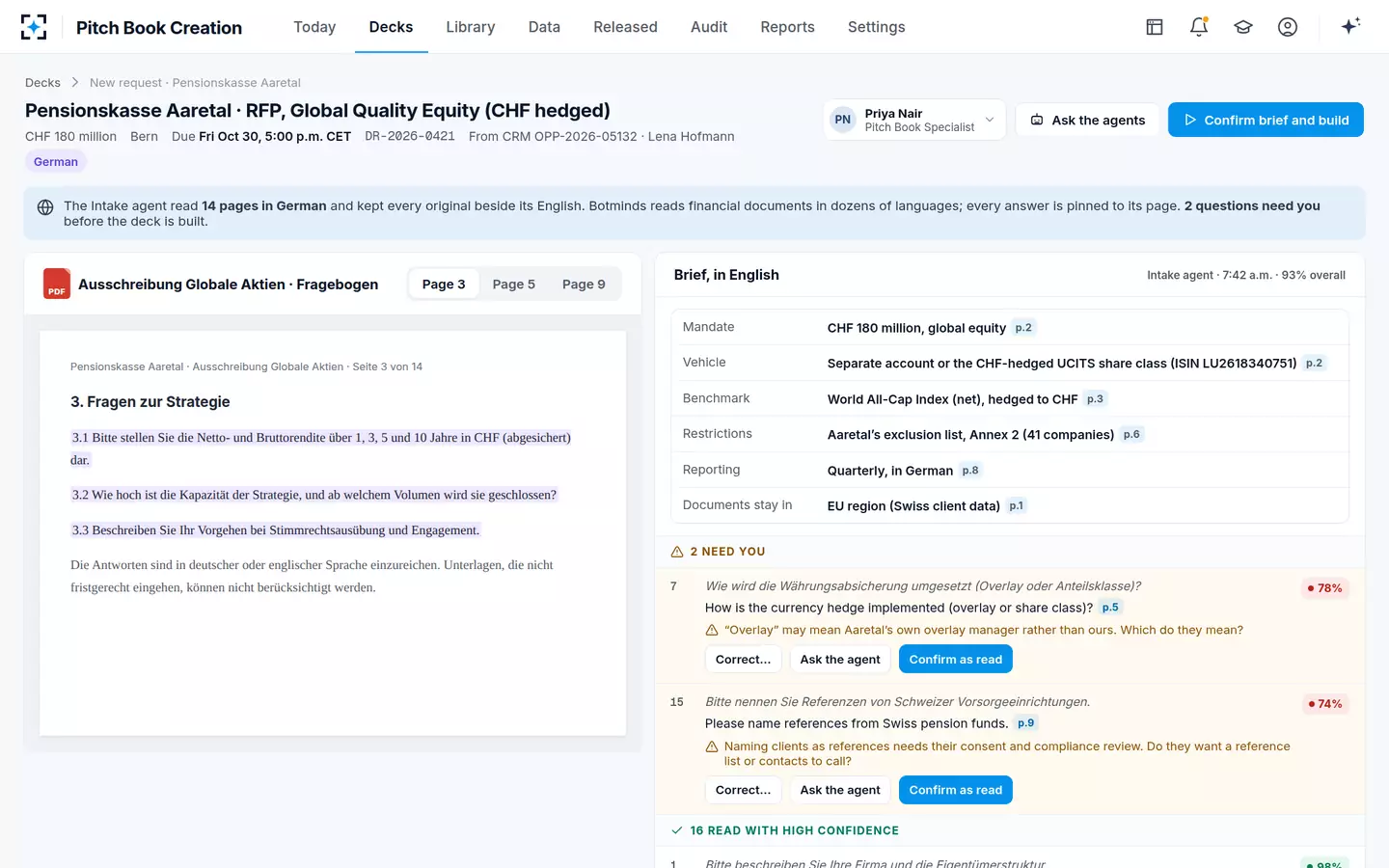
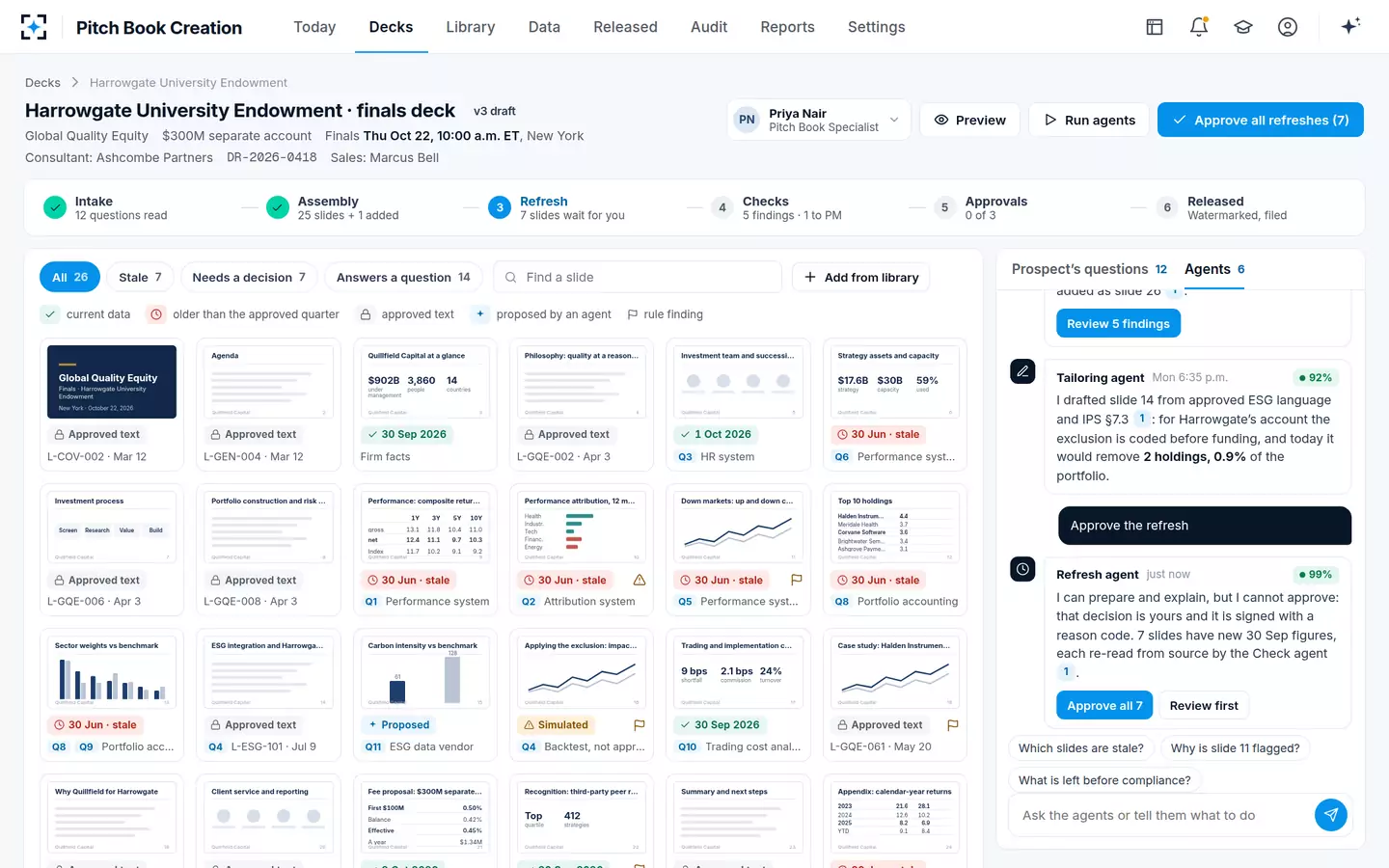
The same discipline applies to tailoring. The sample consultant's fourth question asked how the strategy would apply the endowment's fossil-fuel exclusion. The Tailoring agent drafted that slide from the firm's approved ESG language and the client's policy, and the answer is a fact about the portfolio today, not a simulation of the past. The portfolio manager confirms commentary and any new claim before release, which is where his time belongs: on the questions only he can answer.
Tailored text drafted from approved language and the client's policy, for the PM to confirm
What the research means for a finals deck
Put together, the research gives a short set of rules for anyone building or presenting a finals deck. None of it is about design, and all of it is about evidence.
Seven rules for a fund manager presentation, drawn from the evidence
- Lead with process, not the last three years
Every finalist has a strong recent record; explain what produced yours and why it would repeat.
- Make the soft factors checkable
Team names and tenure as of a date, the succession plan, capacity with its definition.
- Follow the consultant’s order
One slide per finals question, in their sequence, with the question visible.
- Show the whole record
One, five and ten years, net with gross, the weak year included and explained.
- Explain changes before they are asked
If the one-year number fell since the semifinal, say why on the page.
- Answer the client’s policy with facts
What the portfolio holds today under their constraint, not a backtest of what it might have done.
- Never let a figure contradict the consultant’s file
Assets, returns and team must match the database and the RFP answers, or say why they differ.
The fifth rule is the one most decks miss. In the sample, the one-year net return fell from 12.4% to 9.8% between the June and September quarters, because a strong quarter dropped out of the window, while the composite stayed ahead of its index at 8.1%. A committee that saw 12.4% at the semifinal and 9.8% at the finals will ask; a deck that already says why turns a doubt into evidence that the manager knows its own numbers. The professional standard agrees: CFA Institute's Standard III(D) asks members to make reasonable efforts to ensure performance information is fair, accurate and complete (Standard III(D), updated April 2024).
Where Pitch Book Creation fits in the finals week
The solution takes the parts of finals week that research says matter least to the decision and most to the risk: collecting and refreshing figures, re-reading each from its source, checking every slide against the Marketing Rule, and filing the released version. That leaves the specialist and the portfolio manager the parts the research says decide the room: the story of the process, the answers to the consultant's questions and the rehearsal. The seats involved are described in the six seats around a finals deck. To see it on your next finals, start from Pitch Book Creation.
Questions people ask
How long should a fund manager presentation be?
As long as the consultant's agenda allows, which the finals letter usually sets. The deck should hold one slide per question asked plus the required performance and disclosure pages. The sample finals deck is 26 slides, about a fifth of them on process and people.
Who should present at a finals meeting?
The people the committee would be hiring: the lead portfolio manager, ideally with a second investment team member, and the relationship manager or sales director who will own the client. Consultants weigh people and process heavily, so a finals team without the investment decision-makers leaves the room's main question unanswered.
Should a finals deck lead with performance?
Usually not. Every finalist has a strong record, and research on 3,400 plan sponsors found hired managers' strong prior returns did not persist afterwards. Lead with the process that produced the record, then show the full record, net with gross over the required periods, and explain any recent change.
Do consultants' recommendations predict performance?
A 2016 Journal of Finance study of investment consultants' ratings of US equity funds found their recommendations were driven mainly by qualitative factors, moved significant flows, and showed no evidence of adding value. For a manager, the practical point is that the consultant's judgment of people and process is what the finals deck has to satisfy.
What makes a good investment presentation PowerPoint?
A clear order that follows the audience's questions, one point per slide, every figure dated and sourced, and performance shown in full rather than selected. Design helps the committee follow; evidence decides. For an adviser it must also meet the SEC Marketing Rule, since a finals deck shown to a prospect is usually an advertisement.
What is a portfolio management presentation?
It is the part of a fund manager presentation in which the portfolio manager explains how the strategy is run: the investment philosophy, how ideas are researched and sized, how risk is controlled and how the portfolio looks today. In a finals deck it is the section the research suggests consultants weigh most.