Asset management marketing divides one job, winning and keeping mandates, into seats that each own a different part of the same document. Around an institutional finals deck there are usually six: the pitch book specialist who builds it, the portfolio manager and product specialist who own what it claims, the sales director who owns the client, performance measurement who decides when a number is final, marketing compliance who approves its release, and the head of institutional marketing who runs the desk. The work is hard because a deck crosses all six in a few days, and every figure in it lives in a system none of them controls alone. Botminds' Pitch Book Creation is an agentic solution built for that desk: agents read the request, assemble the deck from approved slides, refresh and re-read every figure and apply the SEC Marketing Rule, while each person signs only what their seat already signs.
The examples below follow one deck through the solution: Quillfield Capital, a fictional asset manager, preparing for a fictional endowment's finals. Its people, prospects and figures are sample data.
One finals deck passes through six seats, and the agents work between them
A person decides
Sales directorMoves the opportunity to finals in the CRM and states what the consultant asked for. Approves the deck’s content.
Agent
Intake and assemblyReads the finals letter and the client’s policies, lists the questions, and builds a draft from approved slides in the prospect’s order.
Never: invents a question or uses an expired slide.
A person decides
Pitch book specialistOwns the deck as its maker: approves refreshed figures and fixes, tailors the story, submits for release.
Agent
Refresh and checkProposes the latest approved figures, then a second agent re-reads every one from its source without seeing the first.
Never: uses preliminary data or changes a slide itself.
A person decides
Portfolio managerConfirms commentary, any figure that does not tie, and any new claim.
Agent
Marketing Rule checkChecks each slide against Rule 206(4)-1 and the staff FAQ, proposes a fix for each finding.
Never: approves a deck or removes a disclosure.
A person decides
Marketing complianceReviews what changed since the last approved version and approves the release, or returns it with a reason.
Which marketing roles touch an asset manager's pitch book?
Six roles touch every institutional pitch book, and at large firms each is a separate job title. The maker is the pitch book specialist, also called a presentation specialist, marketing specialist or RFP writer depending on the firm. The content owners are the portfolio manager and, at firms that have them, the product specialist who speaks for the strategy between meetings. The client owner is the sales director or relationship manager. The data owner is performance measurement. The checker is marketing compliance. Above them sits the head of institutional marketing, who sets the template, the slide library and the turnaround the desk promises sales.
Smaller firms fold the seats together, but the functions do not disappear. A boutique where the portfolio manager builds her own deck still has a maker, a content owner and someone who signs the release, and the Marketing Rule asks the same questions of the result. What changes with size is how many of the handoffs happen inside one head, and how many happen by email.
Two other seats appear around a deck without owning it. Consultant relations manages the investment consultant who runs the search and often sets the finals agenda; their side of the work, tracking which searches are coming, is set out in the guide to consultant relations management. Internal audit samples released decks later, for compliance testing and for an SEC examination, and needs each deck with its sources and approvals in one file.
The pitch book specialist: the maker who owns the deck, not the numbers
The pitch book specialist owns the deck as an object: its order, its story, its deadline and its version history. They do not own a single figure in it. Returns belong to performance measurement, holdings to portfolio accounting, attribution to the attribution system, team biographies to human resources, peer rankings to a data vendor. The specialist's craft is assembling those into an answer to one prospect's questions, in the prospect's order, by the consultant's deadline.
In the sample firm the specialist, Priya Nair, owns nine open decks and builds three or four a week. Her description of the job before the agents is the one most specialists would give: copy last quarter's deck, chase the new numbers from five systems, rebuild the charts, and hope nobody finds an old figure first. Her words for what she wanted were "Tell me which numbers are old before the client does."
The portfolio manager and product specialist: owners of every claim
The portfolio manager owns what the deck says about the strategy, and the Marketing Rule makes that ownership concrete. An advertisement may not contain a material statement of fact that the adviser has no reasonable basis to believe it can substantiate if the SEC asks, under Rule 206(4)-1(a)(2). Every claim about process, capacity, risk or results therefore needs someone who can say where it comes from, and on the investment side that person is the portfolio manager or the product specialist who speaks for them.
The seat's problem is volume. A lead portfolio manager on a popular strategy is asked to approve commentary and answer figure questions on every deck that carries it, often several a week, and most of those questions are about arithmetic the PM did not do. The sample firm's PM, Tomás Ferreira, put it bluntly: "Don't make me check your math. Show me the source."
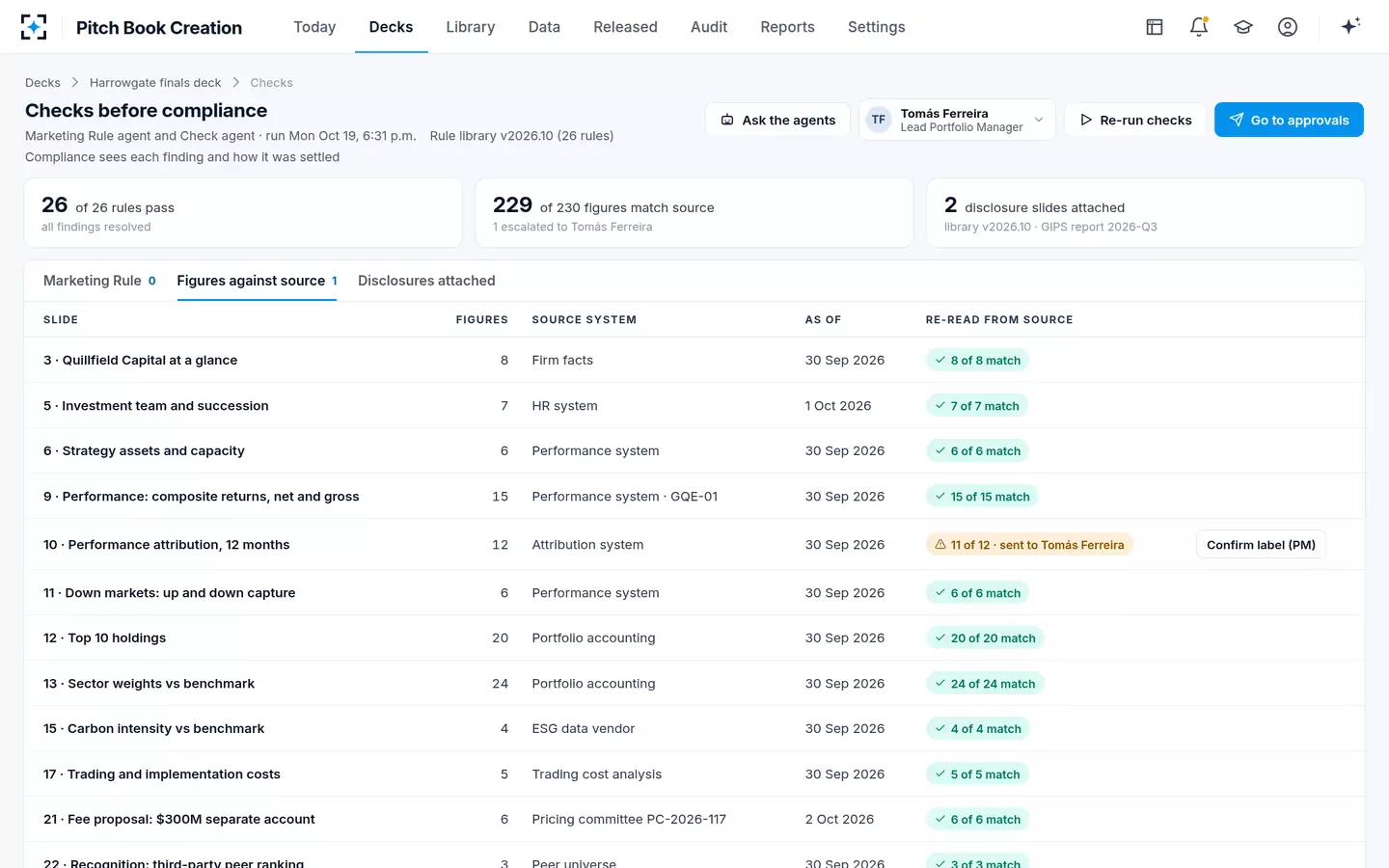
In the solution the PM sees only what needs a judgement. On the sample deck that was one figure and one slide. The holdings-based attribution total on slide 10 was +2.2%, the composite's gross excess return +2.4%. The Check agent did not choose between them; it sent both values and both sources to the PM, who confirmed the label: attribution before fees, with the remaining +0.2% from trading and cash. He also approved a proposed carbon slide for one of the consultant's questions. Everything else had already tied to its source.
The portfolio manager's view: 229 figures tie, one comes to him
Sales and consultant relations: the client owner approves content, never release
The sales director owns the relationship and the request: what the consultant asked, what the trustees care about, what the competition is likely to show. That makes sales the right seat to approve a deck's content, and the wrong seat to approve its release, because the person paid to win the mandate is the person with the strongest reason to let a flattering slide through. A firm's policy can separate the two; the solution enforces it, with a release button the sales director does not have.
Consultants make the seat matter more than it appears. In the SEC's adopting release for the Marketing Rule, materials an adviser gives consultants and other intermediaries to pass on count as the adviser's own indirect communications (86 FR 13024, 2021). And the consultant is a powerful reader: in a study of US equity funds, consultants' recommendations rested largely on soft factors rather than past returns, and moved flows significantly, with no evidence that they added value (Jenkinson, Jones and Martinez, Journal of Finance, 2016). What a finals deck should therefore lead with is the subject of what the research says finals are decided on.
Performance measurement: the seat that decides when a number exists
Performance measurement is easy to leave off a list of marketing roles, and it is the seat every other seat depends on. Until the quarter's composite returns are approved, no figure for that quarter should reach a deck; once they are, every open deck that shows the old quarter is out of date at once. The Advisers Act books and records rule makes the same seat answerable later: an adviser must keep the records needed to form the basis for, or demonstrate the calculation of, any performance it advertises, under Rule 204-2(a)(16).
That moment of approval is where a refresh begins. In the sample, performance measurement approved the third quarter at 6:02 p.m. on a Monday. By the next morning the Refresh agent had proposed 2,418 new figures across 23 open decks, each waiting for its own deck's maker, and the Check agent had re-read all 230 figures in the endowment's finals deck. Seven of its 26 slides still showed June figures. The mechanics of that refresh, and why a linked chart cannot do the same job, are on PowerPoint automation from Excel.
Who approves a pitch book before a finals meeting?
At an SEC-registered adviser, the firm decides who approves a pitch book: the Marketing Rule sets what an advertisement may contain, not who must sign it. When the SEC proposed the rule it went further. In the adopting release the Commission notes that "The proposed rule also would have required internal review and approval of most advertisements", and it did not adopt that requirement (86 FR 13024). The obligation that remains is the compliance rule: written policies and procedures reasonably designed to prevent violations, reviewed at least annually, under Rule 206(4)-7.
Many advisers meet it with pre-approval: the SEC's examiners reported in April 2024 that many advisers required advertisements to be approved before dissemination (SEC risk alert), and for a finals deck that is the sensible default. The SEC's own release lists pre-review and approval of advertisements as one effective tool among several, alongside risk-based sampling and pre-approved templates. A broker-dealer's rules are firmer: under FINRA Rule 2210, a registered principal must approve each retail communication before use, and institutional communications need written review procedures. Where a fund's distributor or a placement agent uses the deck, both regimes can apply to the same pages.
In the sample firm the order is fixed in the solution's settings: the specialist prepares, the portfolio manager confirms, the sales director approves content, and marketing compliance approves the release. The maker can never approve the release. Hannah Okafor, the sample firm's vice president of marketing compliance, reviews about 40 pitch books a week, and on the finals deck she approved the release 40 minutes after it was submitted, with every finding already settled before it reached her.
Where a finals day goes: in the handoffs, not the keystrokes
Most of the elapsed time on a finals deck is waiting between seats, not work inside one. No regulator or independent study publishes how long a pitch book takes to build, so the useful number is your own: log when each seat receives the deck and when it hands it on, for ten recent decks, and the queue shows itself. The sample firm's finals day, as the solution recorded it, makes the point even with the mechanical work done overnight.
Even with the figures done overnight, the finals day is mostly hand-offs
- Maker reviews the refresh30 min
- Waiting for the PM1 h 20
- Sales approves content40 min
- Maker finishes and submits2 h 45
- Compliance approves release40 min
Two lessons travel. First, none of the blocks is mechanical work: the refresh and the re-read had run overnight, so every block on the day is a person reading, deciding or finishing, and the longest is the maker's own. Second, the people steps are short because each person sees only their decision: the PM one figure and one slide, sales the content, compliance what changed since the last approved version. A deck that reaches each seat with the mechanical questions already answered moves at the speed of judgement.
What changes for each seat when agents do the mechanical part
No seat disappears; each loses the part of its week that was copying, chasing or re-reading. That is the honest promise of agents on a pitch book desk, and it matters for staffing conversations: the signatures, the editorial choices and the client relationship stay exactly where they were.
Six seats, before and after, and what each one keeps
Today
Copies last quarter’s deck, chases figures from five systems, rebuilds charts, sends drafts around by email.
With agents
Opens a deck with a data stamp on every slide, approves refreshed figures and proposed fixes, and spends the time on tailoring.
Still theirs: the deck, its story and every approval of a refresh
Today
Answers figure questions and approves commentary on every deck that carries the strategy.
With agents
Sees only differences that need a judgement, each with both values and both sources.
Still theirs: every claim about the strategy
Today
Requests the deck by email and checks that it answers the consultant’s questions.
With agents
Sees each finals question mapped to the slide that answers it, and approves the content.
Still theirs: the request and the content approval, never the release
Today
Fields requests for the same composite figures from every deck builder at quarter-end.
With agents
Approves the quarter once; the approved values flow to every open deck as proposals.
Still theirs: when a number becomes final
Today
Reads each deck end to end against the Marketing Rule, sometimes for the second or third time.
With agents
Reviews what changed since the approved version, slide by slide, with each finding already settled or argued.
Still theirs: the release, and every correction after a restatement
Today
Reassembles a deck’s sources and approvals from email when it is sampled.
With agents
Exports one evidence file per released deck: the PDF, its sources, its checks and its approvals.
Still theirs: independent testing
Marketing compliance and the evidence file a released deck leaves behind
The release seat signs something that will be asked about later, sometimes years later. An adviser must keep a copy of each advertisement it disseminates, directly or indirectly, under Rule 204-2(a)(11), and keep it for five years from the end of the fiscal year in which it was last disseminated, under Rule 204-2(e)(3)(i), the first two years in an appropriate office (17 CFR 275.204-2). The clock starts at the last use, not the first, so a deck reused into January keeps the archive open a year longer.
The release: who signed, in order, and what compliance actually reviewed
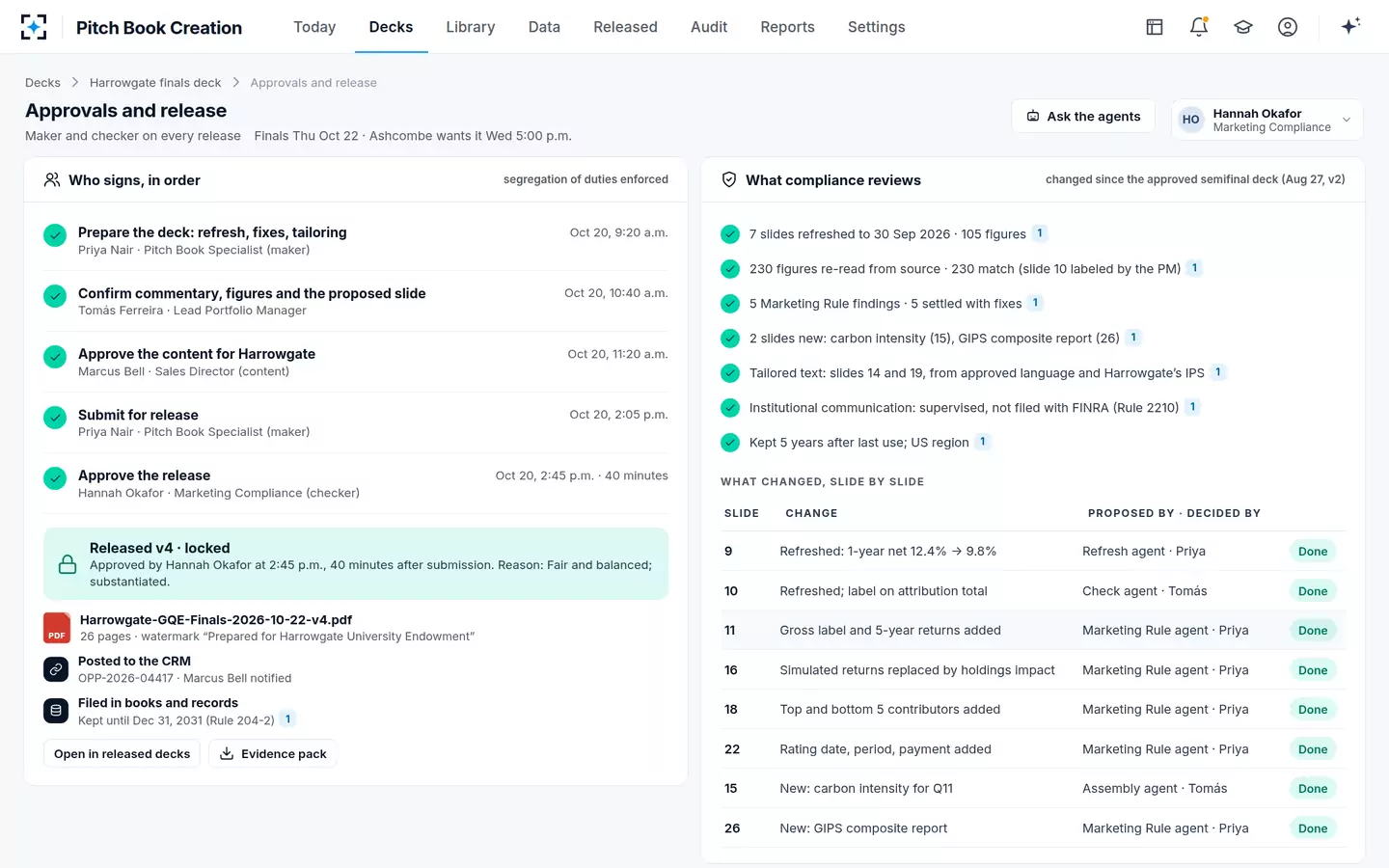
What the seat needs from everyone upstream is therefore not just a correct deck but a reconstructable one: which version was released, to whom, with which figures, from which sources, approved by whom and why. That is the difference between a review that passes and a review that can be defended, a distinction worked through in marketing materials review.
Mapping your own desk before you change it
Before any tool, write down who holds each seat for one real deck. The exercise usually finds a seat held by nobody, most often the data owner for a figure that comes from a spreadsheet, and a seat held by two people who each assume the other signed.
Six questions that map a pitch book desk in an afternoon
- Who is the maker of each open deck?
One named person per deck. A deck with two makers has none when a figure turns out stale.
- Who owns each figure type?
Returns, holdings, attribution, assets, team data, peer rankings, ESG data. Name the system and the approver for each.
- When does a quarter become final?
The time performance measurement approves it, and how decks learn that it happened.
- Who approves content, and who approves release?
If they are the same person for any deck type, write down why.
- What does compliance see?
The whole deck every time, or the changes since the last approved version.
- Where does the released version live?
One copy, locked, with its sources and approvals, kept five years from its last use.
To see the six seats working on one deck, from the finals letter to the locked release, start from Pitch Book Creation.
Questions people ask
What does a pitch book specialist do at an asset manager?
A pitch book specialist builds the presentations sales and portfolio managers take to prospects and clients: intro pitches, finals decks, client review decks. The seat assembles approved content, inserts the latest approved figures, tailors the story to the prospect's questions and steers the deck through portfolio manager, sales and compliance approval.
Which marketing functions does an asset manager run?
The common seats are pitch book or presentation specialist, RFP writer, consultant database coordinator, product specialist, content or campaign manager, marketing compliance analyst and head of institutional or intermediary marketing. Institutional firms weight the list toward RFPs, consultant databases and finals decks; retail and wholesale firms toward fund literature and advisor marketing. Each owns a different document, but most draw on the same approved figures.
Is a presentation specialist the same as a pitch book specialist?
Usually yes in asset management, where the two titles describe the same seat: the person who builds and maintains prospect and client presentations. Some firms reserve "presentation specialist" for design and formatting and give the content and data work to a marketing or RFP specialist. What matters is whether one named person is the maker of each deck.
Who owns the performance figures in a pitch book?
Performance measurement owns them: it calculates and approves the composite returns, and the adviser must keep the records that demonstrate any advertised calculation under SEC Rule 204-2(a)(16). The pitch book specialist places the approved figures; the portfolio manager explains them. A deck that shows a figure no one in performance measurement would recognise is the most common way a review is lost.
Does every pitch book need compliance approval?
The SEC Marketing Rule does not require pre-approval; the SEC proposed it and did not adopt it. Advisers must have written policies reasonably designed to prevent violations, and many require compliance to approve finals decks before use. A broker-dealer must have a registered principal approve each retail communication under FINRA Rule 2210.
What does a head of institutional marketing do?
The head of institutional marketing runs the desk that produces RFPs, consultant database profiles and pitch books: the templates, the slide library, the turnaround times promised to sales and the people who meet them. In the solution the seat also owns the settings, such as how fresh each data type must be.