A hedge fund pitch deck is the presentation a manager uses to raise money for a private fund: the strategy, the team, the track record, the risks, the terms and the operations behind them. Under the SEC Marketing Rule, a deck an adviser uses to offer interests in a private fund it advises to prospective investors is an advertisement, so most of the rule applies to it exactly as it does to a separate-account pitch book. What changes for a private fund is specific and worth knowing precisely: the one-, five- and ten-year performance requirement does not apply, hypothetical performance sent to a private fund investor one-on-one falls outside the first part of the definition, and broker-dealer placement agents now have an SEC-approved route to show projected and targeted returns to some investors. Botminds' Pitch Book Creation runs the same Marketing Rule checks on a private fund deck with the rules set for that audience, and sends every hypothetical to compliance whatever the audience.
A private fund deck: what it is exempt from, and what it is not
- Exempt: the one-, five- and ten-year periods
Rule 206(4)-1(d)(2) applies to portfolios “other than any private fund”. The general prohibition on unfair time periods still applies.
- Narrowly exempt: hypotheticals one-on-one
Hypothetical performance sent to a private fund investor in a one-on-one communication, or in answer to an unsolicited request, is outside the first prong of the definition.
- Not an advertisement: the PPM’s terms
The SEC said information in a PPM about the offering’s material terms, objectives and risks is not an advertisement. The deck that travels with it can be.
- Not exempt: net with gross
Every gross return needs net beside it, same period, same method, including gross and net IRR for funds that report them.
- Not exempt: extracted and related performance
A carve-out or a single position’s return needs the total fund’s performance, or an offer to provide it promptly.
- Not exempt: hypotheticals in a deck sent widely
Backtests, model and targeted returns need policies on relevance to the audience and enough information to understand them.
- Not exempt: ratings, testimonials and the general prohibitions
Dates and periods on rankings; disclosures on testimonials; nothing untrue, unsupported or unbalanced.
Is a hedge fund pitch deck an advertisement?
Usually yes. The Marketing Rule defines an advertisement to include any direct or indirect communication an adviser makes to more than one person that offers its advisory services to prospective clients or to prospective investors in a private fund it advises, or offers new services to current ones (Rule 206(4)-1(e)(1)). A deck used across a capital-raising campaign meets that test, and so does a template deck tailored with each prospect's name.
The SEC drew the boundary with private funds in mind. In the adopting release it agreed that the information in a private placement memorandum about the material terms, objectives and risks of an offering is not an advertisement, and that account statements and presentations to existing investors about the funds they hold are not either. Then it added the sentence every fund marketer should know.
However, pitch books or other materials accompanying PPMs could fall within the definition of an advertisement.
SEC, Investment Adviser Marketing, adopting release, 86 FR 13024 (2021)
So the deck that goes out with the PPM, the one with the track record and the team, is where the rule bites. The practical consequence for a hedge fund's investor relations team is to keep the two documents distinct: offering terms and risk factors in the PPM, under the antifraud provisions; the marketing case in the deck, under the Marketing Rule's full set of conditions, with a copy of each version kept as the books and records rule requires (Rule 204-2(a)(11)).
What a private fund deck is exempt from, and why it matters less than it looks
The best-known difference is that a private fund deck need not show one-, five- and ten-year returns ending at the latest calendar year-end. The requirement in Rule 206(4)-1(d)(2) covers the performance of any portfolio or composite "other than any private fund". A hedge fund can show its monthly net returns since launch, its annual returns or its returns since a strategy change, as it chooses.
The freedom is narrower than it sounds, because the general prohibitions still apply in full. An advertisement may not include or exclude performance results, or present time periods, in a way that is not fair and balanced, under paragraph (a)(6). A deck that starts its track record the month after a bad drawdown, or shows only the three years that flatter the strategy, has used the exemption to break a different rule. A deck that shows monthly net returns since inception leaves the fewest questions to answer.
The second difference is about hypotheticals. A communication with hypothetical performance provided to a private fund investor in a one-on-one communication, or in answer to an unsolicited request, is outside the first prong of the advertisement definition. That covers a model portfolio sent to one allocator who asked for it. It does not cover a deck with a backtest that the IR team sends to fifty prospects, which is an advertisement with hypothetical performance in it.
Can a hedge fund deck show targeted returns?
Yes, but a targeted or projected return is hypothetical performance under the rule, so it comes with conditions. The definition of hypothetical performance expressly includes "Targeted or projected performance returns" with respect to a portfolio or the services offered (Rule 206(4)-1(e)(8)), and an adviser may show it only if it has policies reasonably designed to make it relevant to the likely financial situation and objectives of the intended audience, and gives enough information to understand the criteria, assumptions, risks and limitations.
The SEC was explicit about the audience it had in mind. Its adopting release says hypothetical performance is meant only for investors "who have access to the resources to independently analyze this information and who have the financial expertise to understand the risks and limitations of these types of presentations" (86 FR 13024), and that advertisements for a general audience generally could not meet the standard. For a fund sold to institutions and qualified purchasers that is often achievable; for a deck posted where anyone can download it, it is not. The SEC's September 2023 sweep is the reminder: nine advisers paid $850,000 in combined penalties for advertising hypothetical performance on public websites without the required policies (SEC press release 2023-173).
Placement agents now have a parallel route. On 15 October 2026 the SEC approved a change to FINRA Rule 2210 letting broker-dealers project performance or provide a targeted return in communications, subject to conditions, where they previously could not (SEC Release 34-106675, 91 FR 66371). FINRA described targeted returns as reflecting "the aspirational performance goals for an investment or investment strategy", and said it expects the change to "primarily impact institutional and other sophisticated investors and those members that serve them". The SEC's order does not set an effective date; FINRA announces that separately.
Targeted returns: one rule for the adviser, a new one for the placement agent
2021
the Marketing Rule allows hypothetical performance, including targeted returns, with policies and full context
15 Oct 2026
the SEC approves FINRA’s change letting broker-dealers show projections and targeted returns, with conditions
$850K
combined penalties, nine advisers, for hypothetical performance on public websites, September 2023
A fund whose deck is shown by both its adviser and a placement agent therefore answers to two sets of conditions on the same page. The detail of the FINRA change, including the policies and disclosures it requires, is covered in the guide to the FINRA Rule 2210 changes; for the deck, the safe practice is one version of any targeted-return page, reviewed against both.
Net returns for a fund with several fee classes
Net-with-gross applies to a private fund deck in full, and fee classes make it harder than it looks. A hedge fund may have a founders' class, a standard class and side-letter terms, so "net" depends on which fees are deducted. The rule lets net performance reflect either actual fees or a model fee; if a model fee is used it must produce returns no higher than actual fees would, or equal the highest fee charged to the intended audience (Rule 206(4)-1(e)(10)). The staff's January 2026 FAQ adds that showing only net returns after actual fees can be misleading where the audience will pay more than the investors whose fees produced the record (SEC Marketing Compliance FAQ).
A track record built mostly on founders' class fees, shown as "net" to prospects who will pay standard terms, is the case the FAQ is about. One fix is to show net of the standard class's management and performance fees, or both series with the difference explained.
Funds that report internal rates of return face one more test. The staff said in February 2024 that a gross IRR calculated without the effect of a subscription facility cannot be paired with a net IRR calculated with it, because the two would cover different periods by different methods; both must be calculated on the same basis, and a net IRR including the facility's effect needs either comparable figures without it or disclosure of its impact (SEC Marketing Compliance FAQ). It matters most for drawdown funds that call capital, such as private credit funds, rather than for open-ended hedge funds.
Extracted, related and predecessor performance in a fund deck
Three performance types catch fund decks more often than any other. Extracted performance, the return of a subset of positions such as a sleeve or a single trade, needs the total fund's performance alongside it, or an offer to provide it promptly, under paragraph (d)(5); the staff's March 2025 FAQ explains when the extract may be shown gross. Related performance, the record of similar accounts or funds, must include all related portfolios unless excluding some does not make the results materially higher. Predecessor performance, a record built at a portfolio manager's previous firm, needs the people who produced it to manage accounts at the new adviser, sufficiently similar accounts, and clear disclosure that the results came from another entity, under paragraph (d)(7).
A launch deck for a new fund often uses all three at once: the PM's record at a prior firm, a sleeve that shows the strategy in isolation, and a composite of similar accounts. Each needs its own condition met, on the page where it appears.
The same strategy, two decks: a separate account and a private fund
Separate-account pitch book: One, five and ten years to a date no earlier than the latest year-end.
Private fund pitch deck: Any fair and balanced periods; monthly net returns since inception leave the fewest questions.
Separate-account pitch book: After actual fees or a model fee, usually the highest fee in the schedule.
Private fund pitch deck: After the fees of the class the prospect will buy, or a model fee that does not flatter.
Separate-account pitch book: Policies, audience relevance and full context; a one-on-one send with a hypothetical is still an advertisement unless it answers an unsolicited request.
Private fund pitch deck: The same, except that a one-on-one send to a private fund investor is excluded.
Separate-account pitch book: In the investment management agreement and fee schedule.
Private fund pitch deck: In the PPM, which is not itself an advertisement for its terms and risks.
Separate-account pitch book: FINRA Rule 2210 applies only if a broker-dealer distributes the deck.
Private fund pitch deck: A placement agent brings FINRA Rule 2210 to the same pages.
Separate-account pitch book: Depends on the vehicle offered.
Private fund pitch deck: An AIF marketed in the EU follows ESMA’s marketing communications guidelines.
Marketing a hedge fund in the EU: what ESMA expects of the deck
A fund marketed to EU investors meets a second set of expectations. ESMA's guidelines on marketing communications apply to alternative investment fund managers as well as UCITS management companies, and require a marketing communication to be identifiable as such and consistent with the fund's legal documents (ESMA34-45-1272, 2021). On forecasts they are direct: "Expected future performance should be based on reasonable assumptions supported by objective data."
The guidelines also limit simulated past performance to narrow cases, such as a new share class simulated from an existing class with substantially the same features, and say that past performance should not be the main information in a marketing communication. A US deck with a large targeted-return page and a backtested launch history needs more than a translation before it is used in Frankfurt or Paris.
How to build a hedge fund pitch deck that survives due diligence
An allocator's due diligence team reads a fund deck against the PPM, the audited financial statements, the monthly reports and, increasingly, against what the same manager said last year. The sections below are the usual skeleton, with the check each one has to pass.
The sections of a hedge fund pitch deck, and what each must survive
| Section | What it shows | What it must survive |
|---|---|---|
| Firm and team | Ownership, key people, tenure, prior firms. | Background checks and the PPM’s key-person terms; dated biographies. |
| Strategy and process | The edge, the universe, how ideas become positions. | The general prohibitions: benefits shown with their risks and limits. |
| Track record | Monthly and annual net returns, gross where shown, since inception. | Net with gross, fee class stated, audited figures where they exist. |
| Risk and exposures | Gross and net exposure, leverage, drawdowns, liquidity. | Consistency with monthly risk reports; characteristics labelled if gross. |
| Illustrative positions | Past trades that show the process. | Fair and balanced: losers with winners, or criteria for selection disclosed. |
| Targets and scenarios | Target return, volatility, scenario analysis. | Hypothetical performance conditions; FINRA’s conditions if a placement agent uses it. |
| Terms and operations | Fees, liquidity, service providers, valuation. | The PPM: the deck should summarise it, never contradict it. |
The illustrative-positions page deserves the most care. The rule requires references to specific investment advice to be fair and balanced, under paragraph (a)(5), and a page of three winning trades from a book of three hundred is the kind of selection the SEC's April 2024 risk alert described among its observations (SEC Division of Examinations). Showing the selection criteria, or the worst trades alongside the best, is cheaper than defending the page later.
Where Pitch Book Creation fits for a private fund deck
The solution's checks are configured per audience. In its settings each Marketing Rule check can be switched off only for an audience it does not apply to, so the one-, five- and ten-year check is off for private fund prospects, while net with gross, extracted performance and ratings stay on. The hypothetical performance check cannot be switched off for anyone: every backtest, model or targeted return goes to compliance to decide.
A simulated return line, flagged for compliance with a factual alternative proposed
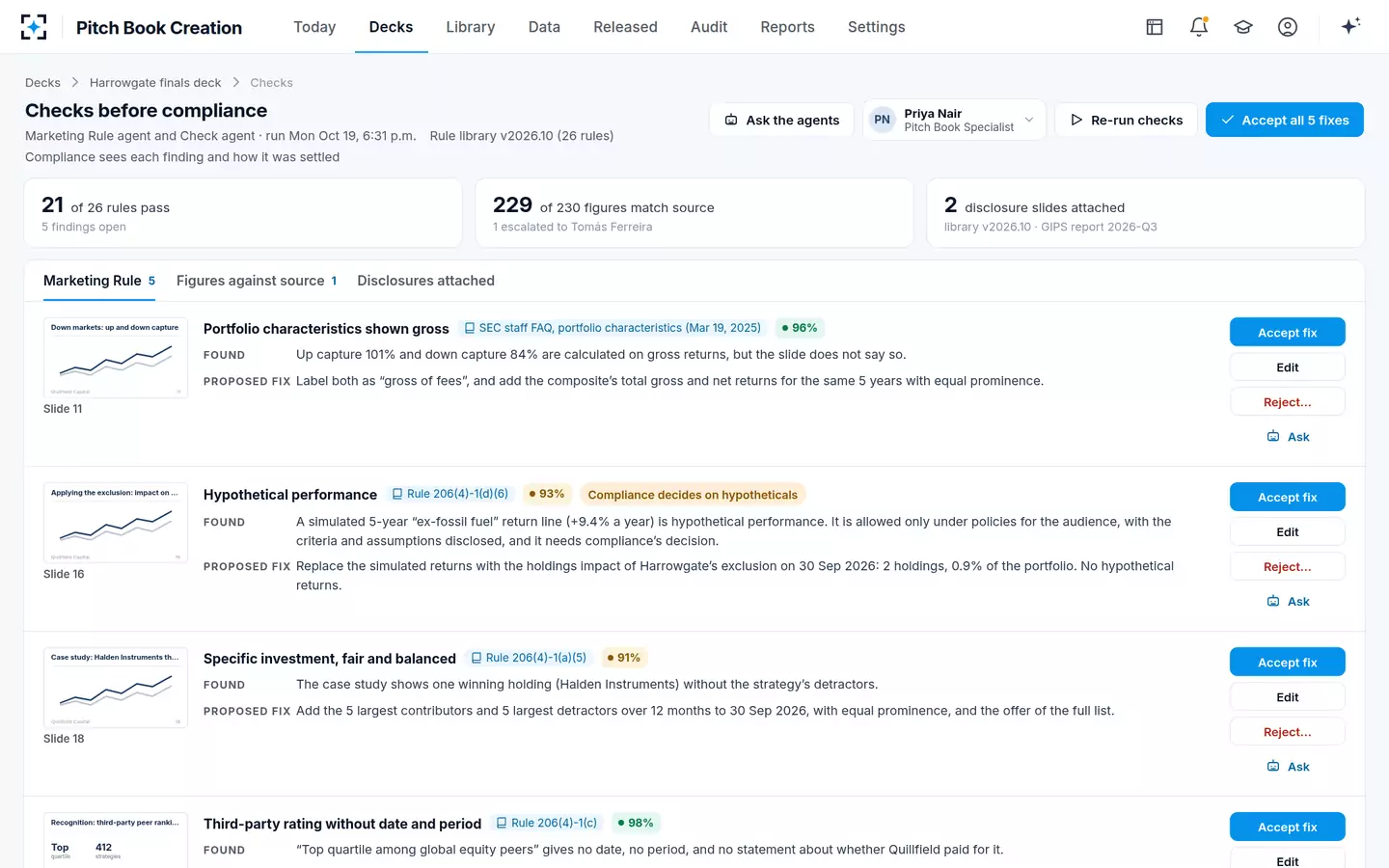
The honest limits are worth stating. The solution's sample firm is a long-only manager pitching separate accounts, and its strengths, refreshing figures across dozens of open decks and re-reading each from source, matter most where many tailored decks are live at once. A single-strategy hedge fund that maintains one deck and updates it monthly may need less: a dated data checklist and a firm review policy may cover it. A multi-strategy platform raising across several vehicles, share classes and regions, with placement agents involved, looks much more like the sample firm. The annotated separate-account deck in an investment pitch book example shows the same checks page by page. To see the checks on one of your fund decks, start from Pitch Book Creation.
Questions people ask
What should a hedge fund pitch deck include?
The firm and team, the strategy and process, the track record as monthly and annual net returns since inception, risk and exposure figures, any illustrative positions, terms and operations, and the required disclosures. Each figure should agree with the fund's monthly reports and audited statements. Offering terms belong in the PPM, which the deck should summarise and never contradict.
Do hedge fund decks need one-, five- and ten-year returns?
No. SEC Rule 206(4)-1(d)(2) requires those periods for portfolios other than private funds. A private fund deck must still present performance and time periods in a fair and balanced way under the rule's general prohibitions, and monthly net returns since inception are the simplest way to show that.
Is a hedge fund pitch deck PDF sent to one investor an advertisement?
A communication to one person is outside the definition unless it contains hypothetical performance, but a template deck tailored with one prospect's name is not a one-on-one communication in the SEC's view. Hypothetical performance sent one-on-one to a private fund investor, or on an unsolicited request, falls outside the first prong of the definition.
Can a placement agent show a fund's targeted return?
The SEC approved a FINRA Rule 2210 change on 15 October 2026 allowing broker-dealers to show projected performance and targeted returns, subject to conditions including policies on the intended audience and disclosure of assumptions, risks and limitations. The SEC's order sets no effective date; FINRA announces it. Until then Rule 2210's existing prohibition on projections, with its existing exceptions, applies.
What net return should a fund with a founders' class show?
A net return that reflects the fees the prospect will actually pay, or a model fee no more flattering than that. The SEC staff's January 2026 FAQ warns that net returns after actual fees can mislead where the audience's fees are higher. Showing net of the standard class's management and performance fees is one way to meet it.
How long must a fund manager keep old pitch decks?
A registered adviser must keep a copy of each advertisement it disseminates, and the records supporting any performance in it, for five years from the end of the fiscal year in which it was last disseminated, under SEC Rule 204-2. Each version sent counts, so a monthly deck creates a monthly record.