An asset management presentation PDF is the locked, released version of a manager's deck: the file a consultant saves to the search folder, a trustee prints for the board book and a colleague forwards to a peer at another plan. It outlives the meeting it was made for. Its performance figures carry an as-of date that ages every day, its required performance periods stop meeting the SEC Marketing Rule after the next calendar year-end, and if a return in it is later restated, every copy already sent is wrong while still looking approved. The work after release is therefore three questions: how long can this version be used, who has a copy, and what happens to each copy when a number changes. Botminds' Pitch Book Creation answers them as part of the release: its Release agent locks and watermarks the approved version, files it with its evidence, and later traces any restated figure to every released deck that carries it and drafts the corrections for compliance to approve.
One released finals deck: current for ten weeks, then the year-end catches it
- To the finals2 d
- In use, figures current70 d
- Year-end returns being calculated≈1 mo
- Periods no longer meet the ruleafter
What is an asset management presentation PDF, and why does it travel?
The PDF is the form in which an asset management presentation leaves the firm's control. Live presentations end when the meeting does; the PDF is saved, printed, attached to minutes, forwarded and, at public plans, sometimes released. The SEC anticipated part of that path. In the Marketing Rule's adopting release it said that materials an adviser gives consultants and other intermediaries for dissemination are the adviser's own indirect communications, and that an RFP response a public entity later releases under a freedom of information request is not an advertisement merely because of that disclosure (86 FR 13024).
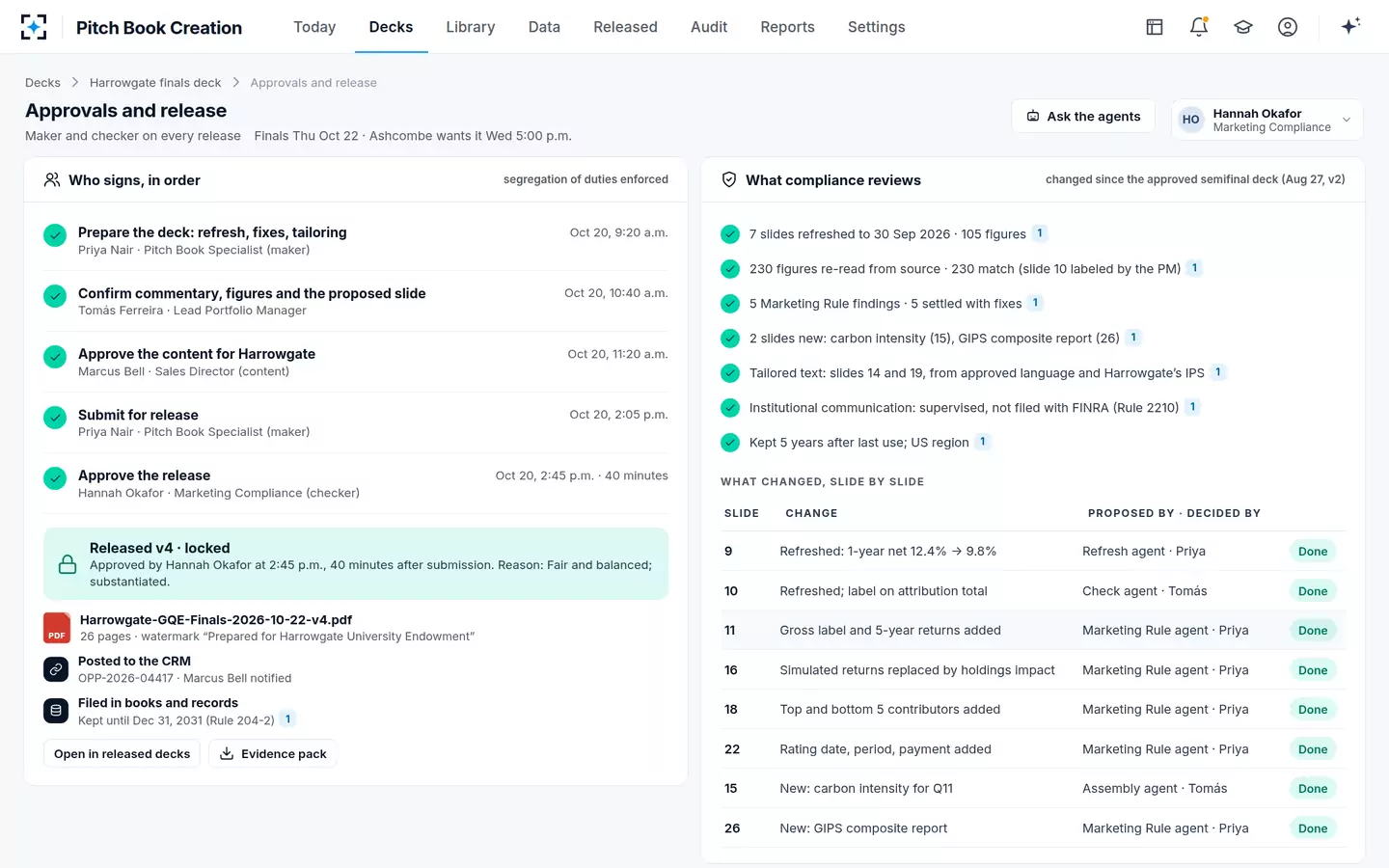
The consequence is that the firm cannot control where a released deck goes, only what is in it and who it gave it to. That makes three features of the PDF itself important: a watermark naming the prospect it was prepared for, an as-of date on every page of figures, and a version number that matches the firm's own copy. In the sample, the released finals deck is version 4, watermarked "Prepared for Harrowgate University Endowment", posted to the CRM opportunity and filed in books and records.
How long can a released deck stay in use?
A released deck can stay in use until its figures fail the firm's freshness policy or the Marketing Rule's periods, whichever comes first, and the rule's limit arrives every January. For a portfolio other than a private fund, performance must be shown for one-, five- and ten-year periods ending no earlier than the most recent calendar year-end (Rule 206(4)-1(d)(2)). A deck with returns to 30 September stops meeting that test on 1 January.
The SEC staff gave the practical answer in April 2021: a firm that cannot calculate year-end returns immediately may keep using performance at least as current as the prior quarter's until it can, and that working out year-end results should generally take no more than about a month (SEC Marketing Compliance FAQ). In practice that means a deck released in October needs replacing by about the end of January, and every deck still in use in January needs the same.
A firm can set a stricter limit of its own. The sample firm requires performance from the latest approved quarter, so its October deck is due for refresh as soon as the fourth quarter is approved, and holdings data no more than 35 days old. Fund advertisements carry a sharper rule: under Rule 482, the currency of returns in a fund advertisement is tested against its date of use, which the rule defines as the whole period investors use it, not only the first day.
The dates a released PDF has to survive
| Date | What it controls | Where the limit comes from |
|---|---|---|
| The as-of date of its figures | Whether returns, holdings and characteristics are the latest approved. | The firm’s policy; the sample firm’s is the latest approved quarter, holdings 35 days or less. |
| The calendar year-end | Whether the one-, five- and ten-year periods still meet the rule. | Rule 206(4)-1(d)(2); staff relief for interim figures, generally about a month. |
| A rating’s date and period | Whether a ranking is still the one disclosed. | Rule 206(4)-1(c); the firm’s retirement schedule for ratings. |
| A team or firm change | Whether biographies, assets and capacity are still true. | The general prohibitions, Rule 206(4)-1(a). |
| A restatement | Whether any figure in it was wrong when sent. | The firm’s correction policy, under the general prohibitions. |
| The last day it is used | When the five-year retention period starts. | Rule 204-2(e)(3)(i). |
Who must hear when a return in a sent deck is restated?
Everyone who received the deck with the wrong figure, decided case by case under the firm's correction policy; and the firm can only reach them if it recorded who they were. No rule sets a single procedure for correcting a released pitch book. The obligations that apply are general ones: an advertisement may not contain an untrue statement of a material fact, or omit one needed to make it not misleading, under Rule 206(4)-1(a)(1), and the adviser owes a fiduciary duty to its clients. A restated return in a deck a committee is about to vote on is the clearest case for a correction.
The record of recipients is easy to miss. The books and records rule requires a copy of each advertisement, but for an advertisement sent to more than ten persons it does not require the adviser to keep the names and addresses of the recipients, only a description of any list used (Rule 204-2(a)(7)(iv)(B)). A firm that relies on the minimum cannot answer the question "who has the old number?" from its records. A firm that posts each released deck to the CRM opportunity it was made for can.
In the sample, performance measurement restated the Global Small Cap composite's August 2026 net return from 1.9% to 1.6% after a pricing correction, approved on Friday 16 October. The Release agent traced the figure to nine released decks. Three had meetings still ahead, and it drafted a replacement version for each; six had already been sent, and it drafted a short correction note and a corrected version for each client. Nothing was sent until marketing compliance approved each draft.
One restated return, nine released decks, two kinds of correction
Tracing a restated figure to every released deck
Tracing is only possible if every released deck records which figures it contains, from which source, as of which date. A folder of PDFs does not; the numbers are in the pictures. The data stamp behind each slide in the solution does: it ties every figure to its source record, so a change to that record can be followed forward to every deck that used it.
A restated return traced to nine released decks, with a correction drafted for each
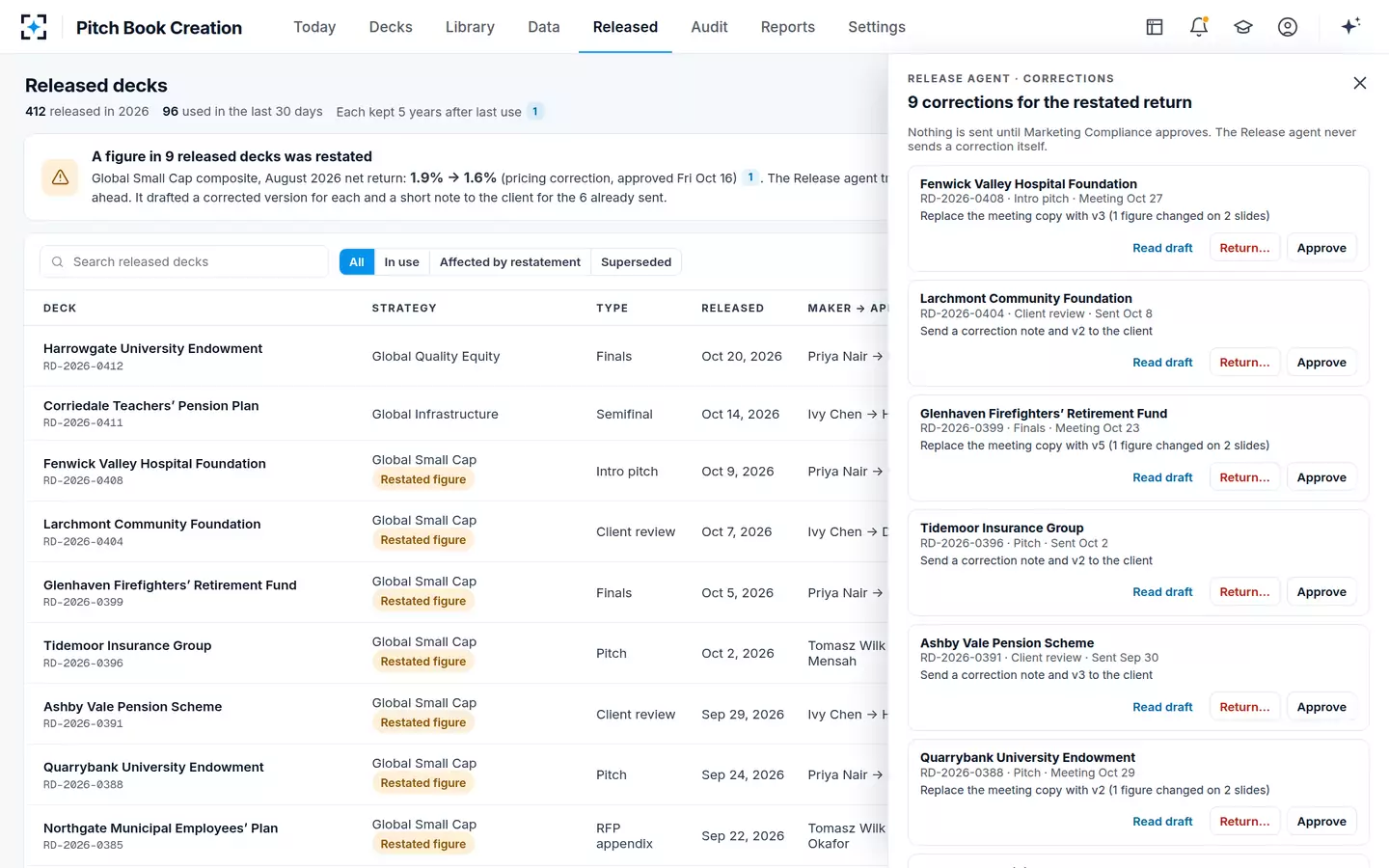
Two design choices matter more than the tracing itself. The agent drafts and never sends, so the decision to contact a client stays with compliance. And the drafts use approved wording only: the figure, the reason and the corrected version, with nothing new in them that would itself need review. A correction that introduces a new claim needs a review of its own.
A restatement is also the moment to look at the process, not only the decks. Performance measurement's correction policy, the time between its approval and the trace, and how many released decks carried the figure are all measurable, and the trend says whether the firm's decks are built on figures that settle before they are used.
What to keep, and for how long: the clock starts at last use
A released deck must be kept for five years from the end of the fiscal year in which it was last disseminated, the first two years in an appropriate office of the adviser, under Rule 204-2(e)(3)(i). The same period applies to the records that demonstrate the calculation of any performance in it, under (a)(16). The clock runs from last use, not first, which matters for a deck that is refreshed and re-sent over months: each released version needs its own copy and its own supporting records.
The cost of getting it wrong is concrete. In the SEC's September 2023 Marketing Rule sweep two of the nine firms charged also failed to keep required copies of their advertisements (SEC press release 2023-173), and the Division of Examinations' April 2024 risk alert found advisers that could not produce documentation supporting the performance claims in their advertisements (SEC risk alert, 17 April 2024). In the sample, the finals deck released on 20 October 2026 is filed until 31 December 2031, with its evidence: the PDF, the data stamps, snapshots of its sources, its checks and its approvals.
The release: locked, watermarked, posted to the CRM, filed until 2031
Versions, watermarks and the copy the consultant holds
The copy that matters most after release is the one the firm no longer controls. A consultant who ran the search keeps the finalists' decks with the search file, and may quote from them in a report to the committee months later. If the firm has since released a corrected version, the two copies differ, and only a version number and a watermark on every page let anyone tell which is which.
That is why the sample firm's release locks the approved version rather than the working file: any edit after release creates a new version with new approvals, and the released one stays in the archive unchanged. It is also why a correction to a sent deck goes out as a corrected version with a note, not as a quietly replaced attachment. A consultant comparing two finalists should never be holding a figure the manager has withdrawn without knowing it.
A release policy for PDF decks
Every firm that sends PDF decks needs a short written policy for what happens after release. The sample firm's settings in the solution amount to the checklist below, and most of it can be adopted without any software.
Eight rules for a released presentation PDF
- Lock the released version
The file compliance approved is the file that is sent. Any change is a new version with new approvals.
- Watermark it for the prospect
“Prepared for” and the date on every page, so a forwarded copy says where it came from.
- Date every page of figures
An as-of date per slide, matching the source the figures came from.
- Record every recipient
Post the released deck to the CRM opportunity or client, not just to a folder. The minimum the rule requires will not tell you who to correct.
- Set a use-by rule
The latest approved quarter, and in any case no later than about a month after year-end for non-private-fund performance.
- Trace every restatement
From the corrected source to every released deck that used it, before anyone asks.
- Correct with approved wording
The figure, the reason and the corrected version; compliance approves before anything is sent.
- Keep it five years from last use
The deck and the records behind its performance, two years of it in an appropriate office.
The before-release half of the same discipline, the checks that make a deck worth locking, is in marketing materials review, and the page-by-page content of the deck in this example is in an annotated pitch book. To see a restatement traced across your own released decks, start from Pitch Book Creation.
Questions people ask
What is an investment management presentation?
It is the deck an investment manager uses with prospective or existing clients: a firm and strategy overview, the team, the process, performance net and gross of fees, holdings and risk, fees and disclosures. Shown to prospects, it is an advertisement under the SEC Marketing Rule. Its released version is usually a locked PDF that the firm must keep for five years from its last use.
Can I send last quarter's pitch book PDF to a prospect?
Only if its figures still meet your firm's freshness policy and the Marketing Rule's periods. Returns to 30 September stop meeting the rule's year-end test after 31 December, with staff relief for interim figures while year-end returns are calculated, generally within a month. A firm that requires the latest approved quarter retires its decks sooner.
Does a pitch book PDF need an expiry date?
No rule requires one printed on the deck, but every released deck has one in practice: the day its figures fail the firm's policy or the rule's periods. Recording that date with the released version, and blocking use after it, is simpler than checking every deck by hand each January.
What happens if a consultant forwards our deck?
Material an adviser gives a consultant to pass on is the adviser's own indirect communication under the Marketing Rule, so the forwarded copy is still the firm's advertisement. A watermark naming the prospect and an as-of date on every page make a forwarded copy identifiable, and the firm's copy and version number show what it said and when.
Do we have to tell clients about a restated return in a deck?
No rule sets a single correction procedure for pitch books; the firm's policy decides, under the general prohibition on untrue or misleading statements and its duty to clients. Where a committee is about to rely on the old figure, a correction is the clear choice. In the sample firm, compliance approves every correction before it is sent.
Where can I find an asset management presentation template?
A firm's template is best built from its own slide library, approved by marketing compliance; generic presentation templates are not built around the performance presentation the Marketing Rule requires. The annotated example in this series shows the pages of a 26-slide finals deck and the rule behind each, which is a sound skeleton for a template.