Presentation automation tools for asset managers fall into four groups: template and brand-control add-ins with a slide library, data links and scripts that refresh figures from Excel or a database, generators, many now AI-based, that draft slides from a prompt or a data feed, and agents that assemble, refresh and check a deck under people's approvals. Comparing them on licence price alone misses most of the cost terms, because an institutional pitch book also costs the time spent collecting approved figures from several systems, the review loops with the portfolio manager and compliance, and the evidence a firm must keep once the deck is used. Botminds' Pitch Book Creation sits in the fourth group; this guide gives a way to price all four on the same basis, per released deck, so the choice rests on your numbers rather than a vendor's.
What one hour saved on every deck is worth in a year, at a marketing specialist's median wage
What are presentation automation tools?
Presentation automation tools are software that removes manual steps from building slides, and they differ in which step they remove. Template and brand tools keep layouts, fonts and disclaimers consistent and give users a searchable library of approved slides. Linking and scripting tools move numbers from workbooks or databases onto slides. Generators produce whole slides or decks from a prompt, a document or a data export. Agents, the newest group, take on a chain of steps, reading a request, assembling slides, refreshing figures, checking them, and stop at each point where a person must decide.
For an asset manager the categories matter because each attacks a different cost. A brand tool saves designer hours and reduces formatting errors. A link saves typing. A generator saves drafting. None of the three, by itself, saves the hours spent establishing that each figure is the approved one, or the hours compliance spends re-reading a deck it has seen twice already. Those hours are what a fair comparison has to price.
What does one customized pitch book cost in hours?
No regulator or independent study publishes how many hours an institutional pitch book takes, and figures in software vendors' marketing are not measurements of your desk. The number you need is your own, and it takes about two weeks to collect: log each released deck's handoffs and the time each seat spent, by stage, for every deck in the period. The stages below are the ones that matter for the comparison, because each approach moves a different set of them.
The stages to time on every deck, and who usually spends the hours
| Stage | What happens | Who spends the time |
|---|---|---|
| Reading the request | The RFP, finals letter or sales request is read and turned into a list of questions and slides. | Pitch book specialist, sales director |
| Collecting figures | Returns, holdings, attribution, assets, team data, ratings and ESG data gathered from their systems, each at its approved date. | Specialist, with performance measurement and data owners answering requests |
| Assembling and tailoring | Slides chosen from the library, ordered to the prospect’s questions, text tailored to their policies. | Specialist, product specialist |
| Owner review | Commentary and figure questions settled with the portfolio manager; content approved by sales. | Portfolio manager, sales director |
| Compliance review | The deck tested against the Marketing Rule and the firm’s policies; comments returned and resolved. | Marketing compliance, specialist |
| Release and keeping | The approved version locked, sent, and filed with its supporting records. | Specialist, compliance, records |
The cost formula: five terms, and which ones each approach moves
The cost of a released deck is the sum of people's time at their rates, the tool's cost spread over the decks it produces, and the expected cost of the errors that get through. Written that way, it shows immediately why licence price is a poor guide: it is one term of five.
Cost per released pitch book, term by term
Maker time
hours × rate
Collecting, assembling, tailoring and rework, for the pitch book specialist.
Your time study; BLS median $37.87 an hour as a floor
Owner time
hours × rate
Portfolio manager and sales review, including answering figure questions.
Your time study, at each seat’s loaded rate
Review loops
loops × hours × rate
Compliance passes and the rework each one triggers.
Your review log
Tool cost
(licence + upkeep) ÷ decks
Licences, implementation spread over a few years, template and link maintenance.
Vendor quotes and your IT estimate
Error cost
probability × cost
Corrections after release, remediation and the exposure of an examination finding.
Your compliance history
Put real numbers on it with care. A loaded rate is higher than the BLS medians, which are wages before benefits, and the portfolio manager's hour is the most expensive in the formula even when it is the shortest. A review loop is not one compliance pass: it is the compliance pass, the specialist's rework and often a second question to the portfolio manager, priced together.
Templates by hand: the cost is collection and review loops
The by-hand process, last quarter's deck copied and edited, costs least to buy and most to run. Its tool cost is close to zero. Its maker time is dominated by collecting figures, because every number must be fetched from its system and checked by eye, and its review loops are long because compliance cannot tell which figures changed and has to re-read the whole deck.
Its error cost is the hardest term to see and the easiest to underestimate. A copied deck carries forward whatever was in last quarter's version, including the June figures on slides nobody remembered to update. In the sample deck that was seven of 26 slides, and every one of them had passed review in its earlier life. The enforcement record is a reminder of what the term can hold: in September 2024 nine advisers paid $1,240,000 in combined penalties in one Marketing Rule sweep, some of them for ratings shown without dates or periods (SEC press release 2024-121).
Linked automation and scripts: cheaper refresh, hidden maintenance
Links and scripts cut the maker's collection time sharply on standard decks and barely touch it on tailored ones. They work best where one workbook feeds one family of slides, and every new composite, benchmark or chart type adds a link or a line of code to maintain. That upkeep belongs in the tool-cost term, and where one analyst carries it, that analyst's departure turns a working process into a fragile one.
The review loops do not shrink much, because a linked figure arrives with no visible trace of where it came from: compliance still has to ask whether the workbook held the approved figures. The full case is on PowerPoint automation from Excel. In the formula, linked automation moves the maker term and leaves the review and error terms roughly where they were.
Presentation automation AI: fast drafts, and the question of where each number came from
AI generators move the drafting cost most of all. A peer-reviewed experiment with 453 college-educated professionals found that access to a chatbot cut the time taken on writing tasks by 40% and raised quality by 18% (Noy and Zhang, Science, 2023). For a pitch book's narrative slides, the philosophy, the process, the tailored answer to an exclusion policy, gains of that kind are real.
For its figures, a generator adds a cost rather than removing one, because every number it writes has to be traced to a source before review. Regulated firms are drawing that line themselves. In the Bank of England and FCA's 2026 survey of UK financial firms, agents in sales and marketing were deployed mostly to support decisions people still take, and the share reporting agents there with broad autonomy rounded to zero (Bank of England and FCA, October 2026).
In UK firms' sales and marketing, AI agents support decisions; broad autonomy rounds to 0%
Agents with an independent check: what changes in the formula
Agents change the terms a generator cannot: collection, review loops and error. In Pitch Book Creation the Refresh agent proposes each figure from the system of record with its as-of date, a separate Check agent re-reads every one from the source, and the Marketing Rule agent settles findings with the maker before compliance opens the deck. The people's time moves from fetching and re-reading to deciding.
Take the sample firm's finals deck as it ran through the solution, on fictional data. The Refresh agent had proposed 105 new figures on seven slides overnight; the Check agent re-read all 230 figures in the deck and matched 229; the portfolio manager decided one attribution label and one proposed slide; compliance reviewed only what had changed since the approved semifinal deck and approved the release 40 minutes after submission. The solution's design target is a finals deck the same day the quarter's data is approved. That is a target, not a measured result, and the formula above is how a firm should test it on its own decks.
The agents' plan for one finals deck: seven steps, each cited, three decisions left to people
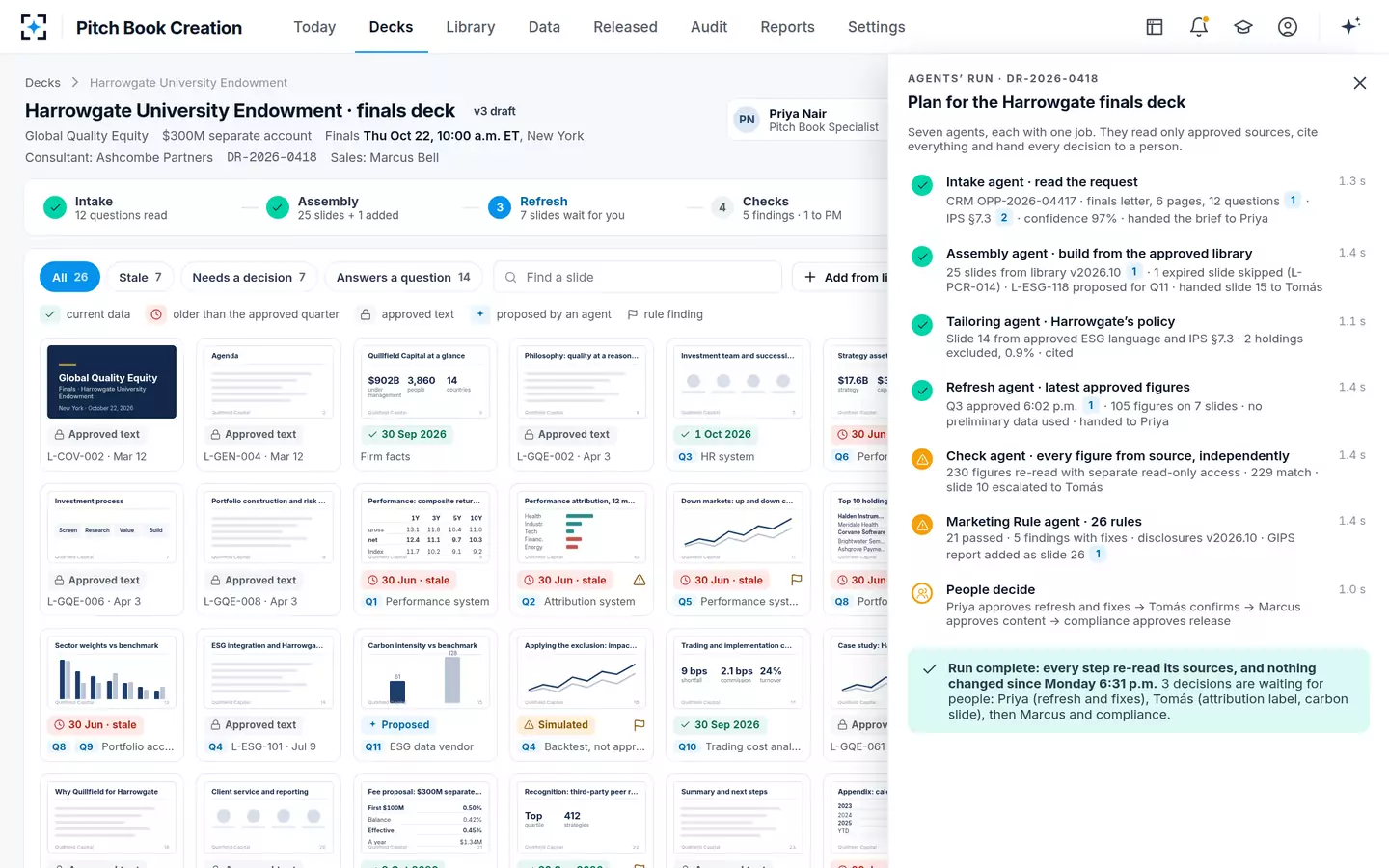
What agents add to the formula is tool cost and set-up: mapping the source systems, the slide library and the firm's rule settings. Those belong in the fourth term, spread over the decks the firm expects to build, and they are why agents make least sense for a firm that builds a few standard decks a quarter.
The four approaches side by side
Laid out term by term, the comparison is less about which approach is cheapest than about which terms a firm's volume and risk make expensive.
Which cost terms each approach moves, for an institutional pitch book
| Term | Templates by hand | Links and scripts | AI generators | Agents with an independent check |
|---|---|---|---|---|
| Maker time | High; collection by hand. | Lower on standard decks; tailored decks still by hand. | Lower drafting time; figures still to verify. | Approvals and tailoring; collection and re-reading done by agents. |
| Owner time | Answers figure questions on every deck. | Unchanged. | Unchanged, or more if drafts add claims. | Only differences and new claims, each with both sources. |
| Review loops | Long; whole deck re-read. | Little change. | Can grow if drafts need more correction. | Changes since the approved version, findings already settled. |
| Tool cost | Near zero. | Low licence; ongoing link and script upkeep. | Licence per user or per output. | Licence and set-up of sources, library and rule settings. |
| Error cost | Stale figures carried forward. | Silent errors from wrong ranges or broken links. | Unsourced or invented figures if not checked. | Lower where every figure is re-read from source before approval. |
| Evidence kept | The PDF, if filed. | The PDF; the workbook may have changed. | The output; prompts and sources vary by tool. | PDF, data stamps, sources, checks and approvals per deck. |
How to run a two-week time study before you buy
A time study turns the formula into numbers you can defend to a budget committee, and it doubles as the acceptance test for any tool you pick. It needs no software: a shared log, the discipline to fill it in, and a fortnight that includes at least one quarter-end or a busy finals week.
A two-week time study for pitch book costs
- Pick the decks
Every deck released in the period, not a sample: finals, intro pitches, client reviews. Mark each by type.
- Log by stage and by seat
Minutes per stage per person, using the six stages above. Rough is fine; missing is not.
- Count review loops
Each return from compliance or the portfolio manager is a loop; log why it came back.
- Count stale and corrected figures
How many figures changed between first draft and release, and how many were found out of date at review.
- Price at loaded rates
Wages plus benefits and overhead from your finance team. The BLS medians are a floor, not an answer.
- Add the tool terms last
Quotes from vendors, implementation over three years, upkeep, divided by your deck volume.
- Re-run it on the pilot
The same log, same stages, on decks built with the tool you are testing. The difference is the business case.
The study also tells you whether the problem is the one you thought. Firms that log review loops often find the deck is not slow to build but slow to clear, and that changes which column of the table matters.
Which approach fits which pitch book desk
Each approach has a volume and a risk profile where it is the sensible choice. Templates by hand fit a small firm with a few strategies and a handful of finals a year, where the specialist and the portfolio manager sit together and the error term is held down by familiarity. Links and scripts fit a firm with many standard decks from a stable set of composites. AI generators fit the narrative slides of any firm, provided someone traces every figure they write.
Agents fit where the volume of tailored decks is high, the sources are many and the evidence matters: dozens of decks open at once at quarter-end, consultants setting deadlines, and every released version an advertisement that must be kept with the records behind its performance for five years from its last use (Rule 204-2). The SEC has been explicit that reusing performance inserts across customized communications does not take them outside the rule (86 FR 13024), so every tailored deck inherits the accuracy of the pieces it was built from. To price Pitch Book Creation against the others on your own decks, start from Pitch Book Creation, and see how it works with the slide library you already have.
Questions people ask
What is a presentation automation tool?
It is software that removes manual steps from building presentations: keeping templates and brand consistent, linking figures from data sources, generating slides from prompts or data, or, with agents, assembling, refreshing and checking a whole deck for people to approve. For a regulated deck the question is which steps it removes, and whether it can show where each figure came from.
Is presentation automation AI safe for performance figures?
Not on its own. A generator can draft narrative well, but every figure it writes must be traced to an approved source before review, or the deck carries unverified numbers into an advertisement. In the 2026 Bank of England and FCA survey, no UK respondent reported agents with broad autonomy in sales and marketing.
What does PowerPoint automation software cost?
Vendors of enterprise tools generally quote on request, and the licence is only one of five cost terms per deck. The others are maker time, owner time, review loops and the cost of errors that get through. Divide licence and upkeep by your annual deck volume to compare tools on the same basis.
How many hours does a pitch book take to make?
No regulator or independent study publishes a figure, and the answer varies by deck type and firm. Measure it: log the minutes each seat spends by stage on every deck released over two weeks, and count the review loops. At the BLS median for marketing specialists, $37.87 an hour in 2025, each hour per deck at 500 decks a year is about $18,935 in wages alone.
Are templates or automated presentation software better for a small asset manager?
For a firm with a few strategies and a handful of finals a year, a disciplined template with a dated data checklist is often enough, because the specialist and the portfolio manager can verify every figure themselves. Automation pays when volume, tailoring and the number of source systems rise faster than the team.
What is the hidden cost of linked presentation automation?
Maintenance and silent errors. Every new composite, benchmark or chart adds a link or script to keep working, and a broken or misaligned link shows old values without warning. Neither appears in a licence quote; both appear in the review and error terms.