A marketing materials review is compliance's check of an advertisement before it is used: for an asset manager's pitch book, a test of every slide against the SEC Marketing Rule, and against FINRA Rule 2210 when a broker-dealer distributes it. The review answers one question well, whether the deck as written complies on the day it is approved, and leaves a second open: whether every figure in it is still the approved figure for the period it shows when the deck is used weeks later. Examiners ask both. Botminds' Pitch Book Creation is built so the two are checked separately: the Marketing Rule agent tests each slide against the rule and the staff FAQ, while a data stamp on every slide shows the as-of date and source of its numbers and turns red when they are older than the approved quarter.
Approval and accuracy are two different tests, so a deck can be in four states
Approved and current
Released last week from this quarter’s approved composite returns, every rating dated.
The goal. It stays here only until the next quarter, year-end or restatement.
Approved and stale
The semifinal deck approved in August, reused for an October finals with June returns still in it.
The trap. It passed review, so nobody re-reads it, and a review stamp is not a data stamp.
Not approved, but current
A draft with this quarter’s figures, waiting for compliance.
Ordinary work in progress. A release control keeps it from leaving the building.
Not approved and stale
An old draft found on a shared drive and sent by a salesperson in a hurry.
Caught by a locked release and a single place for approved versions.
What is a marketing materials review?
A marketing materials review is the step in which a firm's compliance function reads a communication meant for clients or prospects and decides whether it may be used. For an SEC-registered adviser the test is the Marketing Rule, Rule 206(4)-1: seven general prohibitions on misleading content, conditions on testimonials, endorsements and third-party ratings, and specific requirements for any performance shown. A broker-dealer reviews communications under FINRA Rule 2210, where a registered principal approves each retail communication. Fund advertisements carry their own performance requirements under Rule 482, and in the UK the overarching standard in COBS 4.2.1R is that a communication must be fair, clear and not misleading.
The rule itself does not say who must review. When the SEC adopted the Marketing Rule it dropped a proposed requirement for internal pre-approval of most advertisements and left the method to each firm's compliance policies, with pre-review as one option among sampling, pre-approved templates and spot checks. For a finals deck many advisers choose pre-review, and the term "promotional materials review" usually means the same process under another name.
What the review produces is a decision about a version. A pitch book approved on 20 October is approved as it stood on 20 October. Nothing in the approval says what happens when the quarter rolls, the year ends, a rating ages or performance is restated, and those are the moments an approved deck starts drifting away from its sources.
What does compliance check in a pitch book?
Compliance checks a pitch book's content, performance and third-party material against the rule, slide by slide. In practice the review covers the performance pages first, because that is where the rule is most specific and where examiners look hardest.
What a pitch book review tests, and the rule behind each check
| Check | What the reviewer looks for | Rule |
|---|---|---|
| Net with gross | Net returns beside every gross return, at least as prominent, same period, same type of return and method. | 206(4)-1(d)(1) |
| Time periods | One-, five- and ten-year returns, ending no earlier than the latest calendar year-end, unless the portfolio is a private fund. | 206(4)-1(d)(2) |
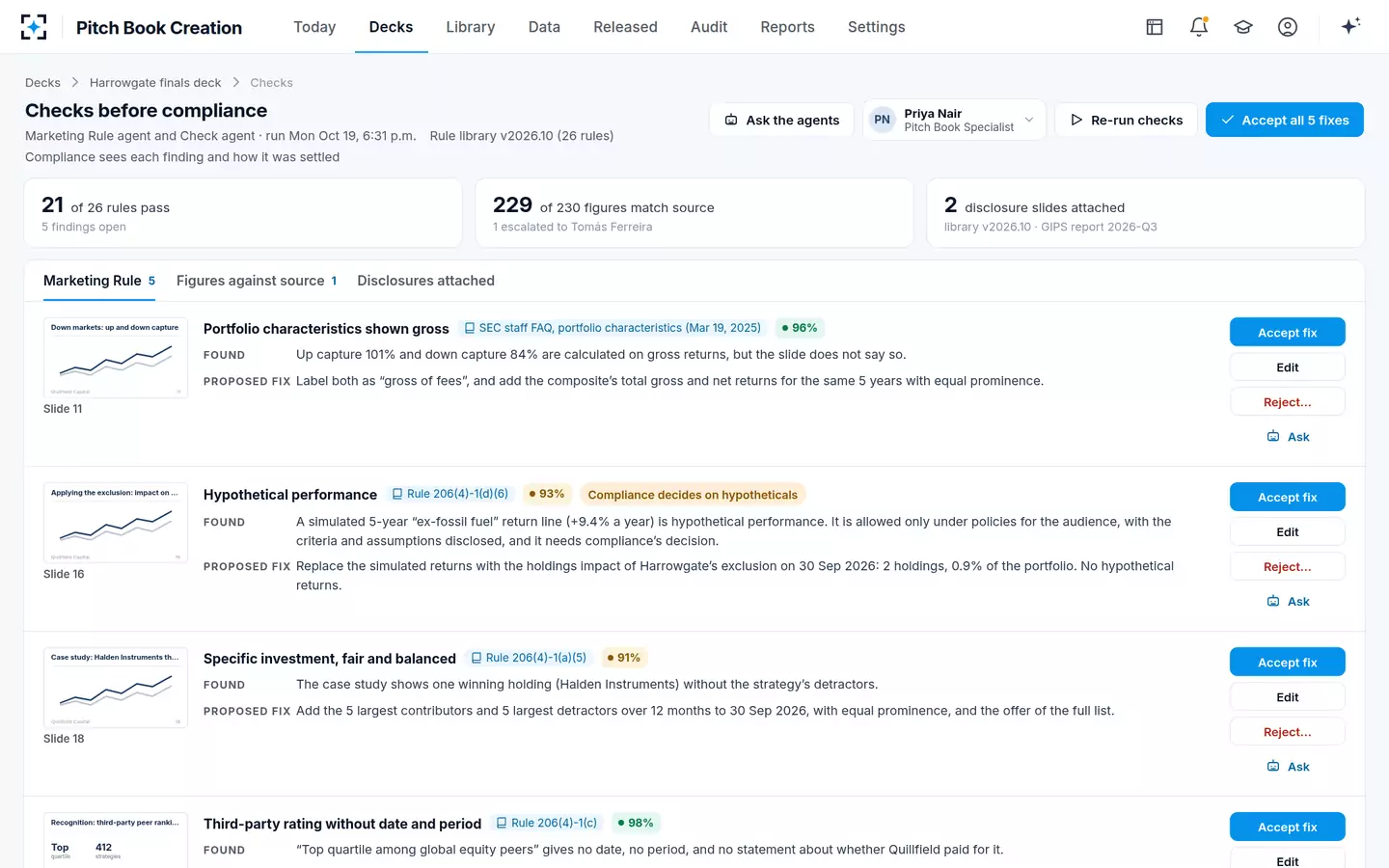
| Gross characteristics | Capture ratios, attribution and similar figures shown gross are labelled as gross and accompanied by the total portfolio’s gross and net returns. | Staff FAQ, 19 Mar 2025 |
| Extracted performance | A carve-out or single holding’s return comes with the total portfolio it was taken from, or an offer to provide it promptly. | 206(4)-1(d)(5) |
| Hypothetical performance | Backtests, model and targeted returns only with policies on relevance to the audience, and enough information to understand the criteria, assumptions, risks and limitations. | 206(4)-1(d)(6) |
| Specific investments | A case study or holding example presented in a fair and balanced way, not only the winners. | 206(4)-1(a)(5) |
| Third-party ratings | The date of the rating, the period it covers, who produced it and whether the adviser paid for it, clearly and prominently. | 206(4)-1(c) |
| Substantiation | Every material statement of fact can be backed up if the SEC asks. | 206(4)-1(a)(2) |
Every one of these checks reads the deck. None of them, on its own, establishes that the 9.8% on slide 9 is the approved figure for the period printed above it. A reviewer can confirm that net appears beside gross for the same period and still pass a slide whose period is a quarter out of date, because both columns moved together and the label says what the old figures were.
Marketing Rule findings, each with the rule behind it and a proposed fix
How do SEC examiners test performance in a deck?
Examiners test the deck against its sources and against the firm's own policies, not only against the rule. The SEC's Division of Examinations has published a series of risk alerts on the Marketing Rule, and three of them, from June 2023, April 2024 and December 2025, read together like a description of what an examiner does with a pitch book. The June 2023 alert listed the starting areas, policies and procedures, substantiation, performance advertising and books and records, and said the staff was widening its focus (SEC risk alert, 8 June 2023).
The April 2024 alert reported what examiners found. Some advisers' policies required net performance with every performance advertisement while their advertisements showed gross alone, a policy adopted but not implemented. Some performance advertisements contained "Benchmark index comparisons that did not define the index or provide sufficient context", and some contained "outdated market data information only (e.g., market data from more than five years prior)". Some advisers could not produce documentation supporting the performance claims in their advertisements (SEC risk alert, 17 April 2024).
The December 2025 alert turned to ratings and named the document directly: third-party ratings without the required disclosures turned up on websites and social media, and in "marketing brochures or pitchbooks", among others; some showed no date for the rating or the period it covered (SEC risk alert, 16 December 2025). Every one of these observations is a mismatch between a slide and the facts behind it, which is a different test from whether the slide's wording complies.
A review reads the deck; an examination reads the deck against its sources
Marketing materials review: Once, before first use.
SEC examination of the same deck: Any time within the retention period, often years after release.
Marketing materials review: The deck as submitted.
SEC examination of the same deck: The deck as used, the records behind each figure and the firm’s written policies.
Marketing materials review: Is net shown with gross for the same periods, and are the periods the required ones?
SEC examination of the same deck: Do these returns match the composite records for those periods, and could the firm produce them on request?
Marketing materials review: Are date, period, provider and payment disclosed?
SEC examination of the same deck: Were they true, and how old was the rating when the deck was used?
Marketing materials review: Followed for this deck, usually.
SEC examination of the same deck: Implemented for every deck, as the April 2024 alert found they sometimes were not.
Why an approved deck goes stale: four clocks that keep running
An approved deck goes stale because at least four clocks keep running after the approval, and none of them is the review's. The useful discipline is to name each clock, its owner and the rule or policy that decides when it has run out.
Four clocks that age an approved pitch book
| Clock | What changes | What decides it | What to do |
|---|---|---|---|
| Quarter-end | Composite returns, attribution and characteristics for the new quarter are approved. | The firm’s policy on how current figures must be; the sample firm requires the latest approved quarter. | Flag every open deck that still shows the old quarter the moment performance measurement approves. |
| Calendar year-end | The one-, five- and ten-year periods must end no earlier than the latest year-end. | Rule 206(4)-1(d)(2), with staff relief for interim figures while year-end returns are calculated, generally within about a month. | Plan the January refresh of every deck in use, not only new ones. |
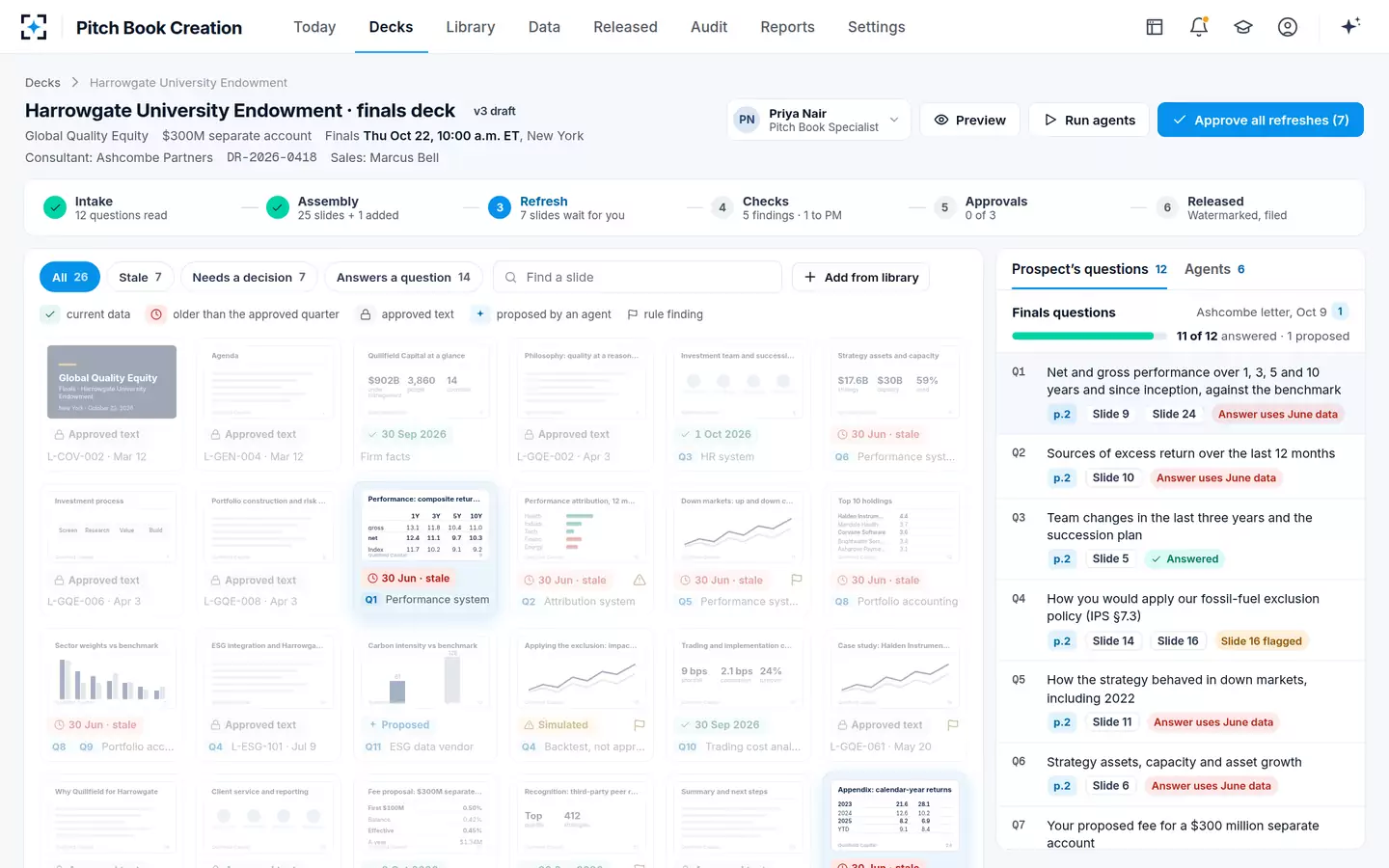
| Holdings | Top holdings, sector weights and characteristics age with each month-end. | The firm’s holdings disclosure policy; the sample firm’s is 35 days or less. | Stamp holdings slides with their as-of date and block them past the limit. |
| Third-party data | Ratings, rankings and peer universes are tied to a date and a period. | Rule 206(4)-1(c): date, period, provider and any payment disclosed. | Carry the rating’s date and period into the slide, and retire it on a schedule. |
A fifth clock, restatement, runs backwards. When performance measurement corrects a published return, every deck released with the old figure is wrong from the day it was sent, and the approval stamp on each one is still valid on its face. Tracing those decks is a job of its own, covered in the deck that outlives its as-of date.
Fund advertisements make the point with a rule. Under Rule 482, the currency of performance in a fund advertisement is measured against its date of use, which the rule defines as the whole period investors use it, not just the first day. Advisers' pitch books have no equivalent bright line beyond the year-end requirement, which is exactly why firms need a policy of their own and a way to see which decks have crossed it.
What stale and undated looks like in the SEC's enforcement record
The SEC has brought Marketing Rule cases in sweeps, and the facts in its press releases are the ones a pitch book review is meant to stop. In September 2024 nine advisers settled for $1,240,000 in combined penalties; four of them had shown third-party ratings without the dates the ratings were given or the periods they covered, some of the ratings more than five years old (SEC press release 2024-121). A year earlier nine firms paid $850,000 for advertising hypothetical performance to the general public without the required policies and procedures, and two also failed to keep required copies of their advertisements (SEC press release 2023-173).
Two sweeps, eighteen advisers: undated ratings and unsupported hypotheticals
$1.24M
combined penalties, nine advisers, September 2024: untrue or unsubstantiated claims and ratings without dates or periods
$850K
combined penalties, nine advisers, September 2023: hypothetical performance on public websites without required policies
5 yrs
how long each advertisement must be kept, from the end of the fiscal year it was last used
Neither sweep turned on a clever reading of the rule. A rating without its date, or a copy of an advertisement nobody kept, is a gap between what was shown and what the firm could prove, which is the gap an accuracy check closes and a wording review does not.
Review the change, not the whole deck again
The fastest review of a finals deck is a review of what changed since the last approved version, provided every unchanged figure has been re-read against its source. That proviso is the whole design. A compliance officer who reads 26 slides from the top for the third time in a month is doing the accuracy check by eye, and eyes are worst at the figures that look familiar.
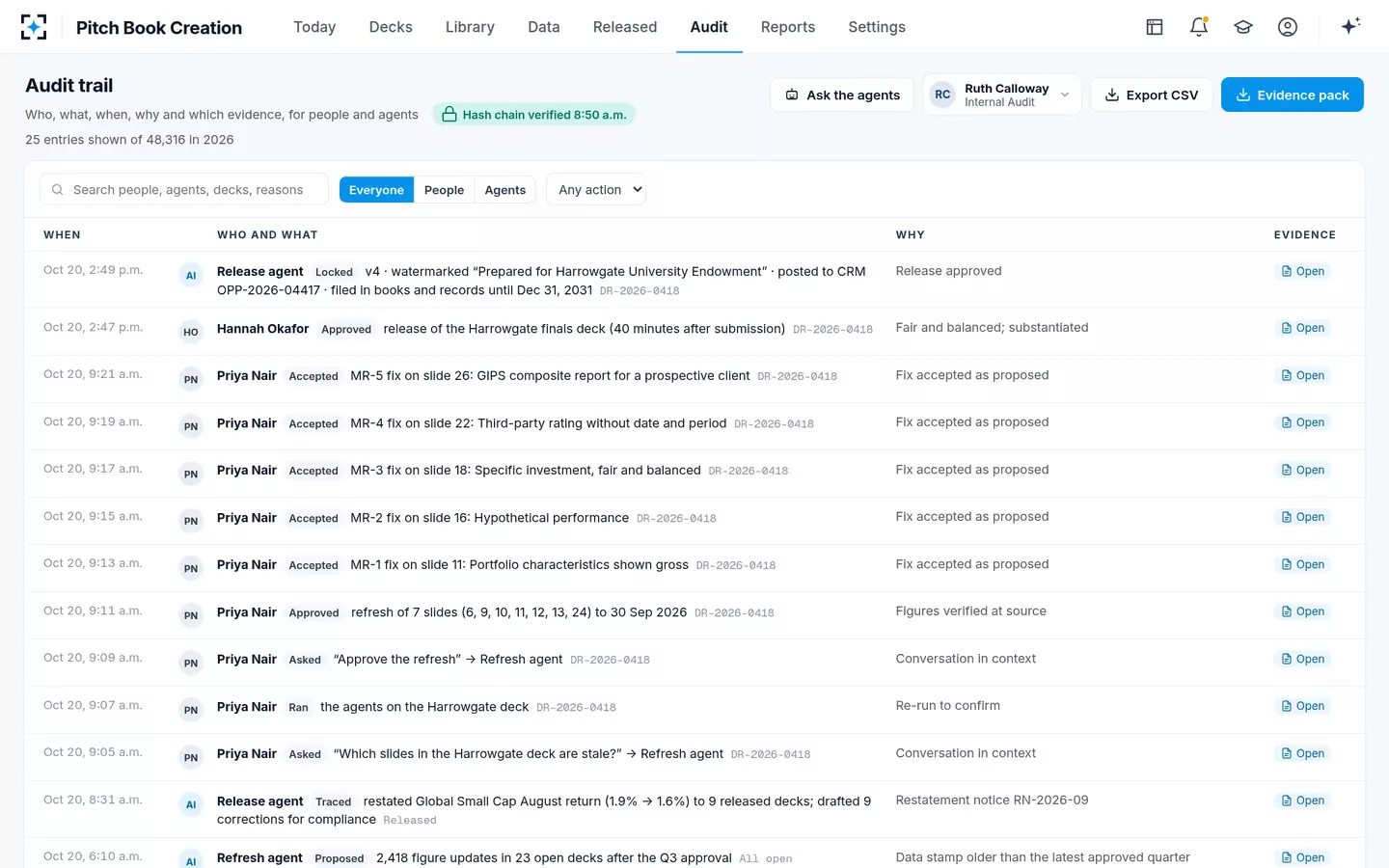
In the sample firm, Hannah Okafor, vice president of marketing compliance, reviews about 40 pitch books a week. On the finals deck she saw the changes since the approved semifinal deck, slide by slide, each with who proposed it and who decided it: seven slides refreshed to 30 September, 230 figures re-read from source, five rule findings settled with fixes, two new slides. She approved the release 40 minutes after submission, with the reason "Fair and balanced; substantiated".
Every slide stamped with the as-of date and source of its numbers
If the presentation is brief, the member or candidate must make available to clients and prospects, on request, the detailed information supporting that communication.
CFA Institute, Standard III(D) Performance Presentation, updated April 2024
A finals deck is a brief presentation in that sense, and the supporting information is the evidence behind every number. Making it available on request is far easier when it was attached to each figure at the moment the figure entered the deck.
What an examiner will ask you to produce
An examiner will ask for the deck as used, the records behind its performance and the policies that governed it. The books and records rule requires a copy of each advertisement disseminated, directly or indirectly, under Rule 204-2(a)(11), and the records needed to demonstrate the calculation of any advertised performance under (a)(16), both kept for five years from the end of the fiscal year the advertisement was last disseminated (17 CFR 275.204-2(e)(3)(i)). Where hypothetical performance or a model fee is used, the adviser must also keep a record of who the intended audience was, under (a)(19).
The audit trail: every person and agent action on the deck, with its reason
Where review software ends and accuracy checking begins
Marketing review software routes a document to compliance, records comments and stores the approved version; choosing and piloting such a tool for the rule review of every kind of advertisement is covered in the guide to marketing material review software. Pitch Book Creation does something narrower and earlier for one document type. It builds the deck from approved slides, stamps every slide with its data's date and source, re-reads every figure from the system of record before compliance sees it, and after release traces any restated figure back to every deck that carries it.
The two answer different failures. Routing software makes sure an unreviewed deck does not go out. An accuracy check makes sure a reviewed deck is still true when it does. A firm that has the first and not the second has a well-documented process for approving stale numbers. To see the second on one of your own released decks, start from Pitch Book Creation; an annotated pitch book example shows each check on the page where it applies.
Questions people ask
What are marketing materials in asset management?
They are the communications a firm uses to offer its services: pitch books and finals decks, RFP responses, consultant database profiles, factsheets, websites, commentaries sent to prospects and social posts. Under the SEC Marketing Rule most of them are advertisements when they go to more than one person, or include hypothetical performance. Each one needs a review policy, and each released version must be kept.
What is the promotional material review process?
A maker submits the material, compliance reviews it against the applicable rules and the firm's policies, comments go back, and an approved version is released and kept. Good processes add two steps: checking the figures against their sources before review, and tracking each approved version through its use. FINRA members must have a registered principal approve each retail communication before use.
How long can an approved pitch book be used?
No rule sets a single expiry for an adviser's pitch book; the firm's policy does. The Marketing Rule requires performance periods ending no earlier than the latest calendar year-end, so every deck must be refreshed after each December, and SEC staff accept interim figures while year-end returns are calculated, generally within about a month. A firm's own policy may also require the latest approved quarter.
Does a one-on-one finals deck count as an advertisement?
Usually yes. A communication to one person is outside the definition unless it includes hypothetical performance, but the SEC said that customizing a template presentation by filling in an investor's name or basic details does not make it a one-on-one communication. Most finals decks are built from template slides and approved performance pages, so most are advertisements.
What records must be kept after a marketing review?
A copy of each advertisement disseminated, the records that demonstrate the calculation of any performance in it, and documentation supporting ratings and testimonials, each for five years from the end of the fiscal year in which it was last disseminated, under SEC Rule 204-2. The April 2024 risk alert found advisers missing exactly the performance support.
Who reviews marketing materials at a broker-dealer?
An appropriately qualified registered principal must approve each retail communication before use under FINRA Rule 2210, and investment company retail communications are filed with FINRA within 10 business days of first use. Institutional communications need written supervisory procedures rather than pre-approval of each piece.